Published on
December 11, 2025


For companies, vendor costs often account for 30%–70% of operating expenses, making them a critical focus area for improving margins and extending cash flow. FP&A (Financial Planning & Analysis) teams play a key role in managing these costs by analyzing data, identifying inefficiencies, and implementing strategies like zero-based budgeting, vendor consolidation, and contract renegotiation. These efforts can lead to savings of 20%–25%, as seen in examples like software licensing and supplier optimization.
Key takeaways:
The article outlines practical steps for setting up data systems, tracking key metrics, and building governance models to ensure long-term savings. Companies can leverage analytics, AI, and structured reviews to maintain control over vendor costs while supporting growth.
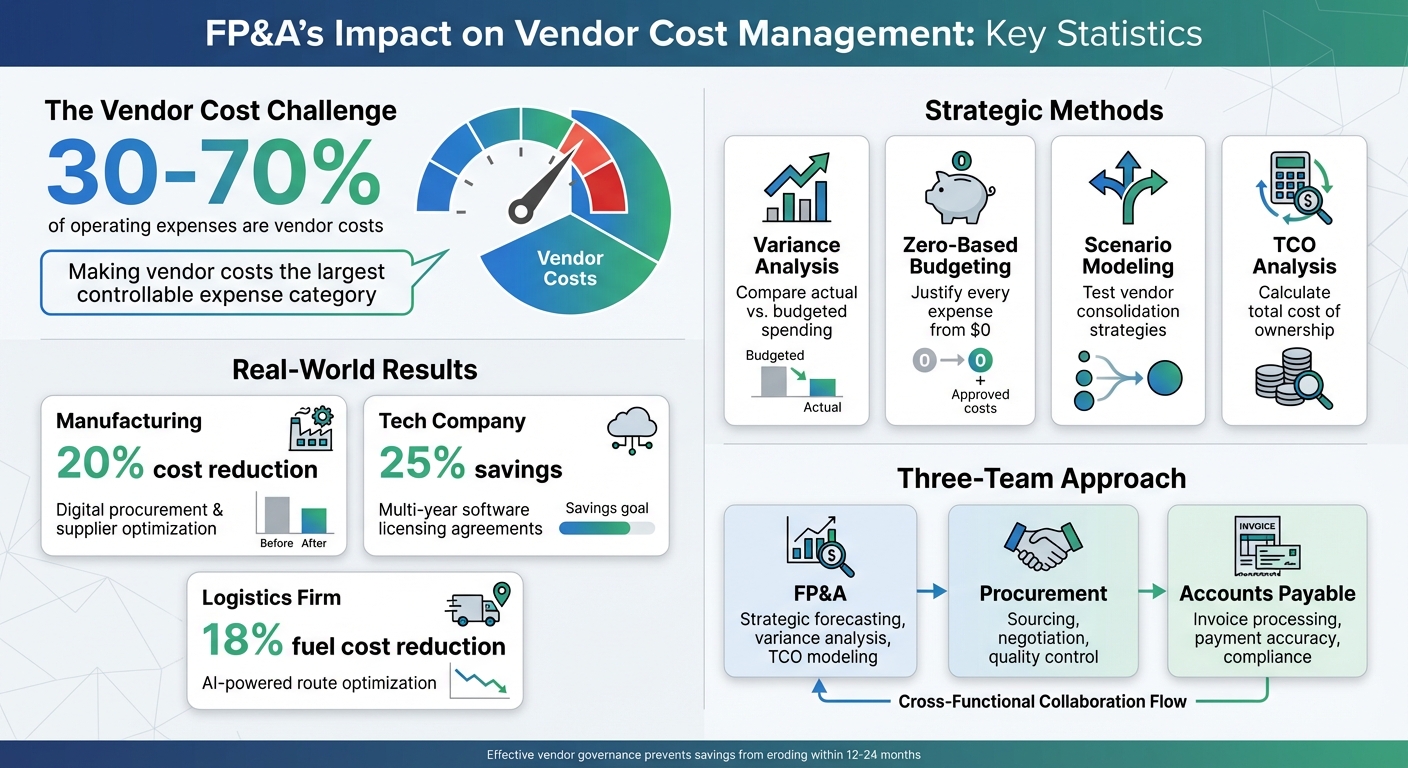
FP&A Vendor Cost Management: Key Statistics and Savings Opportunities
FP&A teams take a strategic approach to managing vendor costs by leveraging tools like budgeting, forecasting, variance analysis, and scenario modeling. Their goal? To assess how vendor expenses impact profitability, cash flow, and overall scalability. While procurement teams focus on sourcing suppliers and negotiating terms, and accounts payable handles invoice processing, FP&A ties these efforts together to create a comprehensive strategy for cost management.
FP&A teams rely on several key practices to keep vendor costs in check. One of the most important is variance analysis, which compares actual spending to budgeted amounts. This helps identify deviations caused by increased usage, pricing shifts, or changes in contract terms.
Another critical tool is scenario modeling, which evaluates different strategies - like switching vendors, consolidating suppliers, or adjusting licensing models. By considering factors like margin impact, payback periods, and the total cost of ownership, FP&A enables leadership to make data-driven decisions that go beyond just upfront costs.
Zero-based budgeting is yet another powerful method. It requires teams to justify every single vendor expense, often uncovering redundant subscriptions, underused services, or vendor relationships that no longer align with company goals.
These methods highlight why vendor costs are more than just numbers - they're a direct influence on your company’s financial health.
Vendor costs play a big role in shaping margins and cash flow. In many companies, they account for 50–70% of operating expenses, making them the largest controllable cost category [6][7]. For example, a manufacturing company that adopted digital procurement tools and systematic spend tracking cut costs by 20% through supplier optimization [8]. Similarly, a tech firm saved 25% on software licensing by negotiating multi-year agreements with volume discounts [8].
But the benefits go beyond immediate savings. Effective vendor cost management can also improve operational efficiency and scalability. Take the example of a logistics company that integrated AI into its route optimization software. By improving vendor-related efficiency, they reduced fuel costs by 18% [8]. FP&A teams often analyze the total cost of ownership - factoring in implementation, training, integration, and ongoing support - to reveal the full financial impact of vendor relationships.
FP&A’s role doesn’t stop at analysis; their impact grows through collaboration with other departments. By working with procurement, accounts payable, operations, and legal teams, FP&A helps streamline vendor relationships. For instance, they analyze consolidated spend data across business units to identify fragmented purchasing, duplicate vendors, or cost categories with high variance. They also flag when actual spending exceeds contract minimums - creating opportunities for renegotiation - or when smaller purchases can be consolidated to unlock volume discounts.
Partnerships with accounts payable are equally important. Together, FP&A and AP ensure invoices are correctly coded to the right general ledger accounts and cost centers. They also establish consistent vendor hierarchies and set thresholds for early-payment discounts (like 2/10, Net 30), enabling AP to operationalize these rules and boost savings.
| FP&A Role | Procurement Role | Accounts Payable Role |
|---|---|---|
| Strategic forecasting, variance analysis, and scenario modeling | Supplier sourcing, price negotiation, and quality control | Invoice processing, payments, and managing short-term cash flow |
| Focuses on total cost of ownership and profitability | Balances cost with quality | Ensures transaction accuracy and compliance |
Streamlining vendor costs begins with a solid, centralized data system. Without one, FP&A teams are left juggling fragmented information from spreadsheets and disconnected systems like accounts payable and procurement tools. This lack of cohesion makes it harder to spot trends, identify savings opportunities, or create accurate forecasts.
The backbone of vendor analysis lies in merging data from three essential systems: accounts payable (AP), procurement and purchasing systems (like purchase orders and goods receipt notes), and contract management platforms. For a more comprehensive view, include data from your ERP system, travel and expense tools, and supplier onboarding platforms.
Create a central data warehouse that organizes vendor spend by key attributes like vendor ID, category, cost center, and time period. Use ETL pipelines to clean and standardize the data - this includes unifying vendor names, converting all amounts to U.S. dollars, and applying consistent tax rules. With this structure in place, business intelligence tools can generate dashboards that offer insights to finance, procurement, and business teams.
Expect some common data quality hurdles, such as duplicate records, inconsistent vendor naming, missing contract references, or misclassified spending. Address these by routinely de-duplicating records, mapping vendor aliases to a single ID, and ensuring purchase orders include contract IDs that flow into AP systems. A standardized vendor-category mapping table can reduce misclassification, while regular data quality checks catch errors before they skew your analysis. With clean, unified data, FP&A teams can accurately evaluate vendor performance.
To manage vendor costs effectively, track core cost metrics like total spend by category, unit costs, and discount rates compared to list prices or previous contracts. Payment metrics are equally important - monitor average days payable (from invoice to payment), early-payment discounts captured versus missed, and any penalties for late payments.
Performance metrics provide a fuller picture. Keep an eye on vendor concentration (the percentage of category or total spend allocated to top vendors), on-time delivery rates, adherence to SLAs (like uptime or response times), dispute rates (credits divided by total invoices), and cost per unit of service (e.g., IT cost per user or logistics cost per shipment). Update these metrics monthly and use dashboards to visualize trends and variances against budgets or targets.
Segment your spending by category (e.g., SaaS, logistics, marketing, facilities), vendor size (top 10, top 50, long tail), and operational importance (critical, important, discretionary). For each segment, benchmark unit costs and discounts both across vendors in the same category and against external market data. Categories with rising costs, above-market rates, or a high number of smaller vendors may present opportunities for consolidation or renegotiation.
Tracking metrics is only part of the story; understanding variances is where actionable insights emerge. Variance analysis enables FP&A teams to pinpoint the real drivers behind changes in vendor spending. Compare budgeted versus actual costs or analyze period-over-period variances by breaking them down into price, volume, and mix components. For instance, a 15% rise in SaaS spending might break down into a 5% price increase, 20% more users, and a shift to lower-cost plans.
Price variances can flag non-compliance with contract terms or missed discount opportunities, while volume variances might highlight over-purchasing or scope creep. Persistent unfavorable variances should prompt a joint review by FP&A and procurement teams to identify corrective actions, such as adjusting license counts or revisiting minimum commitments.
Driver-based models take this analysis a step further by tying vendor spending to operational factors - like linking logistics costs to shipment volumes, SaaS expenses to active users, or manufacturing costs to units produced. These models enhance forecasting accuracy and help differentiate between structural cost issues and normal business growth. Use them to project spending under various demand scenarios or to test the financial impact of rate changes or switching vendors. This kind of analysis directly supports FP&A strategies aimed at cutting vendor costs effectively.
Once your data systems are set up and you're tracking the right metrics, it’s time to put that information to good use. FP&A teams have several effective ways to lower vendor costs without compromising quality or slowing growth. These approaches aim to create long-term savings that align with your strategic goals. Below are some key strategies FP&A teams can use to reduce vendor expenses.
Zero-based budgeting takes a fresh approach to budgeting. Instead of relying on past spending as a baseline, every vendor expense starts at $0 and must be fully justified. This method requires budget owners to explain why each vendor is necessary, what level of service is required, and whether there are more cost-effective alternatives.
To get started, pull 12–24 months of vendor invoices from your ERP or accounts payable system. Organize them by vendor, department, and whether they’re tied to contracts or one-off purchases. Group vendors into categories like SaaS, marketing agencies, logistics, and facilities. Then, ask budget owners to justify each vendor expense by outlining its business purpose, required service level, usage assumptions, and any alternative options.
Tie vendor spending directly to business activity - such as cost per user for software, cost per shipment for logistics, or cost per lead for marketing services. This ensures vendor expenses align with actual business needs rather than historical spending patterns. To support this process, gather details like contract terms (renewal dates, minimum commitments), usage metrics (seats, storage, transaction volumes), and performance KPIs. This data can help identify opportunities for cost reductions, such as cutting unused seats or downgrading to a lower service tier.
Vendor consolidation is another powerful tool FP&A teams can use to cut costs. Often, companies have multiple suppliers providing similar services - like several marketing agencies or multiple logistics providers. Consolidating these relationships can lead to significant savings.
Start by conducting a concentration analysis within each category to identify overlapping vendors. Evaluate vendors based on factors like annual spend, performance metrics (e.g., on-time delivery or quality scores), dependency risks, integration challenges, and flexibility in negotiations. Then, model scenarios to estimate potential savings from consolidating volume with one or two preferred vendors. Benefits could include volume-based discounts, simpler support processes, and reduced administrative overhead. For example, consolidating vendors has proven to deliver meaningful cost savings in many cases.
When renegotiating contracts, FP&A teams should come prepared with detailed negotiation packs. These should include multi-year spending trends, unit economics, and future volume projections to support requests for volume discounts. A tech company, for instance, managed to cut software licensing costs by 25% through multi-year agreements that offered volume discounts and flexible payment terms [8]. Compare different contract structures - like one-year versus three-year terms or varying minimum commitments - and calculate the net present value and cash flow impact over the life of the contract. Once consolidation opportunities are identified, evaluating the total cost ensures that apparent savings aren’t offset by hidden costs.
Sometimes, the vendor with the lowest upfront price isn’t the cheapest option in the long run. Total cost of ownership (TCO) provides a more comprehensive view by factoring in all the costs tied to a vendor relationship over its lifecycle. This includes direct fees, internal labor (for onboarding, integration, and training), infrastructure costs (like APIs and middleware), switching costs, and risks like downtime or compliance issues.
For example, a SaaS tool priced at $80 per user per month might seem cheaper than an alternative priced at $100 per user per month. However, if the first option requires twice as much administrative time and an expensive custom integration, its three-year TCO per user could end up being higher. That’s why FP&A teams should evaluate vendors based on three- to five-year TCO figures rather than focusing solely on upfront costs.
To make this process easier, build a TCO model that accounts for all relevant costs, including internal labor rates. Use this model when reviewing new vendors, renewing contracts, or considering a switch. The goal is to clearly identify which vendor offers the best value over the entire contract period, taking into account both visible costs and hidden expenses that traditional comparisons might overlook.
Modern analytics give FP&A teams the ability to access real-time insights into vendor spending, performance issues, and areas where costs can be trimmed. These platforms pull data from ERP systems, expense management tools, and cloud platforms into one centralized hub. Automated dashboards continuously track budgets against actual spending, making it easier to spot vendor price increases or underutilized software licenses early - long before they surface in periodic reviews. This functionality paves the way for tools and methods that support precise, data-driven vendor management.
Real-time reporting tools let FP&A teams monitor vendor metrics without waiting for month-end reports. Dashboards provide a snapshot of key metrics like vendor spend, pricing changes, and performance indicators, while automatically flagging inefficiencies or overuse. For example, a manufacturing company that adopted a digital procurement system for real-time tracking cut costs by 20% by reducing inefficiencies and making smarter vendor decisions [8].
Automated alerts also play a key role, notifying teams of invoice anomalies, while vendor scorecards compile performance data for quick comparisons [1].
Real-time monitoring is just the beginning. Scenario modeling takes vendor management a step further by simulating the financial impact of consolidating vendors or adjusting cost structures. These models test fixed and variable costs under different volume and price scenarios [4][11].
The process starts by analyzing current vendor cost structures and identifying key drivers, such as per-unit pricing, minimum commitments, or usage-based fees. Start small - pilot these models within a specific vendor category, like raw materials or software subscriptions, to refine your assumptions. Incorporating operational data, such as actual usage patterns and seasonal fluctuations, helps improve the accuracy of projections. Presenting these clear, data-backed scenarios to decision-makers can help secure support for vendor management strategies.
AI takes vendor cost optimization to the next level by automating anomaly detection and providing predictive insights. Algorithms continuously scan vendor spend data to flag irregularities, such as unexpected price increases, duplicate payments, or invoices that deviate from historical trends [4][5]. This automation saves analysts from manually sifting through transactions, freeing them to focus on strategic priorities.
Predictive models use historical pricing, commodity trends, contract clauses, and market conditions to forecast potential cost increases. These insights allow FP&A teams to renegotiate contracts or seek alternative suppliers before costs rise [1][3]. Similarly, machine learning can optimize subscription management by analyzing usage patterns across software tools. It identifies underutilized licenses and suggests cancellations or downgrades, ensuring companies only pay for what they need [1][10]. For instance, a logistics firm used AI to optimize its route planning software, reducing fuel vendor costs by 18% through more efficient delivery routes [8].
These advanced analytics techniques are an essential part of FP&A's broader strategy to manage vendor costs effectively. For customized insights and solutions, Phoenix Strategy Group (https://phoenixstrategy.group) offers FP&A services designed to support long-term vendor cost management.
Spotting cost-saving opportunities with advanced analytics is just the beginning. To make those savings stick, you need a reliable governance model. Without one, savings can vanish in as little as 12–24 months due to automatic renewals, scope creep, and unnecessary tool additions [9][10]. A governance framework ensures vendor optimization isn’t a one-time effort but an ongoing practice. It establishes clear ownership, defines decision-making processes, and tracks progress over time.
When roles are unclear, vendor cost management often gets overlooked. That’s why assigning responsibilities is key:
To keep everything organized, document these roles in a Vendor Governance Charter and review it annually. This prevents duplication, fills any gaps, and keeps vendor spending under control [9][12]. When responsibilities are clearly outlined, decisions happen faster and stay aligned with financial goals.
Not all vendors are created equal, so your review schedule should reflect that. FP&A can segment vendors by factors like annual spend, business importance, and risk level to determine how often reviews should occur:
Each review should follow a structured format, covering topics like historical spend vs. budget, unit economics, variance drivers, and potential savings. This keeps the focus on actionable decisions - whether to keep, renegotiate, consolidate, or exit a vendor - rather than just status updates. Additionally, monthly internal meetings between FP&A, procurement, and operations can address exceptions like large spending variances, upcoming renewals, or new vendor requests.
To ensure accountability, vendor cost targets should be baked into annual budgets and rolling forecasts. Start by breaking down top-level savings goals into specific targets for categories and vendors. For example, aim for an 8% reduction in IT SaaS spending year-over-year or a 5% decrease in logistics cost per shipment [1][2].
Integrate these targets into your chart of accounts and planning tools so cost center owners can see vendor categories and key vendors as distinct line items, rather than lumping them into generic "Other" expenses. Link these targets to specific projects, like consolidating marketing tools or renegotiating cloud contracts, and track their progress. This allows variance analysis to pinpoint whether slippage is due to execution delays or shifts in baseline spending.
Vendor scorecards can provide business owners with a clear view of spend versus targets, utilization rates, and realized savings by vendor and category. Approval workflows can flag requests that exceed vendor cost targets, triggering additional reviews by FP&A or procurement. To embed cost discipline into daily operations, consider tying vendor cost adherence or savings delivery to manager KPIs and bonus plans, especially for departments with significant external spend, such as IT, marketing, and operations.
For companies starting from scratch, Phoenix Strategy Group offers FP&A services to help design governance frameworks, set achievable cost targets, and integrate them into rolling forecasts and budgets. Check them out at Phoenix Strategy Group.
FP&A teams have the power to shift vendor cost management from simple cost-cutting to a strategy that fuels growth. By consolidating spend data, monitoring total cost of ownership, and utilizing approaches like zero-based budgeting and contract renegotiation, they can uncover meaningful, long-term savings. For example, one manufacturing company achieved 20% savings in procurement by adopting group purchasing and digital tracking tools. Similarly, a tech firm slashed software licensing costs by 25% by securing multi-year volume contracts [8].
The key to turning short-term savings into lasting value is strong governance and seamless integration. When FP&A teams establish clear roles, conduct regular vendor performance reviews, and embed cost targets directly into budgets, savings are more likely to endure, even during contract renewals. Tools like real-time dashboards, scenario modeling, and AI-driven insights provide the visibility needed to identify opportunities early and take swift, effective action across all departments. Often, external expertise is essential to fully implement and sustain these advanced practices.
For companies in their growth stages, the challenge lies in accessing the right expertise and systems without overburdening internal teams. This is where Phoenix Strategy Group steps in, offering tailored support to help businesses build FP&A frameworks, data pipelines, and strategic finance processes. Their expertise ensures that vendor optimization becomes a consistent and repeatable part of financial management, driving discipline and value over the long term.
FP&A teams can use zero-based budgeting to cut down on unnecessary vendor costs by starting each budgeting cycle from scratch. Unlike traditional methods that rely on previous spending as a baseline, this approach requires teams to justify every expense, making sure that only the most essential and impactful vendor payments get the green light.
By thoroughly evaluating each vendor's role and contributions, FP&A teams can spot redundant services, renegotiate contracts for better terms, or eliminate expenses that no longer align with the company's priorities. This method not only trims inefficiencies but also ensures that every dollar spent on vendors directly supports the organization's goals.
Scenario modeling is a powerful tool for managing vendor costs. It allows FP&A teams to explore various financial outcomes by simulating changes in vendor agreements, shifting market conditions, or evolving business needs. This method helps uncover potential cost-saving opportunities, anticipate risks, and prepare more effectively for negotiations.
By using scenario modeling, teams can rely on data-driven insights to refine vendor relationships, manage expenses, and ensure costs align with the company’s overall financial objectives. It’s an invaluable approach for crafting strategies that balance immediate cost control with long-term business priorities.
AI and machine learning have the power to cut vendor costs by sifting through massive amounts of data to identify savings opportunities and anticipate how vendors will perform. These tools simplify procurement tasks, improve contract negotiations, and allow businesses to manage vendors more effectively.
With AI-powered insights, companies can make smarter decisions and boost cost efficiency when working with their vendors.