Published on
April 2, 2026

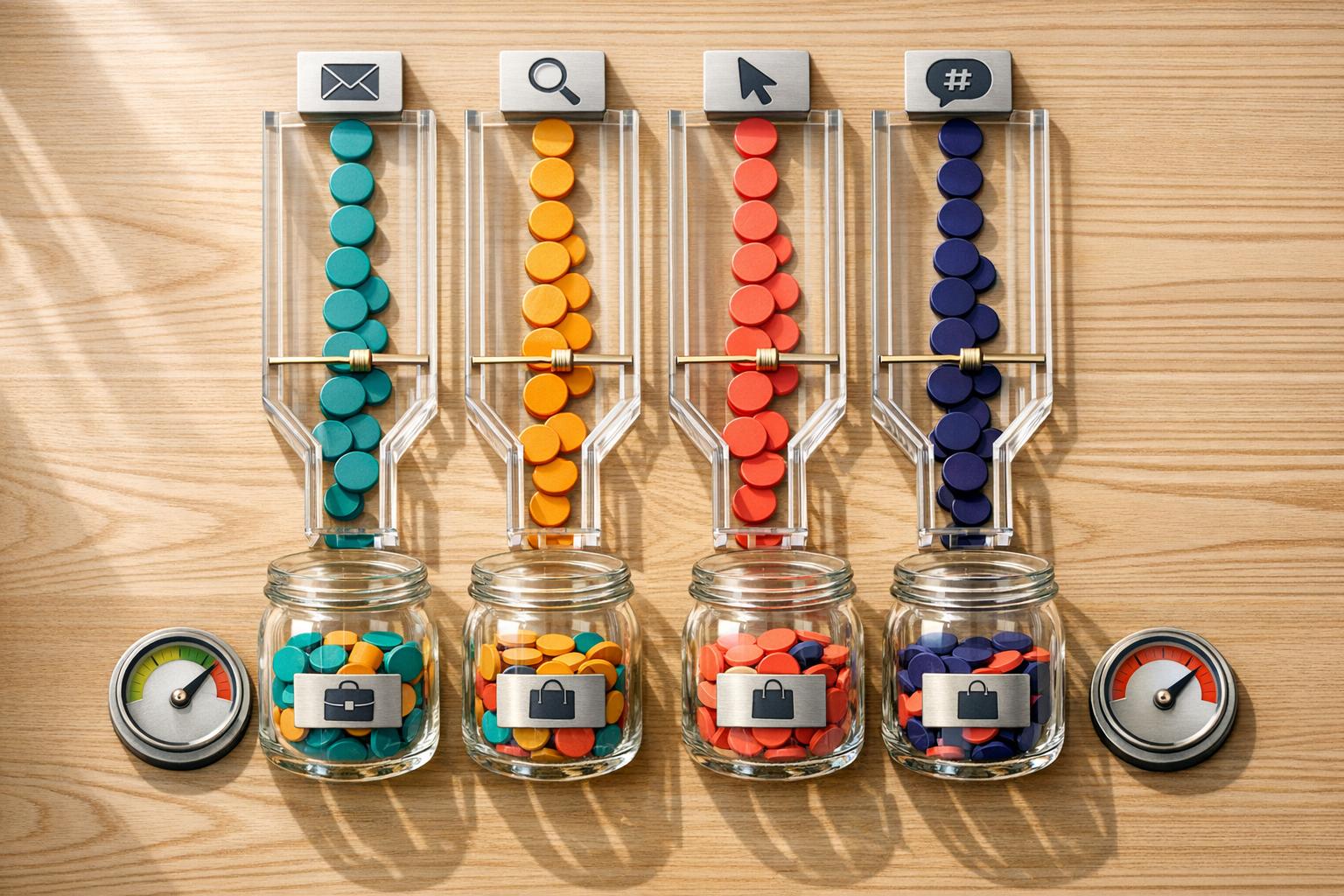
Customer Acquisition Cost (CAC) measures the expense of gaining a new customer, including advertising, software, salaries, and overhead. Your choice of marketing channels significantly affects CAC, and understanding these differences can help you allocate your budget more effectively. Here's a quick breakdown:
Key Takeaway: To optimize CAC, focus on balancing short-term gains from paid channels with long-term efficiency from organic strategies. Evaluate CAC alongside Customer Lifetime Value (LTV) to ensure sustainable growth with a 3:1 LTV:CAC ratio.
Quick Overview:
Understanding and managing CAC by channel ensures smarter budget decisions and better returns with expert financial guidance.
Marketing channels play a major role in shaping your Customer Acquisition Cost (CAC). Each channel has its own dynamics, which influence how much you spend to acquire customers. Understanding these differences allows you to allocate your budget where it can generate the best results.
For B2B companies, organic channels average a CAC of $942, while paid channels nearly double that at $1,907[6]. In contrast, B2C businesses experience a reversal: organic channels average $480, while inorganic options drop to $319[6]. These differences come down to how each channel engages and converts customers. Let’s break down these channels to see how they impact CAC.
Email marketing is all about nurturing relationships and guiding existing leads further down the funnel. It’s especially effective for retention and upselling, as it shifts the focus from "who we are" to "how we can continue to help"[2]. B2B companies see an average CAC of $510 with email marketing, while B2C businesses average $287[6].
Paid social media platforms like LinkedIn and Facebook offer advanced targeting options based on user demographics, interests, and behaviors[5]. For B2B, LinkedIn Ads average a CAC of $982, reflecting the cost of reaching decision-makers. Meanwhile, Facebook Ads for B2C businesses average $230[6], offering a lower-cost way to reach broader audiences.
Search engine marketing (SEM/PPC) targets high-intent users actively searching for solutions. While this means higher conversion rates, it also drives up costs due to competitive bidding[5]. B2B companies face an average PPC CAC of $802, while B2C comes in at $290[6].
Organic content and SEO focus on building long-term value by establishing thought leadership. For B2B, Thought Leadership SEO offers the lowest CAC at $647, compared to $1,254 for general content marketing[6]. Though initial investments in content creation can be high, they continue to deliver value without the need for ongoing ad spend.
Now that we’ve outlined the main channels, let’s look at how your choices impact your overall CAC.
Your channel mix influences three key factors: targeting accuracy, audience reach, and competitive pressure. Channels with precise targeting, such as Account-Based Marketing (ABM), often result in higher CACs for B2B, reaching as much as $4,664 when focusing on high-value accounts[6]. On the other hand, broader channels like social media marketing average $658 for B2B and $212 for B2C[6], prioritizing volume over precision.
Competition also plays a big role. For example, PPC costs can skyrocket in industries with highly competitive keywords. A SaaS company bidding on "project management software" will face different challenges than a local retailer targeting "running shoes near me"[5].
"Customer acquisition cost is designed to measure and maintain the profitability of your acquisition teams. If your costs to get the customer through the door are higher than your Customer Lifetime Value, then the business cannot be viable." - Jordan T. McBride, ProfitWell[7]
To manage CAC effectively with fractional CFO services, align your channel strategy with your customer profile and Lifetime Value (LTV). High-cost channels make sense for enterprise clients with strong LTV, while lower-cost options work better for businesses focused on high-volume, lower-value customers. The right balance ensures growth without overspending.

Customer Acquisition Cost by Marketing Channel: B2B vs B2C Comparison
Understanding how different marketing channels compare in terms of Customer Acquisition Cost (CAC) can help you make smarter decisions about where to allocate your marketing budget. Some channels deliver faster results but can quickly deplete your resources, while others require patience and deliver better returns over the long haul.
For both B2B and B2C companies, email marketing is one of the most cost-effective options. The average CAC is $510 for B2B and $287 for B2C businesses[6]. Since you're working with opt-in audiences, there's less waste compared to broader advertising methods.
Initial setup costs for email campaigns typically fall between $4,000 and $10,000, with ongoing monthly expenses around $500[8]. To get the most out of email marketing, segment your audience and personalize your messages based on their position in the buying journey. This approach is particularly effective for nurturing existing leads rather than cold outreach.
Paid social media platforms offer advanced targeting options, allowing you to reach specific demographics, interests, and behaviors. However, this precision comes with a higher price tag. For B2B companies, LinkedIn Ads average a CAC of $982, reflecting the cost of reaching professional decision-makers. On the other hand, Facebook Ads are more affordable for B2C brands, with an average CAC of $230[6].
While paid social media delivers immediate results, the leads stop flowing as soon as you pause your ad spend. Setup costs generally range from $4,000 to $10,000, and you'll need to budget for continuous ad spending[8]. This channel is ideal for testing new markets or achieving quick results in a short time frame.
Search engine marketing splits into two distinct strategies: pay-per-click (PPC) and search engine optimization (SEO). PPC provides instant results but requires ongoing investment, with a CAC of $802 for B2B and $290 for B2C companies[6]. Setup costs are similar to other channels, ranging from $4,000 to $10,000, but you'll also pay for every click[8].
SEO, on the other hand, takes longer to show results - typically 4 to 6 months - but offers a much higher return over time. SEO leads cost about $31 each, compared to $181 per lead for PPC[9]. Once established, SEO content continues to generate leads without additional spending, creating compounding value. As Christine Athens from Previsible puts it:
"Paid media is a treadmill; SEO is a flywheel. Once that momentum shifts, the compounding value becomes your greatest unfair advantage."[9]
By month 18, SEO can deliver 3 to 5x more leads per dollar than paid media[9]. For companies with over $50 million ARR, organic discovery and existing customers account for roughly 60% of new revenue[9].
Organic content strategies like thought leadership SEO are excellent for long-term CAC efficiency. B2B companies see an average CAC of $647, while B2C companies average $298[6]. Setup costs range from $6,000 to $12,000, but the content continues to generate value indefinitely without additional investment[8].
The downside? It takes time. While paid channels dominate in the first 3 months, organic content starts to outperform them between months 7 and 12[9]. Paid CAC also tends to increase by 10% to 15% annually due to rising competition, whereas SEO CAC can drop by 40% to 50% as your content library grows[9]. This makes organic strategies ideal for companies focused on sustainable, long-term growth.
Here’s a quick summary of how different channels stack up:
| Marketing Channel | B2B CAC | B2C CAC | Time to Results | Primary Advantage |
|---|---|---|---|---|
| Email Marketing | $510 | $287 | Immediate/Ongoing | Low cost; targeted audience |
| Thought Leadership SEO | $647 | $298 | 6–12 months | Long-term value; lower costs over time |
| PPC / SEM | $802 | $290 | Immediate | Fast feedback and lead generation |
| LinkedIn Ads | $982 | N/A | Immediate | Precision targeting for B2B |
| Facebook Ads | N/A | $230 | Immediate | Effective for B2C targeting |
| Content Marketing | $1,254 | $890 | Long-term | Evergreen content; educates buyers |
Note: CAC figures represent a 3-year average, factoring in initial learning periods[6].
The most effective companies use a balanced approach: dedicating 60% to 70% of their budget to organic channels for sustainable growth and 30% to 40% to paid channels for short-term gains[9]. This strategy ensures you can meet immediate goals while building a solid foundation for the future.
After understanding the cost differences between channels, the next step is figuring out why those costs vary so much. Three key factors play a big role in whether your Customer Acquisition Cost (CAC) stays under control or skyrockets: how precisely you target your audience, the level of competition in your market, and the collaboration between your sales and marketing teams. Let’s break these down into targeting accuracy, competitive bidding, and internal alignment to see how they drive these variations.
Accurate targeting ensures your marketing dollars are spent on people who are genuinely interested in your product or service. Platforms like Facebook, Instagram, and LinkedIn offer advanced tools to filter audiences by demographics, interests, and behaviors. This reduces wasted spend on audiences that don’t convert and improves your return on investment (ROI) significantly[5]. The math is straightforward: if you spend $10,000 on marketing and convert 100 customers, your CAC is $100. But if you double that conversion rate to 200 customers with the same spend, your CAC drops to $50.
This is where conversion rate optimization (CRO) becomes critical. Tools that analyze your sales funnel can pinpoint where potential customers drop off during the buying process[2]. Running A/B tests at each stage helps you not only improve conversion rates but also identify the most cost-effective path to purchase[2].
Taking it a step further, behavioral cohort analysis can reveal the user actions that lead to higher conversions. By understanding these patterns, you can tailor your marketing to guide more people along these high-converting paths without increasing your spend[2]. The ultimate goal is to align your marketing efforts with sales objectives, ensuring every lead is high-quality and ready for conversion. This reduces the time and resources needed to close deals, directly lowering your CAC[5].
Your budget and the competitive landscape also play a big role in CAC. High competition drives up costs, especially in pay-per-click (PPC) advertising, where you’re bidding against competitors for ad placements[8]. In crowded markets, you’ll pay more per click just to stay visible, which inflates your CAC.
Digital channels like SEO, PPC, and email marketing often require setup costs ranging from $4,000 to $10,000[8]. However, these channels provide valuable analytics to help you calculate and refine your CAC. Additionally, marketing automation tools can significantly cut labor costs - three days of software usage can cost the same as just five minutes of manual work[8]. This efficiency becomes essential when competing in high-cost markets.
To stay competitive, it’s smart to focus your budget on digital channels where performance can be tracked and optimized. Compare each channel’s CAC to your Customer Lifetime Value (LTV) to ensure you’re investing in channels that deliver the best long-term returns[8]. As Jordan T. McBride from ProfitWell puts it:
"Customer acquisition cost is designed to measure and maintain the profitability of your acquisition teams. If your costs to get the customer through the door are higher than your Customer Lifetime Value, then the business cannot be viable."[7]
By carefully allocating your budget, you can ensure your investments lead to sustainable growth and manageable acquisition costs.
When sales and marketing teams don’t work together, CAC tends to rise. If marketing generates unqualified leads or sales wastes time chasing uninterested prospects, the cost and effort to convert customers increase.
Aligning sales and marketing teams ensures better results. When both teams agree on what constitutes a qualified lead and share consistent messaging, conversion rates improve and CAC drops[5]. Engaging potential customers early - before they’re actively shopping - can also lower acquisition costs by building trust and familiarity over time[7].
Top-performing companies aim to spend 33% or less of a customer’s lifetime value on acquisition costs, maintaining an LTV-to-CAC ratio of at least 3:1[5][6][7]. Achieving this balance requires strong collaboration between the teams responsible for attracting and closing customers, which directly impacts your ability to optimize CAC across all channels.
Understanding these factors provides the foundation for accurately calculating CAC by channel.
Breaking down Customer Acquisition Cost (CAC) by channel helps you understand which marketing efforts are actually delivering results. Most businesses start with a blended CAC, which is calculated by dividing total marketing spend by the total number of new customers acquired[3][10]. While this provides a general sense of efficiency, it doesn’t give insights into how individual channels are performing[3].
The basic formula for channel-specific CAC is straightforward:
Total Channel Spend ÷ New Customers Acquired[3].
Here’s a quick example: If you spend $10,000 on paid social media and gain 50 customers, your CAC is $200. Similarly, if an email marketing campaign costs $2,000 and brings in 10 customers, the CAC is also $200.
However, simple calculations often miss hidden costs. The True CAC formula accounts for shared and sales costs, which can increase the CAC by 40% to 45%:
(Direct Channel Costs + Allocated Shared Costs + Sales Costs) ÷ Attributed Customers[3].
For example, a paid ads channel with a simple CAC of $625 could rise to $889 once overhead costs are included. Similarly, content marketing costs might go from $563 to $817 after factoring in shared expenses[3]. To allocate shared costs fairly, distribute them based on a channel’s share of total direct spend or customer volume. For instance, if paid social media accounts for 30% of your total direct spend, assign 30% of the shared costs to that channel. By using these calculations, you can better evaluate channel performance.
Accurate CAC tracking requires the right tools to connect marketing spend with actual sales outcomes. CRM platforms like Salesforce, HubSpot, and Pipedrive are great for tracking customer journeys and attributing conversions to specific channels[10]. Analytics tools such as Airbook, Google Analytics, and HubSpot Marketing Hub provide the data you need to calculate and monitor CAC across channels[3][10].
For mid-sized businesses, FP&A (Financial Planning and Analysis) systems can integrate marketing data with financial planning. Services like those offered by Phoenix Strategy Group help allocate costs more precisely and calculate True CAC, ensuring that marketing metrics align with broader financial goals. This approach enables better decision-making for sustained growth[3].
It’s also important to track metrics like your CAC Payback Period - the time it takes to recover acquisition costs - and your LTV:CAC ratio, which should ideally be 3:1 or higher for healthy growth[10]. A CAC payback period of 12 months or less is a good benchmark[10]. Reevaluate your True CAC monthly for short-term budget adjustments and quarterly for long-term planning[3]. Businesses that implement detailed CAC tracking often achieve a 25% to 40% improvement in marketing efficiency[10].
Building on the earlier CAC (Customer Acquisition Cost) calculations, these strategies can help refine and enhance your marketing channel performance.
Start by calculating the CAC for each marketing channel and ranking them from the lowest to the highest cost. Channels like email marketing and SEO often have lower CACs compared to paid channels. Once you’ve identified your most cost-effective channels, shift a portion of your budget from high-cost channels to these lower-cost alternatives.
For example, Fasturtle worked with Arizona businesses to reduce CAC by prioritizing SEO to drive organic traffic. This approach significantly cut costs, bringing acquisition expenses down from over $200 per customer to under $50[4]. The takeaway? Base your decisions on actual performance metrics rather than assumptions. Redirecting resources to efficient channels supports sustainable growth and maximizes your marketing ROI.
Keep track of key metrics like cost per click (CPC), cost per lead (CPL), and conversion rates for every channel. This allows you to identify underperforming campaigns quickly. Tools like Google Analytics can help you monitor these numbers, while A/B testing provides insights into what resonates with your audience. Adjusting your budget based on this data can immediately enhance channel efficiency.
Techniques like audience segmentation and frequency caps can further reduce waste by avoiding ad fatigue and irrelevant impressions[11]. Phoenix Strategy Group’s FP&A services integrate marketing data with financial planning, ensuring that costs are allocated accurately and aligned with your business goals. This deeper analysis helps you focus on true CAC rather than surface-level metrics.
Pair these data-driven refinements with smart digital tactics to achieve even lower CACs.
Referral programs are a powerful way to lower CAC, often reducing it to below $50. Offer incentives, such as discounts for both the referrer and the new customer, and track performance using unique codes. Integrating referral strategies with email campaigns can result in CAC reductions of 20% to 50%[11].
Combine referrals with methods like SEO and personalization to amplify results. According to McKinsey, personalization can slash CAC by up to 50%. Companies leading in personalization not only reduce costs but also see 10% higher growth and 40% more revenue from tailored campaigns[11]. Dynamic on-site personalization, for example, can increase conversions without needing additional traffic spend, helping you lower costs while maintaining ad budgets. Together, these approaches improve the overall effectiveness of your marketing channels while keeping acquisition costs in check.
Understanding channel-specific CAC is a game-changer for sustainable growth. Different marketing channels come with vastly different costs; for instance, email marketing averages $287 per customer for B2C, while LinkedIn Ads can soar to $982 for B2B[1]. By comparing the CAC of each channel to your customer LTV, you can identify which channels deliver the best returns and adjust your budget accordingly.
But knowing the numbers is just the start - taking action to improve performance is where the magic happens. The strategies mentioned earlier, like prioritizing low-CAC channels, leveraging data to fine-tune campaigns, and incorporating personalized referral programs, can significantly lower your acquisition costs. Personalization, in particular, is a game-changer, cutting CAC by up to 50%. Businesses that excel in personalization often see 40% higher revenue from tailored campaigns. And let’s not forget: keeping existing customers is far more cost-effective than acquiring new ones, with new customer acquisition costing 5–25 times more[11].
Another critical piece of the puzzle is integrating data across multiple channels. Tracking CAC across platforms ensures your budget is spent wisely and uncovers the true cost of acquiring customers. Tools like Google Analytics provide insights into metrics like cost per click, cost per lead, and conversion rates, empowering you to make smarter, data-driven decisions.
Phoenix Strategy Group specializes in helping growth-focused companies maximize their marketing investments. With services like fractional CFO support, FP&A systems, and real-time financial data synchronization, they provide businesses with the tools to monitor channel performance, forecast cash flow, and align spending with strategic goals. By combining financial clarity with actionable marketing insights, Phoenix Strategy Group ensures that every dollar spent on customer acquisition leads to measurable growth.
Including all direct and indirect marketing and sales expenses in your Customer Acquisition Cost (CAC) is essential for accurate calculations. This means factoring in everything tied to acquiring customers through a specific channel. Here's what to consider:
By carefully tracking these costs for each channel, you’ll get a clearer picture of your CAC and can make more informed decisions about where to focus your efforts.
To set the right LTV:CAC (Lifetime Value to Customer Acquisition Cost) target, it's crucial to align with industry standards while considering your company's growth stage and objectives. For SaaS businesses, a 3:1 ratio is generally seen as the norm. However, the specifics can vary:
To maintain the right balance between growth and profitability, keep a close eye on your LTV:CAC ratio. Focus on optimizing your marketing channels, improving customer retention, and fine-tuning your approach regularly. Seeking expert advice can also help you sharpen your strategy and achieve long-term success.
When comparing the Customer Acquisition Cost (CAC) of SEO and PPC, patience is key. It's recommended to wait 6 to 12 months before making any evaluations. Here's why:
SEO, as an organic channel, often takes time to build momentum. It requires consistent effort before you start seeing the cost efficiencies it can deliver. On the other hand, PPC campaigns tend to produce results much faster, giving you immediate data to work with.
By giving both strategies this timeframe, you allow for a fair and accurate comparison of their performance.