Published on
May 26, 2026


There are more business coaching systems available today than ever before.
Founders can choose from frameworks like EOS Worldwide, Traction, Bloom Growth, Pinnacle Business Guides, C12 Business Forums, and dozens of independent executive coaching models designed to help leadership teams improve accountability, communication, execution, and culture.
Most of these systems are extremely good at helping founders think strategically and organize their companies operationally. They help teams establish rhythms, improve leadership discipline, create accountability structures, and maintain focus as businesses grow more complex.
But there is still one major gap across almost the entire coaching industry:
Very few coaching systems truly address financial operations.
Most coaches are helping founders set goals, solve people problems, improve leadership communication, and execute quarterly priorities while almost nobody is helping them build a real-time financial operating system that ties together sales, marketing, payroll, forecasting, cash flow, profitability, and operational performance into one integrated framework.
At Phoenix Strategy Group, we believe this is one of the biggest opportunities in the coaching industry today.
As PSG Founding Partner John Zandowski puts it:
“A coach without financials is just a therapist.”
It is a provocative statement, but there is truth behind it. Eventually, every founder reaches a point where leadership conversations alone are not enough because the real problems inside the company begin showing up financially. Revenue may be growing while margins decline. Teams may appear productive while cash flow tightens. The business may look healthy from the outside while operational inefficiencies quietly reduce profitability and long-term enterprise value.
That is why we believe coaches who partner with financial advisors with integrated financial management systems will become dramatically more valuable over the next decade.
One of the biggest misconceptions coaches have is that partnering with a financial coach or fractional CFO somehow reduces their revenue because another service provider is involved in the relationship.
In reality, the opposite often happens.
When leadership coaching is paired with financial visibility and operational reporting, clients tend to stay engaged much longer because the relationship becomes more deeply embedded into the actual mechanics of the business.
Many traditional coaching relationships naturally run their course somewhere in the 12–24 month range because eventually the founder feels they have absorbed the leadership frameworks, meeting structures, and accountability systems being taught. But when coaching becomes connected to real-time financial operations, forecasting, KPIs, profitability, and strategic decision-making, the engagement evolves from general advisory into ongoing operational partnership.
We have seen coaching ecosystems extend client lifetime value closer to 36–40 months when paired with integrated financial management support.
The reason is simple: financial complexity inside growing businesses never stops evolving. As the company grows, the founder needs more visibility, not less.
When it comes time to plan their exit, founders often hire an exit coach to help them navigate succession planning, leadership transition, and the overall process of preparing the business for a future sale. Exit coaches play an incredibly important role because most founders have never sold a company before, and the process can be both strategically and emotionally overwhelming.
But there is a major challenge many exit coaches eventually encounter:
A founder can have a strong team, a compelling growth story, and a solid transition plan, yet still leave significant money on the table because the financial side of the business is not properly organized.
That is why exit coaching alone is often not enough to maximize enterprise value.
Buyers are not just purchasing revenue growth or vision. They are purchasing confidence. They want clean financials, reliable forecasting, operational visibility, scalable reporting systems, and evidence that the business can continue operating successfully without heavy founder dependency. If those systems are weak or inconsistent, valuation multiples often suffer.
This is where partnering with a financial operating group like Phoenix Strategy Group can dramatically improve outcomes for both the founder and the coach.
PSG currently works very successfully with exit coaches in this type of partnership model. The coach helps founders navigate the broader strategic and personal side of the exit journey while PSG strengthens the financial infrastructure underneath the business. The result is stronger buyer confidence, better preparation for diligence, and ultimately higher exit value for the client.
For exit coaches, this creates a far more compelling value proposition because the relationship moves beyond guidance and accountability into measurable enterprise value creation.
The coaching industry is changing quickly, especially with the rapid advancement of AI tools like Anthropic and OpenAI.
Many of the services coaches traditionally provided are becoming easier to replicate through AI-assisted systems. Strategic brainstorming, communication guidance, leadership frameworks, meeting prep, accountability tracking, and even difficult management conversations can increasingly be supported through AI platforms.
That does not mean coaching disappears, but it does mean coaches need to become more operationally indispensable if they want long-term staying power.
Financial integration creates that stickiness.
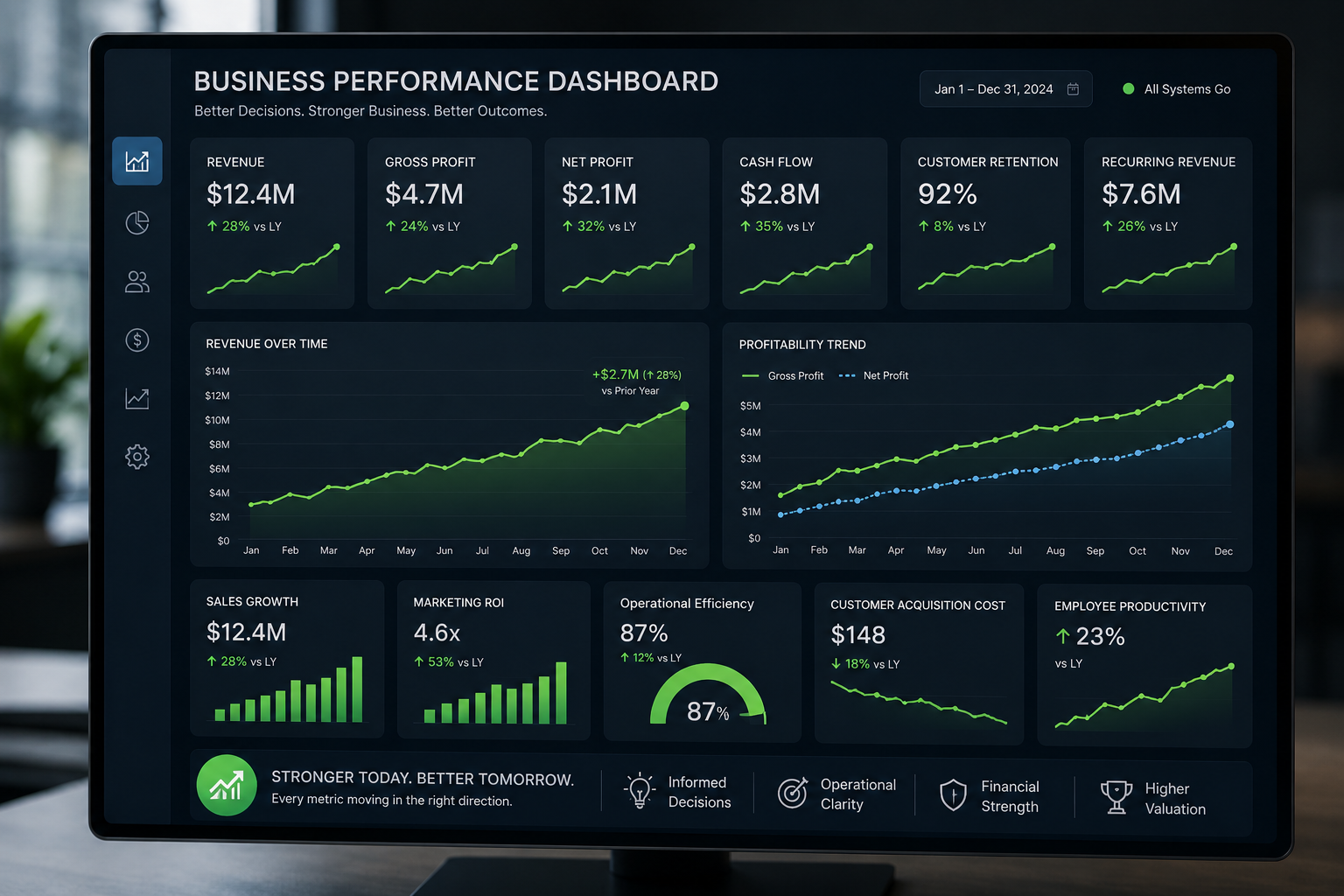
When a coach is connected to an Integrated Financial Management System that gives the client real-time visibility into sales performance, forecasting, profitability, payroll, customer acquisition costs, pipeline health, and operational KPIs, the relationship becomes significantly harder to replace.
The coach is no longer just helping the founder think. The coach is helping the founder run the business.
At the end of the day, the biggest reason coaches should partner with financial operators is because it creates better results for the client.
Founders do not just need motivation and accountability; they need clarity and visibility. They need to understand how decisions inside sales, hiring, marketing, operations, and pricing affect profitability, cash flow, and long-term business health.
An Integrated Financial Management System helps connect those dots in real time so leadership teams can make better decisions faster.
That improves operational confidence, reduces financial fog, helps leadership teams align around measurable business drivers, and ultimately, creates healthier companies.
It also changes the quality of the conversations coaches are able to have with their clients because discussions become grounded in real operational data instead of intuition alone. Instead of simply asking, “How do things feel?” coaches and leadership teams can begin asking much more strategic questions around margin performance, forecasting accuracy, customer acquisition efficiency, revenue quality, and scalability.
That level of visibility allows coaches to help founders identify problems earlier, make adjustments faster, and build more sustainable companies over time.
An integrated financial system can help founders:
Healthier companies create happier clients.
And happier clients stay longer, refer more business, and strengthen the reputation of the coaching ecosystem around them.
Another overlooked benefit of partnering with financial operators is the expansion of referral opportunities.
Many coaches already encounter clients who eventually need deeper financial support, whether that is forecasting, cash flow management, KPI reporting, RevOps integration, or fractional CFO leadership. Without a trusted financial partner, those referrals often leave the coach’s ecosystem entirely.
By partnering with a financial coaching organization, coaches create opportunities for shared revenue, reciprocal referrals, and stronger strategic partnerships that keep more value inside the relationship network.
One coach PSG worked with shared that before partnering with us, he had referred nearly $600,000 worth of business over time to traditional CFO firms because so many of his clients eventually needed cleaner financials and stronger reporting systems before he could truly help them. Since partnering with PSG, he has referred more than $200,000 into our ecosystem in a short amount of time, because the combination of leadership coaching and integrated financial management created stronger outcomes for everyone involved.
The coaching industry is not going away. If anything, founders need guidance today more than ever.
But the expectations of founders are evolving.
Leadership coaching alone is no longer enough for many scaling companies because operational complexity eventually becomes financial complexity. Founders want real-time visibility into the health of their business, not just encouragement around execution.
The coaches who continue to grow over the next decade will likely be the ones who integrate leadership coaching with financial intelligence, operational visibility, and measurable business performance.
Because eventually every founder reaches a point where leadership advice alone is not enough. They want to know whether the business is truly healthy beneath the surface, whether growth is actually profitable, and whether the company is becoming more valuable over time.
The coaches who can help founders answer those questions with real financial visibility and operational clarity will become significantly more valuable in the years ahead.
Phoenix Strategy Group helps founders realize their dreams by installing a proven finance + RevOps system that turns founder-led companies into scalable businesses and maximizes exit value.
Follow us on LinkedIn.