Published on
May 26, 2026

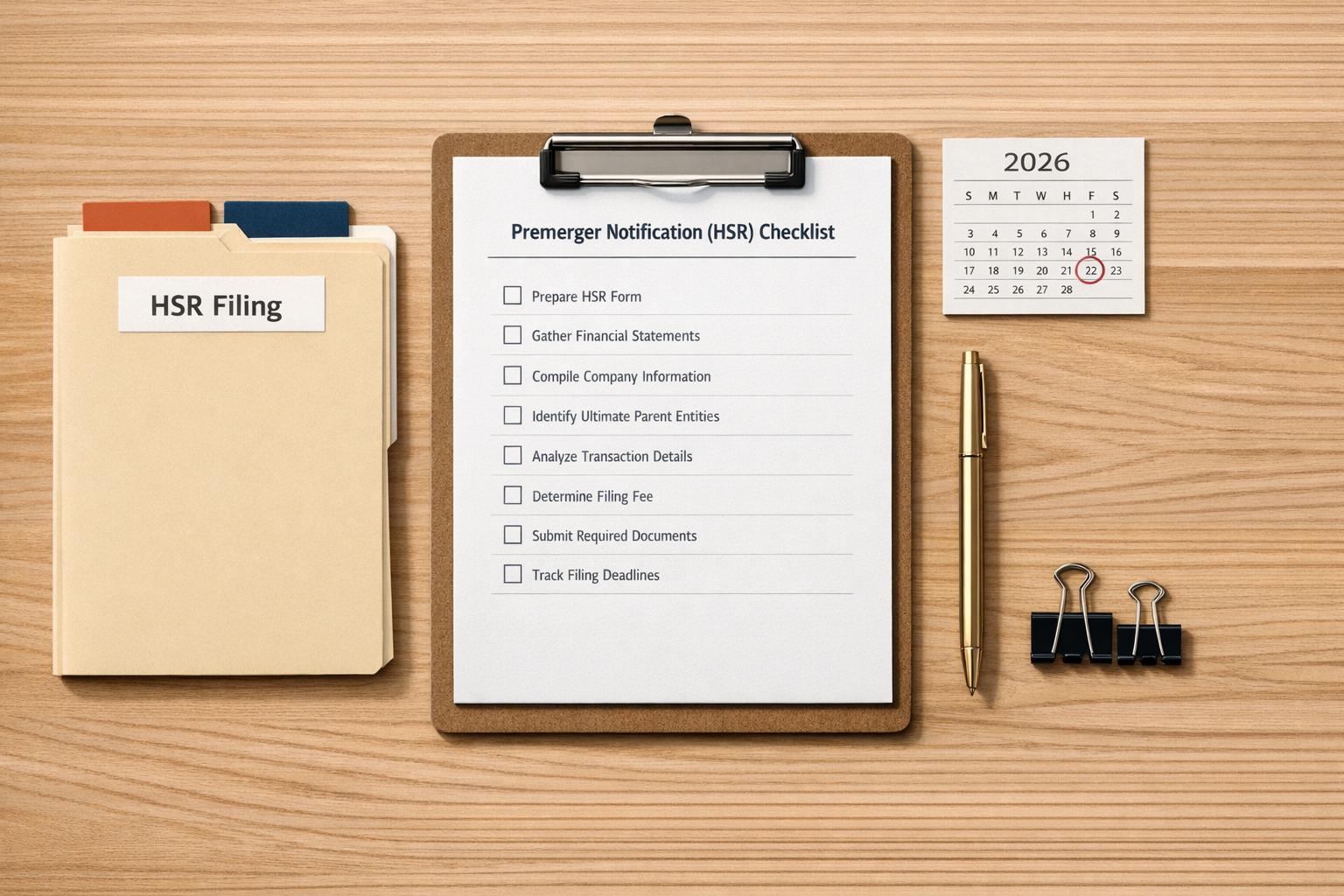
Mergers and acquisitions can hit major roadblocks if you skip premerger notification filings. Here's what you need to know:
Mistakes in HSR filings can delay deals or result in fines. Starting early, understanding the rules, and keeping detailed records are essential for smooth compliance.
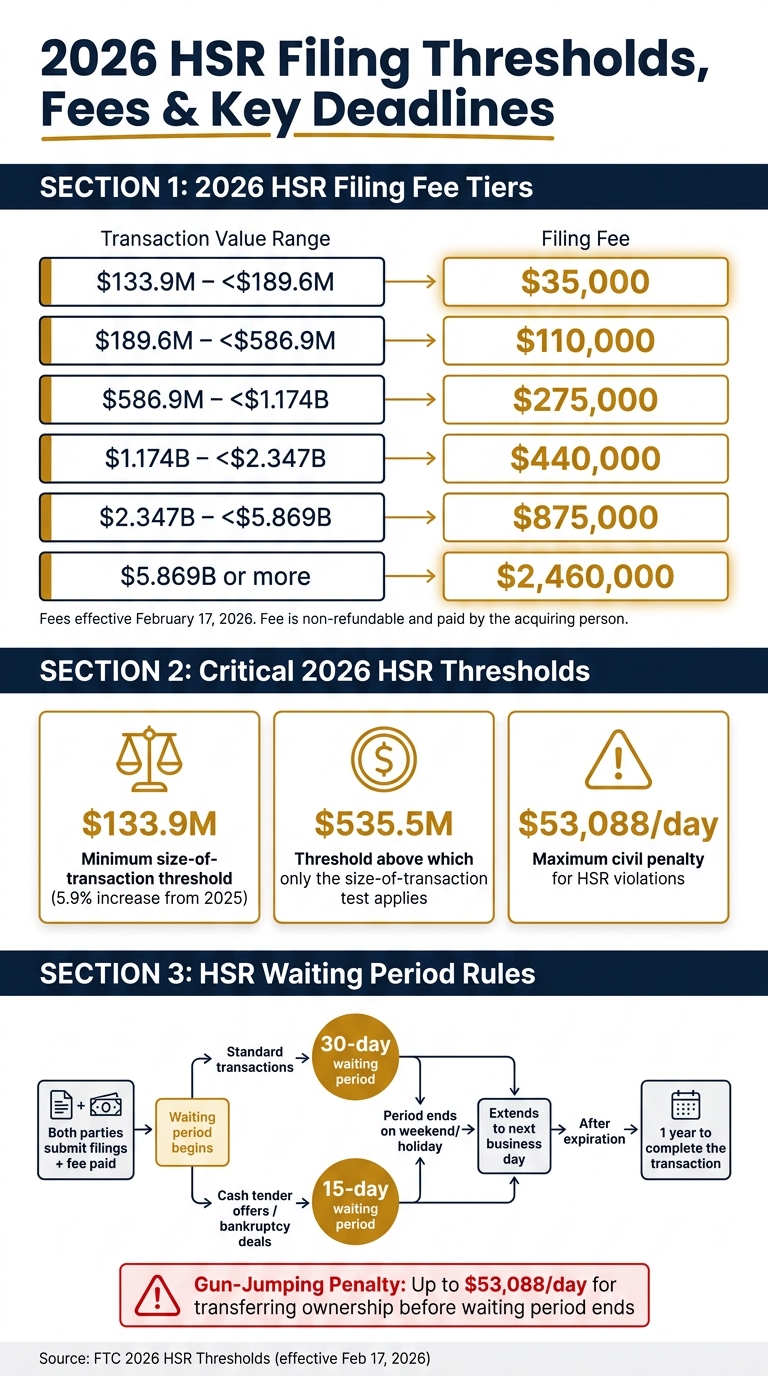
2026 HSR Filing Thresholds, Fees & Key Deadlines at a Glance
The Hart-Scott-Rodino (HSR) Act requires parties involved in certain mergers and acquisitions to notify the Federal Trade Commission (FTC) and the Department of Justice (DOJ) before finalizing their deals [10]. This law applies to various types of transactions, including stock purchases, asset acquisitions, mergers, and joint ventures, provided the deal surpasses specific size thresholds. The purpose is to give regulators time to evaluate potential antitrust concerns before the transaction is completed.
However, not all transactions require an HSR filing. Whether a deal is reportable depends on two criteria: the size-of-transaction test and the size-of-person test. For transactions exceeding $535.5 million in 2026, only the size-of-transaction test applies, bypassing the size-of-person requirement entirely [11].
Let’s break down the updated thresholds and fees for 2026 to understand when a filing is necessary.
The 2026 thresholds, which took effect on February 17, 2026, reflect a 5.9% increase from 2025 levels [10]. This adjustment raises the base size-of-transaction threshold from $126.4 million to $133.9 million [12]. For instance, if a deal worth $130 million closes after February 17, 2026, it is not reportable under the updated rules [5].
Filing fees are determined based on the schedule in place when the HSR filing is submitted - not when the deal closes [5].
Here’s the 2026 fee structure:
| Transaction Value | 2026 Filing Fee |
|---|---|
| $133.9M to less than $189.6M | $35,000 |
| $189.6M to less than $586.9M | $110,000 |
| $586.9M to less than $1.174B | $275,000 |
| $1.174B to less than $2.347B | $440,000 |
| $2.347B to less than $5.869B | $875,000 |
| $5.869B or more | $2,460,000 |
The FTC emphasizes the importance of the minimum size-of-transaction threshold, often referred to as the "$50 million (as adjusted)" threshold. This figure started at $50 million and is updated annually [5].
Once you know the thresholds and fees, it’s essential to understand filing responsibilities and how waiting periods operate. Both parties involved in a transaction must file separately. Timely coordination of these submissions is crucial because the waiting period only begins after both filings are submitted and the filing fee is paid [1][9].
For most transactions, the waiting period is 30 days, but cash tender offers and certain bankruptcy-related deals qualify for a shorter 15-day period [1][9]. If the waiting period ends on a weekend or federal holiday, it automatically extends to the next business day [2][9]. After the waiting period expires or is terminated early, parties generally have one year to complete the transaction [5][9].
One critical compliance issue to avoid is gun-jumping - transferring ownership or combining assets before the waiting period ends. Violations can lead to civil penalties of up to $53,088 per day [2][9][11].
"Compliance with the HSR Act is critical. The maximum civil penalty available for HSR Act violations stands at $53,088 per day." - Baker McKenzie [11]
Finally, a noteworthy update for 2026: following a March 19, 2026 court ruling, the 2025 HSR Form was vacated. As of May 2026, the FTC is primarily accepting the pre-2025 version of the form, though parties can still voluntarily use the 2025 version [2][8].
Once you're clear on thresholds and waiting periods, the next step is assembling the required filing documents. Surprisingly, delays often aren't caused by regulatory hurdles but by missing or incomplete documents and data.
Getting the transaction classification right is essential to avoid errors. HSR rules treat asset acquisitions, purchases of voting securities, and acquisitions of non-corporate interests differently [4][8]. Start by identifying the type of transaction and calculating its total value. This includes cash payments, assumed liabilities, non-cash considerations, and any contingent payments. The goal is to determine whether the deal exceeds the $133.9 million threshold.
For transactions valued between $133.9 million and $535.5 million, you'll also need to confirm that the larger party has a total value of at least $267.8 million and the smaller party meets the $26.8 million threshold [5]. Don’t forget to check for exemptions, like the passive investment exemption, which applies to acquisitions of 10% or less with no intent to influence management. If related transactions occur within 180 days, aggregate the assets in line with rolling-acquisition rules [4].
HSR filing responsibilities are determined at the Ultimate Parent Entity (UPE) level. The UPE is defined as the entity not controlled by any other, with "control" meaning ownership of 50% or more of voting securities or the ability to appoint over half the board [4]. Start by identifying the UPE, then list all controlled subsidiaries, any minority shareholders holding more than 5%, and key officers involved in overlapping NAICS codes [6]. For companies that file regularly, keeping these records updated can save a lot of time in future filings [6].
You'll need to provide a clear explanation of the transaction's strategic purpose, along with detailed descriptions of each party’s main products and services. Highlight any horizontal or vertical overlaps [6][3]. It’s also necessary to identify the person overseeing the deal’s strategic assessment - this might not always be an officer or director - and archive all relevant documentation they produce [6][13]. To avoid last-minute scrambling, companies handling large or strategic deals should start this process four to six weeks before signing.
For companies with a history of acquisitions, both the buyer and target must report past transactions - within the last five years - that involve overlapping NAICS codes. This applies if the acquired entity had at least $10 million in sales or assets [6]. Centralizing this information well in advance can prevent unnecessary delays as the filing deadline approaches.
Once these steps are complete, you’ll be ready to move on to finalizing the logistics and filing timeline.
Now that your documents are ready and the necessary parties have been identified, it’s time to focus on the actual submission process. Even minor mistakes can lead to frustrating delays, so attention to detail is key.
The acquiring person is solely responsible for paying the HSR filing fee, and since it’s non-refundable, ensuring accuracy from the start is critical [4][14]. The fee is determined by the transaction value at the time of filing - not at the time of signing [5].
Transaction value includes several components: cash consideration, assumed liabilities, contingent payments (calculated at present value), and non-cash consideration (evaluated at fair market value) [4]. For acquisitions involving voting securities, you also need to factor in the fair market value of any securities from the same issuer already held by the acquiring person [14].
Here’s a key point: fixed-cap earn-outs should be calculated at their maximum ceiling. On the other hand, variable earn-outs tied to uncertain future outcomes may be excluded initially. However, these could trigger a separate filing obligation later, so make sure to document your analysis thoroughly [14].
Payments must be made via electronic wire transfer, so it’s important to have wire instructions ready before your filing date [2].
Once the fee is paid, the next step is drafting and reviewing the required HSR documents.
As of May 2026, the Federal Trade Commission (FTC) is accepting filings based on the form and instructions that were in place before February 10, 2025. This change follows a March 19, 2026, court ruling. However, filings under the more demanding 2025 rules are still allowed if submitted voluntarily [2]. To avoid any missteps, confirm with antitrust counsel which form version applies to your transaction before starting the drafting process.
"The Agencies are now accepting HSR filings using the Form and Instructions that were in place before the February 10, 2025, effective date of the new rule." - Federal Trade Commission [2]
Your filing must include all agreements related to the transaction, such as non-compete and non-solicitation agreements, along with all exhibits and schedules [6]. If any documents are not in English, provide accurate translations. Also, double-check each PDF to ensure proper margins, as misaligned text is a frequent reason for rejection [2].
When submitting, use the Kiteworks portal and ensure everything is included in a single submission. Splitting documents across multiple submissions can cause processing issues [2]. The message field must follow this specific format: "Acquiring Person-Acquired Person – A/B – Date – ATTORNEY" [2].
Once your domestic filing is ready, don’t overlook international or state-level regulatory requirements. Coordinating across jurisdictions is essential to avoid delays. Foreign regulators, such as the European Commission and the UK’s Competition and Markets Authority (CMA), operate on their own timelines, which may not align with the 30-day HSR waiting period [4]. Engaging antitrust counsel early - ideally by the term sheet stage - can help you map out all notification requirements and develop a realistic closing timeline [4].
One strategy to keep in mind is the pull-and-refile tactic. This allows the acquiring person to withdraw and refile the HSR notification, effectively resetting the 30-day waiting period. It’s particularly useful when you need to coordinate HSR clearance with foreign regulatory approvals or financing conditions. While this adds time, it’s a legitimate way to ensure all conditions are satisfied before closing [4].
"Antitrust clearance is not a checkbox. It is a condition to closing that neither party can waive unilaterally, that no amount of commercial goodwill between the principals can accelerate, and that the agencies are under no obligation to resolve quickly." - Alex Lubyansky, Esq. [4]
Don’t forget about state-level requirements. State Attorneys General have the authority to challenge mergers independently, and some states, like California, have their own premerger notification rules. Addressing these obligations early ensures you won’t be caught in a situation where federal clearance is complete, but state reviews are still pending [4].
Once your HSR filing is submitted, staying compliant and preparing for future filings is essential.
The waiting period starts only when the FTC and DOJ certify both parties' filings as "substantially complete." For most transactions, this period is 30 calendar days, while cash tender offers and certain bankruptcy sales have a shorter 15-day period [1][3]. Agencies don't issue formal clearance notices. As Alex Lubyansky, Esq. explains:
"Clearance is the absence of agency action within the waiting period." [4]
It's crucial to confirm the exact expiration date and time with your antitrust counsel. If your filing is deemed incomplete, the waiting period restarts once deficiencies are corrected. In cases where a Second Request is issued, the waiting period pauses until you achieve "substantial compliance." Once compliance is met, a new waiting period begins - typically 30 days, or 10 days for cash tender offers and bankruptcies [1][3]. Tracking the substantial compliance date is vital for determining the final countdown to closing [1][4].
Responding to a Second Request can be both costly and time-consuming, with mid-market deals often incurring expenses between $3 million and $15 million [4]. Violating the waiting period or engaging in "gun-jumping" can lead to civil penalties exceeding $51,000 per day as of April 2026 [4][7]. To avoid these risks, enforce clean-team protocols to prevent premature information sharing before the waiting period concludes [4].
Once compliance with the waiting period is secured, attention should turn to thorough recordkeeping.
Establish a centralized system for storing HSR-related data. This should include details like operating entities, minority shareholder lists, and past acquisition records to simplify future filings. Organize entities by NAICS codes, keep officer and director interlock data updated, and maintain a five-year log of prior acquisitions involving overlapping NAICS codes or products [13][6].
Additionally, track foreign subsidy records - documenting any subsidies received in the past two years from foreign entities or governments of concern, as defined under the Tariff Act [13]. Maintain a current list of all officers and directors, including any who served in those roles within the past three months, and highlight those holding similar positions at other companies in the same industry [13].
"Filing parties may wish to begin collecting and maintaining some of the required information on a regular basis, and will need to build an additional two to four weeks (or more) into deal timelines to account for the significant incremental work that will be required." - Skadden, Arps, Slate, Meagher & Flom LLP [6]
Under Rule 802.21, after the waiting period expires, the acquiring party typically has one year to cross the notified threshold and up to five years to acquire additional shares up to the next threshold without refiling [5]. Keep a record of these timelines to avoid filing errors.
This structured approach not only ensures compliance but also lays the groundwork for improving your HSR processes over time.
Use your organized records to refine your HSR filing process. After closing, assess what worked well and identify any delays or data gaps. Pay close attention to narrative consistency - discrepancies between your description of competitive overlaps and submitted documents can lead to the waiting period restarting [6].
Check the Federal Register in January or February annually for updates to jurisdictional thresholds and filing fee tiers. It's important to note that the applicable threshold is determined by the date of closing, not signing [5]. Given that the 2025 HSR form was vacated by a district court as of March 2026 and the FTC is now accepting the pre-2025 version, confirm the correct form for your next filing. For companies working with advisors like Phoenix Strategy Group, integrating these regulatory updates into broader M&A planning can help avoid last-minute complications when a deal arises.
Preparing a thorough and accurate HSR filing starts long before the deal is signed. For transactions involving multiple overlaps or vertical relationships, the law firm Skadden, Arps, Slate, Meagher & Flom LLP advises:
"HSR preparations will likely need to begin no later than four to six weeks before signing, or even earlier for large, strategic transactions with numerous overlaps and/or vertical relationships." [6]
Building enough time into your deal timeline and maintaining up-to-date records can help avoid the stress of last-minute scrambling when a transaction arises.
Mistakes in the process carry hefty consequences. Civil penalties can exceed $51,000 per day, and antitrust agencies may challenge a deal under Section 7 of the Clayton Act, even years after it closes. This makes organized recordkeeping and a consistent narrative essential [4].
Taking these steps not only ensures compliance but can also simplify future filings. Companies that file regularly benefit from structured preparation over time. Using internal templates for recurring disclosures, centralizing entity data, and clearly assigning tasks across finance and legal teams can reduce the workload for each filing. Working with advisors like Phoenix Strategy Group allows businesses to weave compliance workflows seamlessly into their broader M&A strategies, ensuring regulatory readiness becomes part of the overall deal process.
One last but crucial step: always confirm which HSR Form version is required before filing. As of March 2026, the FTC reverted to the pre-February 10, 2025 form after a court decision vacated the updated version [2]. Ensuring you're using the correct form can prevent outright rejection of your filing. By following a checklist approach, you can address every element of the HSR filing process efficiently and effectively.
A deal requires HSR reporting if it surpasses the current transaction size threshold (set at $133.9 million for 2026), involves parties that meet the size-of-person thresholds, and does not fall under any exemptions. To determine if filing is necessary, carefully assess the transaction's value, the parties involved, and any applicable exemptions. If the deal meets these criteria, an HSR Form must be submitted, and the waiting period must pass before the transaction can close.
"Gun-jumping" happens when companies involved in a merger act in ways that break antitrust laws before getting clearance under the Hart-Scott-Rodino (HSR) Act. This could involve things like sharing sensitive business information too early, taking control of the target company, coordinating business activities, working together inappropriately, or obtaining beneficial ownership before the HSR waiting period has ended. Such actions can result in legal consequences and delays in completing the merger.
When the FTC or DOJ issues a Second Request, it means the parties involved must submit extensive business documents and data for review. This step often adds an extra 30 days to the process, though fulfilling the requirements can take months. The extended timeline not only raises compliance costs but also increases the chances of the deal falling through. Being well-prepared ahead of time can help reduce potential delays and complications during this phase.