Published on
March 26, 2026

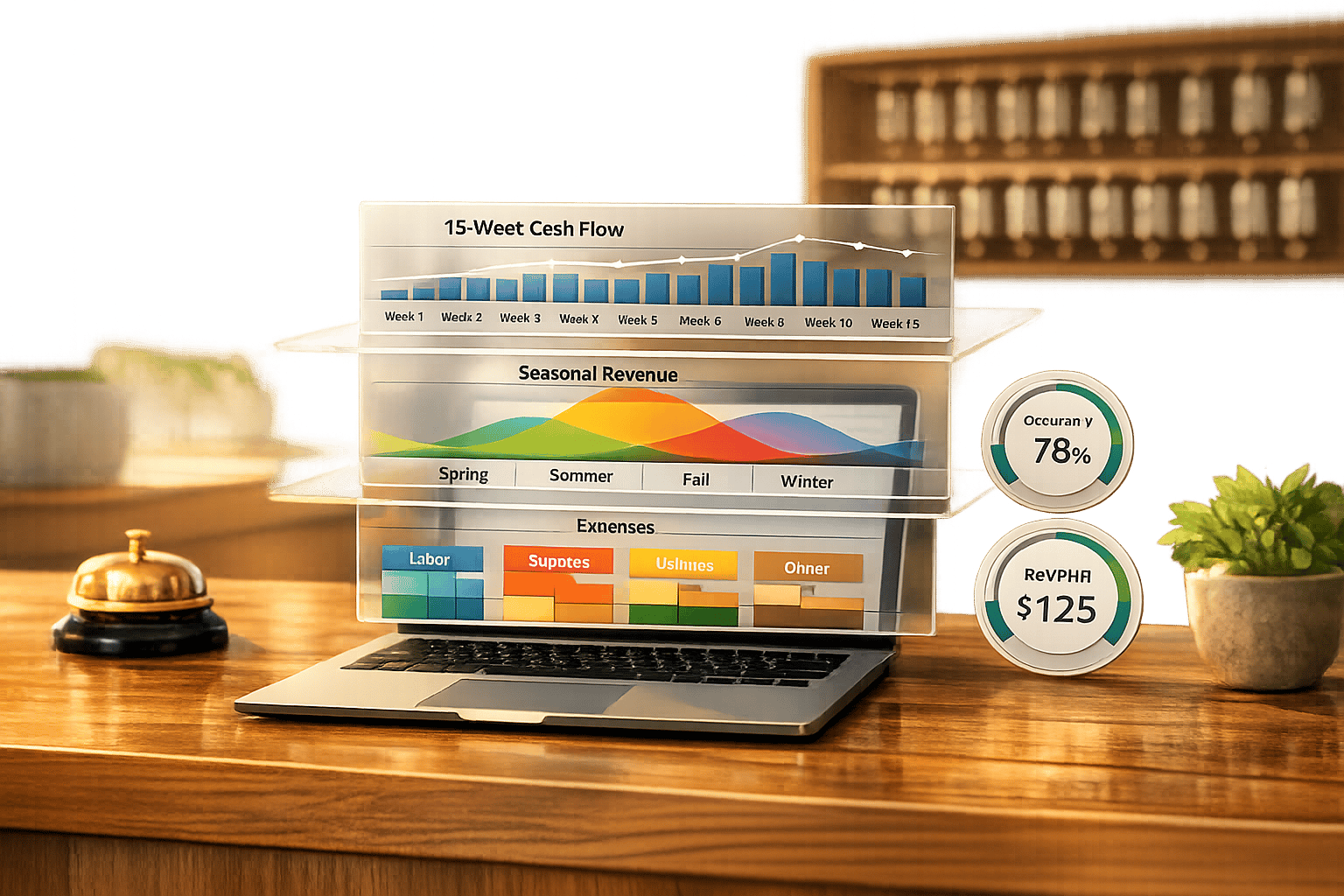
Building a cash flow model for hospitality businesses is essential to managing seasonal revenue fluctuations and ensuring smooth operations. Here's how you can create one effectively:
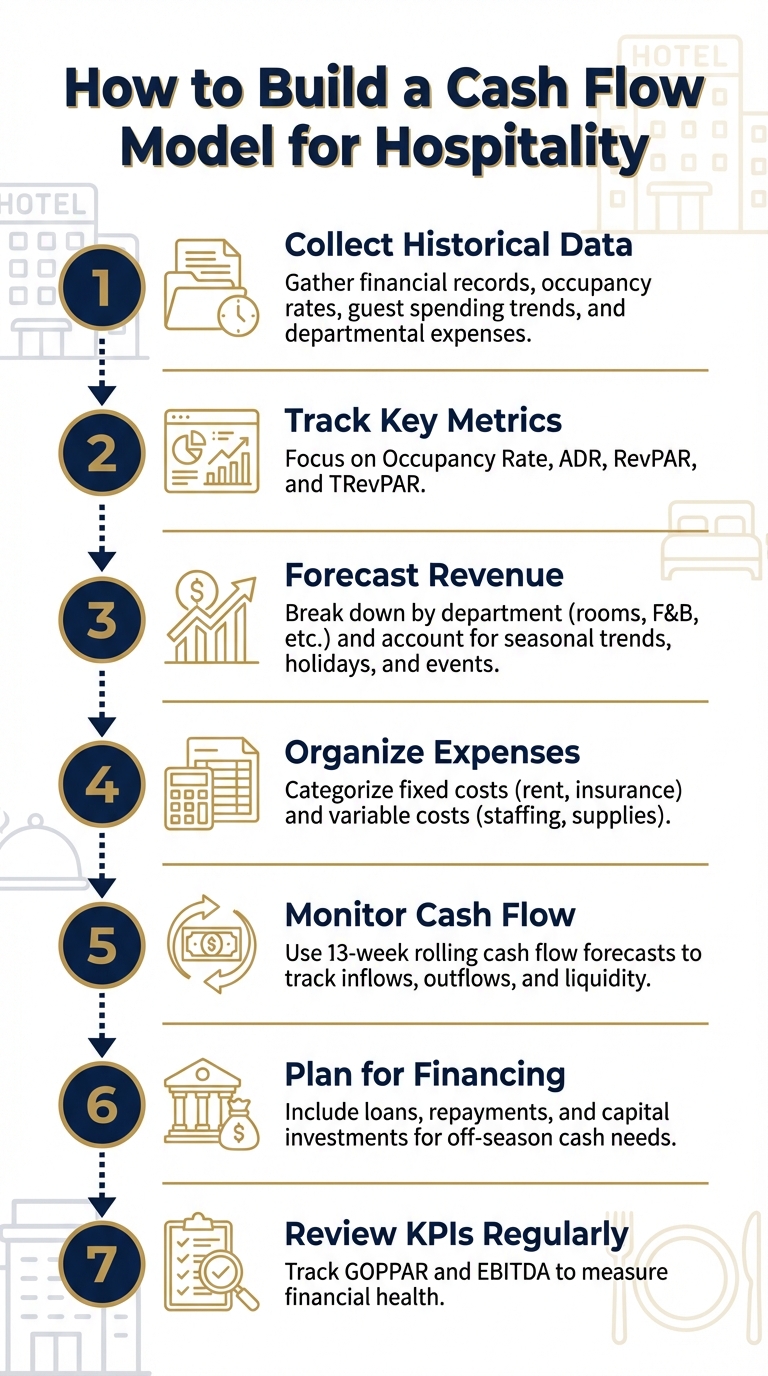
7-Step Cash Flow Model Building Process for Hospitality Businesses
To build a reliable cash flow model, start by collecting essential financial records such as income statements, balance sheets, and cash flow reports. These documents provide a clear foundation for understanding your revenue patterns and spending habits [2]. Once you've got these, dive into a detailed review of each department.
Pull operational data from your Property Management System (PMS), including historical occupancy rates, nights booked, and guest spending trends [2][4]. You'll also need expense records for both fixed and variable costs - think payroll for housekeeping and reception, laundry services, marketing, and utility bills [2][3]. If you're part of a franchise, make sure to include details about recurring fees like royalties, reservation charges, and marketing contributions [3].
Organizing financial records by department is crucial. In the hospitality industry, revenue and expenses should be categorized by operation - Rooms, Food & Beverage, Spa, Gift Shop, and so on. This allows you to evaluate the profitability of each area independently [3].
"The hotel proforma seeks to break down each department so that they can be analyzed independently... This will help investors to get a better picture of the hotel's bright spots and problem areas." - Michael Belasco, Founder, Adventures in CRE [3]
Don’t forget to include financing details like loans, interest payments, and capital expenditures [2][3]. When analyzing historical data, segment occupancy figures to highlight fluctuations in demand [2]. Keep an eye on payment processing fees too, which usually range between 2% and 3% of total sales, and treat them as variable expenses [2].
Once all your records are in order, focus on identifying the metrics that have the biggest influence on your cash flow.
Key metrics for the hospitality industry include:
"Relying on intuition won't work anymore; you need NUMBERS to grow your hotel business because growth doesn't come by CHANCE - it requires monitoring the key metrics." - Gurpreet Kaur, Sr. Technical Writer, BOTSHOT [4]
A great example of metric-driven success comes from Terry McCartney, Managing Director of Belmore Court and Motel. By analyzing metrics and seasonal trends, he expanded his property from 30 to 60 rooms, achieving a 65% average occupancy rate, which peaked at 82% during the high season [4].
For properties with diverse revenue streams, track Total Revenue Per Available Room (TRevPAR) to capture all spending per room, including food, spa services, and parking [5][3]. Monitor Gross Operating Profit (GOP) Margin to measure profitability before fixed expenses, and keep an eye on Labor Cost Percentage - labor costs exceeding 35% of total revenue may signal inefficiencies in staffing or pricing [5].
Finally, create a demand calendar. Map historical financial performance against events like holidays, sports tournaments, and conferences to uncover patterns that drive your revenue spikes [4].
Once you've collected historical data, the next step is to forecast revenue while factoring in seasonal demand. Seasonality includes everything from weekly fluctuations to holidays and local events that can influence your revenue streams.
It's important to forecast each revenue stream individually since different areas of your business - like rooms, food and beverage, or spa services - react differently to seasonal trends. A bottom-up approach works best here. Dive into historical data for each department to pinpoint which areas are most affected by seasonal shifts [7].
Utilize tools like your PMS (Property Management System) and POS (Point of Sale) systems to uncover patterns in guest behavior [7]. For even greater precision, segment your historical data by customer type - such as business travelers versus tourists - and by booking channels, like direct reservations or Online Travel Agencies (OTAs) [7]. This granular analysis will not only improve your forecasting accuracy but also feed directly into your broader cash flow model.
Build a detailed events calendar that includes local and national holidays, seasonal trends, and major recurring events [7]. Historical booking data can give you a clear picture of how these events have impacted your business in the past.
"Failing to account for seasonality can lead to significant forecasting errors, potentially resulting in understaffing during peak periods or excessive costs during slower times." - TRG International [7]
To stay agile, consider implementing rolling forecasts instead of sticking to static annual budgets. These rolling forecasts maintain a forward-looking view for 12–18 months and are updated monthly or quarterly [7]. Regularly comparing actual performance to your forecasts will help fine-tune your seasonal adjustments [7].
Finally, work closely with your Sales, Marketing, and Operations teams. Their insights into upcoming promotions or capacity changes can help you anticipate deviations from historical patterns [7].
Next, the focus will shift to modeling operating expenses and cash flow to complete the forecasting framework.
Now that we've tackled revenue forecasts and key metrics, it's time to dive into expense modeling and cash flow tracking. The goal is to organize your operating expenses and create a system that monitors cash movements, turning your revenue projections into a full financial overview.
Hospitality expenses generally fall into three categories: fixed monthly amounts (e.g., bookkeeping services), percentages of revenue (like credit card processing fees), or volume-based costs (such as laundry and cleaning supplies that fluctuate with room occupancy) [2]. Identifying where each expense fits is crucial for accurate financial planning.
Experts often suggest maintaining a cash reserve equal to 2–4 months of fixed costs to cover slower periods [6].
Additionally, include "undistributed expenses" like general administration, IT systems, and maintenance as a separate category. Breaking down expenses by department - such as Rooms, Restaurant, or Bar - can help you assess the profitability of each revenue stream [3]. Keep in mind that salaries typically make up about 70% of a hotel's operating expenses [2].
Once your costs are categorized, you're ready to build a framework for cash flow tracking.
With expenses sorted, the next step is to create a cash flow system that turns these insights into practical monitoring tools. A good starting point is a spreadsheet that tracks cash inflows, outflows, net cash flow, and cumulative cash flow. Use a 13-week rolling cash flow forecast instead of relying solely on monthly profit and loss statements. Weekly forecasts provide a clearer view of actual cash movements, such as payroll schedules and supplier payments [6][8].
To manage cash effectively:
This structured approach ensures you're not just tracking expenses but actively managing cash flow to keep operations running smoothly.
Once you've established your expense and cash flow framework, the next step is to layer in financing options and performance metrics. This step ties together revenue, expenses, and financing, creating a complete and dynamic cash flow forecast.
When it comes to external financing - like loans, investor funding, or lines of credit - categorize these as "Financing Activities" to separate them from operational cash flows [10]. Loan repayments should be tracked as regular outflows to ensure your property can handle fixed costs, even during periods of low occupancy [11]. In the hospitality industry, lines of credit are often used to balance high-season profits against off-season expenses [9].
If you're planning capital expenditures, such as renovations or technology upgrades, be sure to include the financing sources used to fund these projects. This allows you to better understand their impact on liquidity [11]. As one expert puts it, "A strong cash reserve is your safety net. It protects your property from short-term shocks... without forcing you into high-interest loans" [11]. Compare your peak season cash flow to off-season needs to determine whether a line of credit is necessary to maintain stability during slower periods [9].
Once your financing details are in place, the next step is to focus on tracking performance metrics to anticipate and address potential cash flow issues.
Tracking the right KPIs can help you identify trends and address problems early. Metrics like EBITDA (Earnings Before Interest, Taxes, Depreciation, and Amortization) focus on cash flow from core operations, excluding non-cash accounting decisions and financing impacts [12]. GOPPAR (Gross Operating Profit Per Available Room) offers a closer look at profitability by factoring in key operational costs like payroll and utilities [12][4]. For food and beverage operations, keeping an eye on the Prime Cost Percentage - a combination of Cost of Goods Sold and total labor - is crucial. This percentage typically ranges from 35% to 45% of revenue [13].
Using a mix of metrics like RevPAR, GOPPAR, and EBITDA provides a well-rounded view of your business's performance [12]. Compare actual results to forecasts regularly to spot any discrepancies quickly [4]. While volume metrics should be reviewed daily, cost metrics are better suited for weekly reviews to allow for timely adjustments [13].
With your KPIs in place, it's important to update your model regularly to maintain accuracy. Aim to update it monthly or quarterly to reflect real-world performance and any market changes. A rolling forecast approach - which provides a continuous 12–18 month outlook - keeps your business flexible and responsive, unlike static annual budgets. By integrating your model with systems like Property Management Systems (PMS) and Point of Sale (POS), you can leverage real-time data and automate updates.
To keep everything on track, establish a forecasting review committee that meets quarterly. This group can evaluate performance and adjust forecasting methods as needed. Additionally, maintain a detailed events calendar that includes local holidays, festivals, and conferences to account for seasonal cash flow changes.
For businesses looking for expert financial guidance, Phoenix Strategy Group (https://phoenixstrategy.group) offers fractional CFO services and FP&A systems tailored for growth-stage companies. These services can provide advanced insights into cash flow forecasting, KPI development, and integrated financial modeling, helping you stay ahead in a competitive market.
Creating a cash flow model for the hospitality industry requires consistent attention and updates. By now, you’ve learned how to gather historical data, forecast revenue with seasonal adjustments, and model expenses effectively. These updates are crucial for keeping pace with seasonal trends and ensuring your model remains accurate and actionable.
The hospitality sector is particularly prone to economic shifts and market volatility. Even small changes in metrics or external conditions can significantly impact financial outcomes. As Emma Näpänkangas, a Hospitality Strategy Writer, explains:
"Value shifts can be significant even over a short period. This is why valuations should be refreshed regularly to stay up to date with current realities" [1].
To stay ahead, update your model monthly or quarterly using trustworthy sources like STR, CBRE, or HotStats. Combine forecasting techniques such as Discounted Cash Flow (DCF) and Cap Rate analysis to produce a well-rounded view of potential outcomes and reduce forecasting errors. This is especially important during off-seasons, where careful cost management can have a big impact on overall performance.
For businesses aiming to refine their forecasting methods, expert assistance can make a difference. Phoenix Strategy Group (https://phoenixstrategy.group) offers support in building precise models and making informed strategic decisions as your business grows.
When maintained properly, a cash flow model provides the insight needed to tackle seasonal challenges, plan investments, and set your property up for long-term success. By following these steps, you can better navigate the ups and downs of the hospitality industry and make smarter financial decisions.
Take a close look at past financial records to spot patterns in revenue, expenses, seasonal trends, and payment schedules. Break down your costs into two categories: fixed costs (like rent and salaries) and variable costs (such as supplies and utilities). Use this information, along with insights from market trends, to project future revenue.
Create a detailed outline of your weekly cash inflows and outflows over the next 13 weeks. Be sure to account for any seasonal changes that might impact your finances. Once the plan is in place, keep it updated with actual data as it comes in. This will help you maintain accuracy and ensure you're managing liquidity effectively.
To get started, take a straightforward route: examine your historical revenue data. By looking at 2–3 years of monthly or quarterly revenue, you can spot patterns and make seasonal adjustments. Pay close attention to fluctuations during peak times, such as holidays or significant local events. This approach ensures your cash flow model accounts for these trends, making your forecasts more precise and aligned with real-world variations.
Keeping an eye on specific KPIs can make a big difference when it comes to avoiding cash shortfalls in the hospitality industry. Here are the key metrics to focus on:
Additionally, it’s smart to keep tabs on revenue growth trends, seasonal fluctuations, and the timing of your expenses. These factors can help you identify risks to your liquidity and maintain better financial stability.