Published on
July 7, 2026


Most deal value is lost when leadership decisions are left vague. If I were reviewing a partner M&A today, on July 7, 2026, I’d focus on six points before and right after close: decision rights, leadership model, reporting lines, pay, risk owners, and post-close team shape.
Here’s the short version:
The article’s main point is simple: a good deal can miss its numbers if leadership fit is weak. Missed synergies, slower decisions, leader exits, and customer loss often start with unclear roles, not bad spreadsheets.
A few facts stand out from the piece:
| Focus area | What I’d decide pre-close | What I’d watch post-close |
|---|---|---|
| Decision rights | Who has final say on budget, hiring, pricing, and integration | Whether escalations are clear and used the right way |
| Leadership model | Hub-and-spoke, federated, or fully integrated | Whether the model matches the deal plan in practice |
| Reporting lines | Who reports to whom on Day 1 | Whether middle managers can execute without confusion |
| Incentives | Bonus and retention plans tied to deal goals | Whether pay drives EBITDA, cash flow, and milestone delivery |
| Risk ownership | One named owner per major risk | Whether churn, attrition, budget drift, and compliance issues stay in check |
| Team review | Role clarity for founders and senior leaders | Quarterly fit reviews and succession coverage |
If you want a plain-English takeaway, it’s this: don’t wait until after close to figure out who leads, who decides, and who owns the risk.
Use due diligence to test one thing above all: can the buyer's leaders and the target's leaders carry out the deal thesis together when the pressure is on?
Judge leaders against the deal thesis, not against a generic idea of what a strong leader looks like. A founder may have built the business through organic growth and run it well for years, yet still not be ready for a buy-and-build plan or a cost-out turnaround.
Don't stop at résumés. Use structured behavioral interviews to see how leaders handled ambiguity, disputed calls, and fast organizational change in the past. Then go a step further with off-list references from former peers, indirect reports, and industry contacts.
Also look at the layer below the executive team. These managers run day-to-day operations, and they often carry much of the execution load. Their flight risk matters. If they leave early, synergies can slip, and customer ties can weaken or disappear. What you learn here should feed the next question: can the culture and operating style support the same model?
Use this table to map the findings:
| Leadership Dimension | Buyer Strength / Gap | Target Strength / Gap | Must-Keep Roles |
|---|---|---|---|
| Financial Discipline | High - PE-backed rigor, P&L ownership | Variable - often growth-focused over EBITDA margins | Target CFO/Controller: critical for sponsor-ready reporting |
| Change Track Record | Experienced in M&A and platform integration | Deep domain expertise, limited large-scale transformation experience | Integration Lead: must be a named buyer executive |
| Decision Making | Structured, board-aligned, formal | Agile, informal, often centralized in the founder | Founder: high transition risk if professional management is not accepted |
| Operating Scale | Multi-site, metrics-driven | Single-site or regional, relationship-driven | Head of Sales/Ops: essential for customer continuity |
Culture shows up in behavior under pressure: after a missed quarter, when a direct report pushes back, or when problems come to the surface. In plain English, it shows in how leaders react when things go sideways.
The best way to assess this is with structured behavioral interviews and structured culture surveys. Ask leaders to walk through a specific moment when they had to make a disputed decision with incomplete information. Then listen closely. Did they work through the conflict in the open, or did they handle it through private channels?
Pay close attention to the gap between centralized and decentralized operating styles. A buyer with a tight governance model will often struggle with a target where the founder made every call alone. That gap can be managed with the right structure, but only if you spot it before close. If the styles are likely to clash, define the operating model before close.
Before signing, align founders, investors, and operating leaders on the 3- to 5-year plan, growth targets, and the acquired company's role in the portfolio.
This usually breaks down around role clarity. A founder may expect to run the combined entity after close, while the buyer plans to install a different operating lead. That's a direct conflict, and it needs to be settled before close.
Be clear about who owns what after Day 1. Then make sure compensation and incentives match those future roles, not the roles people held before the deal. Once roles are clear, the next move is to set decision rights and governance.
Once leadership fit is tested, lock down decision rights and governance before close. If no one knows who gets the final call, decisions drag, people step on each other, and friction builds fast. Sort this out before integration starts.
Give each major decision category one clear owner and publish the escalation path so people know where issues go when they hit a wall.
| Decision Category | Final Authority | Where to Document |
|---|---|---|
| Strategy | CEO / Board / Operating Partner | Target Operating Model |
| Capital Allocation | CEO / Board / CFO | Deal Structure / Budget Plan |
| Budget Approvals | CFO / PE Sponsor | Financial Governance Framework |
| Pricing & Discounts | Sales VP / Deal Desk | Commercial Playbook / RACI |
| Executive Hiring | CEO / IMO Sponsor | Target Org Structure |
| Integration Milestones | IMO Lead / SteerCo | 100-Day Integration Blueprint |
| Customer Exceptions | Sales Leadership | Commercial Readiness Checklist |
Publish the RACI before close. [6][4] High-level decision rights and leadership appointments should also come out of diligence and show up in the deal structure or Letter of Intent (LOI). [4][1]
After decision rights are set, define the operating model they will support. The right model should match the deal thesis, not old habits or internal politics.
The table below shows how authority shifts by role based on the model you choose:
| Role | Current State (Legacy) | Target State (Combined) |
|---|---|---|
| CEO | Full P&L and strategic autonomy | Reports to Board/Sponsor; focused on integration and growth |
| CFO | Local reporting and treasury | Standardized sponsor-ready reporting; synergy tracking |
| BU Leaders | Regional or product autonomy | Matrixed reporting; shared functional services (HR/IT) |
| Sales Head | Independent pricing and strategy | Aligned pricing authority; cross-sell accountability |
| Functional Heads | Siloed operations | Rationalized functions; unified process ownership |
Match authority to the deal thesis, not to the legacy org chart. If the goal is standardization and cost savings, centralize authority. If value comes from relationships or market nuance, keep more authority local. [1][2]
Governance keeps the machine moving. Stand up the Integration Management Office (IMO) within 72 hours of close, staffed with senior operators and reporting straight to the CEO or COO. [6][4]
Run the IMO daily as needed. Hold the SteerCo weekly for 90 days. Set the performance review monthly, and board oversight quarterly. Use a shared KPI dashboard to track revenue, EBITDA, synergy realization, integration milestones, and nonfinancial measures, including employee engagement. [6][4]
Use this governance structure to lock in reporting lines, incentives, and risk ownership.
With governance in place, the next step is simple: set reporting lines, compensation, and named risk owners before close so the model works on Day 1.
Confirm every reporting line before close so Day 1 starts with clarity [4].
Use this role matrix as a working check before close:
| Role | Reports To | Core Responsibilities | Key Performance Areas |
|---|---|---|---|
| Integration Lead | Operating Partner | IMO structure, synergy tracking, cross-functional alignment | Integration milestone completion, synergy realization |
| Target CEO | Board of Directors | Strategic vision, culture alignment | EBITDA, revenue growth, talent retention |
| Target CFO | CEO / Sponsor | Financial reporting, treasury controls | 10-day monthly close, cash flow accuracy |
| Functional Leads | CEO / Integration Lead | Departmental stabilization | Regretted turnover, customer continuity |
One place teams slip: middle management. Leaders one or two levels below the C-suite often do much of the day-to-day work, yet they get missed in org design [3][1].
Once reporting lines are set, compensation needs to back up the same model.
Communicate compensation for critical leaders before Day 1 [4][1]. Annual bonus metrics should tie straight to the deal thesis, including revenue, EBITDA, cash flow, integration milestone completion, and people KPIs such as regretted turnover. Long-term incentives should support the value-creation plan, and retention programs often use an 18-month window to cover the most volatile parts of integration [7].
Pay compression and pay gaps also need attention early. Quantify which leaders sit above the new range and which fall below the minimum, then build the harmonization cost into the deal model. If you leave pay compression unbudgeted, it can create internal inequity and add cost to the integration [7].
Give each major risk one named owner. The risk register should be live before close and reviewed weekly for the first 90 days [4].
| Risk Category | Named Owner | Impact | Likelihood | Mitigation Plan |
|---|---|---|---|---|
| Customer Churn | Head of Sales | High | Medium | Proactive outreach to top 20% of customers before Day 1 [4] |
| Talent Attrition | HR Director | High | High | Retention packages for top 15 flight-risk leaders pre-close [4] |
| Cyber Breach | IT Director | Critical | Low | Security audit and MFA implementation within 30 days [4] |
| Budget Overrun | CFO | Medium | Medium | Weekly variance analysis; strict CAPEX approval thresholds [4] |
| Compliance Lapse | Legal Counsel | High | Low | Audit all permits and change-of-control clauses in the first 15 days [4] |
Track the risk register through the IMO and escalate issues to the Steering Committee when a department cannot resolve them [4]. Those ownership decisions often shape the first 30 to 60 days of post-close leadership review.
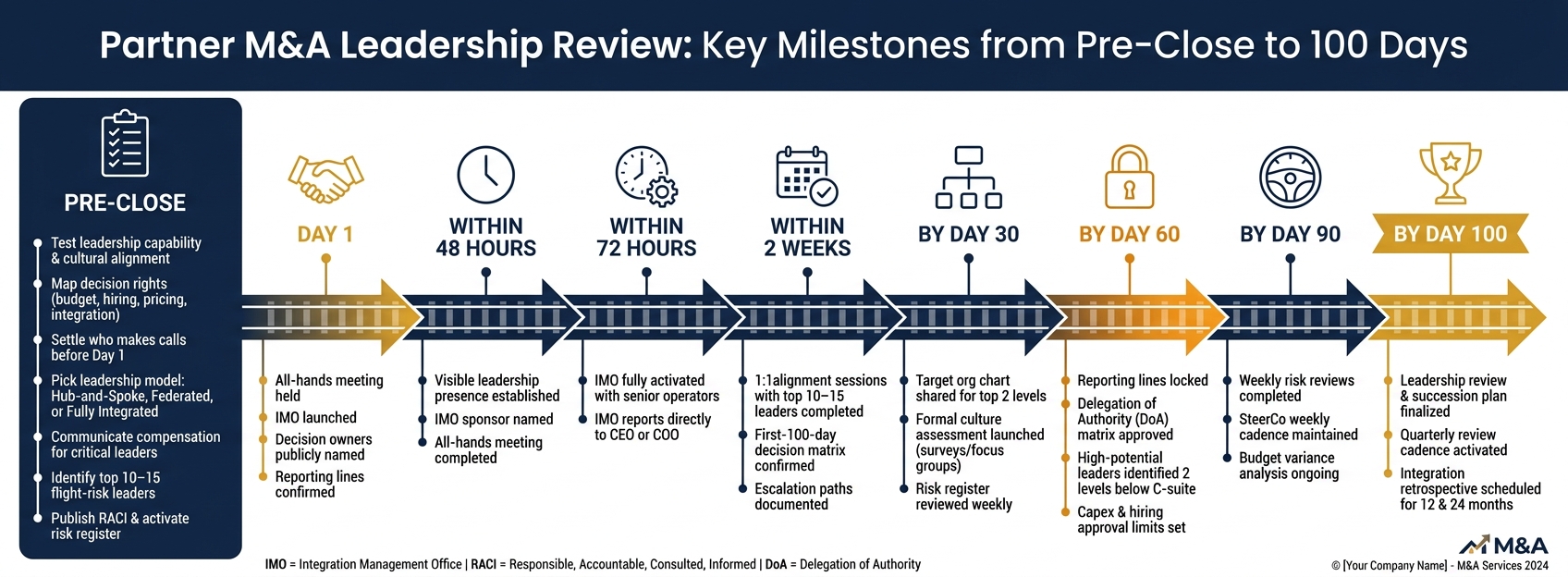
Partner M&A Leadership Review: Pre-Close to 100-Day Timeline
If risk owners are in place before close, the first 100 days should lock down structure, communication, and accountability.
The first 48 hours matter a lot. This is when people decide whether leadership is in control or making it up as they go. You want visible leaders, a clearly named IMO sponsor, and obvious decision owners from the start.
| Phase | Primary Focus | Key Deliverable |
|---|---|---|
| Day 1 | Immediate stability | All-hands meeting & IMO launch |
| Day 30 | Functional clarity | Target org chart & RACI matrix |
| Days 30–60 | Structural alignment | Departmental consolidation & DoA matrix |
| By Day 100 | Leadership review and succession plan | Quarterly review cadence active |
Once the 100-day sprint ends, move from launch mode into a quarterly operating review.
Each quarter, run a formal leadership performance review tied straight to the value-creation plan [6]. Look at financial results versus plan, decision speed, retention, and customer health.
Use 360 feedback and structured behavioral interviews to assess adaptive capacity - whether leaders stay decisive when roll-up deals create ambiguity [1]. Set escalation triggers before problems hit a boiling point. Board intervention makes sense when trust breaks down between senior leaders, when decision paralysis stalls workstreams, or when the DoA matrix is breached on capex or hiring [2][5].
For succession planning, identify high-potential leaders two levels below the C-suite by Day 60 and keep coverage in place for every critical role [4]. Then, at 12 and 24 months, run formal integration retrospectives to turn what worked into the institutional playbook for the next acquisition [6].
Leadership structure shapes the financial model, reporting, and accountability. Phoenix Strategy Group helps growth-stage companies tie leadership and org changes directly to cash flow, EBITDA projections, integration milestones, and KPI visibility through fractional CFO services, FP&A, and M&A support.
Leadership fit shapes partner M&A outcomes because even a solid deal thesis can fall apart if the team can’t carry it out. That shows up fast in decision rights, the target leadership model, reporting lines, incentives, and risk ownership.
Use this checklist in two ways: as the last gate before close and as the first map for post-close review. The order matters. Test leadership capability before close. Lock decision rights before Day 1. Match the target leadership model to the deal thesis. Then line up reporting lines, incentives, and risk ownership after close.
The final review points are below.
| Review Point | Pre-Close Action | Post-Close Priority |
|---|---|---|
| Decision Rights | Map capital and headcount authority | Review escalation paths in weekly steering meetings |
| Strategic Fit | Confirm fit against the deal thesis | Conduct quarterly leadership fit and succession reviews |
| Incentives | Align MIP to integration milestones | Track synergy realization and KPI dashboards |
| Talent Risk | Identify top 10–15 dependencies and flight risks | Execute retention/stay-packages and succession plans |
After close, review leadership every quarter for missed synergies, rising attrition, and behavior that slows execution. Treat leadership accountability as a standing operating discipline, not a one-time close task.
Put less weight on legacy performance and more on integration readiness. Start by defining post-merger roles, because those jobs may look very different from pre-deal positions.
Then assess leaders against your deal thesis and future strategy. Focus on whether they can handle ambiguity, work through culture gaps, and lead change under pressure. Before close, flag key-person dependencies and likely friction points.
Before Day 1, lock down the leadership basics so the deal doesn't drift into confusion or slow integration work.
Focus on a few must-have items:
Watch how the team deals with conflict and makes calls when the heat is on. Early red flags include decisions happening in private channels, centralization, gridlock, or a habit of leaning on personal pecking orders instead of clear integration processes.
Pay attention to surprise attrition, blurry reporting lines, confusion over who owns what, and any gap between stated values and daily behavior. After the deal closes, dysfunction often shows up first as day-to-day operational complexity.