Published on
February 17, 2026

Selling commercial real estate without a clear plan can lead to missed opportunities, unexpected taxes, or poorly timed sales. A well-thought-out exit strategy ensures you maximize returns, minimize taxes, and protect your investment against market fluctuations.
Key Takeaways:
Whether you're scaling your portfolio or cashing out, careful planning and expert advice are essential for a successful exit. Let’s break it down step-by-step.
Defining your exit goals and timeline is key to aligning your property investment strategy with your broader financial plans. Whether you're aiming to build wealth, prepare for retirement, diversify your investments, or fund specific milestones like college tuition, your exit strategy should reflect these priorities [6][2].
You’ll also need to decide whether you’re aiming for steady monthly rental income or a one-time capital payout. This choice will directly influence how you approach property improvements and tenant selection [6][7]. Let’s break this down further.
Establish clear financial benchmarks like ROI (Return on Investment), IRR (Internal Rate of Return), and NOI (Net Operating Income) [2][7].
Tax considerations should be part of your planning from day one. The length of time you hold a property impacts your tax obligations and your ability to use tools like the 1031 exchange. For example, selling a property held for less than a year subjects you to short-term capital gains taxes, which can be as high as 37%. On the other hand, holding it for over a year qualifies you for long-term capital gains rates, which range from 0% to 20% [5][1]. Additionally, you’ll need to account for depreciation recapture, which could add a 25% tax on profits exceeding the depreciated value [5].
Your holding period - how long you plan to keep the property before selling - should strike a balance between generating immediate cash flow and achieving long-term gains [9]. For example, commercial properties are often held for 5–10 years, but your timeline should match your financial strategy [9][10].
Some investors, often called "Finders", focus on short-term gains, holding properties for 1–5 years. They aim to quickly boost NOI through value-add improvements and then sell for profit. Others, known as "Keepers", adopt a long-term mindset, holding properties for 20–25 years to prioritize stable monthly income over quick returns [6]. Whichever approach you choose, ensure it aligns with your financial goals, loan terms, and market conditions. Be mindful of potential prepayment penalties in your mortgage, as these can make an early sale costly [6].
"Holding periods are estimates that are by no means set in stone." - Ian Formigle, Chief Investment Officer, CrowdStreet [11]
Start planning your exit at least 2–3 years ahead of time. Properties with complete financial records for this period can sell for 15% to 25% more than those without [8]. This preparation window also allows you to address deferred maintenance, shift your focus from minimizing taxes to maximizing NOI, and position your property for a higher valuation.
Timing your exit wisely can significantly boost your returns. The commercial real estate market typically moves through four phases - recovery, expansion, hyper supply, and recession - over cycles lasting 7–10 years [14]. Knowing where your property fits within this cycle helps you decide whether to sell now or hold out for better conditions.
Keep an eye on key economic signals like the Federal Funds Rate and the 10-year Treasury Yield. When these rates rise, borrowing becomes more expensive, often reducing refinancing activity and lowering property values [12][13]. Inflation metrics, such as the Consumer Price Index (CPI), also play a role, as higher costs can impact your property's cash flow and operating expenses [12].
In addition to general economic trends, focus on data specific to your asset type. For example:
Vacancy and occupancy rates are another critical measure. Declining vacancy often signals strong tenant demand and stable income, which can support higher property values [13]. Similarly, rising rents reflect increased investor confidence and upward pressure on valuations. However, be cautious if you notice a surge in construction permits. A wave of new developments could lead to oversupply, softening rents even before those projects are completed [13].
"Interest rates have an impact on the cost of financing across the economy... higher interest rates often make transactions and refinancing less feasible and can lead to lower property valuations." - Altus Group [12]
By understanding these broader economic trends, you can refine your timing to maximize your returns. Once you've grasped the big picture, it’s time to dig into local market activity.
While national trends provide context, local market dynamics often paint a clearer picture. Regional factors such as employment growth, corporate relocations, and expanding industries directly influence submarket demand [14][15]. Net migration patterns and business formation data can reveal whether your market is thriving or shrinking. A declining population, for example, might signal it’s time to consider selling [15].
To stay informed, set up a quarterly monitoring system using tools like CoStar or Google Alerts [14]. If you notice a sudden spike in permit filings, it may be a good time to exit before oversupply affects renewal rates [14]. For perspective, U.S. commercial real estate deal volume hit nearly $370 billion in 2024, with a 33% jump in Q4 alone, highlighting how investors use market signals to time their exits [14].
Regularly analyze your net operating income (NOI) alongside current cap rate trends. This helps you weigh the potential upside of holding onto the property versus the immediate value of selling [13]. Staying on top of these local indicators ensures your exit strategy is based on data, not guesswork.
"Smart investors sell when the numbers - not emotions - say it's time." - The Keys 2 Prosperity [14]
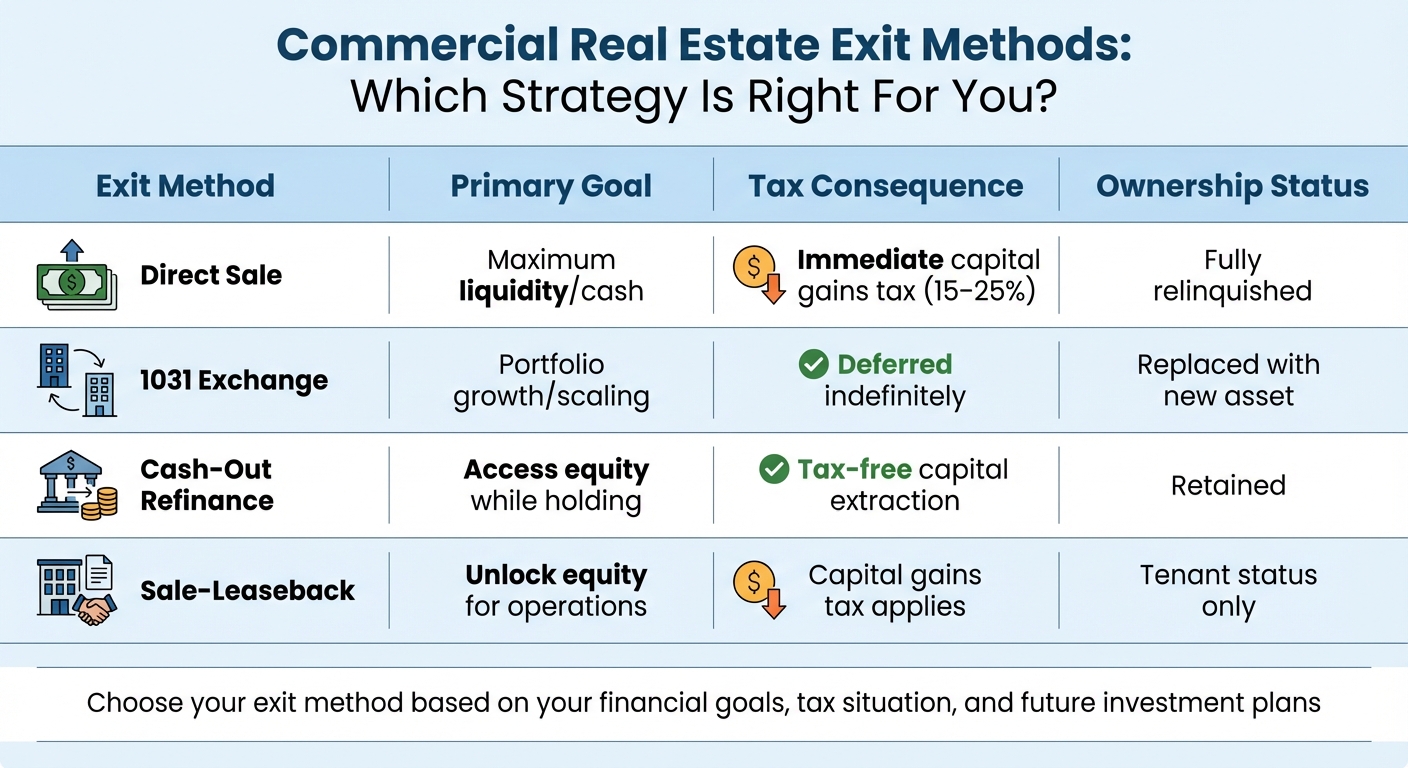
Commercial Real Estate Exit Strategy Comparison: Methods, Tax Implications, and Ownership Outcomes
Once you've assessed the market and pinpointed your timing, the next step is deciding how to exit. This choice should align with your financial objectives, tax considerations, and future plans. Some methods offer immediate cash, while others allow you to defer taxes or retain ownership while accessing equity. Your decision should reflect the financial benchmarks and market insights you've already established. Picking the right approach now lays the groundwork for preparing your property and aligning with your broader financial strategy.
A direct sale is the quickest way to turn your property into cash. This option provides full liquidity and closure, making it ideal if you're exiting the commercial real estate market entirely or need funds quickly for other ventures [4][16].
However, this method comes with immediate tax implications. Capital gains and depreciation recapture taxes will apply right away. To get the best price, ensure your property is in top shape and has a high occupancy rate - ideally above 90% - before listing it [17]. Properties with clean financial records often command 15% to 25% higher sale prices compared to those with unclear documentation [8].
"An exit strategy is your escape plan for the money you put in and want to get out of the investment." - Peter Harris, Commercial Real Estate Mentor [4]
If your goal is to defer taxes while scaling your portfolio, a 1031 exchange could be the right fit. This IRS-sanctioned strategy allows you to sell your property and reinvest the proceeds into a "like-kind" property, deferring 100% of your capital gains and depreciation recapture taxes [16][18].
The process has strict deadlines: you must identify potential replacement properties within 45 days and close on one of them within 180 days from the sale date [16][17]. To stay on track, it’s wise to identify two or three backup properties during the 45-day window in case your primary choice falls through [16]. It's also crucial to work with a Qualified Intermediary (QI) - if you handle the proceeds yourself, you lose the tax-deferral benefit [16].
For example, more than 15 years ago, Goshen Investments LLC used this strategy to resolve a partnership split on a 112-unit apartment building. They refinanced to pay off one partner and completed a 1031 exchange for the remaining partners, reinvesting in a property with higher cash flow [4].
"The 1031 exchange is a wealth-building engine. It transforms a taxable event into a strategic opportunity to compound your investment returns." - Ian Ferrell, Global Property Management [16]
If you're not ready to fully exit but need access to capital, consider a cash-out refinance or sale-leaseback.
A cash-out refinance allows you to tap into your property's equity without triggering immediate tax liabilities. This option lets you retain ownership, cash flow, and the potential for future appreciation [4][17]. Before proceeding, use a Debt Service Coverage Ratio (DSCR) calculator to ensure the new debt won't jeopardize your property's profitability [17].
A sale-leaseback, on the other hand, involves selling your property to unlock its full equity and then signing a long-term lease to continue operating from the same location [4][3]. This method is popular among business owners - like doctors or attorneys - who own their office space but need capital for operations. While you'll owe capital gains tax on the sale, your rent payments become tax-deductible [3].
Here’s a quick comparison of these exit methods:
| Exit Method | Primary Goal | Tax Consequence | Ownership Status |
|---|---|---|---|
| Direct Sale | Maximum liquidity/cash | Immediate capital gains tax (15–25%) [4] | Fully relinquished |
| 1031 Exchange | Portfolio growth/scaling | Deferred indefinitely [16] | Replaced with new asset |
| Cash-Out Refinance | Access equity while holding | Tax-free capital extraction [17] | Retained |
| Sale-Leaseback | Unlock equity for operations | Capital gains tax applies [3] | Tenant status only |
Once you've chosen your method, focus on preparing your property and records for the next steps, whether that’s a sale or reinvestment.
Once you've selected your exit strategy, the next step is to make your property as appealing and transparent as possible. Clean financial records and a well-prepared property can significantly boost buyer confidence and even increase your sale price. Whether you're selling directly or opting for a tax-deferred exchange, careful preparation ensures you maximize value while minimizing issues during the due diligence process. This is your chance to directly impact the final sale price and streamline the entire transaction.
Addressing deferred maintenance is crucial, especially for major systems like roofs or HVACs. For example, neglecting a $100,000 roof replacement could lower your sale price by $150,000 to $200,000. Why? Buyers often factor in not just the cost of repairs but also the inconvenience, uncertainty, and risks involved [8]. Tackling these issues upfront protects your property's valuation.
First impressions also play a significant role. Simple updates like power washing, fresh paint, and landscaping can increase your property’s value by up to 14% [19]. For energy efficiency, consider switching to LED lighting, which can cut energy consumption by 25% to 30%, or install solar panels to reduce energy bills by up to 75% [19]. These upgrades not only lower expenses but also enhance your Net Operating Income (NOI), making the property more attractive to potential buyers.
Tailor improvements to your property type for maximum impact. For retail spaces, reseal parking lots and repair potholes. In multifamily buildings, add low-flow showerheads and toilets. Office spaces might benefit from updated lobby furniture and replacing stained ceiling tiles. Even less visible spaces, like mechanical or janitorial areas, should not be overlooked - buyers often see poorly maintained areas as red flags for hidden problems [19].
| Property Type | Recommended Physical Improvements |
|---|---|
| Industrial | Power wash exterior, fix broken windows, ensure roof integrity, install light timers [19] |
| Retail | Reseal parking lot, repair potholes, clean windows, use neutral storefront paint [19] |
| Multifamily | Install low-flow fixtures, add vending or laundry machines, stage with functional furniture [19] |
| Office | Update lobby furniture, replace stained ceiling tiles, clear desks, add cheerful accent colors [19] |
Buyers base decisions on actual NOI, not hypothetical projections [8]. To build trust, gather essential documents like past rental agreements, current rent rolls, and detailed expense reports. Include maintenance records, repair costs, property management fees, and utility bills, all backed by receipts and invoices [20]. Buyers often expect financial statements prepared on an accrual basis, as these provide a clearer picture of the property's performance [8].
Prepare comprehensive profit-and-loss (P&L) statements and balance sheets to give buyers a straightforward view of the property's financial health. Document your property's adjusted basis - the original purchase price plus improvements minus depreciation - to calculate capital gains tax accurately [20]. Additionally, organize key legal documents like the title deed, property tax receipts, recent surveys, and environmental evaluations [5].
Having a service provider list with contact details for vendors like HVAC, plumbing, and roofing specialists can also reassure buyers. Include notes about each vendor's familiarity with the property to highlight their expertise [8]. For added appeal, create an "opportunity file" showcasing untapped potential, such as unused space for storage or future revenue streams like billboard leases [8].
After organizing your records, validate their accuracy through a professional appraisal. A third-party valuation not only justifies your asking price but also bolsters your negotiation power with market data [5][7]. Professional appraisals are especially valuable when dealing with lenders, as banks often dismiss undocumented income or overly optimistic financial projections [8].
"An accurate market valuation strengthens your negotiating position and maximizes ROI." - Brian Dukes, Exitwise [5]
Appraisers generally use three methods to determine value: the Sales Comparison Approach (evaluating recent local sales), the Income Capitalization Approach (dividing NOI by the cap rate), and the Cost Approach (estimating replacement costs) [5]. For income-generating properties, the Income Capitalization Approach is typically the most relevant, as it focuses on the property’s ability to generate revenue [5].
Engage a commercial real estate appraiser well in advance - ideally two to three years before your planned exit. This allows time to address any issues that might negatively affect the valuation [8][7].
Once your property and financial records are in good shape, teaming up with financial and advisory experts can make a world of difference in achieving a successful exit. In fact, the gap between a decent exit and an exceptional one often hinges on professional guidance. Properties with clean, verifiable financials can fetch 15% to 25% more than those with incomplete records. On top of that, selling during a market peak can add another 15% to 25% to your sale price [8]. These combined factors could mean hundreds of thousands of dollars in extra proceeds.
"The best exit strategies come from wise investors. You will limit yourself and your options and you may leave thousands if not hundreds of thousands of dollars on a table if you don't get help." - Peter Harris, Commercial Real Estate Mentor [4]
Expert advisors can significantly boost your exit value by structuring deals effectively, ensuring your financials hold up under buyer scrutiny, and streamlining the due diligence process. Whether you're considering a direct sale, a 1031 exchange, or a sale-leaseback arrangement, their expertise helps you maximize liquidity while keeping tax liabilities in check. With their support, you can refine your strategy and make the most of your exit.
A fractional CFO offers top-tier financial expertise without the expense of a full-time hire. For commercial real estate exits, this means having a professional who can normalize your EBITDA, prepare accrual-based financial statements, and document add-backs that buyers and lenders will accept. Poorly documented or overly aggressive add-backs can erode buyer trust and even lead lenders to reject the deal, shrinking your pool of potential buyers [8].
Fractional CFOs also help clean up financials by transitioning personal expenses out of the business - ideally two to three years before a sale [8]. This preparation is essential because buyers expect consistent, reliable financial records. Additionally, fractional CFOs assist with cash flow forecasting and financial modeling, giving you a clear picture of how different exit strategies will impact your net proceeds after taxes and transaction costs.
For example, Phoenix Strategy Group provides fractional CFO services tailored to preparing growth-stage companies and investment portfolios for exits. They focus on developing key performance indicators (KPIs), implementing accrual accounting systems, and creating financial models that inspire buyer confidence. By professionalizing your financial operations early, you strengthen your negotiating position and avoid last-minute surprises during valuation discussions.
In addition to financial expertise, M&A advisors play a critical role in simplifying the exit process. They specialize in structuring deals and managing due diligence, particularly for complex methods like 1031 exchanges, Delaware Statutory Trusts (DSTs), and sale-leaseback arrangements - all of which can help defer taxes and enhance liquidity [1][4]. M&A advisors ensure that your "seller's package" - which includes financials, rent rolls, service contracts, and property records - is complete and well-organized [8].
Another key advantage of working with M&A advisors is their ability to create an "opportunity file" for potential buyers. This document highlights value-add opportunities, such as unused square footage, below-market leases, or future revenue streams, supported by contractor quotes and market data [8]. By presenting these growth possibilities realistically, advisors help buyers see the property's potential without overpromising, preserving your credibility.
A successful exit typically requires about 12 months of planning and a 3-month sale process [4]. M&A advisors help structure this timeline strategically, starting with financial cleanup 2 to 4 years before the sale, operational improvements 12 to 24 months prior, and Quality of Earnings (QofE) reviews 6 to 12 months before closing [8]. Phoenix Strategy Group offers comprehensive M&A advisory services, guiding property owners from initial preparation to deal execution and closing, ensuring you achieve the best possible outcome for your exit.
Your exit strategy is the result of careful planning, market knowledge, and smart execution. Successfully exiting commercial real estate often takes years of preparation. This includes organizing your financial records and ensuring accurate accounting to build trust with potential buyers during due diligence.
Timing is just as critical as preparation. Selling during a market peak with well-maintained financials can lead to a 15% to 25% higher return [8]. Keeping an eye on economic trends, local vacancy rates, and your position in the market cycle is essential for maximizing profits.
The exit method you choose should match your initial investment goals. Whether it’s a direct sale for quick liquidity, a 1031 exchange to defer capital gains taxes, or a sale-leaseback to free up equity while continuing operations, each approach serves specific needs.
"The difference between a good and a fantastic return is frequently determined by the timing and circumstances of the sale" - Commercial Brokers International [2]
Having the right team in place is invaluable. Fractional CFOs, M&A advisors, tax experts, and specialized brokers can help you navigate legal hurdles, optimize your tax strategy, and showcase your property effectively. With U.S. commercial real estate transactions expected to hit nearly $370 billion in 2024 and $1.5 trillion in loans maturing soon [13], the market presents big opportunities for sellers who are prepared.
Start planning your exit strategy today to secure the best possible returns. The work you put in now - polished financials, strategic property improvements, and well-timed decisions - directly impacts your outcomes. For expert guidance in crafting a seamless exit plan, consider consulting Phoenix Strategy Group for personalized advisory services.
To figure out the best way to exit your investment, start by clearly outlining your goals - whether that's making the most profit, reducing taxes, or something else entirely. Take a close look at market trends and evaluate if your property is ready to sell, including its financial performance and any necessary updates or repairs. Depending on your priorities, you might opt for strategies like a quick sale, holding the property for a better market, or using a 1031 exchange to defer taxes. Timing and the method of sale are also critical, so plan these aspects carefully to ensure the process aligns with your goals and delivers the results you’re aiming for.
The ideal time to sell your commercial property hinges on a mix of factors, including market trends, how well your property is performing, and your financial situation. Keep an eye on key indicators like vacancy rates, rental growth, and interest rates to gauge the market's health. Having your financial documents in order and maintaining well-organized records ahead of time can help maximize your property's value. It's generally smart to sell when demand is strong and the market aligns with your investment goals, steering clear of typically slower months like August or December.
Before finalizing a commercial real estate deal, buyers must have carefully organized financial records. These should include financial statements, rent rolls, operating expense details, and capital expenditure records. It's also crucial to ensure all accounts are fully reconciled for accuracy and clarity.