Published on
February 28, 2026

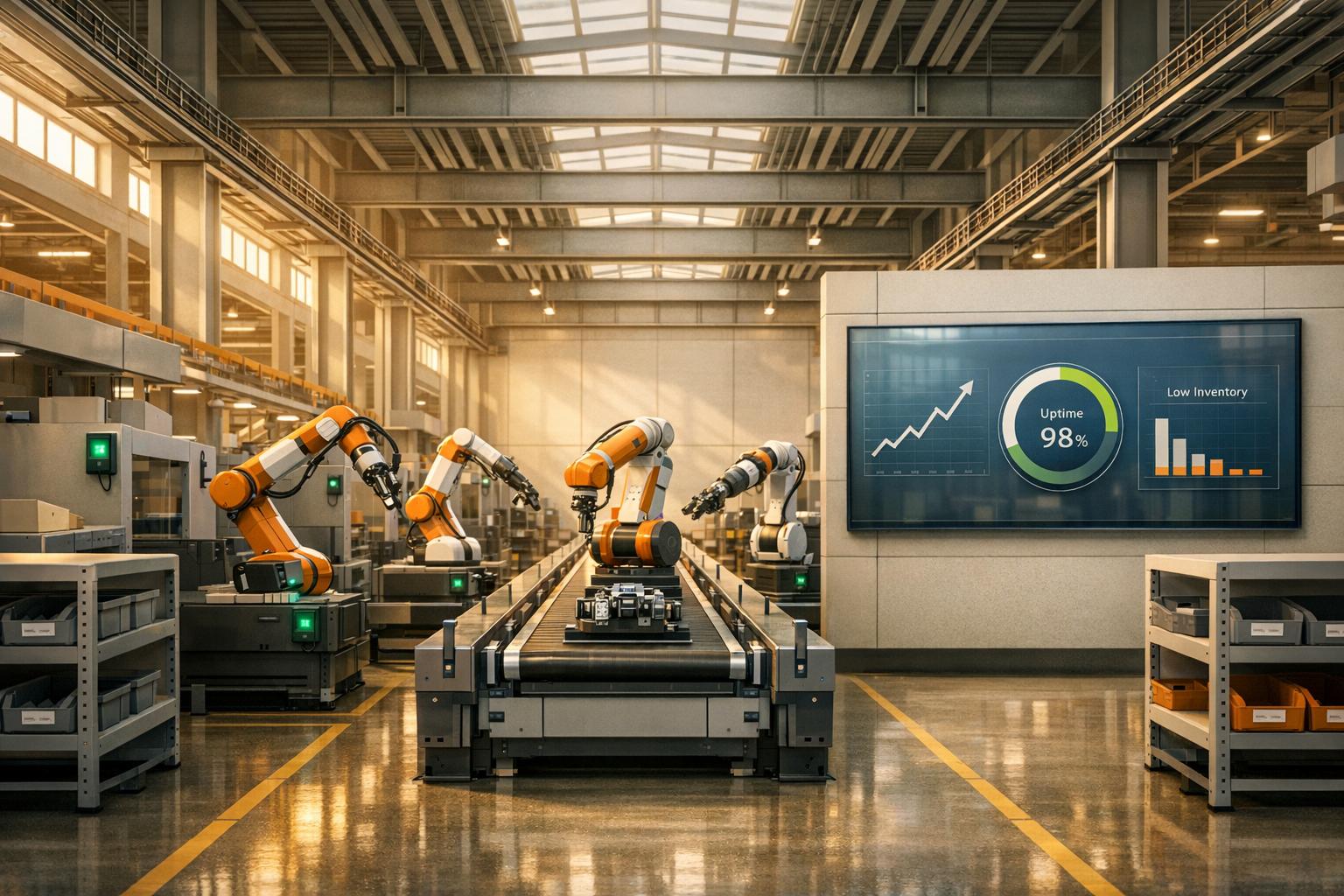
Real-time data is transforming manufacturing by cutting costs, improving efficiency, and enabling faster decision-making. Manufacturers no longer need to rely on outdated reports; instead, they can monitor operations, inventory, and financials as they happen. Here’s how it helps:
For example, companies like Jennison cut late orders by 30%, and Marathon Equipment grew 20% after adopting live data systems. By following steps like integrating systems, using dashboards, and automating processes, manufacturers can protect margins and scale operations effectively.
To effectively monitor costs in real time, you need a robust data infrastructure that eliminates delays caused by manual entries. The key is to create a centralized, live data repository. Here's how to approach technology selection, system integration, and predictive maintenance to streamline operations and cut costs.
Real-time cost monitoring depends on three essential technologies working in harmony:
When these technologies are properly integrated, they provide up-to-the-minute visibility into production costs, enabling smarter, faster decision-making.
One of the biggest challenges in cost monitoring is the disconnect between financial records and shop floor data. Without integration, reconciling these systems often requires time-consuming manual work, creating delays and inefficiencies.
Once you've chosen the right technology stack, the next step is to connect financial and production systems. This integration ensures that events like downtime or inventory changes are immediately reflected in cost reports. With this real-time connection, finance teams can quickly spot cost overruns and take proactive measures, such as reallocating labor or renegotiating material orders.
Traditional maintenance approaches often wait for equipment to fail before taking action, leading to unplanned downtime, budget overruns, and production delays. Real-time systems flip this model by using IoT sensors and PLC (Programmable Logic Controller) data to catch problems early.
For instance, these systems can detect micro-stops - brief machine interruptions that operators might overlook. While a single 30-second stop may seem minor, 40 such stops in a shift add up to 20 minutes of lost production time. Addressing these interruptions can significantly boost efficiency and protect revenue. Consider this: a 1% improvement in equipment availability on a machine with a $50,000/hour True Downtime Cost can recover about $4,000 per day in revenue [3].
Predictive maintenance also helps optimize spare parts inventory. Instead of replacing components based on a fixed schedule, parts are replaced only when data indicates they are nearing failure. This approach reduces waste and ensures equipment stays operational [2][3].
Use live dashboards to turn raw data into actionable insights. These visual tools let you catch cost issues as they happen, instead of waiting for monthly reports. By connecting dashboards to the real-time data system you set up in Step 1, you create a seamless way to monitor inefficiencies and respond quickly.
Focus your dashboard on KPIs that directly affect your bottom line. Keep an eye on cash flow to spot liquidity issues. Track overhead costs like utilities, labor, and indirect expenses to catch unexpected increases. Production variances, which measure the gap between actual output and planned targets, help identify efficiency problems.
In addition to financial metrics, include operational data like machine downtime, labor utilization, and material waste. When floor managers can see inputs, outputs, and downtimes at a glance, they can make faster decisions to optimize capacity and cut waste[4]. Consolidating this information into a single dashboard eliminates the need to switch between systems or rely on manual reports. These KPIs are key to addressing cost overruns as they emerge.
Live dashboards are excellent at uncovering hidden costs that monthly reports often miss. For instance, excess inventory can be flagged through live stock level alerts, helping you optimize reorder points and potentially cut storage costs by up to 20%[5]. Accurate inventory tracking also prevents overstocking and stockouts.
Another common issue is rush shipping fees, which can quietly eat into profits. Dashboards can flag these costs as soon as supply chain delays or stockouts occur. Proactive monitoring has helped manufacturers reduce these expenses by 70–80%[5]. Similarly, budget overages become visible through variances in overhead or production metrics. With timely alerts, you can address shipment delays immediately, explore alternatives, or adjust production schedules to avoid costly rush orders.
The real-world impact of live dashboards is clear. Take Precision Products Inc., for example. By implementing real-time inventory tracking, they achieved an 80% reduction in monthly stockouts and cut rush-order expenses by 70%. This saved them $7,000 in expedited shipping costs while also boosting uptime by 15%[5]. Their dashboard brought together vendor, shipment, and inventory data, eliminating the confusion that previously caused late deliveries, unmet demand, and inflated material costs[4].
Using real-time data can transform how you manage inventory and negotiate with suppliers. Forget relying on outdated end-of-day spreadsheets - instant visibility into inventory empowers you to make smarter decisions. This shift not only lowers holding costs but also strengthens your purchasing strategies.
With tools like MES (Manufacturing Execution Systems) and WMS (Warehouse Management Systems), inventory records update in real time, eliminating the delays caused by manual tracking [8]. This instant access enables you to implement strategies like FIFO (First In, First Out) or FEFO (First Expired, First Out), ensuring older or expiring materials are used first. The result? Less spoilage and fewer costly errors. Plus, mobile connectivity simplifies transactions on the shop floor.
Steve Pombert, Product Manager MES/WMS at Datacor, explains the dynamic between systems:
"While the ERP is the system of record for inventory, the WMS helps facilitate the transactions that happen out on the shop floor."
Jinelle Cioffi from Datacor adds another perspective:
"Without an MES, there's always going to be an element of guesswork and an increased likelihood of potentially costly mistakes." [8]
With these systems in place, you gain precise stock control, paving the way for smarter supplier negotiations.
Real-time cost data gives you leverage when dealing with suppliers. Access to live commodity pricing helps you time your raw material purchases strategically - buying during price dips and avoiding expensive spikes. Collaborative platforms also allow suppliers to share live data, reducing lead times and improving delivery reliability. Drura Parrish highlights this shift:
"Real-time supplier signals offer a revolutionary means of transforming sourcing decisions from reactive to proactive."
When demand spikes, you can immediately secure supplier capacity before prices climb or stock runs out, protecting both your supply chain and profit margins [9]. This approach not only saves money but also aligns with a forward-thinking financial strategy.
Real-time data doesn’t just optimize current operations - it also helps you adapt when the unexpected happens. Alerts for geopolitical events, natural disasters, or regulatory shifts allow you to quickly evaluate risks and secure alternative suppliers, avoiding delays or penalties. Advanced analytics can also detect sudden shifts in demand, enabling your procurement team to act in minutes rather than weeks. This agility keeps you ahead of stockouts or overstocking, directly boosting profitability [9].
Once you've streamlined inventory and purchasing, the next step is fine-tuning production and pricing on the fly. This approach minimizes delays between identifying and addressing issues, transforming your production floor into a nimble, profit-focused operation. It also bridges strategic sourcing improvements with operational flexibility.
Real-time dashboards allow you to spot and address production hiccups as they happen. For instance, if a machine underperforms, the system flags it immediately and suggests adjustments to maintain workflow continuity [7]. This prevents one bottleneck from disrupting the entire production line. By syncing live data across upstream and downstream processes, you create a "pull" system where each station produces only what’s needed, avoiding overproduction and idle time [7].
Equipping operators with devices that display live OEE (Overall Equipment Effectiveness) metrics and production goals empowers them to make quick adjustments. Chris Rost from L2L highlights this benefit:
"Real-time data acts as a digital safety net, catching process drifts before they manifest as waste." [7]
Automated quality controls can also issue "stop-ship" alerts the moment a product fails to meet quality standards, halting defective items from moving further down the line. This instant feedback allows teams to address problems before they escalate and incur additional costs [7].
With production running more efficiently, dynamic pricing becomes a powerful tool. Traditional pricing models often obscure inefficiencies, while real-time pricing considers actual labor costs per SKU, offering a clearer view of profitability. This is especially crucial in industries like consumer packaged goods (CPG), where profit margins hover around 3–5% [10]. Given that unit labor costs in manufacturing rose 2.0% in Q2 2025 [10], relying on delayed reporting can leave you playing catch-up.
By connecting real-time production data - such as labor hours, throughput, and SKU-level output - to financial metrics, you gain a live snapshot of profitability. Sensors can calculate the exact cost-per-unit during each production run. Pair this with external market data, like competitor pricing and demand trends, to adjust prices dynamically. AI-powered pricing tools can process this information far faster than manual methods, ensuring you stay competitive in fast-changing markets. However, when implementing dynamic pricing, be transparent with customers to maintain trust and avoid potential backlash.
Automating cost adjustments as they happen is another key to controlling expenses. Real-time sensors can track production rates and link them to labor costs, including staffing invoices and timecards, to provide an accurate picture of expenditures. This data enables you to simulate "what-if" scenarios, testing how changes to labor or material costs might affect pricing and margins [10].
Chris Rost from L2L underscores the value of this approach:
"Closing the gap between deviation and detection transforms initiatives from damage control to true quality assurance." [7]
Incorporating real-time reporting transforms cost reduction into a cycle of continuous improvement. By consistently monitoring key metrics, your team can stay aligned with production and financial goals, even as conditions shift. Here's how to effectively integrate live data into performance tracking, budgeting, and growth strategies.
Weekly reporting strikes a balance between accountability and data overload. Focus on critical KPIs like downtime, yield, cost per unit, throughput, inventory turns, and overall equipment effectiveness (OEE). These metrics offer early warnings about equipment availability, performance dips, or quality issues, helping you address problems before they escalate into major costs [4].
Take Phoenix Strategy Group's Monday Morning Metrics as an example. This system delivers concise, actionable updates each week, allowing teams to quickly identify and address variances. It aligns with the principles of Business Activity Monitoring (BAM), which uses real-time job and purchasing data to automate alerts. This approach not only reduces inventory waste but also fine-tunes supply chains [4]. By giving operators access to live OEE scores and production targets on their devices, they can make immediate adjustments instead of waiting for end-of-month reports.
Static budgets often fall short when faced with fluctuating material costs or sudden changes in demand. By integrating ERP, inventory, and production data in real time, you can spot variances quickly and adjust procurement or staffing as needed. This approach improves inventory turnover and trims carrying costs [5].
In fact, manufacturers using real-time ERP data have achieved over 20% increases in inventory turnover and cut carrying costs by as much as 20% [5]. This adaptability ensures your financial plans remain relevant and responsive, providing a clearer picture of profitability and cash flow on a week-to-week basis.
Real-time, accurate data does more than help control costs - it lays the groundwork for scaling your business. Investors and potential buyers expect transparent KPIs and forecasts that showcase operational efficiency. For instance, one manufacturer's use of real-time inventory tracking significantly reduced stockouts and rush-order expenses, demonstrating how clean data bolsters growth planning and investor confidence.
Phoenix Strategy Group uses such data to assist with scaling, fundraising, and M&A preparation. By combining IoT sensors, RFID, and ERP integration, they automate data pipelines, minimizing manual errors and generating consistent, audit-ready datasets. This setup supports predictive analytics, helping with capacity planning and waste reduction [4][5]. With clean, automated data, your business is well-positioned to handle growth opportunities while maintaining operational efficiency.
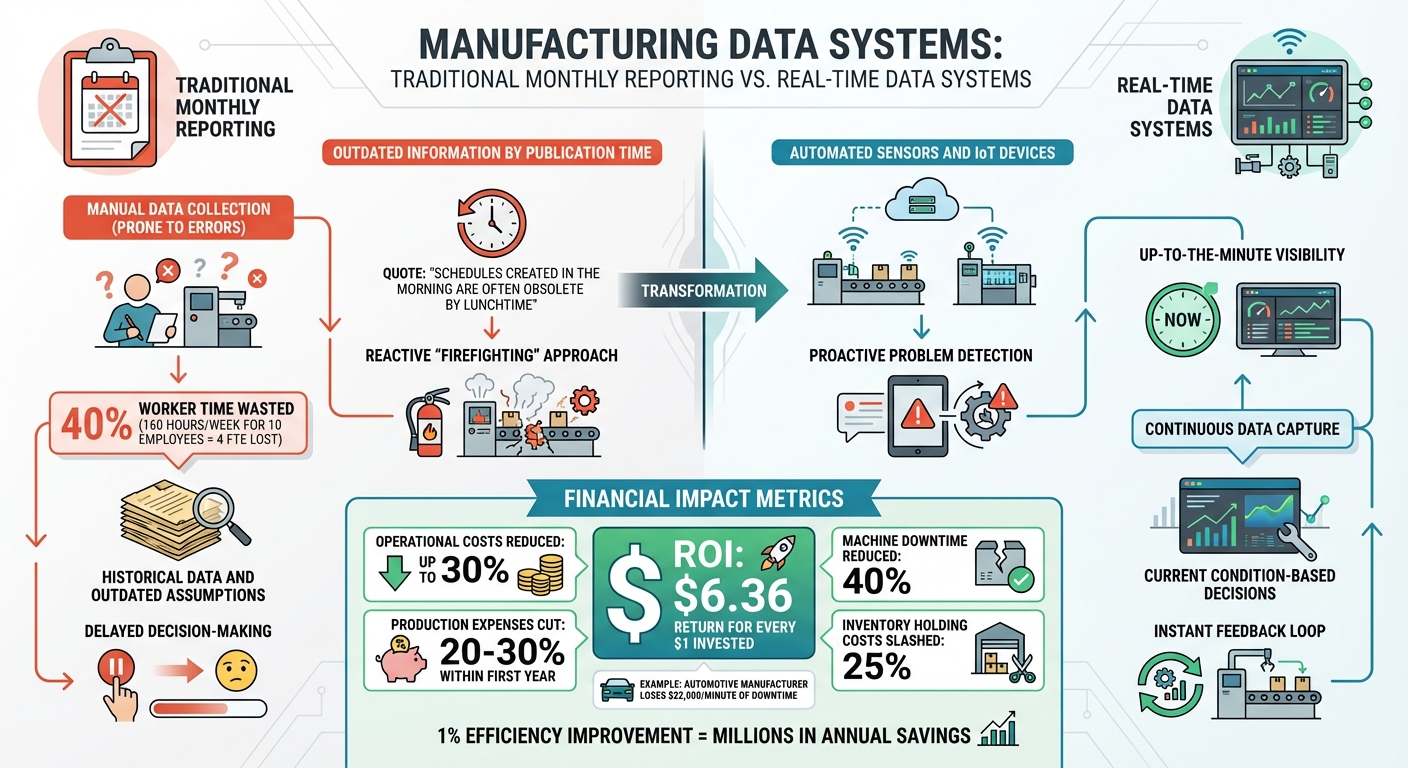
Traditional vs Real-Time Manufacturing Data: Cost Impact Comparison
The differences between traditional monthly reporting and real-time data systems highlight why the latter has become essential for manufacturing efficiency. Traditional methods rely heavily on manual data collection, which is prone to errors and often misses critical opportunities for improvement. By the time a monthly report is compiled, the information may already be outdated. As one industry analysis aptly states:
"Schedules created in the morning are often obsolete by lunchtime" [6].
Real-time systems, on the other hand, leverage automated sensors and IoT devices to continuously capture data, offering an up-to-the-minute view of equipment status, material availability, and operator workloads [6].
This continuous flow of information has a direct financial impact. Traditional reporting often forces manufacturers into a reactive "firefighting" approach, addressing problems only after they’ve caused disruptions or losses [11][14]. Manual processes also waste significant time - over 40% of workers' time is lost, equating to 160 hours per week for a team of 10 employees, or the equivalent of four full-time positions [14]. In contrast, real-time systems enable proactive measures, allowing manufacturers to catch issues like scrap, minor delays, or equipment wear before they escalate into costly problems [11][12].
The financial advantages of real-time data are striking. Smart factory models that incorporate real-time monitoring can reduce operational costs by up to 30% and cut production expenses by 20-30% within the first year [11]. For every $1 invested in supply management technology, businesses can see a return of approximately $6.36 in cost savings and avoidance [14]. Consider this: the average automotive manufacturer loses $22,000 for every minute of downtime [11]. Real-time monitoring, with its predictive maintenance capabilities and instant alerts, significantly reduces such losses. Beyond immediate savings, these systems foster long-term operational improvements.
Real-time insights also enhance decision-making in ways traditional systems cannot. While traditional methods rely on historical data and outdated assumptions [6], real-time systems empower planners to make decisions based on current conditions. This improves Overall Equipment Effectiveness (OEE) and allows for dynamic adjustments to production schedules [6]. As OpenText explains:
"Organizations that can sense and respond to volatility faster than competitors are strengthening their supply chain resilience, capturing market share, building customer loyalty, and protecting margins even as conditions shift" [14].
Digital reporting solutions further streamline operations by automating processes. They integrate directly with data sources and use templates to eliminate time-consuming manual tasks [13]. Instead of waiting weeks for cost variance reports, manufacturers can generate real-time insights to quickly adjust procurement, staffing, or pricing. This shift from reactive to proactive management not only reduces costs but also boosts efficiency, enabling businesses to scale and stay competitive. Ultimately, the move to real-time data represents a strategic transformation in how manufacturers optimize costs and operations.
Real-time data is reshaping manufacturing into a more responsive and efficient industry. By integrating data systems across operations and following the five steps outlined - establishing connected data systems, using live dashboards to identify inefficiencies, fine-tuning inventory and purchasing, adapting production and pricing in real-time, and leveraging real-time reporting for continuous improvement - manufacturers can achieve substantial cost savings and operational improvements.
For instance, real-time IoT predictive maintenance can reduce machine downtime by 40%, while supply chain monitoring can slash inventory holding costs by 25% [1]. In large-scale operations, even a modest 1% boost in manufacturing efficiency through real-time data can equate to millions of dollars in annual savings [1].
Beyond immediate cost reductions, real-time data paves the way for scalable growth. Chris Rost from L2L highlights its transformative potential:
"Manufacturing data - whether it's machine health, shift reports, maintenance orders, or employee skills - is the key to understanding and improving operations at scale" [7].
With real-time platforms, leaders can instantly compare performance across multiple sites, replicating successful processes across the enterprise. These systems replace informal, experience-based knowledge with digital standard operating procedures, helping new employees perform at a higher level from the start [7].
Shifting from traditional monthly reporting to real-time monitoring also eliminates delays in decision-making and uncovers inefficiencies that might go unnoticed with manual logs. This instant feedback loop allows manufacturers to make micro-adjustments within minutes, speeding up improvement cycles and enabling faster Plan-Do-Check-Act iterations [7].
Integrating cloud-based FP&A tools with your existing ERP is one of the quickest ways to streamline your financial processes. This approach helps break down data silos, automates as much as 80% of financial workflows, and delivers real-time insights to aid decision-making. To get started, evaluate your current systems, identify any data gaps, and link your ERP to cloud solutions. This allows for smooth monitoring and forecasting - without the need to overhaul your core system.
When it comes to monitoring your manufacturing performance, it's crucial to zero in on KPIs that reflect both operational efficiency and financial health. Some of the most important metrics to keep an eye on include:
By keeping these metrics front and center, you can make informed, real-time decisions to cut costs and streamline your operations.
To bridge shop-floor data with finance seamlessly, rely on real-time data integration and automation to maintain accuracy and consistency. By linking systems such as ERP with FP&A platforms, you can automate workflows, break down silos, and minimize manual errors. Adding real-time dashboards strengthens this connection by pulling data from sources like manufacturing systems and accounting software. This ensures you have dependable, up-to-date insights to support better decision-making.