Published on
May 9, 2026


Misaligned decisions kill SaaS partnerships. Teams often waste time on flashy partnerships that don’t deliver results because they lack clear frameworks and alignment. Here’s the bottom line:
How to succeed:
Takeaway: SaaS partnerships thrive when decisions are aligned, goals are clear, and systems are in place. Focus on fewer, high-impact partners, and track results to prove ROI.
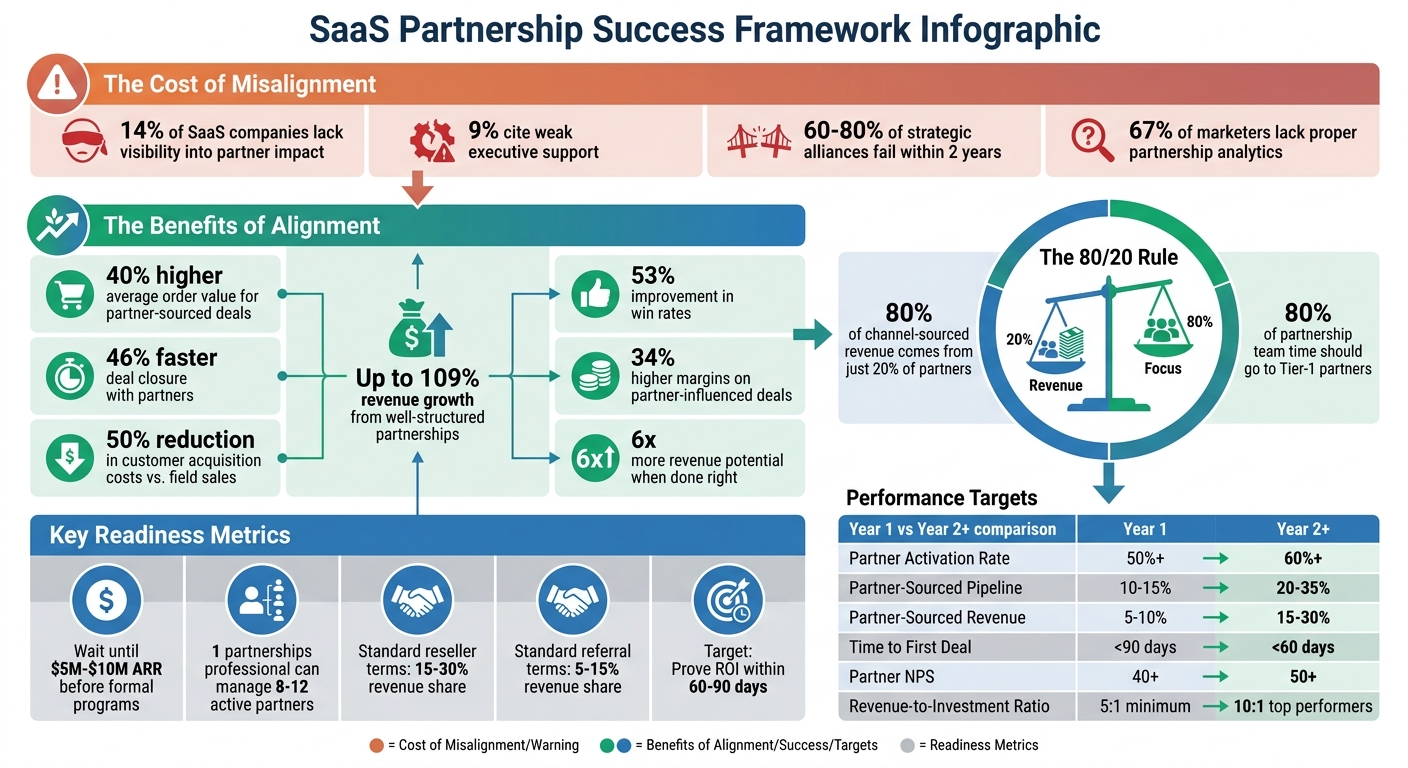
SaaS Partnership Success Framework: Key Metrics and ROI Statistics
Before diving into SaaS partnerships, it’s crucial to assess if your organization is prepared to support such collaborations. Experts often recommend that SaaS companies wait until they reach $5M–$10M in ARR before launching formal partnership programs. This ensures the focus remains on refining a repeatable direct sales process [5]. Timing also plays a big role - a partnership that could secure market leadership today might yield only minor results if delayed by a year [2].
Before expecting partners to effectively represent your product, ensure it has achieved product-market fit (PMF) and a steady sales motion. Rapid product updates, like monthly changes, can quickly make partner training materials and demos obsolete [7]. For example, in April 2026, Pipedrive demonstrated partnership maturity by managing over 700 partners across Solution Providers, Affiliates, and Technology Partners. They achieved this through well-structured training modules and external agency support, which helped their lean internal team drive growth through their ecosystem [4].
Another key step is calculating your quarterly value decay - the economic value lost for every quarter you delay entering a market. If this value is high, partnering sooner rather than building internally may be the better choice [2]. Keep an eye on competitors too. If they secure exclusive partnerships that block your access to key channels, you may need to act quickly to maintain your market position [2]. Regulatory changes, like open-banking mandates or renewable energy incentives, can also create time-sensitive windows for partnerships [2].
Additionally, evaluate your resource gaps. Review your technology, talent, intellectual property, and distribution capabilities to determine whether a partnership offers faster results than internal development. To test the waters, consider controlled pilots, such as joint hackathons or co-selling initiatives, before committing to long-term agreements [2].
Once you’ve established a solid market and product foundation, it’s time to ensure your operations are ready to support successful partnerships.
Operational systems must be ready before you begin recruiting partners. Start by defining standard economic terms - resellers typically earn a 15–30% revenue share, while referral partners receive 5–15% [5]. David Shadrake emphasizes the importance of standardization:
"Standardization also unlocks self-service partner onboarding once the program scales, which is impossible if every partner is a snowflake" [5].
From day one, configure your CRM with fields like "Partner Source" and "Partner Influenced." Without this setup, proving your program’s ROI to finance teams later becomes much harder [5]. Also, remember that a single partnerships professional can effectively manage about 8–12 active partners, so plan your staffing needs accordingly [5]. Regular communication is key - schedule weekly pipeline reviews, monthly joint reviews, and quarterly business reviews to keep things on track [5].
A great example comes from May 2026, when a Series B SaaS company in legal technology targeted legal-tech consultancies with a well-thought-out partnership plan. By establishing standard reseller terms (20% revenue share and 90-day deal protection) and hiring a senior operator, the company saw 18% of its ARR sourced from partners and achieved deal closures 22% faster [5].
Once you’ve established a solid operational foundation, the next step is to set clear success metrics for every partnership. Without well-defined goals, even the most structured collaborations can lose direction. Objectives should be measurable and trackable in real time to ensure both parties stay aligned.
Effective partnership goals should follow the SMART framework: Specific, Measurable, Achievable, Relevant, and Time-bound. Many SaaS companies often confuse two key frameworks - OKRs (Objectives and Key Results) and KPIs (Key Performance Indicators). While OKRs focus on driving growth and innovation (e.g., launching a co-branded product to increase sales by 30%)[10], KPIs monitor ongoing metrics like monthly recurring revenue or website traffic[9][10].
Tyrone Lingley, a partnerships expert, explains the distinction well:
"OKRs are your GPS - they help you understand if you're on the right path and make corrections to the course if needed. KPIs are your dashboard. They tell you if everything is alright." [9]
To avoid overcomplicating things, keep your partnership team focused on three to five objectives, with no more than five key results per objective[9][10]. Each key result should include both leading indicators (e.g., recruiting 100 new partners) and lagging indicators (e.g., reaching $250,000 in partner-sourced revenue). This combination gives a comprehensive view of progress[9]. Research shows that teams using the OKR framework consistently see a 15.5% improvement in overall performance[10].
Goals should also reflect each partner's specific commercial role. For instance, a partner working to generate new leads will need different metrics than one focused on accelerating deals or reducing churn[3]. However, avoid tying OKRs directly to compensation, as this can lead to "sandbagging" - a practice where teams set unambitious goals to ensure they hit targets, which stifles the bold thinking needed for impactful partnerships[9].
Once your goals are in place, the next step is to track how these objectives translate into financial outcomes.
To demonstrate the value of partnerships to your finance team, you need to track the right metrics from the start. Use a three-pillar framework that includes Pipeline Metrics (e.g., sourced and influenced pipeline), Revenue Metrics (e.g., sourced and influenced revenue, average deal size), and Efficiency Metrics (e.g., customer acquisition cost, sales cycle length, win rates)[11].
Data shows that partner-sourced deals outperform direct sales in several ways: they have a 40% higher average order value, close 46% faster, and improve win rates by 53%[11]. Channel sales can also reduce customer acquisition costs by up to 50% compared to field sales[11]. As Alliantra Research highlights:
"The difference between a partner program that scales and one that stalls is almost always a measurement problem. When you can't show finance what the program is worth, you can't get the investment to make it worth more." [3]
To ensure accurate ROI tracking, establish clear attribution rules and automate CRM and partner data integration. This minimizes errors and helps prove ROI within 60–90 days[11][12]. Leading indicators, such as deal introduction rates and training completion, can also predict ROI early in the process[3].
Segmenting partners by their commercial role - such as Pipeline Generators, Deal Accelerators, Expansion Drivers, or Retention Anchors - allows you to apply tailored ROI formulas to each group[3]. Regular 30/60/90-day reviews can help track onboarding progress and ensure early alignment in the partnership[12]. A mature SaaS partnership program should aim for a customer acquisition cost that’s at least 20% lower than direct channels, with partner-influenced revenue making up over 40% of the total pipeline[11].
Once you've nailed down your goals and metrics, the next step is choosing partners that align with your broader strategy. Here's a sobering fact: between 60% and 80% of strategic alliances fail to meet their objectives or fall apart within two years [6]. Why? Often, it's because of mismatched expectations, capabilities, or market alignment right from the beginning.
To avoid falling into this trap, approach partner selection like hiring a senior executive. Start by crafting a partnership thesis. This should clearly define the partner category, the value you’ll exchange, and the outcomes you’re aiming for [5]. From there, build an Ideal Partner Profile (IPP) - a detailed blueprint that prioritizes quality over quantity [6].
Zuzanna Martin from Journeybee puts it perfectly:
"Companies sometimes equate availability with suitability. They engage in 'partner-hustle,' signing agreements with anyone available instead of defining what makes a partner truly valuable." [6]
The numbers back this disciplined approach. On average, 80% of channel-sourced revenue comes from just 20% of partners [8]. Take the example of a public security software company in 2026: after auditing its 200+ partners, it found that 90% of revenue came from only 12. By cutting its partner roster by 94% and focusing on those top performers, the company boosted partner-sourced revenue by 60% in just 18 months [5]. This kind of focus lays the groundwork for creating partner profiles that align with long-term goals.
An IPP should detail the traits, capabilities, and motivations of your ideal partner, ensuring they align with your go-to-market strategy. A key starting point is ensuring overlap with your Ideal Customer Profile (ICP). Your ideal partners should already have strong relationships with the same industries, company sizes, and decision-makers you're targeting [6][8]. But overlap alone isn’t enough. It needs to be productive overlap - where partners target the same accounts for complementary reasons, not to compete for the same budget [8].
Next, assess go-to-market (GTM) compatibility. Partners should have similar sales cycle lengths, procurement processes, and deal sizes to ensure a smooth collaboration [8]. For instance, a partner with a 30-day sales cycle likely won’t mesh well with a 120-day enterprise process. Operational discipline is also critical - partners need to follow standardized processes for lead qualification, deal registration, and pipeline management [8].
To streamline the selection process, use a scorecard to evaluate potential partners. Rate them on factors like Market/ICP Fit, GTM Compatibility, Revenue Potential, and Operational Readiness, using a scale of 1 to 5 [8]. Include clear disqualifiers, such as budget constraints, financial management gaps, tech stack mismatches, or lack of executive sponsorship [6][8].
As Proxxy explains:
"A scalable partner is not the biggest logo or the loudest champion. A scalable partner is one that can produce results without heroics." [8]
Before diving into a full partnership, consider testing the waters with a 60-day pilot. For example, a Series B legal operations SaaS company in 2025-2026 identified legal-tech consultancies as its IPP. By setting standard 20% revenue share terms and appointing a senior leader, they achieved 18% of new ARR from partners within a year. Even better, partner-introduced deals closed 22% faster than direct deals [5]. Once you’ve nailed down your ideal partner profiles, the next step is designing agreements and incentives that scale.
After identifying the right partners, the structure of your agreements becomes the backbone of scalability and alignment. Avoid tailoring deals for every individual partner. Instead, rely on predefined standard terms for resell and referral motions. For example, Value-Added Resellers (VARs) offering post-sales support and customization typically earn 20-30% margins, while standard resellers focused on transactions receive 5-10% [13].
Encourage long-term collaboration by offering recurring margins rather than one-time fees. This motivates partners to focus on renewals and ongoing customer success. Consider a tiered structure to reward high performers with better commissions, co-marketing opportunities, and other perks. Allocating 80% of your partnership team’s time to Tier-1 partners can significantly amplify revenue [5].
Internal alignment is just as critical. Use "compensation neutrality" to ensure internal account executives (AEs) earn full quota credit on deals, even when revenue is shared with a partner [13]. This removes any incentive for AEs to bypass partner-led deals and fosters real co-selling collaboration. As MP Eisen, a GTM leader, points out:
"The question shouldn't be, 'How can we use a partnership program to hit our revenue target next year?' but rather, 'What's missing in our go-to-market strategy that we don't necessarily want to solve ourselves?'" [13]
Finally, agreements should include clear communication protocols, such as regular performance reviews (quarterly or biannually) and dedicated channels like Slack for real-time support. Keep in mind that one partnerships professional can effectively manage 8 to 12 active partners, so structure your program accordingly [5].
Once the right partners and agreements are in place, the next hurdle is creating systems that keep everyone on the same page as the partnership grows. Here's the reality: 67% of marketers say they lack proper analytics for their partnerships, which leads to wasted budgets and missed chances [15]. Without solid infrastructure, even the best partnerships can veer off course.
To address this, start by treating onboarding as a structured, intentional process. High-performing programs aim to certify partners within 30–60 days and help them generate their first registered opportunity within 60–90 days [17]. This involves setting clear entry requirements, timed milestones, and role-specific training. As David Shadrake, Strategic Business Development & Tech Partnerships, explains:
"Activation, not signing, drives revenue. Spend more time on activating fewer partners than on signing more."
Real-time visibility is just as important. Companies that track partner profitability see 34% higher margins on partner-influenced deals compared to those that don’t [15]. Achieving this requires a standardized data model to unify disparate fields from CRMs, Partner Relationship Management (PRM) systems, and Learning Management Systems (LMS) into consistent entities like "partner" or "opportunity" [14]. Tools such as Snowflake provide secure data sharing, while platforms like PartnerView, Tableau, and Looker offer real-time insights into metrics like revenue, deal velocity, and partner health [14][15].
However, technology alone won’t cut it. Seb Tayak, CEO of Twogether, stresses the importance of transparency:
"Expose the same rules and data to partners you use internally; transparency reduces friction and drives productivity."
This means implementing PRM workflows that automate processes like deal registration, lead routing, and acceptance criteria. Moving from manual emails to systematic processes with clear Service Level Agreements (SLAs) ensures smoother operations [17].
Once you’ve established a unified data system, focus on building an effective onboarding process. Think of it as a 90-day playbook with specific milestones.
Role-specific enablement is also critical. Different roles within a partner’s team - like sales, marketing, or technical staff - require tailored training. For instance, sales reps benefit from battle cards and demo scripts, while marketers need co-marketing kits and campaign materials [17]. This targeted approach helps partners execute effectively, not just understand the value proposition.
Technical interoperability is another key factor. For tech partnerships, early planning of APIs, webhooks, and integration infrastructure is essential. Elena Angela from StackOne highlights:
"The bar for integration quality in an agentic context isn't higher because the technology demands it. It's higher because the failures are invisible until they aren't."
With enterprises managing an average of 106 different SaaS applications [16], seamless integration is no longer optional. Poor connectivity can lead to hidden process failures that quickly erode trust.
Designate Partnership Champions from both organizations - motivated team members who can test messaging, identify objections, and advocate for the partnership internally [16]. Start with one strong joint use case that addresses a real customer pain point instead of spreading efforts too thin. This creates a scalable success story.
Don’t forget to wire attribution from the start. Add "Partner Source" and "Partner Influenced" fields to your CRM to demonstrate the program’s value to finance teams [5]. Partner-sourced deals typically come with 40–60% lower customer acquisition costs (CAC) and close 20–30% faster because buyers already trust the partner [7].
Real-time visibility goes beyond dashboards - it requires a data infrastructure that can handle the complexity of partnerships. Start with tools like Snowflake for secure data sharing and dbt for data transformations. These create reliable pipelines so both parties work from the same source of truth [14].
A standard data model is essential for consistency. For example, if your CRM refers to "Account" and your partner’s system uses "Customer", the data model translates these into a unified "partner" entity [14]. This eliminates reconciliation headaches and enables automated workflows.
To monitor relationship health, move past annual surveys. Tools like Partner Score gather frequent, short feedback at key interaction points, such as onboarding or deal closing [14]. David Ward, Founder of Partner Score, notes:
"Relationship quality predicts revenue outcomes more reliably than any single commercial metric."
Dashboards should segment metrics by commercial role rather than traditional tiers. For example, instead of treating all Tier-1 partners the same, categorize them by their function - pipeline generators, deal accelerators, expansion drivers, or retention anchors. Each type requires different metrics:
| Partner Archetype | Primary Focus | Metrics |
|---|---|---|
| Pipeline Generators | Net new opportunities | Deal introduction rate, opportunity quality [3] |
| Deal Accelerators | Speeding up active deals | Time-to-close, win rate delta [3] |
| Expansion Drivers | Upsell/Cross-sell | Net revenue retention (NRR) [3] |
| Retention Anchors | Reducing churn | Churn rate delta [3] |
Use multi-touch attribution to give credit to partners across deal stages. Platforms like Alliantra help distribute attribution fairly, ensuring strategic relationships aren’t undervalued simply because they weren’t the "last touch" [3]. As Alliantra Research points out:
"The difference between a partner program that scales and one that stalls is almost always a measurement problem."
Modern integration platforms now include pre-built connectors and automated workflows powered by AI. These systems allow AI agents to operate autonomously, managing tasks like finance collections or employee onboarding [16]. To ensure accuracy, define clear data contracts covering frequency, freshness, and lineage [14].
Security is non-negotiable. Real-time data sharing requires strict access controls, audit logs, and well-defined data-sharing agreements [14][15]. Jason Atkins from 360insights predicts:
"AI will move from advice to action - an operational co-pilot that executes with human guardrails."
Setting up strong systems for aligned decision-making is crucial, but the real challenge lies in keeping that alignment intact as markets shift and team structures evolve. Building the foundation is just the beginning - sustaining alignment requires ongoing effort, regular reviews, and the flexibility to adapt strategies as needed.
This means committing to structured review cycles that measure progress against shared goals and creating clear, actionable frameworks for making tough decisions. Sometimes, this also involves recognizing when a partnership has run its course and making the call to end it.
Quarterly Business Reviews (QBRs) are where the strength of alignment is tested. These aren't just routine check-ins; they are strategic discussions designed to evaluate performance, ensure cross-functional alignment, and determine whether a partnership continues to support expert growth strategies and broader company objectives [18].
The best QBRs go beyond surface-level metrics like direct leads. Instead, they focus on a more comprehensive view that includes:
This broader perspective is essential because partner-referred deals often close 20–30% faster than direct deals, thanks to the trust already established [7].
Preparation is critical. Share key documents or presentations with attendees ahead of time so everyone arrives informed and ready to contribute [18]. During the meeting, encourage open dialogue to uncover valuable insights. Assign someone - whether a team member or an AI tool - to take detailed notes, allowing the partnership lead to focus fully on the discussion [18].
Use the review to highlight challenges overcome during the quarter, identify trends, and adjust strategies for the future [18]. Pay close attention to metrics that reflect both current performance and long-term potential:
| Metric | Target (Year 1) | Target (Year 2+) |
|---|---|---|
| Partner Activation Rate | 50%+ | 60%+ |
| Partner-Sourced Pipeline | 10–15% of total | 20–35% of total |
| Partner-Sourced Revenue | 5–10% of total | 15–30% of total |
| Time to First Deal | Under 90 days | Under 60 days |
| Partner Satisfaction (NPS) | 40+ | 50+ |
Keep the 80/20 rule in mind: in most SaaS partner programs, 80% of revenue typically comes from the top 10–20% of partners [7]. QBRs are an opportunity to identify which partnerships deserve more resources and which may need to be reconsidered. As Alexander Chua, Co-Founder of Growigami, wisely points out:
"Five great partnerships beat fifty mediocre ones. Every time. The temptation to 'scale the partner program' by signing as many partners as possible is understandable but misguided."
After the QBR, address any unresolved questions right away and incorporate new ideas into the next quarter’s plans [18]. These reviews not only refine current strategies but also provide clarity on which partnerships have the potential to thrive in the future.
While regular reviews help maintain alignment, it’s equally important to have a clear process for ending partnerships that no longer fit. Not all partnerships are meant to last forever, and as priorities shift, some relationships may no longer align with your business goals. QBRs can help determine when it’s time to part ways. If a partnership hasn’t delivered results after six months, it may meet the exit criteria outlined in the initial agreement [7]. This isn’t a failure - it’s simply a reflection of changing business needs.
A well-structured agreement should include a clear exit process to protect both parties. Define how to handle active deals, customer relationships, and shared data. Specify notice periods and transition responsibilities to ensure a smooth exit that preserves reputations.
When initiating an exit discussion, be straightforward but respectful. Clearly explain the strategic reasons behind the decision and refer to the agreed-upon criteria. Offer to fulfill any outstanding commitments and provide sufficient time for the transition. The aim is to part ways professionally, leaving the door open for future collaboration if circumstances change.
Document the exit plan in detail, including timelines, responsibilities, and communication protocols. This ensures nothing is overlooked and helps both sides navigate the transition effectively.
As Alexander Chua, Co-Founder of Growigami, aptly notes:
"Partnerships done right are one of the most powerful growth levers in B2B SaaS. Partnerships done wrong are one of the most expensive time sinks. The difference is structure, selection, and incentive design."
Knowing when to walk away is just as important as knowing when to invest. A professional exit not only safeguards your reputation but also frees up resources to focus on partnerships that are better aligned with your evolving goals.
Successful SaaS partnerships don’t happen by chance - they require a clear structure, measurable goals, and consistent effort. Before signing any agreements, ensure your systems can handle shared tracking, unified messaging, and co-branded materials. Devon Wood from Webstacks sums it up perfectly:
"The truth is, most SaaS teams treat partnerships like side projects instead of growth channels. Without a clear strategy and the infrastructure to support it, even the best-fit partners won't drive results."
When building partnerships, prioritize ICP (Ideal Customer Profile) alignment over flashy brand names. The strongest collaborations stem from shared audiences and products that solve related problems - not just from partnering with well-known companies. Start small with 2–3 pilot partners to fine-tune your approach. Track both hard numbers, like partner-attributed revenue, and softer indicators, like mentions of your partner during sales conversations.
To keep partnerships thriving, ongoing alignment is key. Regular Quarterly Business Reviews (QBRs) ensure both sides stay accountable and focused on mutual goals. The best programs aim for a revenue-to-investment ratio of at least 5:1, with top performers reaching 10:1 [19]. These reviews also help you decide which partnerships deserve more investment and which might need to be phased out.
Speaking of phasing out, not every partnership lasts forever. Having a clear exit strategy saves resources and keeps things professional. How you handle transitions can impact your reputation and open doors for future collaborations.
When done right, partnerships can generate up to six times more revenue than going solo [19]. The difference between success and failure lies in having a solid foundation, choosing the right partners, and designing effective incentives. These takeaways highlight the importance of disciplined processes and strategic management in making SaaS partnerships a true growth driver.
Your SaaS is primed for partnerships when you've pinpointed your growth stage, outlined clear collaboration objectives, and built the necessary infrastructure to make them work. Some key signs include achieving product-market fit, operating with a scalable business model, and aligning your processes with partnership strategies. It's also crucial that your team treats partnerships as a core growth channel rather than an afterthought and has the bandwidth to manage them successfully.
To measure partner ROI effectively in your CRM, start by setting up a clear attribution framework. This framework should assign credit to partners based on their contributions to moving deals forward. Focus on tracking key performance indicators (KPIs) such as partner-driven revenue and overall ROI. Incorporate attribution models to differentiate between sourced revenue (deals initiated by partners) and influenced revenue (deals supported by partners). This approach allows you to capture both direct and indirect impacts, ensuring your ROI tracking aligns with the actual deal-closing process.
Ending a partnership isn’t a decision to take lightly, but certain factors can make it clear when it’s time to move on. If key performance indicators (KPIs) like revenue, deal pipeline growth, or operational efficiency consistently fall short, it may suggest the partnership isn’t delivering as expected. Similarly, repeated misalignment in goals, processes, or overall compatibility can indicate deeper issues. When attempts to fix these problems don’t lead to improvement and the partnership starts to block growth or interfere with core objectives, it might be the right moment to part ways.