Published on
April 28, 2026


Pricing is the most powerful lever for SaaS revenue growth. Even a 1% pricing improvement can boost operating profit by 11%–12.7%. But many companies fail to optimize pricing, leading to missed revenue targets and reduced profitability. Here's what you need to know:
Key metrics like Monthly Recurring Revenue (MRR), Customer Lifetime Value (LTV), and churn rate are directly impacted by pricing. For example, hybrid models report median growth rates of 21%, while effective price increases typically lead to minimal churn (2–7%).
Takeaway: Pricing isn't just about setting a number - it shapes customer behavior, retention, and long-term growth. SaaS companies that prioritize pricing strategy grow faster and achieve better financial outcomes.
Optimizing these strategies often requires the high-level financial oversight found in fractional CFO services to ensure long-term profitability.
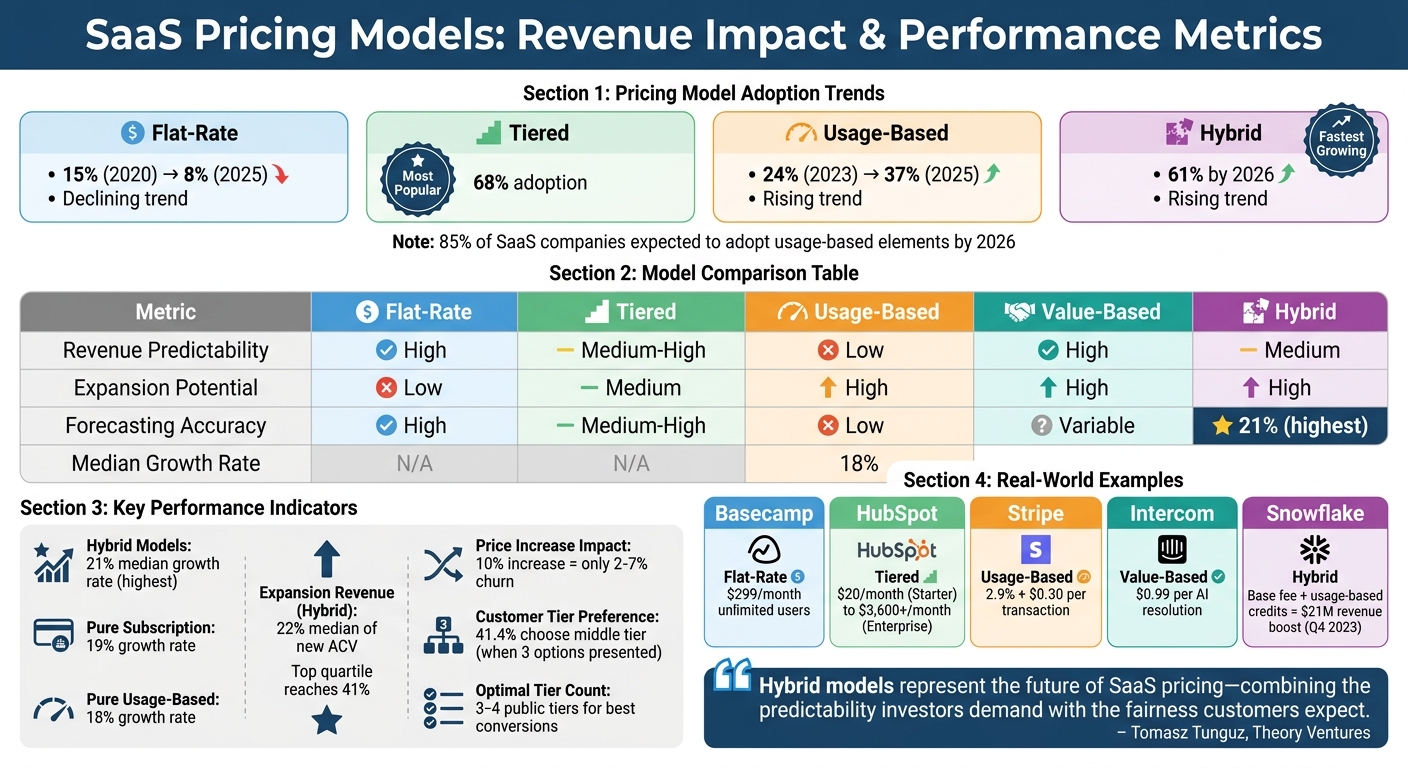
SaaS Pricing Models Comparison: Revenue Impact and Key Metrics
Your pricing model doesn’t just determine how much customers pay - it shapes your revenue flow, impacts metrics like Monthly Recurring Revenue (MRR), and influences your business’s growth potential. Let’s break down the most common SaaS pricing models and see how they affect revenue projections.
Flat-rate pricing keeps things simple: one fixed fee for unlimited access, no matter how much the customer uses or how large their team is. For example, Basecamp charges $299 per month for unlimited users [4][5]. This model makes revenue predictable and forecasting straightforward since every customer pays the same amount each month. Many companies consult a fractional CFO to model these projections accurately. However, it has a major downside - it doesn’t capture expansion revenue. Whether a customer’s team doubles or their usage skyrockets, they’ll still pay $299. This limitation might explain why only 8% of SaaS companies were using flat-rate pricing in 2025, compared to 15% in 2020 [5].
Tiered pricing offers customers multiple packages, each with its own features and price. HubSpot, for instance, has tiers ranging from $20/month for its Starter plan to over $3,600/month for its Enterprise package [2]. This approach allows businesses to cater to different customer segments and create clear upgrade paths, maximizing revenue potential. It’s no surprise that 68% of SaaS companies use tiered pricing [7]. Interestingly, when presented with three options, 41.4% of customers tend to pick the middle tier [3]. Still, there’s a catch: offering too many tiers can overwhelm customers, leading to decision paralysis. Research shows that sticking to three or four public tiers is optimal for conversions [9][10].
This model charges customers based on how much they use - think transactions, API calls, or compute hours. Stripe, for example, charges 2.9% plus $0.30 per transaction [5][2]. Usage-based pricing naturally aligns revenue with customer success: as customers grow and use more, revenue scales with them. Adoption of this model jumped from 24% in 2023 to 37% in 2025 [5]. However, it comes with revenue volatility, requiring businesses to maintain strong communication and monitoring practices [4][5][8][6]. Despite this, usage-based pricing works particularly well for products like APIs, infrastructure services, and AI tools, where customer value is tied directly to consumption.
Value-based pricing sets prices based on the customer’s perceived value or the ROI they gain. Companies using this model often see strong net revenue retention [5][2]. For example, Intercom shifted to charging $0.99 per AI resolution instead of per agent seat [2], while Salesforce Agentforce charges $2 per conversation [2]. The challenge? It demands deep market research to understand what customers are willing to pay. Without this, 55% of SaaS companies risk pricing based on guesswork rather than data - a costly mistake [5][2][7].
Hybrid pricing combines a stable base subscription with usage-based elements, offering both predictability and scalability. Snowflake, for instance, charges a base fee for storage while adding usage-based fees for compute credits [5][2]. In Q4 2023, this model helped Snowflake forecast a $21 million revenue boost by allowing customers to scale storage and compute independently [3]. Hybrid models are gaining traction, with 61% of SaaS companies using them by 2026 [11]. They also boast the highest median growth rate at 21%, compared to 19% for pure subscription models and 18% for pure usage-based models [7][3].
"Hybrid models represent the future of SaaS pricing - combining the predictability investors demand with the fairness customers expect."
– Tomasz Tunguz, Theory Ventures [3]
Here’s a quick comparison of these models to highlight their strengths and weaknesses:
| Model | Revenue Predictability | Expansion Potential | Forecasting Accuracy |
|---|---|---|---|
| Flat-Rate | High | Low | High |
| Tiered | Medium-High | Medium | Medium-High |
| Usage-Based | Low | High | Low |
| Value-Based | High | High | Variable |
| Hybrid | Medium | High | Medium |
Hybrid pricing stands out for its ability to cater to diverse customer needs. It’s especially effective for mature SaaS companies that want to balance consistent revenue with the flexibility to grow alongside their customers’ usage.
Pricing decisions are at the core of tracking growth and predicting future revenue in SaaS businesses. A poorly designed pricing strategy can create misleading metrics, while a thoughtful approach can reveal untapped growth opportunities.
MRR and ARR are the lifeblood of SaaS businesses, and your pricing model directly impacts their stability. Flat-rate pricing offers simplicity and predictability - every customer pays the same, making revenue forecasting straightforward. However, it may miss out on additional revenue as customers grow [5]. On the other hand, per-user pricing grows naturally as customers add more users, although some businesses may try to reduce costs by sharing accounts [4].
Usage-based pricing introduces flexibility and can drive monthly revenue growth of 5–10%. However, it often results in fluctuating MRR, as revenue depends on customer consumption [4]. Tiered pricing provides a balance, offering stable revenue with opportunities for growth as customers move to higher tiers for added features or capacity. Meanwhile, hybrid models - combining a fixed subscription with usage-based fees - are gaining traction. By 2026, 85% of SaaS companies are expected to adopt usage-based elements as part of their pricing [10].
Businesses using hybrid models report median growth rates of about 21%, with expansion revenue accounting for a median of 22% of new Annual Contract Value (ACV), and the top-performing quartile reaching 41% [10]. Interestingly, a 10% price increase typically results in only 2–7% additional churn, often leading to a net positive impact on MRR [13].
ARPU is a key indicator of how effective your pricing strategy is. The median per-user price is roughly $45 per month, with entry-level plans starting at around $29 [10]. Tiered pricing helps segment ARPU, encouraging customers to choose plans that match their needs. For large enterprise accounts with over 1,000 seats, the median ACV can reach $890,000 [10].
In usage-based models, ARPU grows with customer consumption, often resulting in Net Revenue Retention (NRR) rates of 110–130%, compared to 105–115% for per-user pricing [4]. A related metric, price realization - the percentage of the list price collected after discounts - averages 84%. Falling below this can indicate revenue leakage. For instance, at $15 million ARR, the difference between 104% and 115% NRR could mean an extra $1.65 million in revenue [10].
LTV and churn rate are deeply connected and provide insight into long-term sustainability. LTV is often calculated as:
LTV = ARPA × Gross Margin × Average Customer Lifespan [14][15]
Pricing that aligns with customer value can lower churn, while pricing that penalizes growth may increase it [14]. For example, effective communication during price adjustments can reduce churn by up to 40%. Additionally, giving customers an extra month’s notice before a price increase can lower churn by about 15% [13]. Offering annual billing discounts also reduces churn by roughly 30% compared to monthly subscriptions [15].
Slack’s 2018 strategy of adding premium features while grandfathering existing customers boosted its net retention rate to 143% [13]. Similarly, HubSpot transitioned from a flat pricing model to a tiered structure, improving its CAC/LTV ratio from 1:1.5 in its early days to over 1:5 in its best-performing segments [15].
"We discovered that certain customer segments had acquisition costs nearly twice as high as others but stayed with us three times longer. This insight fundamentally changed our pricing strategy." – Mike Volpe, Former CMO, HubSpot [15]
By integrating expansion mechanisms such as tiered, usage-based, or hybrid models, SaaS businesses can increase LTV without significantly raising acquisition costs. Expansion revenue typically costs $0.15–$0.25 per dollar earned, compared to $1.00 for acquiring new customers [10].
As pricing optimizations improve revenue and retention metrics, acquisition efficiency becomes even more critical. The LTV:CAC ratio is a key indicator of business health, with a target of around 3:1. Ratios below this suggest acquisition costs may outweigh revenue potential [15]. Over the last five years, the average CAC for B2B SaaS companies has risen by nearly 60% [15].
Pricing models also affect how quickly acquisition costs are recovered. Annual billing options can improve cash flow and speed up CAC payback [15]. Multi-tiered pricing strategies use entry-level plans as cost-effective acquisition tools, while higher-priced tiers maximize LTV. For example, Dropbox designed its pricing tiers to encourage upgrades at specific usage thresholds, achieving an LTV:CAC ratio of approximately 3.5:1 [15].
| Pricing Model | Net Revenue Retention (NRR) | CAC Payback | Gross Margin |
|---|---|---|---|
| Per-User | 105–115% | 10–16 months | 75–85% |
| Usage-Based | 110–130% | 8–14 months | 60–75% |
| Tiered | 108–120% | 12–18 months | 70–80% |
"The best SaaS companies develop a deep understanding of their unit economics by customer segment and use that data to inform not just their pricing but their entire go-to-market strategy." – Tomasz Tunguz, Venture Capitalist, Redpoint Ventures [15]
Companies that refine their pricing strategies tend to grow 30% faster than their peers. Even a 1% improvement in pricing can lead to an 11.1% boost in profitability [15]. Pricing isn’t just about setting a number - it’s about ensuring every dollar spent on acquisition delivers steady, reliable returns.
Once you grasp how pricing models impact your key metrics, the next step is to turn those insights into reliable revenue forecasts. This process goes beyond just plugging numbers into a spreadsheet - it requires incorporating customer behavior, market trends, and the mechanics of your pricing model.
Before diving into pricing changes, it’s crucial to establish key baseline metrics like Monthly Recurring Revenue (MRR), Annual Recurring Revenue (ARR), customer counts by tier, and Average Revenue Per User (ARPU). These metrics provide a clear picture of where your revenue is coming from and help pinpoint areas with the most potential for growth.
Churn rates should be broken down by tier and customer tenure instead of using an average across your customer base. For instance, customers who have been with you for over two years tend to be 50% less sensitive to price changes compared to newer customers [1]. Additionally, tracking Net Revenue Retention (NRR) reveals how much revenue movement comes from account expansion versus contraction, offering deeper insights into your growth dynamics.
Establishing these metrics upfront lays the groundwork for accurate forecasting and smarter pricing decisions.
Once you’ve nailed down your current metrics, the next step is to analyze how price changes will affect demand. Price elasticity measures this relationship, and for B2B SaaS companies, it typically ranges from -1.5 to -2.5. This means a 10% price hike could lead to a 15–25% drop in demand [1]. Keep in mind, though, that elasticity varies by segment, pricing tier, and how well you communicate the added value of your product.
To calculate elasticity for any pricing adjustment, you can use the Midpoint Formula [18]. It’s also critical to differentiate between new customer sensitivity and that of existing customers - new leads are often more price-sensitive, while loyal customers are less likely to churn if they’ve integrated your product into their workflows [18].
A real-world example: In 2018, Slack restructured its pricing by introducing premium features and new tiers while grandfathering existing customers at their current rates. According to their S-1 filing, this strategy resulted in a net retention rate of 143% [13]. Grandfathering can help stabilize projections, as it typically limits churn increases to around 2–3%, compared to the 7–9% churn spikes seen with uniform price hikes [1].
For better accuracy, create at least three forecast scenarios - Conservative, Expected, and Optimistic - to account for different customer responses. Companies that use multi-scenario modeling improve their revenue forecast accuracy by 35% after pricing changes [1]. Testing new pricing strategies in specific segments or regions can also provide valuable insights without jeopardizing your entire revenue base.
Your pricing strategy doesn’t just affect current customers - it also influences how you attract and expand your customer base. To account for this, integrate data like conversion rates, lead metrics, and sales cycle lengths into your forecasts. While a price increase might boost ARPU, it could also lower conversion rates, which might offset revenue gains.
Expansion revenue is where pricing strategies can really shine. For SaaS companies, the median expansion revenue is 22% of new Annual Contract Value (ACV), with top performers reaching up to 41% [10]. Hybrid pricing models - combining subscription fees with usage-based components - offer a stable revenue foundation while capturing growth potential. Companies using hybrid models report forecasts that are 38% more accurate compared to those relying solely on usage-based pricing [17].
Using simulation models, you can predict revenue trajectories based on customer behavior. For example, one Enterprise SaaS platform transitioned from user-based pricing to a consumption-based model. Their simulations predicted a 7% short-term revenue dip followed by 23% growth over 18 months. Actual results were within 3% of the forecast, leading to an additional $14 million in ARR over two years [16].
Another way to stabilize revenue is by converting at least 50% of your customer base to annual contracts, which can reduce revenue churn by 27% [17]. Offering discounts for longer commitments encourages this shift and improves cash flow predictability. Additionally, identifying triggers like storage limits or user thresholds can create natural opportunities for customers to self-upgrade, further boosting revenue.
Refining your pricing strategy isn't something you do once and forget about. It’s an ongoing process that relies on data and consistent monitoring. Without a well-thought-out pricing strategy, SaaS companies risk falling short of their revenue goals [1]. Here’s a guide to building a pricing optimization process that works.
To position your product effectively, you need to understand how your pricing compares to competitors. This involves analyzing tier structures, feature-price relationships, and how competitors communicate their value propositions. Keep track of these factors monthly, but don’t just copy their prices. Instead, use this as a reference to understand how prospects might evaluate your offering [20][19].
How often you analyze competitors matters. Companies that review pricing quarterly achieve 23% higher net revenue retention compared to those that do so annually [20]. A good rhythm includes weekly monitoring of competitor promotions, monthly reviews of usage and revenue trends, and quarterly deep dives into pricing.
Don’t focus solely on dollar amounts - pay attention to how competitors frame their value. Value-based pricing tends to generate 15–35% more revenue than cost-plus models [19]. By studying how competitors tie features to customer outcomes, you can identify areas where your own value messaging might be falling short. This can also reveal opportunities to adjust or improve your offering.
Once you have competitive insights, the next step is to integrate pricing into your financial models. This means looking beyond basic updates like ARPU adjustments and considering how pricing changes affect your entire revenue system.
Start by documenting key metrics such as MRR/ARR by tier, customer counts, ARPU, churn rates by segment, and conversion rates [1][12]. Companies that establish clear baseline metrics before implementing pricing changes are 3.2 times more likely to hit their revenue targets [1]. These metrics act as your benchmark for evaluating the impact of adjustments.
Your financial model should account for different customer segments and their reactions to pricing changes. For instance, long-term customers often show lower price sensitivity [1], so your model should reflect varying elasticity across cohorts. Don’t forget to include operational costs, like billing updates, increased support needs during transitions, and changes to sales commissions, as these can affect your bottom line [1].
To improve accuracy, develop multiple forecast scenarios - Conservative, Expected, and Optimistic - and create month-by-month projections. This approach can increase forecast accuracy by 35% compared to relying on a single scenario [1]. For example, if you’re planning to raise the price of a product from $49 to $69 per month, your Conservative forecast might assume churn increases from 3.0% to 4.5%, while the Optimistic forecast assumes a smaller rise to 3.2%. The Expected scenario, which usually carries the most weight, might land around 3.5%.
If you plan to grandfather existing customers under old pricing, make sure your model reflects when those customers will renew at the new rates. This creates a gradual ARPU increase rather than a sudden spike.
When evaluating different pricing models, use comparison tables to weigh trade-offs across various factors. Don’t just look at projected revenue - consider revenue predictability, growth potential, complexity, and how well each model aligns with customer behavior.
Here’s a framework for comparing pricing models:
| Pricing Model | Revenue Predictability | Expansion Potential | Complexity | Best Fit |
|---|---|---|---|---|
| Flat-rate | High | Low | Low | Simple, single-persona products |
| Per-seat | High | Medium | Low | Collaboration and CRM tools |
| Tiered | High | High | Medium | Multi-persona B2B products |
| Usage-based | Low–Medium | Very High | High | APIs, infrastructure, AI |
| Hybrid | Medium–High | Very High | High | Companies balancing predictability with growth |
There’s no one-size-fits-all solution. The best pricing model depends on your product, market, and growth stage. For instance, while usage-based pricing can drive significant growth, its unpredictability might complicate financial planning or investor discussions.
When comparing models, also factor in how pricing changes affect financial ratios. For example, a 20% ARPU increase might look great, but if it pushes your CAC payback period from 12 months to 18 months, you may need extra working capital to sustain growth.
A 1% improvement in pricing can lead to an 11% boost in operating profit [1]. That’s a level of leverage far greater than similar improvements in sales volume or cost reduction. This is why pricing optimization is one of the most impactful activities for SaaS companies - especially when it’s built on detailed analysis and strong baseline metrics.
For additional support, consider working with experts like Phoenix Strategy Group. Their financial modeling and strategic advisory services can help align your pricing strategy with long-term revenue goals.
Pricing is one of the most powerful levers for any SaaS business. The right approach not only influences how customers perceive value but also helps define target segments and fuels organic growth. With the rise of AI, traditional per-user models are evolving into usage- and outcome-based structures, making pricing strategies even more pivotal.
To keep revenue projections accurate, pricing needs to be a dynamic process - adjusted continually based on customer behavior and shifting market conditions. These adjustments ensure your business stays aligned with evolving trends and remains competitive.
For SaaS companies in their growth phase, having a well-thought-out pricing strategy is essential for scaling revenues effectively. If you're grappling with the challenges of pricing optimization and financial planning, Phoenix Strategy Group offers the expertise you need. Their fractional CFO services and FP&A capabilities help businesses refine pricing strategies, build strong financial models, and align pricing with long-term revenue goals. With experience in unit economics, cash flow forecasting, and strategic decision-making, they provide the tools and insights necessary to turn pricing into a driver of sustainable growth.
Success in SaaS goes beyond setting prices - it’s about creating pricing systems that reflect customer value, adapt to market changes, and grow alongside your business. Give pricing the strategic focus it deserves, and you’ll tap into one of the most impactful drivers of revenue growth.
If you're aiming for more stable and reliable revenue forecasts, the right pricing strategy can make all the difference. Pricing models that align closely with customer value and offer flexibility tend to create steadier revenue streams.
Flexible approaches, such as tiered pricing or hybrid models, adapt to varying customer needs, making revenue more predictable. Another effective option is value-based pricing, which links your pricing directly to the results customers achieve. This ensures your revenue reflects the value you're delivering.
It's also important to revisit your pricing regularly - whether that's quarterly or annually. Market conditions change, and adjusting your pricing accordingly helps keep it effective and aligned with your goals.
To plan a price increase without negatively affecting Monthly Recurring Revenue (MRR) or churn rates, consider using pricing simulations or forecasting models. These tools help you anticipate how customers might react and estimate the potential impact on revenue and retention.
Equally important is transparent communication. Clearly explain the reasons behind the price change and highlight the value your product or service delivers. This approach helps maintain customer trust and loyalty.
By blending data-driven predictions with thoughtful messaging, you can adjust pricing in a way that supports your revenue goals while keeping churn under control.
To determine price elasticity for different customer segments, collect data on key aspects of customer behavior. Focus on factors like switching costs, product relevance, market share, and whether the customer or someone else covers the cost of the service. These insights will help you understand how demand shifts in response to price changes across various segments.