Published on
April 18, 2026


Nonprofit financial sustainability isn’t just about covering costs - it’s about building a stable foundation to achieve your mission long-term. Yet, many organizations face challenges:
To overcome these hurdles, focus on four core areas:
Key strategies include:
Track critical metrics like liquidity, fundraising efficiency, and program expense ratios to ensure financial health. Use tools like cloud-based accounting software for automation and data-driven decisions. Start small, plan for growth, and build reserves to weather unexpected challenges.
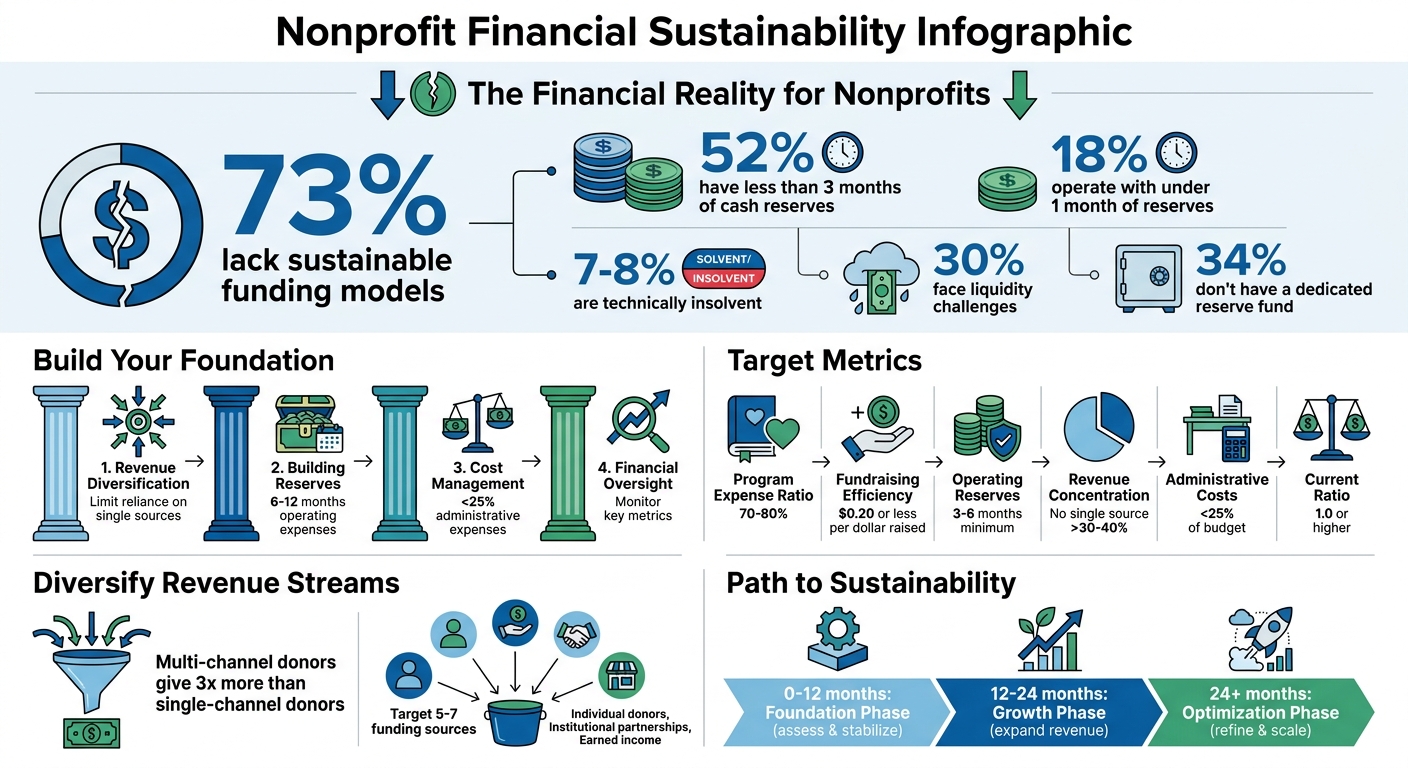
Nonprofit Financial Sustainability: Key Statistics and Best Practices
While it might seem logical to chase funding from every possible source, research suggests otherwise. In fact, focusing on one or two primary revenue streams can create a stronger, more reliable financial foundation [2]. Nonprofits that excel often master their chosen revenue streams instead of spreading their efforts too thin.
Start by digging into your five-year revenue trends. Identify which areas are growing or shrinking as a percentage of your total income. Break down the data into specific categories instead of relying on broad labels like "events." For example, how much of your event revenue comes from corporate sponsors versus individual donors? This detailed analysis helps pinpoint where to focus your efforts [2]. The goal isn't to diversify endlessly but to find what The Bridgespan Group calls a "natural match" - a synergy between funder motivations and your mission [2]. With this clarity, you can focus on three core strategies: engaging individual donors, forming institutional partnerships, and generating earned income.
Building a strong base of individual donors requires a different approach than securing government contracts or foundation grants. For example, high-net-worth donors often rely on personal relationships with executive directors or board members, while smaller-scale donors respond to broad outreach through social media, email campaigns, and recurring giving programs [2]. Interestingly, donors who engage through multiple channels - like events, online giving, and volunteering - contribute three times more revenue than single-channel donors [6].
To succeed, focus on donors whose motivations align with your mission. Engage with them directly to uncover what drives their support. Do they care about your track record, the population you serve, or a personal connection? This insight ensures that your future fundraising appeals hit the right notes [2].
Institutional partnerships offer another layer of financial stability. However, each type of institutional funder comes with its own set of requirements. For example:
Before approaching corporate partners, research their ESG priorities and identify key decision-makers [6]. Start the conversation by discussing shared values rather than jumping straight to funding requests. Invite potential partners to visit your organization - virtually or in person - to see your impact firsthand before making a formal pitch.
Earned income offers a way to generate unrestricted funding without the usual reporting requirements [6]. As long as the revenue aligns closely with your mission, it qualifies as tax-exempt nonprofit income. A great example comes from Partners in School Innovation. Under CEO Derek Mitchell, the organization created a market for their educational equity services, with school districts paying for these offerings. By focusing on the quality of their product, they reached a point where earned income made up about 30% of their total revenue [2].
"If our product is strong, then districts should be willing to pay for it." - Derek Mitchell, CEO, Partners in School Innovation [2]
If you're new to earned income, start small. Consider offering paid workshops or renting out unused office space [6]. These options give supporters more ways to engage - some people prefer paying for a service or product rather than making a traditional donation. Keep in mind, though, that earned income often requires proving a return on investment to institutional payers, such as insurance companies or government agencies, through data and research partnerships [2]. By focusing on these strategies, you can build a more sustainable financial future.
Managing costs effectively is critical for maintaining financial health and achieving your goals. While diversifying revenue streams is essential, keeping program expenses under control is just as important. Lauren Shadford, Executive Director of Voices in Contemporary Art, highlights this balance:
"Being truly confident in the full costs allowed us to articulate that to funders, and strategically decline program partnerships that would drain our resources instead of uplifting our programs" [7].
This section focuses on strategies to streamline expenses and improve financial efficiency.
Understanding the complete costs of your programs is crucial. These include everything from salaries and supplies to debt payments, reserves, and "change capital" - resources needed for growth and adaptation [7]. Start by distinguishing direct costs (specific to a program, like staff salaries or materials) from indirect costs (shared expenses like rent or administrative support) [8]. Nonprofits, on average, allocate about 75% of their budgets to program services [8].
A reliable way to calculate program costs involves five steps:
For example, you might allocate salaries based on staff time, rent based on square footage, or IT expenses based on headcount [8]. Using program codes in your accounting system ensures that expenses are tied directly to their respective programs. This level of precision helps avoid committing to partnerships or grants that may appear beneficial but ultimately cost more than they contribute.
Strong financial policies help prevent errors and protect resources. These board-approved documents outline how your organization handles budgeting, debt, reserves, and spending [12]. Unlike procedures, which explain "how", policies focus on the "what." The National Council of Nonprofits emphasizes the importance of a conflict of interest policy, calling it:
"The conflict of interest policy is perhaps the most important policy a nonprofit board can adopt" [12].
Review these policies annually using board surveys to ensure ongoing compliance.
Internal controls act as safeguards against fraud and financial misuse. This is especially important since nonprofits account for 10% of reported fraud cases, with a typical loss of $76,000 per case [10]. Simple measures can make a big difference: have one person log incoming checks and another deposit them, require receipts for reimbursements over $5, and assign a second person to review bank statements [11]. Surprise audits of cash flow and vendor payments can further deter fraud [11]. To move beyond breakeven budgeting, add a 3-5% contingency line and regularly contribute to a 3-6 month operating reserve [9][10]. These practices not only protect resources but also strengthen your overall financial strategy.
Technology can significantly reduce administrative burdens and errors. Cloud-based accounting tools like QuickBooks, Sage Intacct, and Xero automate tasks such as transaction recording, expense tracking, and financial reporting. Grant management platforms like Instrumentl streamline application tracking, deadlines, and spending reports. Karen Lee, an Account Executive at Instrumentl, explains:
"Effectively and efficiently managing your nonprofit's finances is a necessity. It's a core piece of guiding important decisions regarding the future operations and growth of your organization's mission" [13].
Financial planning tools like Cube (starting at $2,000/month with a 10% nonprofit discount) simplify data consolidation and provide real-time spending insights. Donation platforms like Givebutter, Classy, and GoFundMe Charity offer customizable pages and automatically generate tax-compliant receipts, saving time during busy giving periods. By integrating donor management, grant tracking, and accounting systems, you can automate data flow and create dashboards for clear financial insights. These tools not only enhance efficiency but also support the broader financial strategies discussed earlier.
In addition to managing costs effectively, creating solid financial reserves is crucial for safeguarding your nonprofit against unexpected challenges. Reserves act as a safety net when revenue dips or urgent expenses arise. Unfortunately, many nonprofits operate with limited cash reserves, and about 34% don’t have a dedicated reserve fund at all [17]. Without these reserves, organizations may face tough choices, like cutting programs or missing payroll, especially during economic downturns.
Kate Barr, President & CEO of Propel Nonprofits, highlights the importance of tailoring reserve strategies to each organization:
"Every nonprofit needs to have adequate cash balances available to support the timing of payroll and other expenses, as well as to pay for unanticipated costs or increases. Reserve needs vary by organization; no single standard fits all nonprofits." [14]
Your reserve goals should align with your nonprofit’s specific needs, such as cash flow patterns, payroll schedules, and the risks tied to your funding sources. For instance, nonprofits that rely on seasonal fundraising might need larger reserves compared to those with steady, year-round revenue streams [16].
Financial reserves come in different forms, each serving a unique purpose:
Clear, board-approved policies should guide the management of each reserve type. These policies should define target amounts, criteria for accessing funds, approval processes, repayment plans, and any restrictions on how the reserves can be used [14][17].
Once your reserve strategy is in place, consistent monitoring is key. A helpful metric is the operating reserve ratio, which is calculated by dividing unrestricted net assets by annual operating expenses. This ratio shows how many months of coverage your reserves provide [15]. Including this data in monthly board reports, along with cash flow projections, strengthens financial oversight [4].
For nonprofits that depend heavily on government funding, the stakes are even higher - 84% expect funding cuts, and 65% predict reductions exceeding 10% of their government revenue [4]. To mitigate these risks, aim to diversify your revenue streams so no single source accounts for more than 30–40% of your total funding [4].
When reserves are used, document withdrawals carefully and stick to your repayment plan. Some nonprofits go a step further by including a management discussion section in annual reports to explain how planned deficits were covered by reserves. This transparency helps maintain donor trust while ensuring financial flexibility [15].
Once you've established reserves, keeping an eye on key financial metrics becomes essential for maintaining stability and ensuring operational efficiency. As we've highlighted before, a strong financial foundation requires not just diverse revenue streams and healthy reserves but also consistent monitoring of critical indicators.
Think of these metrics as your organization's financial dashboard - they provide insights into what's working, highlight potential risks, and show where your attention is needed. By focusing on a core set of metrics, you'll gain a clearer picture of both short-term liquidity and long-term operational effectiveness.
Here’s a sobering fact: about 7–8% of U.S. nonprofits are technically insolvent, meaning their liabilities outweigh their assets. Additionally, nearly 50% have less than one month of operating reserves [5]. On top of that, 30% face liquidity challenges, with minimal cash reserves to cover short-term liabilities [5]. These numbers highlight the struggles many organizations face in managing payroll, handling emergencies, or bridging funding gaps.
Liquidity metrics help answer a crucial question: How long can your organization sustain itself without new revenue? One straightforward measure is months of cash, which you calculate by dividing your cash on hand by your average monthly expenses. Ideally, aim for three to six months of unrestricted cash. For higher-risk organizations, a target of six to twelve months might be more prudent [1][5]. Operating with less than three months of cash puts your organization in a precarious position [20].
Another essential metric is the current ratio, which compares current assets to current liabilities. A ratio of 1.0 or higher indicates that your nonprofit can meet its short-term obligations [18]. Similarly, the liabilities-to-assets ratio is worth monitoring - keeping it below 50% can help avoid debt-related challenges that could disrupt your mission [5]. As the Nonprofit Finance Fund aptly states:
"Nonprofit is a tax status, not a way of operating: Positive operating results (unrestricted revenue consistently exceeding expenses) are an indicator of strong financial management, and are necessary for organizational health and financial resilience" [20].
Beyond liquidity, it’s critical to evaluate how efficiently your organization uses its resources. The program expense ratio is a key measure here, showing the percentage of total expenses dedicated to mission-related activities. Donors and rating agencies generally expect this figure to fall between 70–80% [18]. In fact, seven out of ten nonprofits listed on Charity Navigator allocate at least 75% of their expenses directly to programs [19].
Another vital metric is the fundraising efficiency ratio, which measures how much it costs to raise a dollar. A good benchmark is $0.20 or less per dollar raised [18], though some best practices suggest aiming for even lower costs [19]. Curtis Ruder, Chief Financial Officer at Meals on Wheels San Antonio, noted the value of having access to actionable metrics:
"Straight out of the box, the Sage Intacct Nonprofit Digital Board Book has provided nonprofit executives with access to metrics that are actionable. By using industry best practice metrics, they've given immediate credibility to our communications with the board and external funders" [5].
Monitor these metrics on a monthly basis and review trends over three to five years to identify patterns [19]. For nonprofits heavily reliant on government funding - where 84% anticipate cuts and 65% expect reductions of over 10% in government revenue [4] - it’s crucial to diversify income sources. No single funding source should account for more than 30–40% of your total revenue [4].
Building financial sustainability takes time and a structured, step-by-step approach. Brian Abernathy, VP of Operations at Convergent Nonprofit Solutions, sums it up well:
"The first steps to sustainability are the same: assessing your strategy, researching solutions, and restructuring as necessary" [3].
A good multi-year plan tackles financial weaknesses systematically, starting with immediate stabilization and progressing toward long-term growth. The journey begins with securing your current finances and gradually laying the groundwork for future success.
The first year is all about understanding your financial position and putting basic controls in place. Start with a thorough financial audit to assess liquidity, spot budgeting issues, and confirm compliance with legal standards.
Dive into revenue trends from the past five years. Break down your income sources in detail: How much of your event revenue comes from individuals versus corporations? Are you relying heavily on a few large donors, or do you have a broad base of smaller contributions? This level of detail helps you see which revenue streams are thriving, which are declining, and where you might be overly dependent on one source.
Additionally, document key processes to safeguard institutional knowledge. Once you have a clear picture of your financial baseline, you can begin implementing targeted strategies for growth.
With a strong foundation in place, the focus shifts to growing your revenue. Instead of spreading efforts thin across numerous opportunities, concentrate on one or two revenue streams where you have a clear advantage.
Take a page from Community Servings' playbook. They identified a strategic fit within the health care sector and developed fee-for-service partnerships, turning it into their second-largest revenue source. In this phase, consider upgrading your technology systems to replace outdated tools, like spreadsheets, and work on building unrestricted revenue streams. These unrestricted funds give you the flexibility to adapt and innovate when challenges arise.
After two years of steady progress, the Optimization Phase is about refining and sustaining growth strategies. At this stage, you can consolidate major, annual, and planned giving into unified campaigns. This approach not only reduces donor fatigue but also creates more predictable cash flow through multi-year pledges.
Seek out major donors who are ready to transition from income-based contributions to asset-based planned giving, which can support endowment goals. This transition turns one-time donors into long-term partners in your mission. Additionally, invest in scalable technology, leadership development, and board training. Andy Garcia from ASU's Master of Nonprofit Leadership and Management emphasizes:
"Financial literacy shouldn't be isolated to just the CFO or finance team - it should be embraced across leadership and the board of directors" [21].
Keep in mind that your financial model should evolve as your organization grows. Strategies that work during a recovery phase might need adjustments as you move into expansion. Regularly review your plan, track progress, and adapt your approach to meet changing circumstances.
For nonprofits aiming to maintain financial stability, leveraging data analytics is a game-changer. By turning raw data into actionable insights, organizations can identify trends, anticipate cash flow issues, and allocate resources more effectively. This approach shifts financial management from being reactive to proactive - starting with the adoption of the right FP&A tools and fostering a results-driven culture.
Modern financial planning and analysis (FP&A) tools simplify complex workflows by integrating data from various sources. Platforms like Cube connect systems such as ERP, CRM (like Salesforce), and donor management tools into a single, unified dashboard. This setup offers a clear view of revenue and expenses across multiple levels [22]. Lauren O'Connor and Alex Leavitt, both Directors of FP&A, praise Cube's functionality:
"I'm really happy with the overall flexibility of the system, and the ability to have transactional and operational data all in one place! As [Cube] is based in Excel, it is easy to look at things in different ways to quickly analyze data or change the drivers of your forecast." [22][23]
Because Cube operates on an Excel foundation, it allows for quick adjustments to forecasts and flexible data analysis while reducing human error. This combination of accuracy and adaptability supports long-term financial planning and ensures greater stability [22].
Effective financial planning requires a deeper understanding of your revenue engine - not just tracking total funds raised. Metrics like donor acquisition costs, lifetime donor value, and the balance of recurring revenue sources (e.g., the Rule of 40) provide sharper strategic insights [1].
Breaking down revenue by source - such as grants, individual donations, sponsorships, or program fees - can reveal potential vulnerabilities. For example, if government grants make up more than 40% of your revenue, your organization could face risks tied to policy changes. In fact, 84% of nonprofits relying on government funding anticipate cuts following the 2024 election [4]. By linking financial models to operational metrics like headcount, participant volume, cost per beneficiary, and fundraising ROI, organizations can better monitor their financial health and respond to shifts before they escalate [22].
Beyond analyzing revenue, tracking key metrics weekly ensures that emerging issues are addressed promptly. Regular financial reviews are especially critical when cash flow is tight. Weekly tracking helps identify and resolve potential problems before they grow into crises. Curtis Ruder, who utilizes fractional CFO services to enhance financial oversight, highlights the value of improved reporting systems:, highlights the value of improved reporting systems:
"Non-profit leaders have struggled for years to provide funders more meaningful metrics than just administrative percentage. Straight out of the box, the Sage Intacct Nonprofit Digital Board Book has provided nonprofit executives with access to metrics that are actionable." [5]
Dashboards can help track vital indicators such as liquidity ratios, the balance between restricted and unrestricted funds, and the rate at which grants are being spent [22][24]. With 52% of nonprofits holding only three months or less in reserves - and 18% with just one month - having access to real-time insights is essential for staying afloat [3]. Automated alerts can signal when metrics fall outside acceptable ranges, like if program expense ratios drop below 65% or fundraising efficiency falls under the $3:1 benchmark [1][24]. These early warnings allow nonprofits to adjust their spending, refocus fundraising efforts, or delay initiatives before financial challenges become unmanageable.
Achieving financial sustainability is not a one-time task - it’s a continuous process built on four key pillars: diversified revenue streams, disciplined cost management, sufficient reserves, and data-driven decision-making. Together, these elements provide nonprofits with the stability and flexibility needed to fulfill their missions effectively.
To diversify revenue, aim for 5–7 funding sources, ensuring no single stream accounts for more than 40–50% of total income. Pair this with a focused approach to cost management - prioritizing the optimization of "cost per outcome" over indiscriminate budget cuts. Additionally, maintaining 6–12 months of operating reserves provides the financial cushion necessary to take calculated risks and adapt to challenges. As Together Forward Capital aptly puts it:
"True financial sustainability creates a virtuous cycle: stable finances enable consistent program delivery, which builds trust with stakeholders, attracts additional resources, and reinforces the organization's capacity to fulfill its mission." [1]
Data analytics plays a critical role in turning these strategies into actionable plans. Tools like real-time dashboards, weekly metrics tracking, and 12-month rolling cash flow projections allow leaders to spot potential funding gaps early and make informed investment decisions. This proactive approach ensures that resources are allocated where they’ll have the greatest impact.
For many nonprofits, seeking expert financial leadership is a logical next step. Fractional CFO services provide access to high-level financial expertise, helping organizations move beyond survival mode to a position of growth and impact. Firms like Phoenix Strategy Group specialize in delivering these services, along with FP&A systems and data engineering, to help nonprofits strengthen their financial foundations and scale their operations effectively.
As your organization evolves, so will its financial strategies. The multi-year planning framework outlined in this guide offers a clear roadmap for adapting to changing circumstances. By investing in these capabilities today, nonprofits can build the resilience and flexibility required for long-term success.
To build reserves quickly when cash flow is tight, consider broadening your revenue streams by incorporating steady, recurring income sources, such as a recurring giving program. This approach not only stabilizes cash flow but also deepens connections with donors. Alongside this, create a 12-month cash flow projection. This helps you map out funding cycles, predict potential shortfalls, and allocate resources wisely. By combining diversified revenue with forward-thinking cash flow planning, you can maintain financial stability and navigate uncertain times with greater confidence.
When choosing ways to generate earned income for your nonprofit, it’s important to stick with ideas that align with your mission, strengths, and available resources. Think about activities like selling products, charging service fees, or offering memberships - options that not only bring in revenue but also support your organization’s purpose.
At the same time, steer clear of ventures that could pose tax challenges or harm your reputation. To figure out if an idea is realistic, ask yourself: Does your nonprofit have the capacity to take it on? Will it make a meaningful impact? Can you adapt existing programs or assets to create income?
By focusing on mission-aligned opportunities, you can build a revenue stream that supports both sustainability and long-term growth.
Nonprofits need to keep a close eye on revenue diversity, reviewing it monthly to spot any over-reliance on specific income streams and to identify potential risks. Other key financial health indicators, such as liquidity ratios and long-term reserves, are generally assessed either monthly or quarterly, depending on how complex the organization is. By consistently reviewing operational metrics on a monthly basis and strategic ones quarterly, nonprofits can stay financially stable and adjust to changes as needed.