Published on
April 21, 2026


Wealth management APIs are transforming retirement planning by automating data integration, forecasting, and analytics. These tools simplify pulling data from various accounts (401(k)s, IRAs, real estate, etc.), automate complex calculations, and provide real-time insights. Features like Monte Carlo simulations and stress tests help advisors predict financial outcomes and create tailored plans.
Key players include:
Each API offers unique strengths, from advanced analytics to seamless integration, catering to different advisory needs. Choose based on your focus - data aggregation, forecasting, or retirement-specific tools.
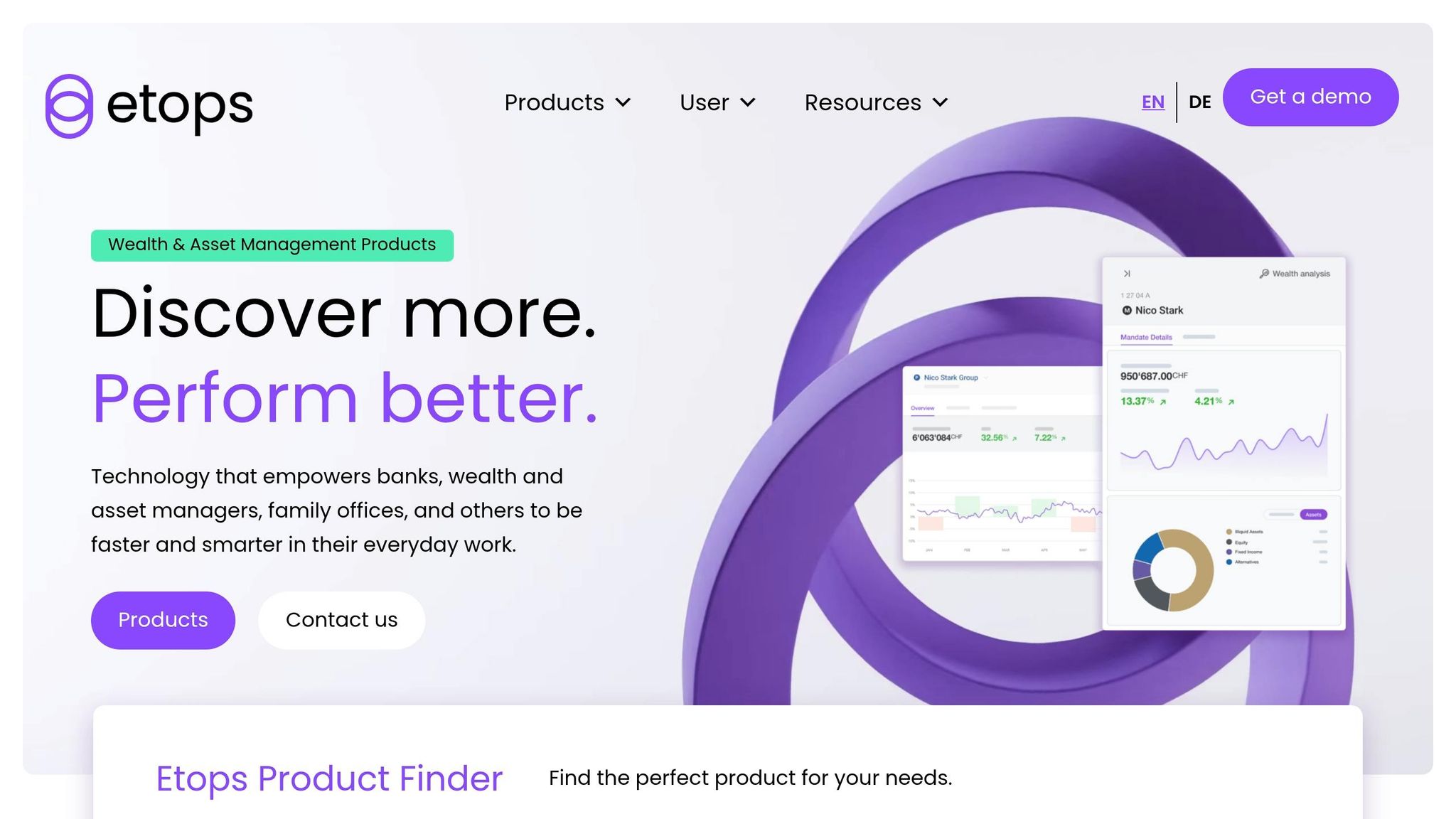
Etops offers a streamlined approach to retirement planning through its unified RESTful interface, which consolidates data from various custodians and asset types. With over $500 billion in Assets under Management (AUM) and more than 2,000 clients, the platform is supported by a team of 275+ professionals[5]. This scale highlights its capability to manage complex financial structures efficiently.
The platform's REST interface, built on JSON, simplifies development and integrates smoothly into existing IT systems. Developers can explore detailed documentation at developer.etops.com to build custom workflows efficiently[4][6]. Its modular design allows firms to create tailored solutions on Etops' data backbone, making it especially useful for advisory firms with unique client needs[5][7].
Alexander Sinn, Co-Founder & CEO of 47 Capital AG, shared:
"By working in partnership with Etops, we can offer our families an easy to read and customized wealth report that offers them an enormous advantage."[4][5]
Etops provides real-time portfolio, position, and transaction data across all custodians and asset types[4][6]. Automated processing ensures instant access to portfolio insights, enabling faster decision-making. Sacha Fedier, CEO of VT Wealth Management, described the benefits:
"With a few clicks, staff access critical information instantly, focusing more on investor-centric decisions."[4][5]
Users can customize data groupings for consolidated analytics, gaining a complete view of all mandates and positions in real time[6]. This continuous data flow supports advanced forecasting capabilities.
Etops employs DIN 77230 standards for thorough household budget and risk analysis[8]. Using machine learning and generative AI, the platform delivers precise insights for risk assessment and portfolio optimization[5][7]. For retirement planning, it includes integrated subsidy calculators to optimize pension contributions and identify coverage gaps for occupational disability, death, and long-term care[8].
The etops FinanzPortal, backed by over two decades of experience from FinanzPortal24, offers visualized retirement plans, statutory pension details, and coverage gap analysis[8].
Built on a cloud-native, SaaS-based architecture, Etops ensures horizontal scalability to meet growing demands[6][7]. Fitore Miftari, Marketing Director at Etops, highlighted this feature:
"Horizontal scalability removes technological bottlenecks during growth."[6]
The platform's connectivity to hundreds of global counterparties via a single FIX network simplifies operations for firms managing diverse portfolios[9]. This scalable design also supports retirement-specific tools and services.
Etops enhances retirement planning with tools like its etops FinanzPortal, which provides pension gap analysis, tier classification, and subsidy calculators for optimized contributions[8]. The "Finance-Self-Check" API allows clients to securely input data via mobile, streamlining prequalification and helping advisors prepare for consultations more effectively[8]. These tools deliver personalized insights and improve engagement by offering a comprehensive view of retirement readiness.
For those interested, a non-binding free trial is available. It doesn’t automatically convert to a paid subscription, and users can choose between monthly or annual payments via SEPA direct debit[8].
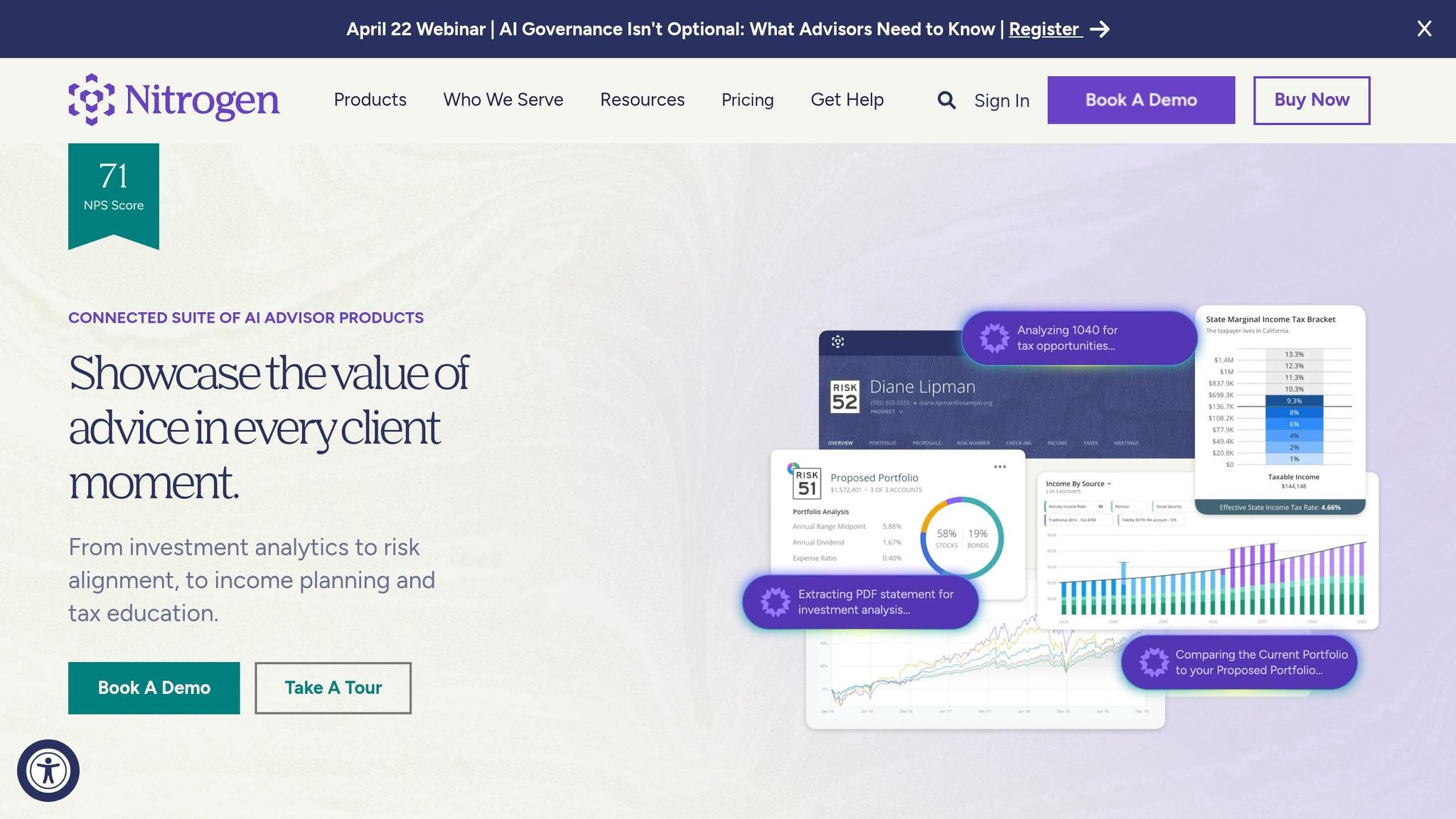
Nitrogen is making strides in simplifying retirement planning with a suite of AI-driven tools. These tools focus on investment analytics, risk alignment, income planning, and tax education, all contributing to automated retirement forecasting[11]. With a Net Promoter Score of 71 and the ability to generate over 1,000 client proposals daily, representing around $1.1 billion in assets, Nitrogen showcases its ability to handle high-volume workflows for a wide range of advisory firms[11].
Nitrogen fits seamlessly into existing tech stacks, enabling advisors to integrate features like the "Risk Number" and "95% Historical Range" into their wealth management systems[11]. This integration ensures that advisors can streamline their processes without disruption.
The Outside Asset Sync feature pulls in data from thousands of financial institutions automatically, eliminating the need for manual updates and offering a comprehensive view of client portfolios[10]. Additionally, advisors can use a Lead Generation Questionnaire - easily added to email signatures or websites - to attract leads through interactive risk analysis[10]. These tools work together to enhance efficiency and simplify retirement planning workflows.
Nitrogen's Timeline feature is a powerful tool for advisors, allowing them to see how adjustments to income, expenses, or Risk Number affect a client’s overall risk capacity in real time[10]. Advisors can add events like Social Security benefits, college expenses, or even the purchase of a vacation home to visualize how these changes impact retirement success probabilities[12]. This real-time modeling helps advisors craft precise and adaptable retirement strategies.
To provide accurate insights, Nitrogen includes Stress Tests that simulate historical market events, such as the 2008 Financial Crisis or the 2013 Bull Market. Advisors can also use tailored Scenarios to benchmark portfolios against specific market conditions, helping to forecast potential outcomes[10].
Nitrogen’s Retirement Plan Matching feature is designed for large-scale operations. With just a few clicks, advisors can match thousands of participants in 401(k), 457, 403(b), or Simple IRA plans to suitable investment strategies[10].
"The Risk Number creates a common language, allowing you to bridge the gap between advisor and participants without flooding your to-do list."[10]
The platform supports firms with over 1,000 advisors and connects to thousands of financial institutions via the Outside Asset Sync feature[10][11]. This scalability ensures that as advisory firms grow, they can continue to manage increasingly complex portfolios without compromising performance.
Nitrogen offers tools tailored specifically for retirement planning. For instance, Retirement Maps calculate the likelihood of clients achieving their goals by analyzing both risk tolerance and risk capacity. These maps also help uncover assets like old 401(k)s that clients may have forgotten about[10]. The Partner Store provides access to free and subscription-based models that can be downloaded directly into the platform, keeping advisors informed about the latest industry strategies[10].
Focus Advice Financial Engines leverages a proprietary advice engine to deliver tailored recommendations in seconds. This approach is rooted in a philosophy co-developed by Nobel Prize winner Dr. William F. Sharpe, emphasizing a balance between returns, tax efficiency, and risk management for retirement planning scenarios[15][13].
The platform's API-first design seamlessly integrates with legacy systems and CRMs, offering direct access to advanced retirement forecasting tools[15]. With three decades of FCA-compliant experience, Focus Advice has honed its ability to integrate across various technology environments[15]. This robust integration ensures reliable forecasting and enables customized retirement planning.
Focus Advice avoids generic assumptions by modeling individual risk-return profiles. It incorporates critical variables like Social Security timing, estimated healthcare costs (which averaged $315,000 for a 65-year-old couple in 2022), and adaptive withdrawal strategies (e.g., increasing withdrawals from 4% to 5% at age 75). These inputs allow the platform to recalculate portfolio longevity in real time[13].
"We're uniquely focused on modeling both the risk and return potential of each piece of your financial plan -- we know this takes more than a presumptive, one-size-fits-all approach." - Edelman Financial Engines[13]
The platform also features Financial Health Scores, which evaluate participant progress across investments, savings, and retirement income, providing clients with a clear and actionable metric[14]. Additionally, advisors can use the Focus Cashflow tool to illustrate how specific financial decisions impact a client's long-term outlook, making complex retirement planning more tangible[15]. These precise forecasts enable advisors to craft truly personalized strategies.
Focus Advice significantly reduces the time required for advice preparation - by as much as 68% - allowing firms to serve three times as many clients without increasing staff[15]. The platform also delivers a 100% success rate for first-time compliance and governance cases, minimizing administrative tasks and supporting scalable growth. This ensures that as client portfolios expand, advisors can continue to provide accurate and individualized retirement forecasts.
Apex AscendOS provides four integration options: the Developer Portal, the GenAI assistant called "Ask Ascend", the Agentic Development Kit (ADK), or a hybrid approach. These options are designed to meet diverse technical requirements and timelines for firms [17][18].
The platform's AI-driven tools simplify and speed up the integration process. For example, in early 2025, Stirlingshire, a startup wealth management firm, achieved time-to-production in just one month using the AscendOS Agentic Development Kit. According to CEO Steven Woods, this rapid deployment saved the company approximately $10 million in outsourced development costs [17]. Similarly, ília Digital reported a 40% faster integration using Apex's SDK and resources [17].
"Platform integrations have historically been a long and distracting endeavor for wealthtech engineering and operational teams. That's why our engineers have built a modern developer experience: To help our clients fast track their AscendOS integration." - Lucille Mayer, Chief Solutions Officer, Apex Fintech Solutions [18]
The "Ask Ascend" GenAI assistant is available 24/7 across multiple continents, enabling non-technical users to validate features and create functional prototypes with natural language prompts before developers even begin coding [17]. For retirement-specific workflows, AscendOS offers pre-built solutions like 401(k) rollover automation and supports over 30 different account types, including retirement and trust accounts [17][19]. This approach ensures a faster, smoother integration process while laying the groundwork for real-time data delivery.
Powered by Google Cloud, AscendOS delivers 24/7 real-time updates on account activity, positions, and cash balances [16]. The Apex Ledger acts as a centralized source for retirement forecasting, offering up-to-the-minute insights into portfolio health. By March 2025, Facet, a wealth management firm, implemented this infrastructure and reported a 50% boost in operational efficiency [19].
Additional features include real-time webhooks and streaming event alerts, which notify clients instantly about key retirement account events, such as rebalancing needs or milestone achievements [16]. These capabilities enhance decision-making and ensure consistency in retirement planning.
In a partnership with Wavvest announced in March 2026, Apex integrated AI-powered planning tools that use real-time custodial data to generate financial plans, eliminating the need for manual data entry by advisors [3]. These tools handle complex tasks like 401(k) rollover proposals, equity compensation planning (RSUs/ISOs), and tax-alpha benefits modeling [17].
The Apex Rebalancer offers intraday automated portfolio adjustments to maintain alignment with target risk models during market fluctuations. Additionally, Apex Alts enables side-by-side analysis of traditional and alternative assets within retirement portfolios [16]. All these features are supported by a scalable, cloud-native infrastructure.
The cloud-native design ensures optimal performance, even during periods of high market activity [20]. As of June 2025, Apex maintains net capital exceeding 10 times the required minimum, ensuring financial stability to support scaling operations [20]. The modular structure of AscendOS allows firms to adopt the full platform or integrate specific modules, such as rebalancing, direct indexing, or the Model Marketplace. This flexibility supports advisors as their client base expands [19]. Some clients have even reduced integration timelines by up to 50%, completing onboarding in six months instead of the typical 12–24 months [19].
Plaid simplifies retirement planning by merging essential data streams into actionable insights, making it a go-to solution for advisors and developers alike.
Plaid's developer-friendly API streamlines processes by covering identity verification, account funding, and detailed investment data retrieval - all under one roof. This eliminates the hassle of juggling multiple integrations and connects to over 12,000 financial institutions through a standardized data schema [21][22].
The Plaid Link interface offers a familiar onboarding experience, already trusted by one in four Americans. This familiarity not only reduces integration headaches but also boosts user conversion rates. For instance, Zeta managed to complete full integration in under a single working day [26][27][28]. Speed is critical here - 66% of investment app users have abandoned sign-up processes that were too complex [21].
"Plaid makes onboarding seamless and allows customers to start moving money on the platform right away." - Dan Mendes, Senior Director of Product, Stash [21]
This smooth onboarding process sets the stage for efficient real-time data updates.
While Plaid typically updates investment data overnight, the /investments/refresh endpoint allows for instant updates. This ensures advisors have the latest information during active planning sessions [25]. Developers can also use webhooks like HOLDINGS: DEFAULT_UPDATE and INVESTMENTS_TRANSACTIONS: DEFAULT_UPDATE to receive automated alerts when client data changes, eliminating the need for manual API polling [24][25]. This keeps retirement portfolios updated without adding unnecessary server strain.
Plaid delivers up to 24 months of enhanced transaction history, enabling advisors to analyze spending patterns and cash flow for more tailored retirement advice [21]. The /investments/holdings/get endpoint provides granular details like cost basis, quantity, institution price, and total value - crucial for accurate forecasting [23][24].
These tools ensure that advisors work with the most current and detailed data for crafting retirement strategies.
Plaid supports nearly 20 types of investment and retirement accounts, including 401(k), IRA, Roth IRA, SEP IRA, and various pension plans [23][24]. For those with stock-based compensation, the API retrieves the total quantity and value of vested assets, offering critical insights for equity-based retirement planning [24]. It also provides standardized identifiers like CUSIP and ISIN, making it easier to link holdings to market research and performance data [24].
"Plaid enables our users to easily link their held-away investment accounts to our platform, and the /investments/holdings/get endpoint returns a detailed view of positions to support our in-depth analysis across a broad set of investment account types." - Andrew Moreland, Founder and CTO, Haven [23]
By combining data from the Investments and Liabilities APIs, advisors can calculate precise debt-to-income ratios for retirement planning [21]. The cost basis field further supports personalized tax-loss harvesting strategies within retirement modules [23]. These advanced insights help advisors create tailored plans for their clients.
Plaid's infrastructure handles over 1 million new connections daily, proving its ability to support large-scale growth and frequent data requests [26][27]. This is particularly valuable for advisors managing growing client bases, as 87% of investment app users prefer apps that offer instant access and easy sign-ups [21]. The unified integration reduces the technical burden of managing diverse client needs across thousands of financial institutions [21].
Pontera zeroes in on a specific but crucial area of wealth management: held-away retirement accounts. These include 401(k)s, 403(b)s, and other employer-sponsored plans that often fall outside an advisor's direct management. Considering that nearly 50% of the median American's net worth is tied up in retirement plans [29], Pontera addresses a significant gap in wealth management by offering a specialized solution.
Pontera works seamlessly with over 26 wealthtech partners, including major portfolio management systems like Orion and Black Diamond [31]. This integration ensures advisors can manage held-away accounts alongside other assets using their existing tools. The platform syncs with reporting systems and captures orders in a supervision view, removing the hassle of duplicate data entry [30].
Security is a top priority for Pontera. Its client-permissioned connections prevent transfers, withdrawals, and beneficiary changes by default, ensuring advisors can manage assets without breaching regulatory custody rules or storing sensitive client credentials [29][30]. In June 2025, Pontera strengthened its offering by teaming up with BridgeFT, enabling enterprise wealth management firms and TAMPs to access retirement account management through a single API interface [32].
"Our partnership with BridgeFT will provide financial advisors with the portfolio management tools they need to help their clients achieve their long-term financial goals." - David Goldman, Chief Business Officer, Pontera [32]
This integration-focused approach ensures advisors can effortlessly incorporate Pontera into their workflows.
Pontera supports a broad array of defined contribution plans, such as 401(k), 401(a), 403(b), 457, TSP, and some 529 accounts [29]. Advisors can make adjustments directly within employer-sponsored plans, preserving institutional pricing and unique plan benefits. This capability allows for more effective asset allocation across taxable and tax-deferred accounts [31].
The platform also provides compliance-ready documentation. It generates uneditable, time-stamped records of rebalancing actions, meeting DOL PTE 2020-02 standards while adhering to SOC 2 Type II and ISO/IEC 27001:2022 certifications [31]. This level of compliance is essential, particularly since 73% of retirement plan participants express a desire for personalized advice on their 401(k) accounts [30].
"The ability to use the Pontera system to manage a 401(k) is game changing. It bridges the gap that currently exists between your client, their financial plan, and their 401(k) account." - Jason Kolinsky, COO, Kolinsky Wealth Management [29]
Pontera's integration and retirement-focused features have led to impressive results, with firms seeing up to 90% client adoption of eligible held-away accounts [30]. Managed accounts using Pontera also deliver an edge, with annual returns averaging 3% to 4% higher than unmanaged accounts [29]. By automating visibility and rebalancing for held-away assets, Pontera allows wealth management firms to expand their reach and provide comprehensive advice to a larger client base - all without adding operational complexity [29].

Wealth Management APIs Comparison: Features and Capabilities for Retirement Planning
Each API brings its own strengths and challenges to retirement planning, offering unique tools and features tailored to different needs.
eMoney Advisor stands out with its ready-to-use UI components, making visualization quicker and easier. For those seeking advanced tools like Monte Carlo simulations or tax bracket analysis, these are available in the Premium tier [1].
FinMason (FinRiver) shines in high-speed analytics, processing data in milliseconds for over 9 million global securities. It provides access to more than 1,500 analytic data points and handles billions of calculations daily. However, its focus on analytics means users will need other tools for CRM and client management [2].
Plaid Wealth APIs excel in account unification, connecting to over 12,000 financial institutions and supporting more than 20 account types, including HSAs, 529 plans, and cryptocurrencies. With over 7,000 financial apps and 40,000 developers using the platform, Plaid is a leader in this space. But it only provides raw data, lacking built-in forecasting or simulation tools. Developers must integrate additional software for projections [22][23][33].
Etops APIs cater to complex portfolios, including non-bankable assets and private market investments. They offer real-time performance and risk analytics. As Alexander Sinn, Co-Founder & CEO of 47 Capital AG, remarked:
"By working in partnership with Etops, we can offer our families an easy to read and customized wealth report that offers them an enormous advantage."
However, Etops lacks fully self-service documentation, requiring users to engage with their sales team for support [4][6].
Below is a summary table comparing the key advantages and limitations of each platform:
| API Platform | Key Advantages | Key Disadvantages | Monte Carlo | Tax Analysis | Account Unification |
|---|---|---|---|---|---|
| eMoney Advisor | Comprehensive retirement planning; ready-to-use UI components | Advanced features require Premium tier | Yes* | Yes | Yes |
| FinMason | Millisecond response times; covers 9M+ securities | Focuses on analytics; requires separate CRM | Yes | No | No |
| Plaid Wealth | Connects to 12,000+ institutions; supports 20+ account types | Provides raw data only; lacks native forecasting | No | No | Yes |
| Etops | Handles non-bankable assets; offers real-time analytics | Limited self-service documentation | No | No | Yes |
*Premium tier only
After analyzing the platforms, it’s clear that selecting the right wealth management API for retirement planning depends on your unique priorities - whether that’s robust data aggregation, real-time analytics, or advanced forecasting tools.
Etops shines with its real-time portfolio analytics across custodians and asset types, including non-bankable and private market investments. Its adherence to DIN 77230 standards and integrated subsidy calculators make it a strong choice for household budget and risk analysis. As Alexander Sinn, Co-Founder & CEO of 47 Capital AG, stated:
"By working in partnership with Etops, we can offer our families an easy to read and customized wealth report that offers them an enormous advantage." [4][5]
Plaid Wealth APIs are a standout for data aggregation, connecting to over 12,000 financial institutions across the U.S., Canada, the U.K., and Europe. With support for over 20 account types, including HSAs, 529 plans, and retirement accounts, it offers an unmatched breadth of coverage [22][23].
For advanced forecasting and risk analysis, Nitrogen and Focus Advice Financial Engines set themselves apart. Nitrogen uses AI-driven stress tests and scenario modeling [10], while Focus Advice leverages proprietary algorithms co-developed by Nobel Prize winner Dr. William F. Sharpe [13][15].
Apex AscendOS prioritizes speed, enabling rapid deployment. For example, Stirlingshire achieved production in just one month, saving roughly $10 million in development costs [17]. On the other hand, Pontera specializes in managing held-away retirement accounts, allowing advisors to oversee 401(k)s and 403(b)s directly while adhering to DOL PTE 2020-02 compliance standards [31].
APIs can integrate with various retirement accounts, such as Traditional IRAs, Roth IRAs, qualified retirement plans, HSAs, and annuities. However, their compatibility depends on the particular API in use.
APIs play a key role in delivering accurate retirement projections by facilitating real-time data exchange. They offer immediate access to updated information like portfolio holdings, market prices, and transaction details. This constant flow of current data sharpens the accuracy of forecasts, allowing for more informed and confident decision-making. By integrating these capabilities, APIs simplify the retirement planning process while boosting both reliability and client trust.
Before diving into a retirement planning API, it's crucial to ensure it meets key security standards like PCI DSS and PSD2. Check if the API has automated vulnerability testing in place and confirm that it aligns with regulatory requirements. These steps are essential for protecting sensitive customer data and maintaining trust, which are both critical for long-term reliability.