Published on
June 25, 2026

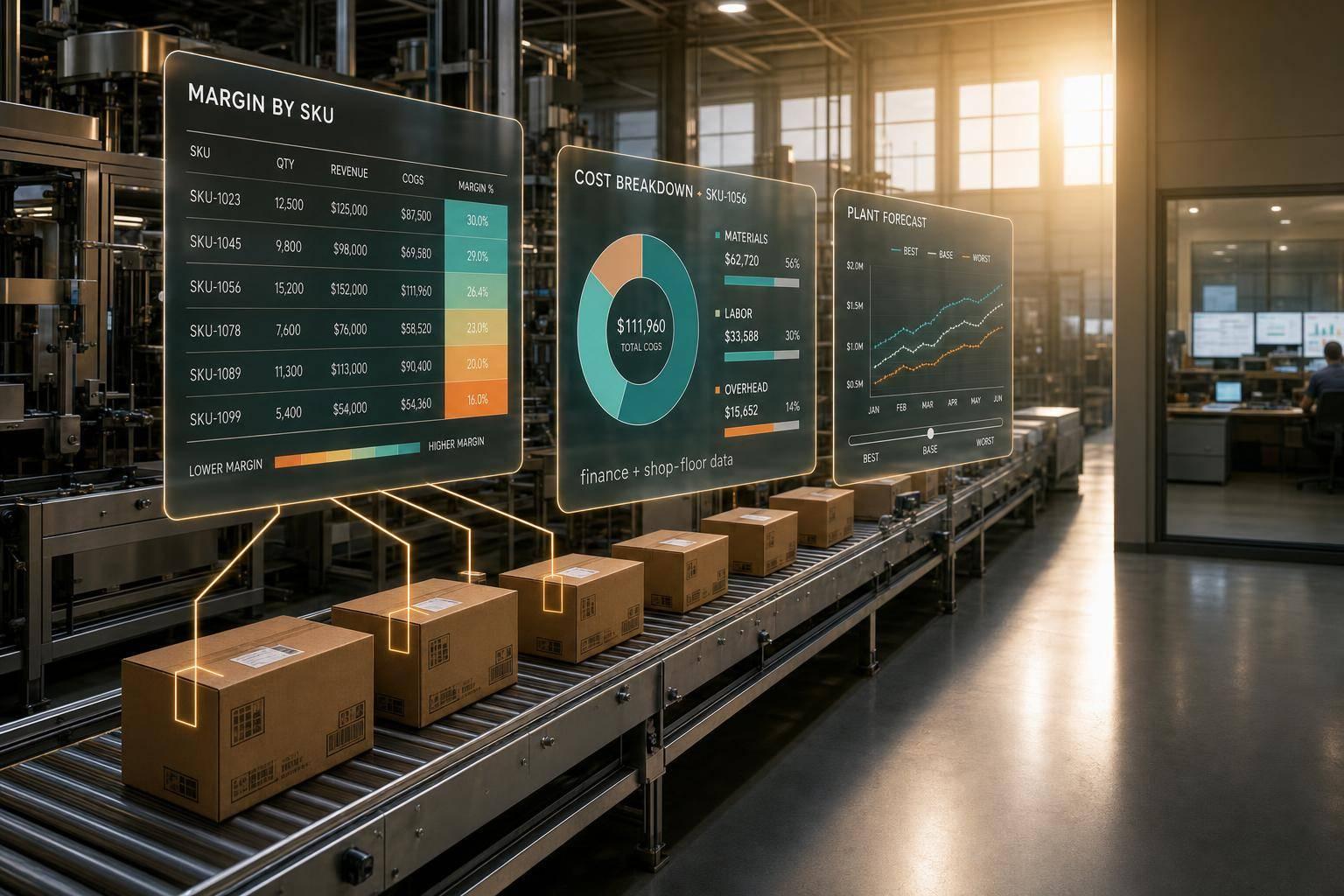
If your FP&A team sees margin problems 10 to 15 days after close, you’re already late. In manufacturing, that delay can let a weak line run for up to 45 days before finance flags the gross margin hit.
Here’s the short version: manual FP&A is still usable in stable plants, but it starts to fall apart when input costs, labor, scrap, and schedules move fast. AI-supported FP&A helps by linking ERP, MES, SCADA, and sensor data so finance can spot cost changes sooner and test more scenarios with less spreadsheet work.
If I had to boil the article down, it comes to four margin jobs:
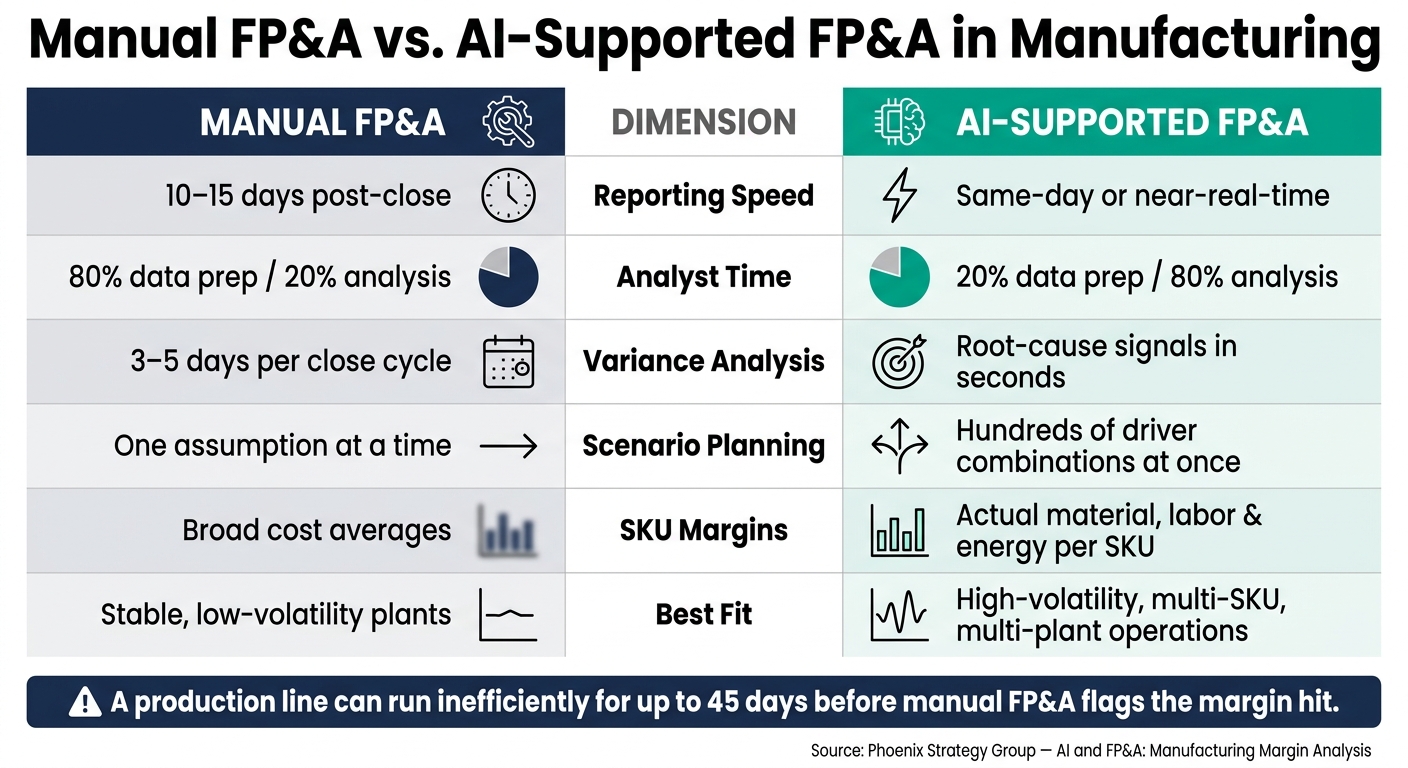
Manual FP&A vs. AI-Supported FP&A in Manufacturing
| Area | Manual FP&A | AI-Supported FP&A |
|---|---|---|
| Reporting timing | 10–15 days post-close | Same-day or near-real-time |
| Variance work | Review starts after close | Live monitoring with root-cause signals |
| Scenario planning | One model change at a time | Many driver combinations at once |
| SKU margins | Broad averages | Actual usage by SKU |
| Plant forecasts | Based on older files and assumptions | Updated from current plant data |
| Analyst time | About 80% data prep, 20% analysis | About 20% data prep, 80% analysis |
| Best fit | Lower-volatility settings | Plants with more cost and demand swings |
The main point is simple: AI does not replace finance judgment. It cuts the lag between what is happening on the floor and what finance sees in margin reports. But if your ERP, MES, and cost rules are messy, AI will push out wrong answers faster.
That’s the lens for the rest of the piece: where manual FP&A misses margin signals, where AI helps, and what each setup asks from the team.
Manufacturing finance teams still lean on a familiar setup: ERP exports, Excel models, and long email threads between plant controllers and regional finance. It works - until it doesn’t.
The problem is simple. This setup makes it hard to get fast visibility into variance review, scenario planning, SKU margin analysis, and plant forecasting. By the time the numbers are pulled together, the business has often already moved on.
Manual variance review usually begins after close. So finance spots the issue days late. At that point, the report is already stale, which cuts down the chance to act in time.
A production line can run inefficiently for up to 45 days before a manual finance workflow flags the hit to gross margin [7].
Speed comes first. Precision comes after.
Manual models are fine for planning in steady conditions. They struggle when the ground shifts.
If raw material costs jump by 15%, finance teams often have to edit formulas, update assumptions, and check links across several files before they can trust the model again - and that’s often right when margin assumptions start to fail [8].
In plain English: the spreadsheet can handle the plan, but it starts to wobble when the shock hits.
Without detailed data, costing tends to rely on broad averages. That creates a blind spot.
Price and usage variances are often rolled together, which makes it hard to tell what’s driving the problem: supplier pricing or production waste [7]. WIP is another issue. Manual systems usually capture raw materials and finished goods, but miss the capital tied up in WIP [7].
That means teams may see margin pressure without seeing the source.
When plant controllers and regional finance teams trade Excel files by email, version control falls apart fast. One file gets updated. Another doesn’t. A third gets forwarded with last week’s assumptions.
At the same time, finance tracks costs in ERP systems, while production tracks efficiency in MES or SCADA data. Since those systems rarely connect before month-end close, plant forecasts tend to reflect past conditions instead of what’s happening now. The result: forecasts can skew plant-level margin decisions before anyone catches it [7].
These gaps help explain why AI-supported FP&A changes both speed and precision.
Manual FP&A workflows often don’t show problems until month-end. AI-supported FP&A works in a very different way: it runs all the time.
It pulls data from ERP, MES, and plant-floor systems - including IoT sensors and SCADA - into one governed data model. That means finance teams spend less time matching numbers across systems and more time explaining what’s moving margin. You see that shift most clearly in variance review, scenario planning, SKU margin analysis, and plant forecasting.
AI turns variance review from a post-close task into a live process. It keeps watching cost data and flags unusual spikes in energy, scrap, or labor as they happen instead of 10 to 15 days after month-end [7][2].
It also points to the driver behind the variance - price, volume, mix, or cost - so teams can tell the difference between supplier inflation and plant or process issues [2][7]. That saves a lot of back-and-forth. Instead of asking, “Why did margin drop?” teams can get much closer to the answer right away.
Manual models usually test one assumption at a time. AI can test hundreds of driver combinations at once [1][2].
When raw material costs move, the model recalculates across the affected SKUs, plants, and regions. So you’re not stuck updating one tab after another in a spreadsheet. Rolling forecasts then take the place of static annual budgets, with monthly updates based on actual operating data [7].
Broad cost averages can hide what’s going on at the SKU level. AI gets closer to the ground.
It pulls actual consumption data - material, labor, and energy - from MES systems and calculates SKU margin from actual material, labor, and energy use [5][9]. That makes it much easier to see which SKUs are pulling margin down and why, whether the issue is scrap rates, freight costs, or rebate structures [6][1].
A good example is Silafrica Packaging. The company centralized data with Prophix, cut month-end close time by 67%, and saved $37,800 in annual labor [4].
AI links live operating data - capacity utilization, downtime, and yield rates - straight into financial planning models [3]. As a result, plant forecasts reflect current margin risk instead of last month’s conditions.
That matters because senior analysts still spend 30% to 40% of their time on routine and repeatable work [1]. AI helps shift that time away from data wrangling and toward analysis.
The catch is simple: AI only works as well as the data feeding it.
The clearest trade-offs show up in variance review, scenario planning, SKU margin analysis, and plant-level forecasting. This is where AI changes manufacturing margin analysis the most. And the shift isn’t only about speed. It also changes where finance teams spend their time and attention.
| Dimension | Manual FP&A | AI-Supported FP&A |
|---|---|---|
| Reporting Speed | Reports arrive 10–15 days post-close [7] | Same-day or near-real-time visibility [2] |
| Variance Analysis | Sequential testing; 3–5 days per close cycle [1] | Parallel processing; root-cause signals in seconds [1][2] |
| Cost Allocation | Broad overhead averages; hides SKU-level leakage [10] | Dynamic allocation from machine logs and IoT data [10] |
| Analyst Time Split | ~80% data prep, ~20% analysis [2] | ~20% data prep, ~80% analysis and judgment [2] |
| Scenario Planning | Static budgets; hard to update for volatility [3] | Continuous "what-if" and rolling forecasts [3][6] |
| One-Off Shocks | Flexible; humans adapt to unprecedented situations [1] | Limited; may struggle with situations lacking historical precedent [1] |
| Auditability | Documented formulas; human error risk [1] | Governed data lineage; traceable outputs [1][2] |
Manual FP&A still has an edge when the business gets hit with a one-off shock. When something happens that has no clear pattern in past data, people can step back, read the room, and make a call. That kind of judgment still matters [1].
But there’s a catch. In many finance teams, analysts spend about 80% of their time getting data ready and only 20% on analysis [2]. That’s a rough trade. It’s like hiring a sharp mechanic and asking them to spend most of the day looking for tools.
AI-supported FP&A flips that balance. Teams can move from about 20% data prep and 80% analysis and judgment [2]. Variance review that once took 3–5 days per close cycle can shrink to root-cause signals in seconds [1][2]. Reporting can move from 10–15 days after close to same-day or near-real-time visibility [2][7].
Still, AI is only as good as the systems feeding it. If ERP, MES, and cost definitions are messy, the output will be fast but off-base. Bad inputs don’t just create bad answers. They create bad answers faster.
That’s a big reason data setup matters so much in manufacturing. Cost allocation, for example, can move from broad overhead averages that hide SKU-level leakage to dynamic allocation tied to machine logs and IoT data [10]. Scenario planning can also shift from static budgets that are painful to update into continuous "what-if" analysis and rolling forecasts [3][6].
Phoenix Strategy Group helps growth-stage manufacturers connect factory and ERP data and build driver-based rolling forecasts [7][10].
The right workflow comes down to one thing: how much volatility your operation deals with.
Manual FP&A can still work in stable settings with steady demand and fairly fixed raw material prices. When demand and input costs don’t move much, a manual process is often enough. But once volatility picks up, that edge starts to disappear.
For manufacturers dealing with lots of SKUs, multiple plants, swingy commodity prices, or frequent schedule changes, manual FP&A can leave a serious margin blind spot. A production line can keep running inefficiently for up to 45 days before a manual finance team flags the margin hit [7]. At that point, finance isn’t stopping the loss. It’s just reporting it after the fact.
AI helps close that delay by turning margin monitoring into a live process. AI-backed FP&A helps teams move faster across variance review, scenario planning, SKU margin analysis, and plant-level forecasting. That means they can catch margin erosion sooner, make better product mix calls, and improve plant-level forecast accuracy with inputs like scrap rates, machine hours, and yield.
Phoenix Strategy Group helps growth-stage manufacturers connect shop-floor and ERP data, then build rolling forecasts that surface margin shifts earlier.
AI-supported FP&A makes sense when a manufacturer works in a complex, volatile setting and manual, spreadsheet-heavy processes drag down decision-making. It’s a good fit when finance teams need to shift from reactive reporting to more predictive, near-real-time insight.
It becomes most useful when teams want to automate variance analysis, run multi-variable scenarios, or see SKU-level margins across both operational and financial data. Put simply, it makes sense when business complexity outgrows manual modeling.
AI needs one shared, real-time data base that links finance and operations instead of keeping them in separate silos.
That means pulling in detailed data like procurement and material costs, production metrics, sales and pricing history, and logistics or fulfillment data.
When ERP, MES, CRM, and WMS data are connected, AI can do more than spot that margins changed. It can use driver-based modeling to show why they changed by breaking margin variances into factors like price, volume, mix, scrap, and downtime.
Yes. AI helps with SKU margin analysis and plant-level forecasting by shifting finance away from manual reporting and toward more proactive, driver-based management.
It can break down variances across factors like price, volume, mix, and efficiency much faster. That makes it easier for teams to spot SKU-level margin pressure and see what's causing it without digging through reports by hand.
AI can also use real-time production and financial data for scenario planning. In plain English, that means plants can see possible disruptions coming earlier and respond before margins take a hit.