Published on
April 2, 2026


AI-powered cash flow tools are transforming financial forecasting by offering real-time insights, automating manual tasks, and improving accuracy to 92–97%. These tools help businesses reduce errors, save time, and make better financial decisions with expert cash flow management. Here's what you need to know:
Quick Comparison:
| Tool | Best For | Key Features | Limitations |
|---|---|---|---|
| Abacum | SaaS and small businesses | Real-time insights, driver-based modeling | May not fit large enterprises |
| Agicap | Mid-market companies | Multi-entity setups, 13-week rolling forecast | Limited non-European banking |
| Fathom | Long-term planners | 3-5 year forecasts, multi-entity support | No daily cash flow tracking |
| Spotlight | Advisory-focused accountants | Scenario modeling, customizable reports | Steeper learning curve |
| Syft Analytics | SMBs and advisory accountants | AI-driven commentary, extended forecasts | Advanced features in higher tiers |
| Futrli | Accountants in advisory roles | Predictive tax algorithms, scenario planning | Higher cost for larger firms |
AI tools simplify cash flow management, but challenges like data quality and implementation timelines remain. Start small with a proof of concept to test these tools before full adoption.
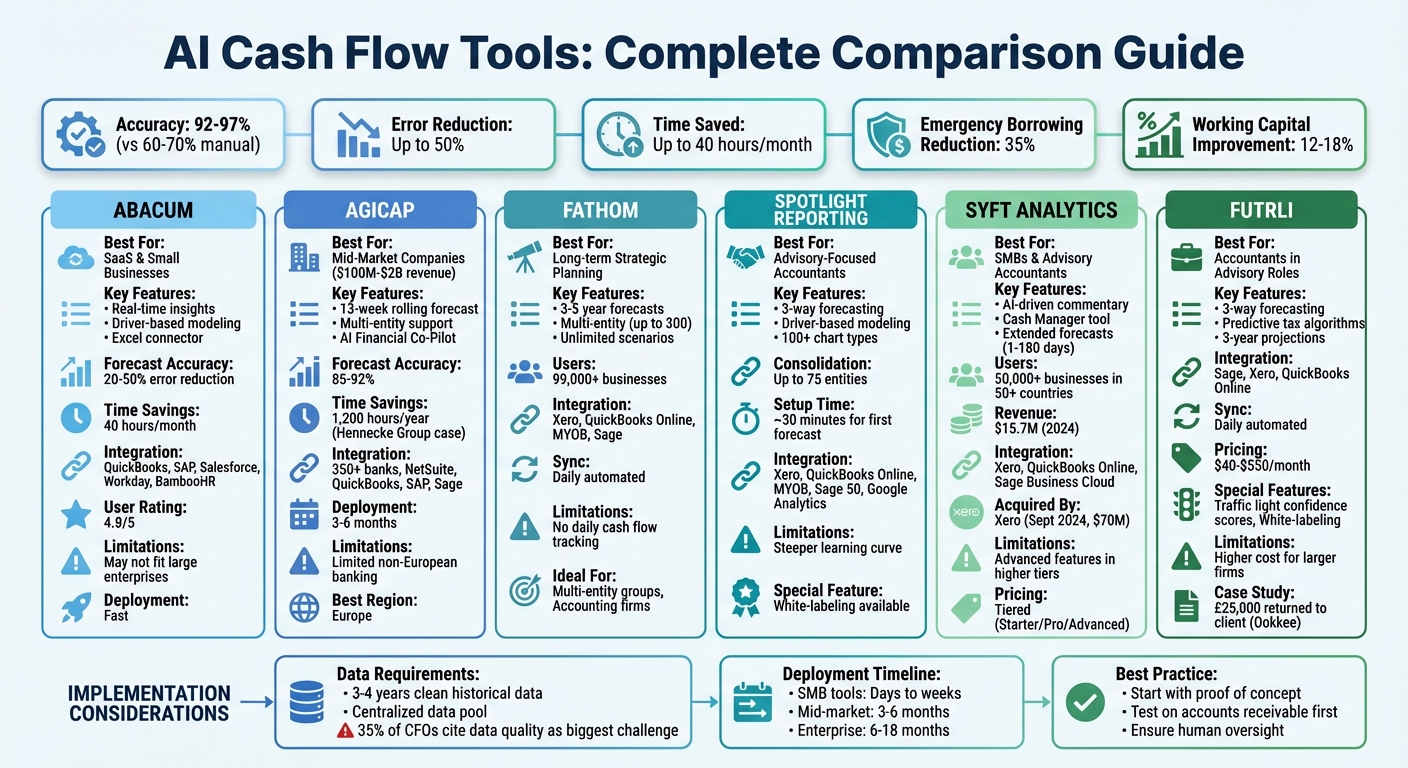
AI Cash Flow Tools Comparison: Features, Best Use Cases, and Limitations
Abacum transforms cash flow forecasting from a monthly task into a daily, real-time process, giving finance teams up-to-the-minute insights into liquidity. By leveraging advanced techniques like time series analysis, machine learning, and deep learning, Abacum uncovers trends that spreadsheets often miss. This approach can cut forecast errors by an impressive 20% to 50% compared to manual methods [3].
The platform shines in driver-based financial modeling, focusing on key business metrics instead of relying solely on historical averages. It also supports quick "what-if" scenario planning, enabling users to explore the effects of changes like pricing adjustments or increased marketing spend. On top of that, it automatically flags discrepancies between forecasts and actual results, helping teams stay on track [4].
These forecasting features are designed to work seamlessly with system integrations.
Abacum connects with popular systems like QuickBooks, SAP, Salesforce, Workday, BambooHR, and ERP platforms, automating data entry and saving teams up to 40 hours per month [3][5][6]. By creating a single, continuously updated source of truth, the platform eliminates the need for manual data reconciliation. Additionally, an Excel connector allows teams to stick with familiar workflows while reducing reporting errors by up to 60%. This shift enables finance professionals to focus less on data processing and more on strategic decision-making [4][6].
Abacum is particularly well-suited for small to mid-sized businesses, especially in the SaaS sector, that need real-time financial visibility across various departments. It’s designed for fractional CFO services, FP&A teams, RevOps, and HR professionals, fostering collaboration and helping organizations move from manual spreadsheet processes to automated, integrated systems [4][5][6].
"The finance department once spent 80% of its time crunching numbers and only 20% providing insights. AI tools for finance have flipped that ratio."
– Julio Martínez, Co-Founder & CEO at Abacum [6]
Abacum’s speed is a standout feature. Tasks like consolidating data from multiple systems, which used to take weeks, now happen automatically - saving finance teams up to 40% of their time [6]. Its machine learning models also reduce forecast variances by 10% to 20% compared to traditional spreadsheet methods [4]. Even a modest 15% improvement in forecast accuracy can drive pre-tax performance gains of 3% or more [5]. With a high user rating of 4.8 out of 5 and certifications like SOC 2 Type II, ISO 27001, and GDPR compliance, Abacum is a trusted choice for finance teams [4][6].
Agicap uses a 13-week rolling cash flow forecast, a standard approach in mid-market liquidity management. Instead of relying on accrual-based models, it applies the direct method for short- and medium-term planning. This method bases projections on actual scheduled cash events - like invoices, purchase orders, and debt schedules - achieving an accuracy rate of 85%–92% [1][7].
The platform provides three forecasting horizons tailored to different needs:
Agicap also features an AI-powered Financial Co-Pilot that enables users to pose plain-language queries and instantly clone scenarios. This makes it easy to test the impact of potential challenges, such as late payments, currency fluctuations, or mergers and acquisitions [7][8][9].
Agicap integrates seamlessly with major accounting systems like NetSuite, QuickBooks, SAP, and Sage, as well as over 350 banking institutions using protocols such as SWIFT, ACH, and SFTP [1][9]. By automating data capture from these sources, the platform eliminates the need for manual data consolidation, reducing errors and saving time [7][9].
Its Bank Journal Automation feature takes it a step further, automating general ledger coding and posting directly back to accounting systems [9].
A real-world example: In 2025, the Hennecke Group, a $180 million manufacturer backed by private equity, adopted Agicap to manage operations across five sites and multiple ERP systems. Under the leadership of Group CFO Yves Souguenet, the company transitioned from weekly manual Excel updates to daily real-time cash visibility. This shift reduced their manual workload from 32 hours per week to just 2 hours, saving over 1,200 hours annually [7][9].
"We've saved over 1,200 hours annually, minimized errors, and have real-time information at our fingertips - enabling us to focus on strategic decisions, not spreadsheet maintenance."
– Yves Souguenet, Group CFO, Hennecke Group [7]
These integrations are designed to meet the complex cash flow needs of mid-market businesses.
Agicap is well-suited for mid-market companies with annual revenues between $100 million and $2 billion, particularly private equity-backed groups and multi-entity organizations with intricate cash flow structures [7]. The platform typically deploys in 3 to 6 months, offering a faster implementation timeline compared to enterprise treasury management systems [7][9].
For US companies, especially those navigating fragmented banking systems, Agicap provides robust support for NACHA and ACH payment protocols, making it a practical solution [7].
Agicap stands out by combining its advanced forecasting and integration features with a focus on operational accuracy. Its forecasts incorporate client-specific payment behaviors, delivering precise insights even at the subsidiary level [7]. This is critical given that 43% of US mid-market companies depend on unreliable forecasts, often resulting in unexpected cash deficits averaging over $50,000 every 20 days [7]. The financial toll of such inaccuracies can reach $465,000 annually for mid-sized US firms [7].
Additionally, the platform’s AI Assistant operates securely within Agicap’s servers, ensuring sensitive financial data remains protected and is never shared externally [8].
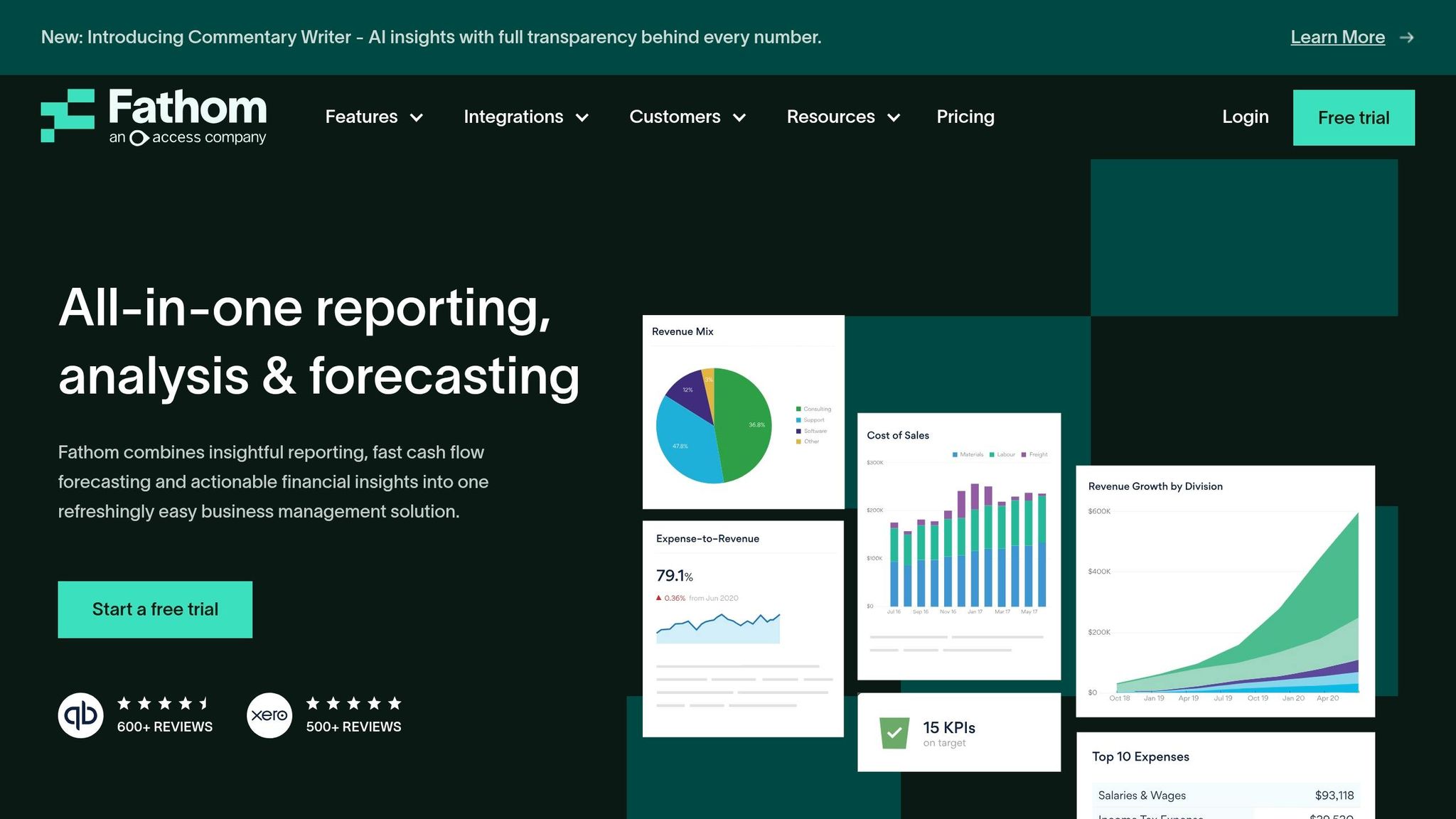
Fathom brings together Profit & Loss, Balance Sheet, and Cash Flow into a single, unified model, offering rolling forecasts that stretch 3 to 5 years. This makes it a great tool for strategic planning. The platform shines with its unlimited "what-if" scenarios and "micro-forecasts", which can simulate specific events like hiring new staff or purchasing equipment. However, it doesn’t provide daily or weekly predictions, focusing instead on long-term planning. This approach is well-supported by its strong accounting software integrations.
Fathom integrates seamlessly with leading accounting platforms such as Xero, QuickBooks Online, MYOB, and Sage. It enables automated daily syncs and supports spreadsheet imports for added flexibility. The ChatFin Editorial Team highlights its strengths, stating, "Fathom, Spotlight, and Syft have the most robust integrations with Xero and QuickBooks. This includes daily syncs and deep data mapping" [1]. By automating data syncing and reducing manual entry, Fathom helps finance teams dedicate more time to analysis rather than data management [11].
Thanks to its forecasting tools and integration capabilities, Fathom is particularly well-suited for accounting firms and finance teams managing complex, multi-entity groups. Trusted by over 99,000 businesses worldwide, it can consolidate up to 300 entities and supports multi-currency operations, intercompany eliminations, and custom charts of accounts. Positioned between entry-level and enterprise solutions in terms of cost and features, it offers excellent value. Its presentation-ready dashboards and benchmarking tools are especially useful for client and stakeholder reporting [10].
Fathom’s all-in-one interface simplifies reporting, forecasting, and consolidation, eliminating the need to switch between tools. It delivers dependable long-term projections, provided assumptions are carefully managed. While it doesn’t offer daily cash flow insights, this trade-off is often acceptable for businesses focused on strategic planning. As Hamidah Abd Rahman from The Access Group notes, "Fathom is widely considered a leading choice for accountants, offering integrated three-way forecasting, scenario planning, multi-entity consolidation, and polished reporting in one platform" [10]. Its focus on strategic forecasting makes it a top pick for long-term planning, though it may not be the best fit for those needing granular, day-to-day cash flow visibility.
Spotlight Reporting offers 3-way cash flow forecasting, linking your Profit & Loss, Balance Sheet, and Cash Flow statements for projections that span up to five years. This integration ensures projections remain accurate and aligned. The platform also features driver-based modeling, which lets you create forecasts based on key business metrics like billable hours, headcount, or price-per-unit calculations. One standout feature is its ability to perform unlimited dynamic scenario modeling, allowing users to see how different decisions could impact their cash flow. Impressively, users can build their first forecast in just about 30 minutes [12]. For businesses with complex structures, Spotlight can consolidate up to 75 entities, offering multi-currency support and inter-company eliminations [13]. These forecasting tools integrate seamlessly with its data integration capabilities, creating a robust financial planning system.
Spotlight Reporting integrates effortlessly with accounting software such as Xero, QuickBooks Online, MYOB, and Sage 50 [12][15]. Beyond financial platforms, it also connects to non-financial data sources like Google Analytics, WorkflowMax, and myprosperity, providing a more comprehensive view of business performance [15].
"With Spotlight we spend less time manipulating the data and more time analyzing" – Jacqui Loveridge, CFO at San Churros [14]
The platform's automated syncing not only reduces manual data entry errors but also frees up finance teams to focus on delivering strategic insights rather than managing data.
Spotlight Reporting shines in delivering insights and enabling quick analysis, supporting the article's focus on AI-driven cash flow precision. It’s particularly effective for accounting firms transitioning to advisory roles, CFOs looking for tools to guide strategic decisions, and organizations managing multiple entities. Its driver-based modeling and adaptable templates cater to industries like Professional Services, Real Estate, E-commerce, Hospitality, Retail, and SaaS [12][15]. For example, TNM Consulting used Spotlight Forecasting to help a client secure $11 million in project funding, showcasing its value in capital raising [15]. Similarly, Frank Druda, Accounting Director at BlueRock, shared how his firm now delivers detailed analyses to hundreds of clients in just a fraction of the time previously required [12]. The platform also supports white-labeling, allowing firms to create branded, customized reports for client presentations [15].
Spotlight Reporting stands out with its customizable reporting options, offering over 100 chart types, including cash flow waterfall charts that clearly illustrate how decisions affect bank balances [15]. Its "Dynamic Rules" feature is another highlight, automatically updating linked account values when base figures change. This reduces manual errors and speeds up decision-making for finance teams.
"I love your Dynamic Rules! Compared to everyone else, your tool works really well because you can very easily assign a Dynamic Rule to multiple accounts at the click of a button" – Shannon Smit, Director and Founder of Smart Business Solutions [15]
While the platform might have a steeper learning curve and its dashboard can initially feel overwhelming, its depth and capabilities make it a strong choice for firms serious about delivering strategic financial insights [13].
Syft Analytics provides cash flow forecasting through its Cash Manager tool, which uses AI-driven predictions to help businesses visualize their cash flow and anticipate potential shortfalls. This tool allows projections for timeframes ranging from 1 to 180 days, offering businesses - especially those with seasonal quarterly cycles - an extended view of cash flow impacts. For example, it can help businesses prepare for the financial demands of the first month of a new quarter. This feature is part of the Advanced plan. Like other platforms, Syft Analytics incorporates AI to improve the accuracy of its cash flow predictions. [16]
Syft Analytics integrates seamlessly with major cloud accounting platforms such as Xero, QuickBooks Online, and Sage Business Cloud Accounting. These integrations use secure APIs to automatically sync financial data. Following Xero's acquisition of Syft Analytics in September 2024 for up to $70 million, the platform now offers deeper integration within the Xero ecosystem. Currently, Syft Analytics supports over 50,000 businesses across more than 50 countries and reported revenue of $15.7 million in 2024. [17]
This platform is well-suited for advisory accountants and small-to-medium businesses (SMBs) that need straightforward, ready-to-use financial analytics. It shines in areas like managing debt and tax payments, ensuring cash availability for payroll, and supporting businesses with seasonal income fluctuations through its extended forecasting tools. [16] Additionally, its AI-powered commentary feature, Syft Assist, offers a helpful starting point for financial reports, though human oversight is still recommended for verifying accuracy. [17] Syft also turns static financial reports into dynamic, visual presentations, making it a step up from basic accounting software.
Syft Analytics stands out with its AI-driven financial commentary and user-friendly design tailored for accounting data. Features like customizable report packs, multi-level consolidations, and interactive dashboards provide advanced capabilities that go beyond standard accounting tools. Its scenario forecasting tools allow users to model multiple outcomes, including best-case, base-case, and worst-case scenarios.
The platform also offers tiered pricing to meet different needs:
Users frequently highlight its ease of use and the efficiency it brings to reporting, as noted on review platforms like G2 and Capterra. [17] By combining forecasting, analytics, and customizable reporting, Syft Analytics continues to enhance the capabilities of AI-powered cash flow tools.
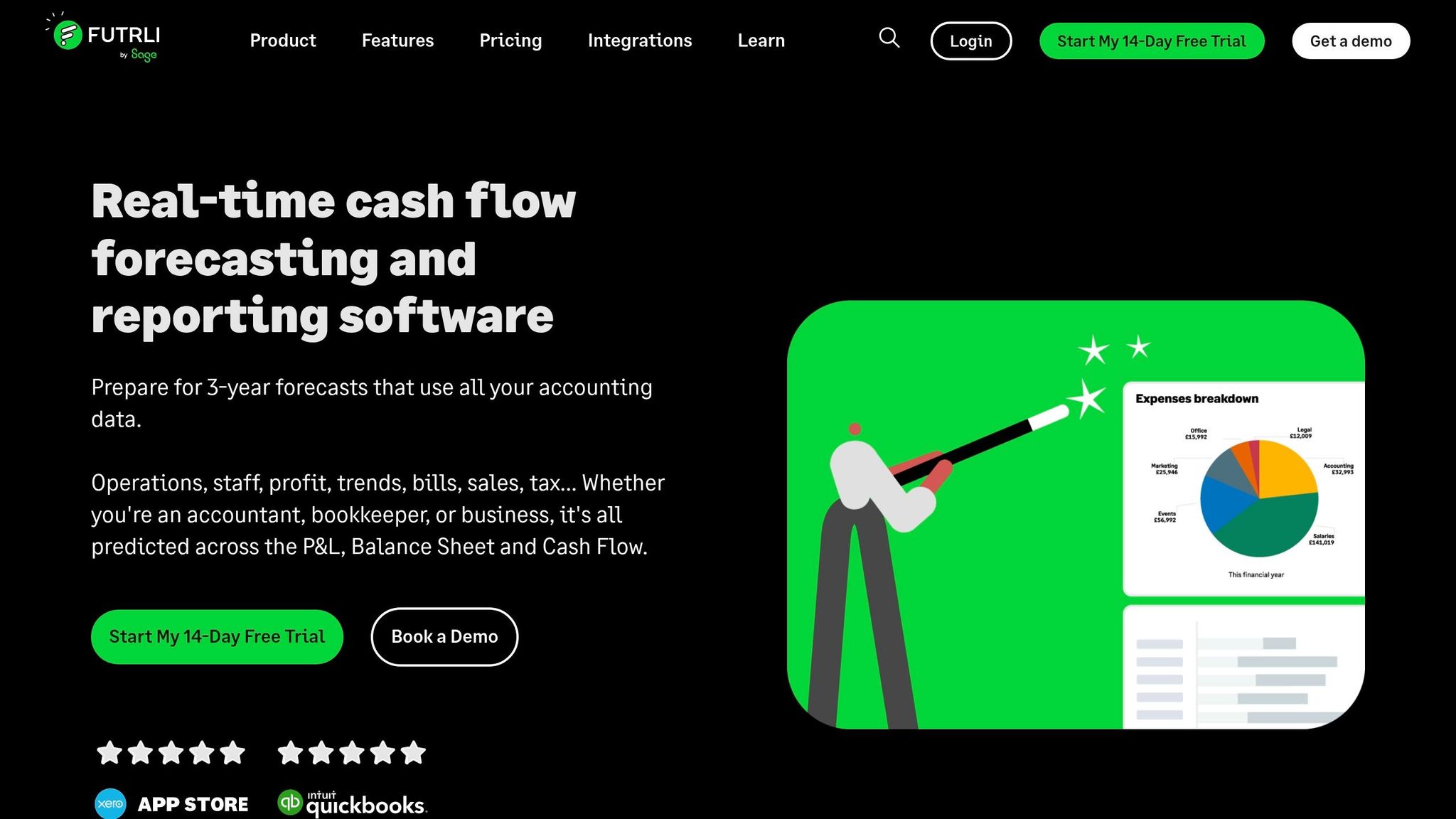
Futrli stands out among AI-driven cash flow tools with its integrated approach to financial forecasting. Its 3-way forecasting connects your Profit & Loss, Balance Sheet, and Cash Flow statements into a single, cohesive view. This setup ensures that any changes in one area are automatically reflected across all financial statements, giving you a complete and synchronized understanding of your business's financial health [18] [19].
What sets Futrli apart is its use of automated predictions based on accounting principles and real-time data, rather than relying solely on historical trends. By analyzing your transaction data, the platform generates forecasts for sales, costs, and expenses while factoring in VAT, GST, and sales tax variables. You can also create scenario models to evaluate different outcomes - best-case, base-case, and worst-case scenarios - helping to reduce risks tied to critical business decisions. Additionally, it allows for 3-year cash flow projections that incorporate unpaid invoices, offering precise short-term liquidity forecasts [23]. To make things even easier, Futrli uses a traffic light system to assign confidence scores to its predictions, helping you quickly gauge their reliability.
Futrli integrates seamlessly with Sage Accounting, Xero, and QuickBooks Online through secure APIs. The platform automatically syncs data daily, eliminating the need for manual updates and ensuring your forecasts and reports are always up to date. As Laura Day-Henderson, Founder of More Than Bookkeeping, describes:
"When you sign up for Futrli it automatically pulls through the data. It's like a plug-and-play system. Instantly you have your cash flow there created for you already." [18]
For businesses managing multiple entities, Futrli supports multi-currency consolidation, allowing you to connect organizations from various accounting platforms into a unified forecast. It also accommodates external data uploads via Microsoft Excel, providing flexibility for additional inputs.
Futrli is an excellent choice for accountants and bookkeepers looking to shift from compliance services to offering strategic advisory roles. The platform enables firms to act as virtual CFOs by delivering investor-ready financials and advanced scenario planning tools. James Solomons, Director at Aptus Accountancy & Advisory, highlights this advantage:
"Futrli extends Xero and makes real-time or 'anytime' advisory possible. So we can spend time adding value in areas like forecasting and scenario planning." [21]
Small and medium-sized businesses dealing with financial uncertainty, intricate tax obligations, or seasonal fluctuations also benefit from Futrli's predictive tax algorithms, which focus on future activity rather than past trends. For example, in January 2024, Paul Clarke, co-founder of Ookkee, shared how using Futrli for cash flow management helped return £25,000 to a client while growing his firm's advisory revenue. Similarly, in February 2023, Accounts and Legal doubled both their revenue and staff by leveraging Futrli's advanced features [22]. These examples highlight how the platform improves decision-making in real-time, a recurring theme among tools in this category.
One of Futrli's standout features is its ability to simplify complex financial data for non-financial stakeholders. Stuart Hurst, Director at Accounts and Legal, explains:
"Futrli humanises the numbers. It's a jargon-free way of communicating your numbers to your clients." [20]
The platform offers tiered pricing to accommodate businesses of various sizes. Plans start at around $40 per month for sole traders and go up to $550 per month for larger businesses and accounting firms. All plans include unlimited users and daily forecasting, while higher tiers offer additional licenses and personalized training. Martin Greenhow, Business Owner at Mojo Bars, appreciates the quick response capabilities Futrli provides:
"Futrli has dramatically reduced our response rates. If things go right or wrong, we're on it." [18]
For those seeking customization, Futrli also supports white-labeling, allowing users to brand reports with their own logo and color schemes using hex codes. This feature ensures that reports not only deliver insights but also align with your branding.
AI-powered cash flow tools boast an accuracy rate of 92–97%, far surpassing the 60–70% typically achieved with manual spreadsheets. They also slash error rates by up to 50% [1][2]. Teams using these tools report significant savings, including a 35% reduction in emergency borrowing costs and a 12–18% improvement in working capital efficiency [1]. Additionally, these platforms provide intraday updates instead of weekly or monthly ones, pulling real-time data directly from bank accounts, receivable schedules, and market signals [1].
However, deploying enterprise-grade platforms like Kyriba can take anywhere from 6 to 18 months and may involve professional service fees that reach hundreds of thousands of dollars [1]. Data quality remains a persistent challenge, with 35% of CFOs citing it as the biggest hurdle to adopting AI [24]. Cleaning up historical data often requires extensive manual work [25]. Another concern is the opaque nature of many AI systems, which complicates explaining predictions and raises potential regulatory issues [2][25].
Here’s a comparison of key platforms, showcasing their strengths and limitations:
| Platform | Key Advantages | Key Limitations |
|---|---|---|
| Agicap | Over 350 European bank connections; intuitive for non-treasury users; supports multi-entity setups (2–20); 85–92% accuracy [1] | Limited connectivity outside Europe, with a focus on EU regulations [1] |
| ChatFin | Automatically handles data ingestion with agentic AI; integrates with 200+ banks; real-time scenario modeling; 92–97% accuracy [1] | May require workflow adjustments for traditional finance teams due to its newer AI-native design [1] |
| Kyriba | Connects to 800+ global banks; includes FX risk and liquidity management; 90–95% accuracy [1] | High ownership costs, long deployment times, and complexity that may overwhelm smaller teams [1] |
Regional focus plays a crucial role. For instance, Agicap is tailored to European banking needs, while tools like Tesorio cater to SaaS companies with subscription-based revenue models [1]. Large enterprises managing over 100 banking relationships might benefit from enterprise treasury management systems, whereas smaller businesses with under $10 million in revenue may find accounting-integrated tools like Xero or QuickBooks more practical [1].
These findings highlight the delicate balance between achieving precision through advanced technology and addressing the ongoing need for clean data and expert oversight.
"Implementing AI in treasury management requires a mindset shift, quality data and collaboration between human expertise and machine intelligence." – Alberto Hernandez-Martinez, Executive Director of Industry Solutions at J.P. Morgan [2]
For organizations considering AI adoption, starting with a proof of concept - such as focusing on accounts receivable - can help ease the transition before expanding its use across the business [25]. However, human expertise remains a critical part of the equation.
Small businesses can reclaim 10 to 15 hours each week by automating the process of consolidating data from banks, payment processors, and accounting systems [27]. Take the example of a founder managing an e-commerce brand that spends $10,000 daily on Meta ads. They often face a cash gap of $70,000 to $140,000 because revenue can take 7 to 14 days to come in [27]. Tools like Luca AI help bridge this gap by pulling data from multiple systems, offering a clear view of when cash will arrive. This allows business owners to decide whether to ramp up ad spending immediately or wait for incoming payouts. The result? A more efficient approach to dynamic forecasting.
FP&A teams at growth-stage companies are moving away from traditional monthly, board-driven forecasts to more agile, automated weekly updates. For example, Doe sends rolling 13-week forecasts every Monday morning via Slack, providing base, downside, and upside scenarios [28]. Kenneth Chen, CFO at Aiven, shared how Atlar transformed their workflow:
"The beautiful thing is you can log into Atlar and see your cash positions and payments in one reliable, real‑time view. This helped us shift from tactical work to strategic finance." [30]
These tools empower finance teams to quickly model the impacts of decisions - like hiring new staff or launching a product - using live data instead of waiting for month-end reports.
Mid-sized companies gain from AI tools that improve forecasting precision while offering real-time insights. Some solutions boast up to 95% forecast accuracy by analyzing historical trends and external signals across different entities and currencies [32]. Many mid-sized firms also use platforms like Atlar to get a global view of their cash positions. Hendrik Bitterschulte, CFO at Acne Studios, noted:
"With Atlar in place, we can operate in a more scalable way as a finance team and with greater insight into our cash positions globally." [30]
These companies often track 7-day, 30-day, and 90-day variances separately, understanding that short-term forecasts are more predictable, while long-term projections require scenario planning [29][31].
The level of system integration evolves with a company’s growth stage, offering more than just time savings. Growth-stage companies often connect additional systems, such as ERP platforms, payroll calendars, and multi-currency bank feeds [31]. Eric Calaman, Business Executive at Bank of America, emphasized the value of proactive cash management:
"The best way to monitor cash flow is to use a budgeting tool that can categorize expenses and identify any potential shortfalls before they occur." [26]
Typically, businesses start with a small-scale proof of concept before rolling out these solutions across the organization [29][31]. To support this progression, Phoenix Strategy Group incorporates advanced financial tools into its fractional CFO and FP&A services, ensuring high-quality data and seamless integration. This approach helps companies make faster, more informed decisions.
Picking the right AI cash flow tool means matching its features to your business needs. For small businesses with less than $10 million in annual revenue, simplicity and quick implementation are key. Larger enterprises, on the other hand, need tools that handle multi-currency operations and integrate with numerous banks. AI forecasting delivers accuracy rates of 92–97%, compared to 60–70% with manual methods, and it can reduce emergency borrowing by 35% [1]. These benefits highlight the importance of choosing a tool that fits your company's specific requirements.
Before diving in, ensure you have three to four years of clean, centralized financial data. This is crucial for detecting seasonal trends accurately [25]. As Hubert Rappold, Senior Treasury Expert at Nomentia, points out:
"AI-based cash flow forecasting is possible for any company as long as the data pool is large enough and centralised" [25].
If your data is fragmented or inconsistent, focus on organizing it first.
For small and medium-sized businesses, tools can often be set up within days or weeks. In contrast, enterprise-level solutions might take 6–18 months to implement and could involve significant professional fees [1]. Starting with a pilot project is a smart way to test the tool’s capabilities [24].
Alberto Hernandez-Martinez of J.P. Morgan emphasizes that successful AI integration depends on a combination of factors: a shift in mindset, high-quality data, and blending human expertise with machine intelligence [2]. Establish clear success metrics from the start - whether it's improving forecast accuracy or saving time on data collection [24]. This kind of strategic alignment is central to Phoenix Strategy Group's approach.
Phoenix Strategy Group uses advanced financial tools in its fractional CFO and FP&A services to help growth-stage companies build a strong data foundation and strategic oversight. Their focus is on turning cash flow insights into quick, confident business decisions.
To get the most out of an AI cash flow forecasting tool, you need to feed it precise and detailed data. This includes historical financial records like accounts receivable and payable, along with past cash flow statements. Pair this with real-time banking data and ensure the tool integrates seamlessly with systems such as CRMs or accounting software. These inputs allow the AI to spot patterns, adapt to changes, and minimize mistakes, helping you manage your cash flow more effectively.
Implementing an AI cash flow tool in a U.S. business typically takes several months. On average, the entire process, including integration, spans about six months. However, the exact timeline often depends on how complex the business's systems and requirements are.
To ensure AI-generated cash flow forecasts are accurate, compare them against historical data and manual projections. This helps identify any discrepancies and refine the model. Regularly revisit assumptions and data sources to keep the process reliable and consistent. It's also crucial to maintain a clear, auditable process - this builds trust in the system.
When presenting to stakeholders, emphasize the system's strengths: its ability to deliver real-time, data-driven updates, minimize manual work, and enhance clarity. Providing frequent updates on how forecasts are validated and sharing performance metrics can further strengthen confidence in the AI's capabilities.