Published on
June 19, 2026

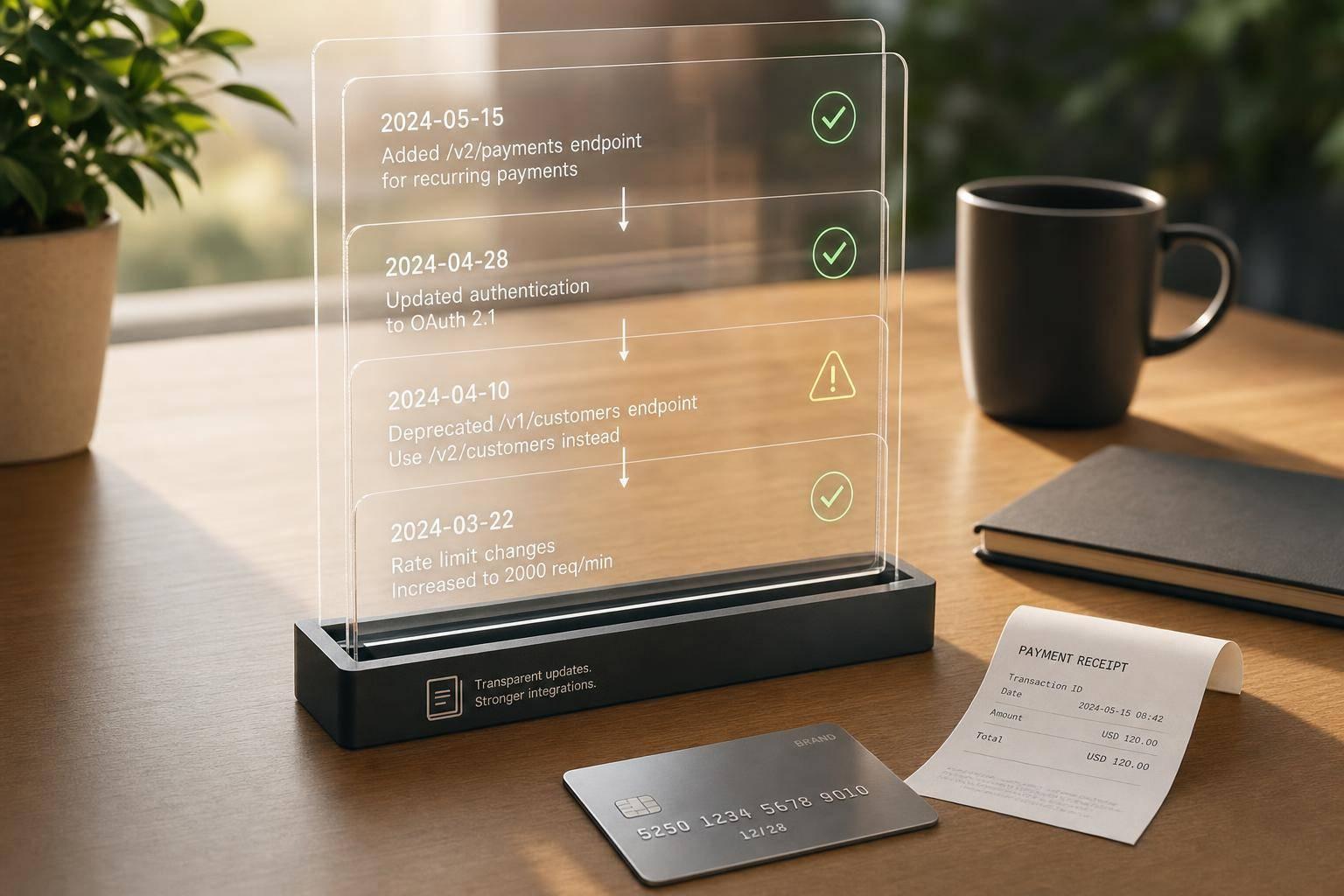
If you rely on third-party APIs for payments, billing, ERP, or reporting, a weak change log can turn a small API update into a finance problem. I’d treat API change logs as a business control because one breaking change can cost $500 to $2,000 per integration, delay close, skew reports, and leave gaps during audit review.
Here’s the short version:
I see the main takeaway like this: if an API helps run your money movement or financial reporting, its change log is part of your control stack. That means each entry should state what changed, what breaks, when it takes effect, and what your team needs to do next.
A simple process usually includes:
Here’s a quick view of the article’s core point:
| Area | What weak change logs cause | What better change logs help you do |
|---|---|---|
| Payments | Failed or duplicate transactions | Plan updates before release |
| Reporting | Data drift and broken dashboards | Keep reports and models stable |
| Audit | Missing history of record changes | Show dated release history |
| Engineering | More debugging and support work | Cut release confusion |
| Finance | Close and reconciliation issues | Review change risk earlier |
My bottom line: API change logs are not just release notes. They help protect cash flow, reporting accuracy, and audit records. The rest of the article explains how to set up that process in a simple, repeatable way.
When a third-party API changes without a clear log, the damage usually doesn't announce itself. For growth-stage companies that rely on automated integrations, the first signal is often a failed close, a payment error, or bad reporting data. And without a clean record, finance teams can't see what changed or when it happened.
Small contract shifts can turn into finance incidents fast.
The most painful failures are often the quiet ones. If an endpoint disappears, systems tend to fail right away. But a field type shift or pagination change is sneakier. It can corrupt data or drop records without setting off alarms. A field type change from integer to string, for example, may not trigger a hard error. Instead, it can quietly damage data moving into your general ledger or ETL pipeline, leaving stale ledger data in place for weeks before someone spots it in a financial report.
Some failures hit cash flow head-on. A silent change to idempotency rules can create duplicate payments that take days to sort out. Pagination changes can drop transactions, so records just vanish from sync jobs. And test-to-production mismatches often don't show up until month-end close, which is about the worst time to find them.
Even a "performance improvement" can cause trouble. Under Hyrum's Law, every observable behavior becomes a dependency, including timing [6]. So if response times get faster, an old reconciliation script that expected a slower pace can run into race conditions.
Weak change logs don't just slow engineers down. They stretch out the whole incident response cycle. When an outage hits and the changelog says "various bug fixes", the engineering team first has to piece together what changed before they can fix anything [7]. Every hour spent doing that is another hour of disrupted bookkeeping, stalled cash flow data, and less visibility for leadership.
The compliance risk builds over time too. If financial records shift because an upstream API quietly changed its rounding logic or removed a security field, there's no release history to show during an audit. That's a hard gap to explain to an auditor, and even harder to patch after the fact. At an estimated $500 to $2,000 per integration in developer time, testing, and support overhead [3], even a small set of poorly communicated breaking changes in a year becomes a line item in the budget.
All of these failures point back to the same issue: undocumented change.
| Problem | Root Cause in Change Management | Impact on Financial Operations |
|---|---|---|
| Failed Payments | Undocumented authentication flow change or required parameter addition | Cash flow disruption and higher support load. |
| Duplicate Transactions | Silent shift in idempotency rules or response code changes | Reconciliation breaks between billing systems and the general ledger. |
| Broken ETL/Dashboards | Response field type change (e.g., integer to string) or field removal | Inaccurate KPI tracking and corrupted investor reporting. |
| Audit Exposure | Security-default fields retired without structured notice | Missing audit trail for financial-record changes. |
That points to the next move: a disciplined changelog process, not reactive troubleshooting.
A well-kept change log isn't just another doc. It's a control point.
Proper API change communication can cut developer disruption by up to 70% [1]. That matters fast when one small update can ripple across apps, billing flows, and internal systems. Engineers get a clear view of what changed and when. Finance teams get a record they can point to during audits. Leadership gets more confidence that integrations won't fail out of nowhere.
That control starts with versioning discipline.
Semantic versioning - MAJOR.MINOR.PATCH - only works if the changelog spells out the type of release. Breaking changes should land in MAJOR releases. Additive updates belong in MINOR releases. Bug fixes go in PATCH releases [1][8]. Without that context, version numbers are just labels.
A structured change log cuts through the guesswork by tagging each entry with a standard category:
Each entry should also include the API version, release date, effective date, and deprecation window. Breaking changes often need 60–90 days of notice. Full retirements usually need more time [1][6].
| Change Type | Example in Financial API | Expected Consumer Action |
|---|---|---|
| Breaking | Removing discountCode field; changing amount from string to integer |
Code changes and retesting |
| Additive | Adding optional metadata field to POST /payments |
Optional adoption |
| Deprecated | GET /v1/balance scheduled for sunset in 6 months |
Schedule migration to GET /v2/balance within the notice window |
| Security | Updating TLS requirements to 1.3 | Verify client environment supports the new protocol |
| Fixed | Correcting rounding error in total_interest calculation |
Review historical transactions for potential reconciliation adjustments |
Version control is only part of the job. Auditability matters just as much.
When an API touches financial records, the change log becomes a compliance artifact. For SOC-style controls, SLAs, and incident reviews, auditors need to see exactly what changed, who approved it, and when it took effect. That means each entry should capture the reason for the change, the approval, the effective date, and a link to the migration guide. If that record is missing, release review turns into a scavenger hunt.
This gets even more important during M&A diligence. Multi-year change logs show disciplined engineering and lower the odds of ugly surprises when a buyer's technical team reviews platform history [8][2]. Teams should keep historical entries for multiple years and link each one to internal risk records, test IDs or coverage reports, and the matching release [8][2].
The same log that protects releases also cuts support load.
Clear changelogs show that an API is stable and managed. When documentation is missing or wrong, developers can spend up to 25% of their time debugging and hunting for information [5]. On the flip side, teams with high-quality documentation are 2.4 times more likely to see better software delivery and operational performance [5].
Use plain-language summaries, migration windows, and links to the right docs so teams can make updates before release.
Building a changelog once is easy. Building one every single release is the hard part. Once the risk is clear, the process needs to make changelog updates happen by default, not by luck.
A good changelog entry should answer four questions right away: What changed? Why? What breaks? How do I migrate?
Each entry should include:
Write for the team that has to live with the change. Internal notes like "Refactored auth module" don't help someone decide what to do next. "Tokens now expire in 24 hours" does. It tells people the business impact in plain English.
Breaking changes should stand out visually, such as with a ⚠️ icon, so finance and compliance teams can spot high-priority items fast. It also helps to group entries by release version and API surface area. On top of that, keep a separate section for scheduled deprecations across billing, ERP, reconciliation, and reporting endpoints, so teams have time to plan.
Automation should enforce the format. Review should add the finance impact.
Generate changelogs inside the release workflow. Using Conventional Commits standards - feat:, fix:, BREAKING CHANGE: - gives tools like semantic-release or release-please enough structure to compile entries during CI/CD. Tools like oasdiff can also detect API changes in CI/CD and help block merges when a breaking change does not have a matching changelog entry [4][3]. That makes documentation part of the release gate instead of something people scramble to fix later.
Automation covers the what. Human review needs to cover the business meaning. A CI tool can spot that a field changed. It can't tell you whether that change will throw off reconciliation, distort reporting, or create silent API drift that weakens financial controls. A reviewer who knows the workflow can catch that.
| Poor Changelog Practice | Improved Practice | Benefit to Financial Teams |
|---|---|---|
| Vague entries like "various bug fixes and improvements" | Categorized entries (Added, Fixed, Breaking) with impact levels | Allows FP&A and Ops to quickly assess if reconciliation logic is affected |
| Changes announced after shipping, or docs updated manually after release | 60–90 day advance notice with explicit Sunset dates and automated generation from commits and PRs in CI/CD |
Prevents sudden breaks in automated reporting or payment workflows, and eliminates documentation lag where code is live but docs are stale |
| Describing internal code changes (e.g., "Refactored auth") | Describing consumer impact (e.g., "Tokens now expire in 24 hours") | Enables clear planning for security and compliance updates |
Reference doc updates should be part of the definition of done for every release. If a pull request changes a public endpoint, the changelog entry and the updated reference docs should ship in the same cycle, not a week later. That kind of discipline keeps finance workflows readable during close, reconciliation, and audit review. Those controls matter most when finance teams depend on the API for close, reconciliation, and reporting.
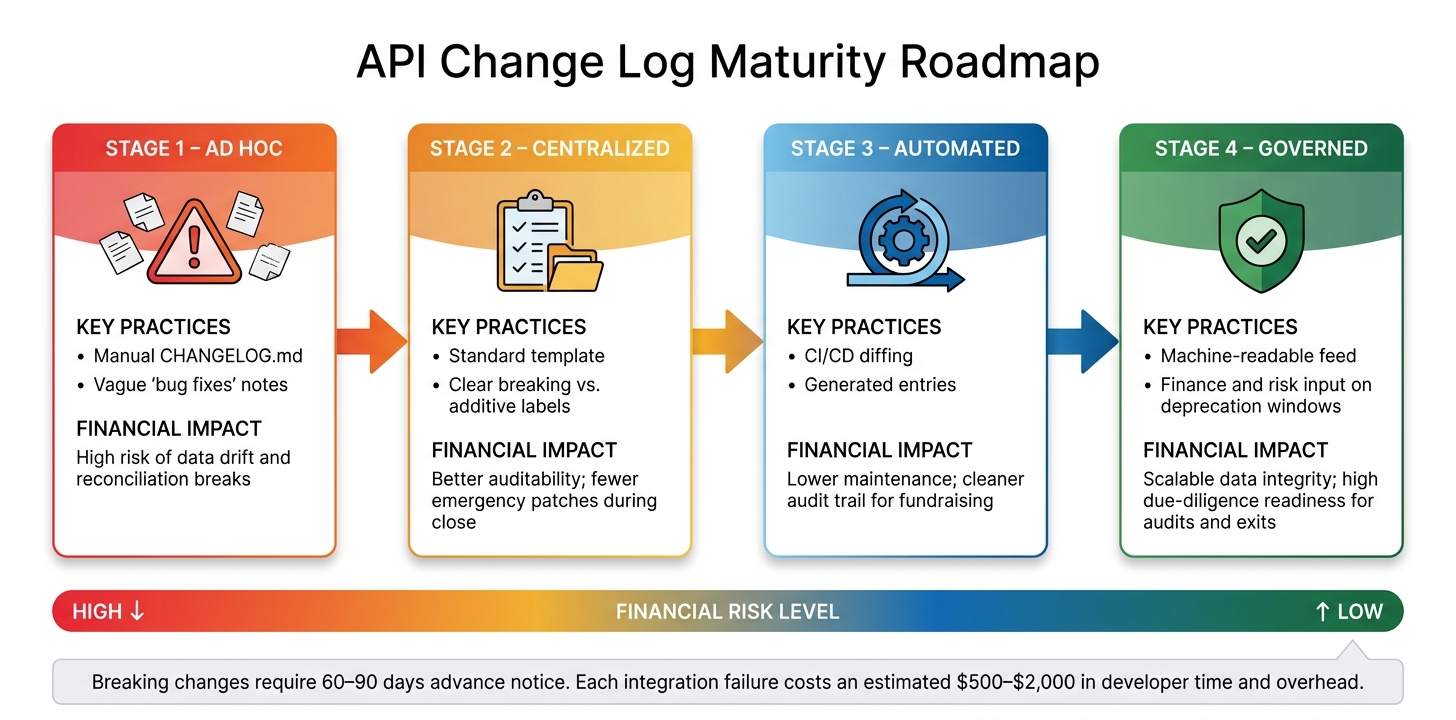
API Change Log Maturity Levels: From Ad Hoc to Governed
In finance operations, this kind of control matters most during close and reporting. API change logs aren't just notes for developers. They're a finance control.
During close, they help teams catch schema drift before it throws off FP&A models, KPI reporting, or cash flow forecasts. A unit change, a renamed billing path, or a different response shape might sound minor. In practice, it can skew cash flow forecasts and unit economics.
Take a billing API as an example. If it removes a discountCode field or renames a path, automated reconciliation and revenue recognition can break. That's the sort of issue that can slip in quietly and then cause a mess later.
Adding changelog review to close checklists and data quality checks gives teams a way to catch problems before they hurt audit readiness or exit prep. In plain English: finance, data, and engineering all need to own this together.
This only works if the process can happen the same way every time. Most companies start with a manual CHANGELOG.md that gets updated off and on. From there, the aim is to move from an ad hoc setup to a more automated, finance-aware process over time.
The path is pretty simple.
| Maturity Level | Key Practices | Financial Impact Profile |
|---|---|---|
| Ad Hoc | Manual CHANGELOG.md; vague "bug fixes" notes |
High risk of data drift and reconciliation breaks |
| Centralized | Standard template; clear breaking vs. additive labels | Better auditability; fewer emergency patches during close |
| Automated | CI/CD diffing and generated entries | Lower maintenance; cleaner audit trail for fundraising |
| Governed | Machine-readable feed; finance and risk input on deprecation windows | Scalable data integrity; high due-diligence readiness for audits and exits |
For companies getting ready for fundraising, an audit, or an exit, the governed level shows the kind of discipline buyers, investors, and auditors want to see. It shows that the business understands how its systems change and can explain how financial data changed over time.
The shift is straightforward: move from manual notes to governed, finance-aware change management. That's how teams protect reconciliations, audits, and reporting as systems keep changing.
An API change log is not the same thing as a system log. The two serve different jobs.
System logs record what happened inside a system. That usually includes access events, errors, and security activity. Teams use those records for troubleshooting, monitoring, and incident response.
An API change log records why the system changed. It tracks versioning, deprecations, and other modifications in a structured, human-readable format. That makes it easier to review updates, get approval, and communicate changes clearly to API consumers.
Reviewing API change logs should be a shared job. An API council or a set of named reviewers should sign off on change types and version numbers before release.
Technical writers help keep change logs clear and consistent. Engineering, product managers, and support teams should review them too, so deprecations, migrations, documentation updates, and user support stay aligned.
Treat this as a formal retirement of a feature, and walk customers through the change step by step. Add the update to your portal changelog and spell out what is changing, why it’s changing, and how to move over, with code examples that show the old path and the new one side by side.
Give people notice ahead of time through email and in-app messages. Use Deprecation and Sunset headers to make the timeline clear, keep legacy behavior in place during the support window, track adoption as customers move over, and update your reference docs at the same time.