Published on
December 24, 2025


Managing cash flow is easier when your systems talk to each other. API synchronization automates data sharing between banks, accounting software, and dashboards, keeping your financial data up-to-date in real-time. This eliminates manual tasks like downloading statements or reconciling spreadsheets, reducing errors and saving time.
Key benefits include:
APIs are transforming cash flow management by providing instant, reliable insights for faster decisions on payments, payroll, and forecasting.
API Sync vs File-Based Transfers: Key Differences in Cash Flow Management
API synchronization eliminates batch processing delays by securely transferring data almost instantly. This means finance teams can access up-to-the-minute cash balances and transaction details, which is critical when deciding whether to approve a major vendor payment or tap into a credit line.
By adopting an API-first strategy, companies can achieve complete visibility into their cash positions across all banks and accounts every single day [2]. For example, in 2023, Krispy Kreme implemented an API-driven cash management system to oversee $2 billion spread across multiple currencies and banking partners, including Wells Fargo. This shift allowed their treasury team to consolidate multi-bank data in just a few weeks, eliminating the need to log into various banking portals [2].
"Treasurers are using APIs to move from traditional manual processes to the treasury of tomorrow... corporates strive for real-time monitoring of cash flows, optimization of working capital and the flexibility to respond to rapid changes in the macro landscape."
- Mario Benedict, Head of APIs and Digital Product Solutions for EMEA, J.P. Morgan Wholesale Payments [2]
API synchronization doesn’t just provide real-time updates - it also simplifies financial workflows. In traditional setups, finance teams often juggle multiple bank portals, download files, and manually organize data in spreadsheets. This process is not only time-intensive but also prone to errors and version-control headaches. API-based payment systems, on the other hand, assign unique payment IDs, even for bulk transfers, eliminating the need for complicated batch reconciliations [2].
APIs aggregate data from various formats - such as BAI2, CAMT, JSON, and CSV - into a single, unified source. This automated parsing and normalization process does away with the need to resolve discrepancies between spreadsheets, freeing finance teams to focus on strategic analysis rather than tedious data preparation.
As transaction volumes grow, maintaining accuracy becomes increasingly challenging with manual processes. Errors in data entry or file handling can quickly multiply, especially for businesses managing thousands of transactions each month. API synchronization reduces this risk by establishing direct, automated connections between systems, effortlessly handling increased complexity without adding to staff workloads. This scalability is invaluable for growing companies.
"Since we started using Trovata, our treasury technology capabilities have completely transformed for the better. We have more time to focus on driving strategy and unlocking growth opportunities."
- James Krikorian, VP & Treasurer, Krispy Kreme [2]
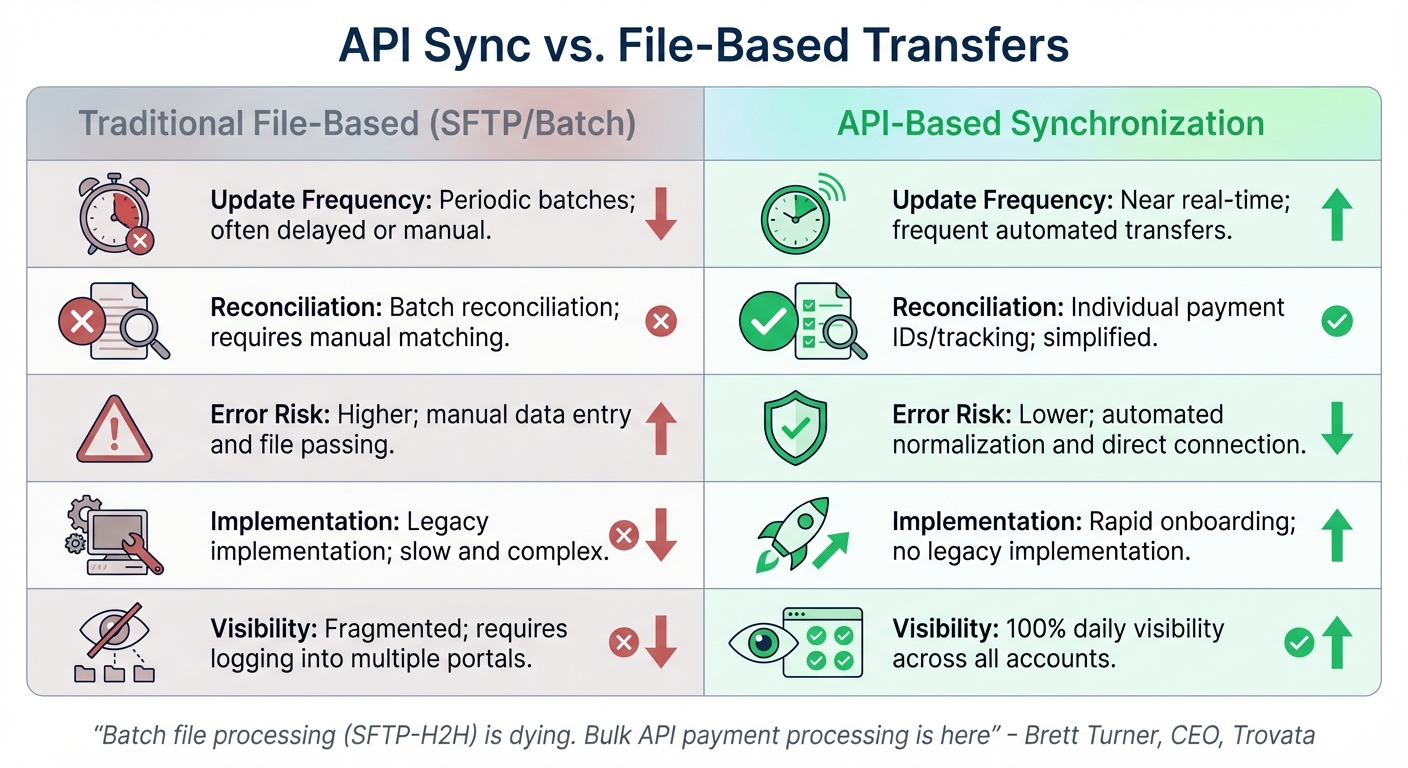
To better understand the advantages of API synchronization, let’s compare it to traditional file-based methods:
| Feature | Traditional File-Based (SFTP/Batch) | API-Based Synchronization |
|---|---|---|
| Update Frequency | Periodic batches; often delayed or manual | Near real-time; frequent automated transfers |
| Reconciliation | Batch reconciliation; requires manual matching | Individual payment IDs/tracking; simplified |
| Error Risk | Higher; manual data entry and file passing | Lower; automated normalization and direct connection |
| Implementation | Legacy implementation; slow and complex | Rapid onboarding; no legacy implementation |
| Visibility | Fragmented; requires logging into multiple portals | 100% daily visibility across all accounts |
The shift is undeniable. As Brett Turner, Founder and CEO of Trovata, aptly states:
"Batch file processing (SFTP-H2H) is dying. Bulk API payment processing is here" [2].
Treasurers are increasingly prioritizing banking partners with strong API capabilities, recognizing that banks lacking this functionality can hinder real-time visibility and proactive risk management.
When selecting APIs for your financial systems, it's crucial to choose ones that seamlessly integrate with your existing tools. Look for banking partners that use OAuth authentication, which allows for secure account verification and API token generation without needing to store raw credentials [5].
Banks offering real-time data access through APIs are becoming increasingly preferred over those still relying on outdated batch file systems. Similarly, your accounting software - whether it's a cloud-based solution like QuickBooks Online or Xero - should support API connections to ensure smooth integration.
In 2023, Puzzle, an accounting software company, showcased how effective API integration can be. By connecting with the BILL API platform, they enhanced their financial automation capabilities. Co-founder and CEO Sasha Orloff collaborated directly with developers to implement the integration in just two days. This quick turnaround allowed Puzzle to automate cash and accrual bookkeeping for its users, saving them significant time each month.
"It only took two days to get everything up and running, and we sent it out to our customers, immediately saving them hours every month closing the books."
- Sasha Orloff, Co-founder and CEO, Puzzle [6]
Once you've chosen compatible APIs, the next step is to ensure secure and reliable connections.
Securing your API connections is non-negotiable. Using OAuth authentication is a smart way to maintain access without storing sensitive credentials [5].
Set up connection parameters carefully to ensure that requests are routed to the correct provider [4]. A multi-tier synchronization schedule is recommended, starting with an initial sync to retrieve historical data (often up to five years). Following this, schedule automated daily updates and allow for on-demand syncs to provide real-time insights [3].
To keep everything running smoothly, monitor the health of your syncs through endpoints like /data/syncStatus. This lets you track the currentStatus of data transfers, so you can quickly address any failures or delays before they affect your dashboard [3][4]. Additionally, include logic to handle "409 Conflict" errors, which can occur when multiple on-demand sync requests overlap [3].
For extra functionality, balance-check APIs can be used to verify account funds before initiating transfers, helping to avoid non-sufficient funds (NSF) fees. For instance, the financial health app Brigit uses balance-check APIs to track user accounts in real time. This feature enables Brigit to send $250 interest-free advances to users at risk of overdrawing, saving them an average of $500 annually in NSF fees and interest [5].
After securing your connections, the next step is mapping the data fields to ensure accurate cash flow metrics.
To support accurate cash flow analysis, consolidate different bank data formats - such as BAI2, CAMT, JSON, and CSV - into a unified standard. Identify and define key fields like account numbers, balances, and transaction histories. Validate your mappings by checking synchronization statuses.
Balance data is crucial for monitoring liquidity, while transaction data provides insights for historical trends and categorization [3]. For forecasting, ensure historical data is mapped consistently across timeframes - monthly, quarterly, and yearly. This often involves retrieving up to five years of data to establish reliable patterns [3]. You can verify the effectiveness of your mapping by monitoring sync statuses and ensuring the lastSuccessfulReportId aligns with the lastReportId [3].
| Sync Status | Description | Action Required |
|---|---|---|
success |
Data fetched, extracted, and ready via API. | No action needed; mapping is functional. |
empty |
No data found for the specified period or type. | Check date ranges or account activity. |
failed |
An error occurred during data extraction. | Re-authorize the connection or investigate changes. |
pending |
Data extraction is still in progress. | Wait for completion before validating metrics. |
Before launching your dashboard, thoroughly test the synchronization process. Verify that API connections are secure and data mappings are accurate.
Use the GET /data/syncStatus endpoint to monitor the currentStatus of each data type. A "success" status indicates that the data has been fetched and is ready for use [3][4]. Double-check that the lastSuccessfulReportId matches the lastReportId to confirm the most recent sync completed without issues [3]. Additionally, review the meta object in API responses to ensure parameters like startDate, endDate, currency, and businessName align with your setup [4].
To streamline operations, implement webhook monitoring so "success" events automatically trigger upon sync completion. This reduces the need for constant manual checks [3]. During the initial setup, confirm that the system successfully retrieves the full scope of historical data - up to five years of monthly, quarterly, and yearly reports [3].
API sync is a game-changer for cash flow dashboards, offering faster and more reliable ways to manage finances. By leveraging API synchronization, businesses can streamline their operations in several impactful ways.
Gone are the days of logging into multiple banking portals or manually downloading and organizing transaction data. With API sync, webhooks and streaming APIs provide near real-time updates, instantly reflecting transactions as they happen [2][7].
For example, when a customer makes a payment, the API immediately records it and updates your dashboard - no manual input required. This is especially valuable for businesses with high transaction volumes, where manual tracking becomes impractical. APIs also convert different data formats into a standardized structure, seamlessly integrating with accounting or ERP systems [2][7].
This automation not only saves time but also improves efficiency in managing receivables and payables.
API sync revolutionizes how businesses handle accounts receivable and payable by connecting ERP systems like Sage or Oracle NetSuite directly to banking platforms [2]. When a payment is received, the API matches it to the correct invoice and updates both your accounts receivable and cash accounts. No more manual spreadsheet updates [7].
With real-time updates, businesses can ensure vendor payments are on schedule and receivables are collected more quickly. AI tools further enhance this by analyzing transaction details - such as amounts, dates, and descriptions - to identify matches in the general ledger. Confidence scores are assigned to automate postings for high-confidence matches [7].
This frees up treasury teams to focus on strategic tasks while improving cash flow forecasting accuracy.
Accurate forecasts depend on having consolidated, real-time data from multiple sources. API sync simplifies this by pulling normalized transaction and balance data into a single, unified dataset. This historical data, often spanning several years, enables machine-learning algorithms to identify trends and predict future cash positions with greater accuracy.
Real-time access to cash flow data also allows treasury teams to move idle funds between accounts, avoiding overdraft fees or making short-term investments [7].
"Treasurers are using APIs to move from traditional manual processes to the treasury of tomorrow... automation and digital transformation are more necessary than ever as corporates strive for real-time monitoring of cash flows, optimization of working capital and the flexibility to respond to rapid changes in the macro landscape." - Mario Benedict, Head of APIs and Digital Product Solutions for EMEA, J.P. Morgan Wholesale Payments [2]
This level of forecasting precision enables businesses to consolidate accounts for a clearer financial picture.
For companies managing multiple bank accounts or entities, API sync offers a centralized solution. Instead of logging into separate banking portals, APIs aggregate and standardize data from all accounts into one dashboard [2][7]. This provides a complete view of global cash flow, including balances across various banks and currencies.
With API-driven cash management, businesses can achieve 100% daily visibility of their cash across all accounts [2]. The automated data normalization process ensures scalability, making it an ideal solution for growing companies where traditional spreadsheet methods often become bottlenecks. This consolidation empowers faster, more strategic decision-making as transaction volumes increase.
Setting up API sync is just the beginning. To keep your integration running smoothly, you need ongoing monitoring and proactive management.
Keep a close eye on your API's performance by using the /data/syncStatus endpoint and webhook listeners. These tools provide real-time updates on sync statuses, such as pending (extraction happening), success (data is ready), empty (no data found), and failed (an error occurred). Webhook listeners are especially useful for triggering instant dashboard updates or quickly addressing issues. Regularly auditing webhook logs through your dashboard can help you spot patterns or pinpoint specific data types - like invoices or transactions - that might be causing trouble. These steps ensure you’re always ready to tackle problems as they arise.
Sync errors often occur due to expired service authorizations, connectivity hiccups, or provider maintenance. To avoid issues like "409 Conflict" errors, which happen when a new sync overlaps with an ongoing one for the same data type, ensure timely re-authentication and proper scheduling. If you encounter an empty status, double-check that the source system actually has data for the specified time period before assuming there’s an issue. Once errors are addressed, you can shift your focus to optimizing sync processes to handle growth.
As your transaction volume grows, syncing entire datasets might not be practical. Instead, refine your approach by syncing at the Data Type Level (e.g., just invoices or accounts) or Connection Level (specific banking or accounting providers). For routine updates, daily automated syncs work well, while on-demand syncs are ideal for critical reporting. Keep in mind that on-premise software like QuickBooks Desktop may not support on-demand synchronization, requiring a different maintenance plan compared to cloud-based APIs.
To maintain security, implement Role-Based Access Control (RBAC) to restrict manual sync triggers to authorized users. Additionally, automate financial workflows to initiate only after receiving a success webhook event. For banking syncs, adjust your monitoring approach, as these rely on provider alerts rather than fixed schedules. Regularly reviewing failed syncs and re-authorizing services when needed will help keep your API sync secure and compliant.
API-based synchronization is transforming how businesses in the US manage cash flow, offering real-time connections between banks, payment platforms, and accounting systems. This instant access to accurate USD cash flow data empowers businesses to make quicker decisions on payroll, vendor payments, and cash allocation - no more relying on outdated figures.
But it’s not just about speed. The precision of API syncing eliminates the need for manual CSV uploads and data entry, significantly reducing reconciliation errors. For instance, a manufacturing company managed to cut its month-end close time by 50% by automating processes like invoices, payments, and general ledger entries [1]. This level of accuracy lays the groundwork for effortless scaling.
As your business grows, APIs make scaling smoother. Whether you're handling higher transaction volumes, adding new payment methods, or managing multi-entity operations, APIs ensure seamless data flow across systems. They consolidate everything into a unified dashboard, maintaining performance and clarity.
On top of that, modern APIs strengthen security with features like authentication, encryption, and detailed audit trails. Every sync is logged and monitored, simplifying compliance with both internal controls and external regulations.
With enhanced visibility, precision, scalability, and security, the next steps are straightforward. Start by evaluating your banking and accounting APIs, run a pilot program with one bank, and then expand your integration. Phoenix Strategy Group offers the technical know-how and strategic financial support to help growth-focused companies design effective cash flow models, configure APIs, and turn real-time data into actionable insights tailored to fundraising and long-term goals.
API synchronization enhances the precision of cash flow dashboards by seamlessly importing and standardizing financial data in real time. This automation removes the need for manual data entry, minimizing the chances of human error and ensuring the dashboard consistently displays the latest information.
By relying on accurate and up-to-date data, businesses can make smarter financial decisions, streamline cash flow management, and spot trends or potential issues with greater efficiency.
API synchronization can play a huge role in improving cash flow dashboards, but keeping sensitive financial data secure is non-negotiable. Here are some critical practices to ensure robust security:
By putting these measures in place, businesses can keep their dashboards secure, ensure data accuracy, and meet compliance requirements under U.S. financial regulations.
Scaling an API integration is all about making sure your system can handle increasing transaction volumes without sacrificing speed or accuracy. It means building a data integration process that can grow alongside your business. According to Phoenix Strategy Group, modern APIs are built to handle heavier workloads with ease, making them a strong choice for powering cash flow dashboards.
To make scaling work, there are a few strategies worth prioritizing:
Adding real-time updates and automated data validation into the mix ensures your dashboards remain accurate and up-to-date, even as transaction volumes climb.
By following these steps, businesses can create API integrations that scale seamlessly, keeping cash flow dashboards efficient, dependable, and ready for growth.