Published on
February 13, 2026

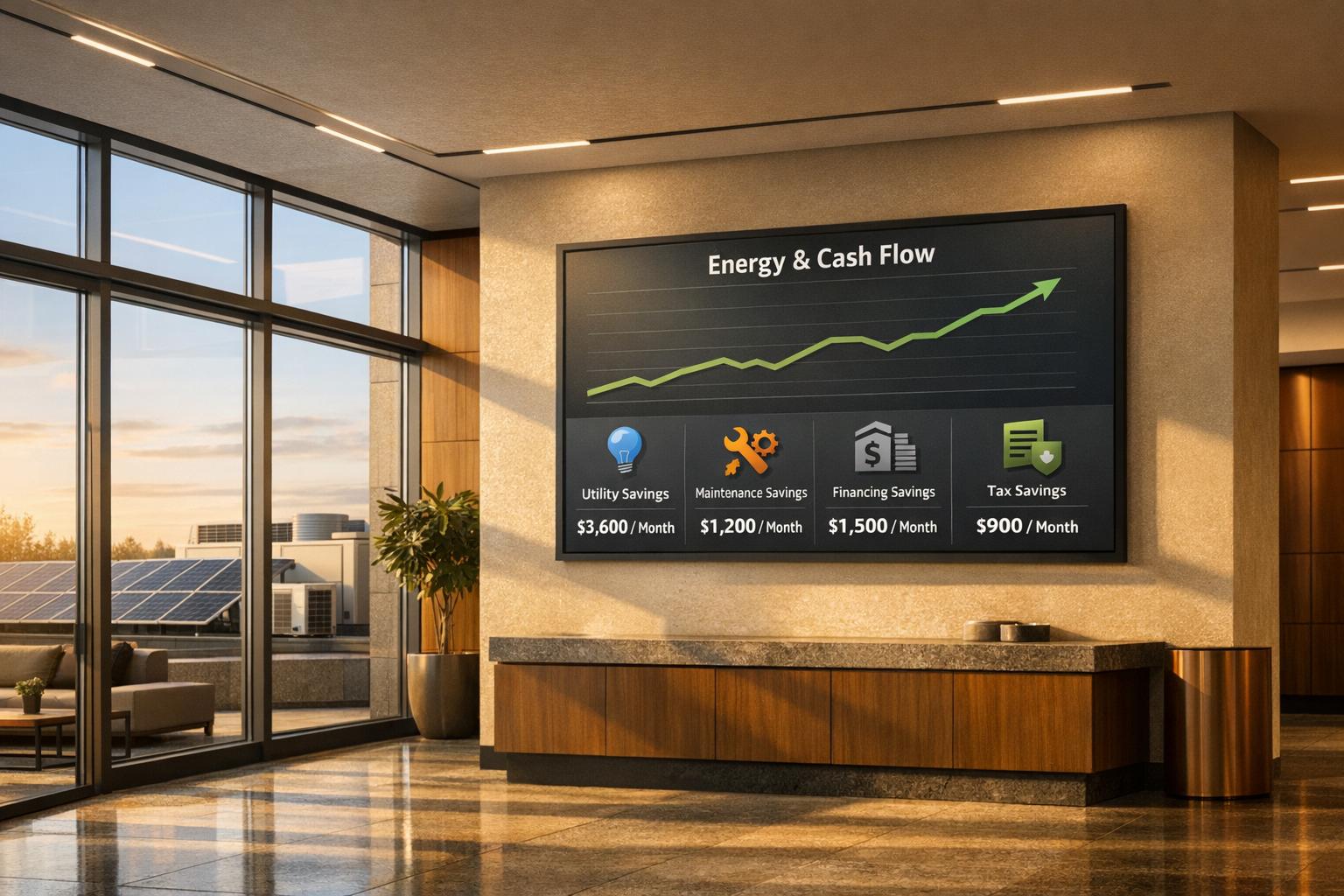
Energy-efficient facilities save money, reduce waste, and improve cash flow. For businesses, this means cutting utility costs, lowering maintenance expenses, and even securing better financing terms. Here's the key takeaway: upgrading to energy-efficient systems isn't just about saving energy - it directly improves your bottom line.
Act now: Delaying upgrades increases energy waste, costing businesses thousands every year. Tools like ENERGY STAR calculators and financing options - like CPACE or on-bill financing - can make upgrades affordable and cash flow positive from day one.
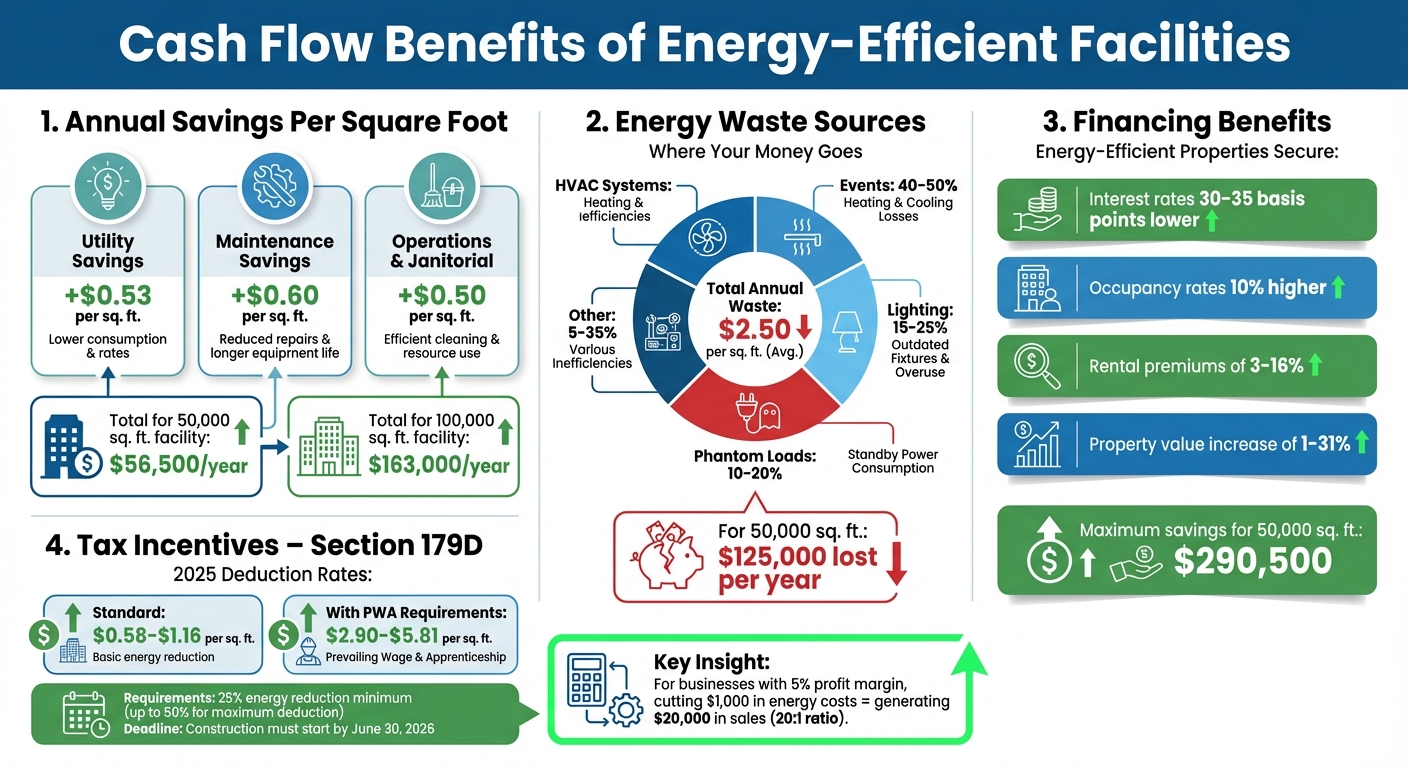
Cash Flow Benefits of Energy-Efficient Facilities: Annual Savings Breakdown
Energy bills are a direct hit to your cash reserves. Unlike expenses like depreciation, utility costs are real, out-of-pocket expenses that chip away at your cash flow every single month. For many businesses, utilities and maintenance alone eat up 6% to 15% of total operational expenses [3]. That’s money that could be reinvested into hiring, upgrading equipment, or expanding your market reach.
But the problem doesn’t stop there. Inefficient facilities often face higher financing costs because lenders see them as riskier investments. This risk premium raises borrowing costs, putting even more pressure on your cash flow. On top of that, these facilities tend to have lower occupancy rates and reduced rental income, creating a financial squeeze from multiple angles. When utility costs spike during peak seasons, businesses may have to delay growth plans or rely on credit just to stay afloat.
Pinpointing where energy is being wasted is the first step toward addressing these costly inefficiencies.
HVAC systems are the biggest energy hogs, accounting for 40% to 50% of commercial energy use [4]. Waste happens when systems run during off-hours, use inefficient temperature settings, or rely on outdated equipment that strains to perform. Running HVAC systems unnecessarily during vacant periods can drain significant cash.
Lighting is another major expense, consuming 15% to 25% of energy budgets [4]. Then there are phantom loads - things like idle office equipment, vending machines, and computers left on overnight. These can add another 10% to 20% to energy consumption [4]. Altogether, most commercial buildings waste about 25% of their energy through inefficiencies [4].
The building envelope - which includes insulation and windows - also contributes to hidden costs. Poor insulation and unshaded windows force HVAC systems to work overtime to compensate for heat loss or gain, driving up energy use and wear on equipment. On average, commercial buildings lose $2.50 per square foot annually due to energy inefficiencies [4]. For a 50,000-square-foot facility, that’s a staggering $125,000 in yearly losses - money that could be redirected toward meaningful business investments.
Addressing these inefficiencies isn’t just about reducing energy waste - it’s about reclaiming cash that can drive your business forward.
Under Section 179D, businesses can claim up to $5.81 per square foot in 2025 for energy-efficient upgrades. For a 50,000-square-foot facility, this could mean savings of $290,500, provided the project meets prevailing wage and apprenticeship standards [5].
Eligible upgrades cover a range of improvements, including interior lighting, HVAC systems, hot water systems, and building envelope enhancements like insulation and upgraded windows [5]. To qualify, projects must reduce energy costs by at least 25% compared to ASHRAE 90.1 standards. The higher the energy savings - up to a 50% reduction - the greater the deduction [5].
Key deadline: Construction must start by June 30, 2026, under the One Big Beautiful Bill Act [5].
| Tax Year | Standard Deduction (per sq. ft.) | Deduction with PWA Requirements (per sq. ft.) |
|---|---|---|
| 2023 | $0.50–$1.00 | $2.50–$5.00 |
| 2024 | $0.57–$1.13 | $2.83–$5.65 |
| 2025 | $0.58–$1.16 | $2.90–$5.81 |
Even non-profits and tax-exempt organizations can benefit. These entities can allocate the deduction to project designers - architects, engineers, or contractors - who may lower their fees or donate the savings back to the organization [6].
In addition to tax incentives, creative financing solutions can make these upgrades affordable, sometimes even generating income.
On-bill financing allows businesses to fund energy upgrades through their utility bills with little or no upfront costs. The capital is provided by utilities or private lenders and repaid through monthly charges that are typically less than the savings achieved [7][8].
Commercial Property Assessed Clean Energy (CPACE) financing ties the loan to your property taxes instead of your credit. This means the debt stays with the property if sold, making it ideal for long-term investments. CPACE loans typically have terms of 10 to 20 years and can often remain off your balance sheet [7][8]. For example, in September 2023, Prologis, Inc. used CPACE financing to retrofit its San Francisco headquarters, cutting electricity use by 32% and saving nearly $100,000 annually [7].
Energy Savings Performance Contracts (ESPC) shift the financial risk to an Energy Service Company (ESCO). The ESCO handles everything - from design to maintenance - and guarantees energy savings will cover financing costs. If savings fall short, the ESCO reimburses the difference [7][8]. BAE Systems leveraged this model with Metrus Energy to retrofit facilities nationwide without any upfront costs [7].
ENERGY STAR highlights that most well-designed efficiency projects are fundable [8], making these strategies a smart way to free up capital for business growth. Many companies utilize fractional CFO services to manage these complex financing structures and reinvest the resulting savings into high-growth initiatives.
Energy-efficient upgrades don’t just offer immediate benefits - they also deliver lasting financial gains through green building standards.
Energy certifications like ENERGY STAR and LEED can significantly boost property value and financing terms. Certified buildings often secure lower mortgage rates and higher rental incomes. For instance, ENERGY STAR and LEED-certified buildings command rental premiums of 3% to 16% and achieve occupancy rates up to 10% higher [1]. When sold, these properties can fetch prices that are 1% to 31% higher [1].
Financing costs drop as well. Buildings with ENERGY STAR labels typically secure mortgage interest rates that are 30 to 35 basis points lower than non-labeled buildings. On a $5 million loan, this could translate to roughly $15,000 in annual interest savings.
These long-term savings enhance cash flow year after year, making facilities more valuable and easier to finance. This, in turn, frees up resources for scaling operations and driving business expansion.
When you look at the numbers, the gap between conventional buildings and energy-efficient ones is striking. Energy-efficient buildings can deliver impressive utility savings, while also cutting $0.60 per square foot annually on operations and maintenance costs and $0.50 per square foot on janitorial expenses [1]. For a 100,000-square-foot facility, those savings translate to a hefty $163,000 per year, directly improving cash flow, a process often optimized by a fractional CFO. On top of that, energy-efficient buildings often qualify for lower mortgage interest rates compared to non-labeled properties, further strengthening their financial advantage [1].
Delaying energy upgrades comes at a cost. Every month of inaction means higher energy bills - money that could have been used to invest in new equipment or expand operations. These unnecessary expenses drain resources that could otherwise fuel business growth [2][9]. Now, let’s dive into the tools that help quantify these cash flow benefits.
Accurately measuring the financial benefits of energy efficiency requires specialized tools. One such tool is the ENERGY STAR Cash Flow Opportunity (CFO) Calculator. This Excel-based resource helps businesses figure out how much new equipment they can finance purely through energy savings [2][12]. By treating the operating budget as a "revenue source", it shows how reallocating energy savings can cover financing costs. It even helps determine whether taking a loan today would cost less than continuing to waste money on inefficient energy use [2][12].
For commercial real estate, the Building Upgrade Value Calculator (BUVC) tackles the tricky issue of split incentives - where building owners pay for upgrades, but tenants reap the benefits of lower operating costs [2][11]. This tool breaks down how energy savings reduce tenant expenses under different lease types, such as triple net, modified gross, and full-service gross leases. It even generates customized letters that landlords can use to show tenants how upgrades will lower their share of operating costs [11]. These tools provide clear, actionable insights, making it easier for businesses to see how energy efficiency directly boosts cash flow and supports long-term growth.
When it comes to long-term financial planning, the savings from energy-efficient upgrades shouldn't just be seen as an occasional bonus - they should be treated as an integral part of your financial strategy. Many businesses make the mistake of viewing these savings as a recurring cash flow without leveraging them strategically. By treating your operating budget as a potential revenue source, you open the door to smarter planning opportunities [10].
Think of energy waste as a monthly penalty draining your cash flow. For a business with a 5% net profit margin, cutting $1,000 in energy costs is equivalent to generating an additional $20,000 in sales. That’s a 20:1 ratio, underscoring why financial planning should focus on metrics like the Internal Rate of Return (IRR) rather than just payback periods [13].
Energy efficiency doesn’t just save money - it also reduces your exposure to fluctuating energy prices, making cash flow forecasts more stable. Plus, it can boost your facility's market value by about 10% while enhancing your credit profile, creating a solid foundation for sustainable growth [14]. Industrial plants, which consume nearly 32% of U.S. energy, illustrate the vast potential of these savings [13].
To turn these savings into predictable revenue streams, businesses need robust tracking systems. That’s where Phoenix Strategy Group steps in.

Tracking energy savings effectively requires financial systems that clearly link reduced energy use to measurable dollar impacts on your cash flow and profitability. Phoenix Strategy Group offers FP&A (Financial Planning and Analysis) and cash flow forecasting services tailored to help growth-stage businesses quantify how energy efficiency projects bolster their bottom line [2].
Their analysis goes beyond simple calculations, evaluating whether financing upgrades now can deliver better returns than waiting for a future budget cycle. By factoring anticipated energy savings directly into financial plans, businesses can treat reduced utility costs as a reliable revenue stream to support debt repayment [10]. Financing strategies that produce net-positive cash flow - where energy savings exceed loan payments - can immediately improve cash flow without requiring upfront investments [13].
Phoenix Strategy Group also tackles split incentive challenges often found in commercial lease agreements [2]. Their economic evaluations calculate how much new energy-efficient equipment can be funded purely through the savings it generates. This ensures that efficiency upgrades yield measurable, long-term financial benefits, aligning with broader cash flow optimization goals [2].
Energy efficiency offers a straightforward way to improve cash flow. By reducing utility and operating costs, energy-efficient upgrades free up funds that can be reinvested into key areas like product development, market expansion, or daily operations [1]. For growth-stage businesses, where margins can be tight, these savings make a real difference.
But the benefits don’t stop at lower utility bills. Energy-efficient facilities often command higher market valuations and can secure more favorable financing terms [1]. With operational costs typically accounting for 6%–15% of total expenses [3], cutting these costs directly boosts cash flow in a meaningful way.
The real advantage comes from strategic financial planning. When businesses view energy savings as a predictable revenue stream rather than a one-off bonus, they can structure financing that essentially pays for itself while improving cash flow right away. Waiting to make these upgrades only prolongs unnecessary energy waste, draining resources that could fuel growth.
By incorporating energy savings into financial strategies, businesses can turn temporary cost reductions into a steady source of revenue. Phoenix Strategy Group’s FP&A and cash flow forecasting services help businesses pinpoint the financial impact of energy efficiency projects, ensuring these savings contribute directly to long-term financial health.
In the words of ENERGY STAR:
"Energy efficiency remains the single most cost-effective way to cut energy use in buildings." [1]
Energy efficiency isn’t just about cutting costs - it’s about building a stronger, more sustainable financial foundation.
Upgrades such as high-efficiency lighting, modern HVAC systems, and variable frequency drives can quickly boost cash flow by cutting down on energy use and lowering operational expenses. These adjustments often lead to immediate cost savings, which can be a game-changer for businesses in their growth phase, helping to improve overall profitability.
To figure out if an upgrade will generate positive cash flow after financing, start by estimating potential savings. Tools like the ENERGY STAR Cash Flow Opportunity Calculator can help with this. Once you have the savings estimate, compare it to the financing costs to determine if the savings will cover or exceed those expenses.
Also, think about timing - would financing now or waiting for potentially better rates align better with your financial goals? Taking this step-by-step approach helps ensure you fully understand the financial impact of the upgrade before moving forward.
To qualify for the Section 179D deduction in 2025, the property needs to meet a few key criteria. It must be energy-efficient, located within the United States, and comply with specific energy savings standards. The deduction amount depends on the level of energy savings achieved, ranging from $0.58 per square foot for 25% savings to $1.16 per square foot for 54% savings. Additionally, construction must start before July 1, 2026, to qualify.