Published on
February 23, 2026


Audit readiness is critical for SaaS companies, especially given the complexities of subscription-based revenue and compliance with ASC 606. Missteps in revenue recognition, scattered data systems, and weak compliance documentation can lead to audit delays, regulatory penalties, and lost investor trust. Here's what you need to know:
To succeed, SaaS companies must streamline systems, automate processes, and conduct mock audits. Proactive planning, clear documentation, and automated tools are key to maintaining financial clarity and securing investor confidence.
SaaS companies face several hurdles when it comes to audit readiness. Three key challenges often stand out: the complexity of revenue recognition, scattered data systems, and gaps in compliance documentation. Overcoming these issues is critical to avoiding audit delays, maintaining investor confidence, and steering clear of regulatory trouble.
The ASC 606 standard requires companies to recognize revenue as services are delivered, not when payments are received. For example, a $360,000 annual contract paid upfront must be spread out and recognized monthly over 12 months. However, some finance teams mistakenly record the entire amount immediately, which can raise red flags during an audit [5].
Things get even trickier with bundled services. A typical SaaS contract might include software access, training, implementation, and premium support. To comply with ASC 606, these components must be unbundled and valued separately based on the Standalone Selling Price (SSP) [5][4]. If a company can't clearly document how it allocated the contract's value across these components, auditors may delay their approval.
Variable pricing adds another layer of difficulty. Fees based on usage, tiered pricing models, or performance bonuses require careful estimation, often using methods like "expected value" or "most likely amount." Auditors examine these calculations closely [5]. As Arron Bennett, Strategic CFO, puts it:
"The issue isn't the accounting standard. It's the data feeding it" [5].
Contract changes - such as mid-term upgrades, downgrades, or added seats - also complicate things. For instance, if a $10,000 contract is upgraded mid-year to $15,000, the additional $5,000 must be allocated across the remaining months [5]. Without a clear audit trail, deferred revenue balances might not match. A $360,000 contract with a 15% first-year discount can create an $18,000 discrepancy if the discount is recorded in the CRM but left out of the billing system [10].
"Revenue recognition software handles calculations fine. But it assumes the inputs are correct. For most SaaS companies, they aren't." – Safebooks [10]
Data fragmentation is another major challenge. SaaS companies often rely on six to ten different systems - Salesforce for CRM, Stripe or Chargebee for billing, NetSuite or QuickBooks for ERP, and various HR and procurement tools. When these systems don’t sync, they produce conflicting records for the same transactions, creating headaches for auditors [10][11].
For example, a discount listed in a signed contract might not appear in the billing system, or a customer upgrade might show up in Salesforce but not in the revenue recognition software. These inconsistencies can undermine even the best automation tools [10].
Shadow IT makes things worse. Employees often adopt tools independently - marketing teams might use HubSpot, sales teams might prefer Gong, and engineering teams might rely on Jira. These tools often lack proper security checks and centralized documentation, making it hard to provide auditors with a unified view of the company’s operations [12][13]. Manual processes during onboarding or offboarding can also lead to "orphaned" accounts or undocumented changes [11]. With departments managing their own software stacks, no single team oversees everything, leaving finance teams scrambling to trace revenue back to its source in less than 10 minutes - a standard auditors now expect [10][7].
Compliance with frameworks like SOC 2, GDPR, and CCPA is a must for SaaS companies dealing with enterprise clients and investors. Yet, nearly half (47.9%) of organizations struggle to gather the necessary evidence for these audits [14]. The problem often isn’t a lack of controls but the inability to prove they exist and are functioning as intended.
Manual evidence collection slows everything down, pulling experts away from their regular tasks [14]. For companies operating in multiple regions, differing regulations add another layer of complexity. A staggering 76% of CISOs report that this regulatory patchwork significantly hampers their efforts [14]. Meanwhile, only 17% of organizations comply with country-specific data security and privacy laws [14].
Data silos further complicate things, making it hard for CISOs to give boards a clear picture of organizational risks. Conflicting compliance statuses across systems can signal operational weaknesses to investors, potentially delaying fundraising or lowering valuations. Companies that manage risk reactively are particularly vulnerable - 60% experienced a data breach in 2024, compared to 41% of those using integrated, automated GRC (governance, risk, and compliance) tools [14].
In many cases, audit failures don’t stem from incorrect accounting but from the inability to provide evidence that supports specific treatments or controls. Closing these gaps is essential for building a solid audit readiness plan that ensures financial transparency and trustworthiness.
To address the challenges discussed earlier, it's crucial to evaluate compliance risks and identify system weaknesses. This involves reviewing relevant regulations, conducting mock audits, and mapping data flows to catch potential issues before auditors do.
SaaS companies face a complex regulatory landscape, which can generally be divided into three categories: Financial (e.g., ASC 606, GAAP/IFRS, SOX), Security (e.g., SOC 2, ISO 27001, PCI DSS), and Data Privacy (e.g., GDPR, CCPA, HIPAA) [15][16]. Each category serves a unique purpose - financial regulations ensure accurate revenue reporting and fraud prevention, security standards protect systems and sensitive data, and privacy laws govern the handling of personal information.
On average, enterprise SaaS companies must comply with 13 different regulatory frameworks and standards [19]. Keeping up can be overwhelming, especially with regulatory updates increasing by approximately 300% since 2010 [19]. To simplify, consider creating a unified compliance taxonomy. This approach consolidates requirements across multiple frameworks, allowing you to meet diverse regulations with a single set of controls and evidence [19].
Once this unified framework is in place, mock audits become a powerful tool for identifying operational vulnerabilities.
Mock audits simulate real audits, giving you a chance to identify and address issues before official auditors step in [4]. These reviews should focus on four key risk areas: Compliance (e.g., keeping up with regulatory changes), Security (e.g., preventing data breaches), Operational (e.g., minimizing system downtime), and Financial (e.g., avoiding revenue misreporting) [15].
"An audit shouldn't feel like a final exam you didn't study for. With the right preparation, it can be a smooth and straightforward process." - GuzmanGray [3]
Start by testing transactions, tracing each sale from contract to payment to ensure compliance with ASC 606 [18]. Use cut-off testing to confirm that transactions are recorded in the correct accounting period, avoiding any manipulation of financial results [18]. Assess employee security practices, such as the use of personal accounts, adherence to privilege levels, and implementation of multi-factor authentication (MFA) [17]. Companies with advanced compliance tracking systems are 56% less likely to face significant penalties and report 23% fewer business disruptions [19].
After completing mock audits, map your data flows to assign risk scores and measure compliance gaps.
Data flow mapping helps you visualize how information moves through your systems - where it's collected, stored, and accessed. Break down data into its three states: at rest (stored in the cloud), in use (accessed by users), and in transit (moving between systems) [17]. This practice highlights vulnerabilities and ensures adherence to privacy laws like GDPR and CCPA [15].
Track data across all integrated tools, such as billing systems, CRM platforms, and third-party vendors, with a focus on personally identifiable information (PII) and financial data [9]. Build a centralized controls library that maps each control to specific regulatory requirements and integrates automated monitoring tools [19]. Use risk-weighted metrics to clearly illustrate your compliance status and potential cost implications [19]. Continuous monitoring can detect compliance issues 71% faster and slash remediation costs by 48% [19].
For example, Snowflake's CISO implemented a continuous compliance program that standardized evidence collection across teams, cutting audit preparation time by 62% and enabling entry into regulated markets [19]. Similarly, Atlassian reduced audit response time by 71% and cut audit-related resource needs by 40% by using an integrated audit management platform [19].
Once compliance gaps are identified, the next step is creating a detailed roadmap to address them. A compliance roadmap takes audit findings and translates them into actionable plans with realistic timelines. Without this structured approach, teams may find themselves rushing at the last minute, leading to missed deadlines and incomplete documentation.
Begin with a gap analysis to compare your current practices against regulatory requirements like ASC 606, SOC 2, and GDPR [20]. Use this analysis to document deficiencies and rank tasks based on risk, urgency, and dependencies [20][22]. For example, high-risk gaps such as missing revenue recognition policies or weak access controls should be tackled first.
To streamline efforts, use a unified compliance taxonomy. This approach aligns requirements across frameworks, cutting management costs by up to 30% and improving audit readiness by 40% [19]. Plan ahead by mapping all audit obligations for the next 12–24 months to avoid resource conflicts [19][21].
Assign clear responsibilities using a RACI matrix (Responsible, Accountable, Consulted, Informed). This ensures that every compliance control has a designated owner [21]. Key roles include an Audit Lead for overall coordination, Technical Leads to prepare evidence, and a Compliance Officer to oversee regulatory adherence. Establish a task timeline at intervals of 60, 30, 14, and 7 days before the audit, starting with defining the scope and ending with final system checks [21].
With priorities and roles in place, the next step is to formalize these efforts by updating policies and training your team.
Using the prioritized actions as a guide, update your company’s policies to provide clear instructions. For instance, create detailed policies on how to implement ASC 606's five-step model [3]. Ensure all critical policies are updated at least 30 days before the audit begins [21].
Next, train your teams - especially those in finance, sales, and product departments - on the updated standards. Focus on areas like handling contract modifications and bundled services [4]. The high cost of non-compliance is evident: regulators issued about €1.2 billion in GDPR fines across Europe in 2024 [23]. Make sure your team understands key data privacy requirements, including explicit consent for data collection and GDPR's 72-hour breach notification rule [23].
Internal controls serve as the backbone of compliance by ensuring checks and balances are in place. For example, establish segregation of duties so that the person booking a sale isn’t the same person recognizing the revenue [4][15]. Require secondary reviews for non-standard contracts and enforce least-privilege access restrictions so only authorized personnel can access sensitive data [4][15].
To meet SOC 2 and ISO 27001 standards, implement Multi-Factor Authentication (MFA) and Role-Based Access Control (RBAC) [23]. Automate logging for audit trails to ensure tamper-proof records of all system activity [15]. Maintain a single, version-controlled evidence repository, organized by framework for easy access [21].
Regularly conduct spot checks on contracts and controls to catch potential issues before they escalate [4][15]. Set Service Level Objectives (SLOs) for audit reporting, such as ensuring 95% of evidence is accessible within 24 hours of a request [21]. These internal controls not only address previously identified compliance challenges but also turn audit readiness into an ongoing, manageable process instead of a last-minute scramble.
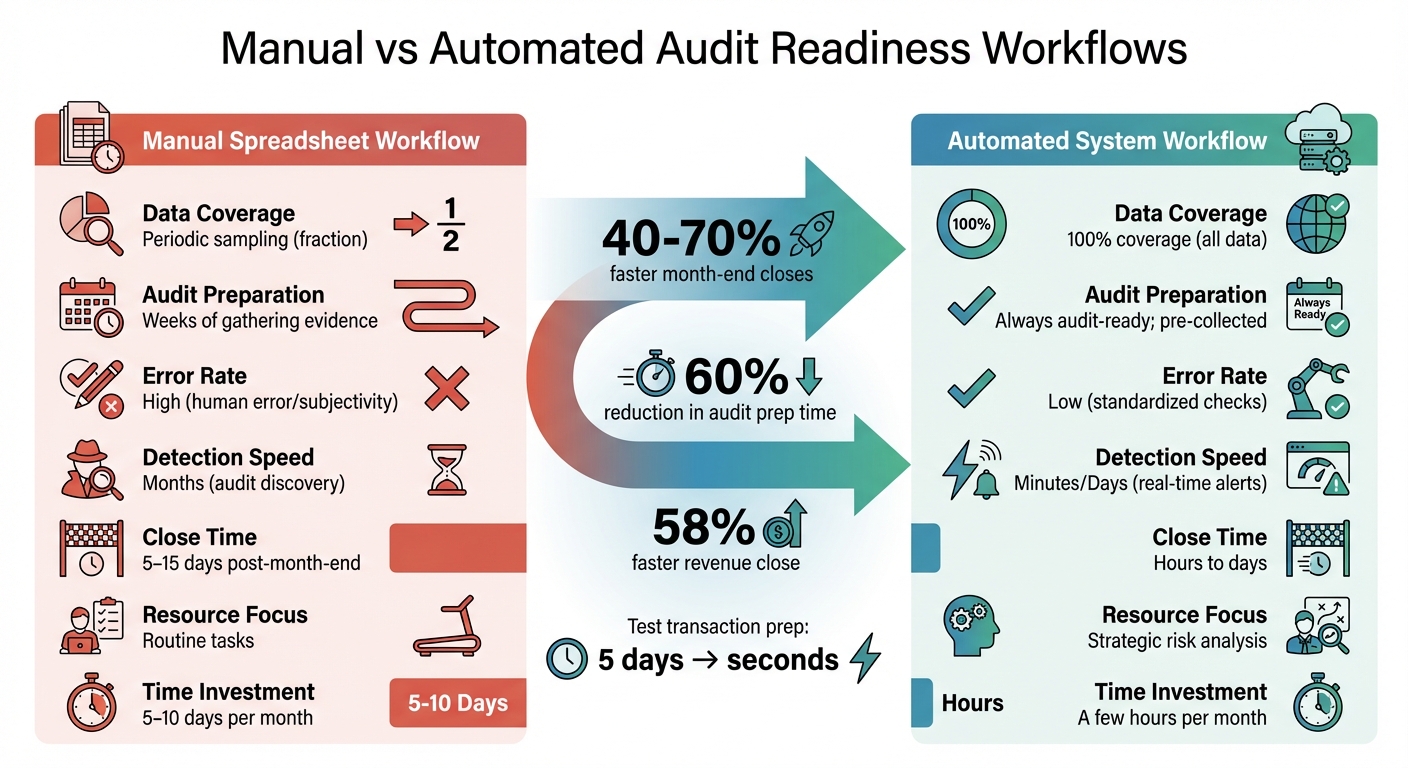
Manual vs Automated Audit Readiness Workflows for SaaS Companies
Handling compliance manually can eat up 5–10 days every month, but automation cuts that down to just a few hours [30]. By adopting the right systems, SaaS companies can move from last-minute compliance chaos to a state of continuous audit readiness. This transition not only speeds up financial workflows but also sets the stage for proactive compliance monitoring.
One of the biggest wins from automation is in ASC 606 revenue recognition. By connecting your CRM, billing, and ERP systems, you create a unified source of truth [8][30][33]. These integrated systems handle the entire five-step ASC 606 process - from identifying performance obligations to allocating transaction prices based on the Standalone Selling Price (SSP) [3][30][33]. Any changes, like upgrades, downgrades, or cancellations, are automatically reflected with real-time revenue schedule updates, eliminating the need for manual intervention [8][30][33].
For SaaS finance teams, automation means faster month-end closes. Teams using automated platforms often close their books 40% to 70% faster than those relying on spreadsheets [31]. These systems generate journal entries, reconcile subledgers nightly, and provide CFOs with real-time insights into recognized revenue, deferred balances, and future forecasts [30][31][33].
Continuous Control Monitoring (CCM) takes compliance to another level by scanning SaaS configurations and financial data in real-time for deviations from frameworks like SOC 2 and ASC 606 [24][26]. Unlike manual audits that only sample a portion of your data, automated systems analyze 100% of transactions and configurations, catching anomalies that manual sampling might miss [27]. These platforms continuously collect and time-stamp evidence - such as system logs, configuration states, and transaction records - ensuring you're always audit-ready without lifting a finger [24][28]. If a control fails or a configuration drifts from compliance, the system sends real-time alerts so you can address issues immediately [24][25]. Companies using automated compliance tools report cutting audit prep time by up to 60% [26].
"The fact that Obsidian maps our SaaS configurations to these standards makes it a lot easier to maintain and demonstrate compliance."
- Chief Information Security Officer, Leading Healthcare Company [24]
Automated tools connect directly to your tech stack - AWS, Salesforce, Workday - via APIs, pulling data straight from the source [26][29]. This creates immutable audit trails with clear, time-stamped logs of all activities, changes, and evidence retrievals [25][27]. Auditors gain access to secure dashboards with read-only views of evidence, making external reviews much smoother [28].
Automation doesn’t just save time - it transforms workflows. Take, for example, checking an AWS account for misconfigured roles. Manually, this might take 1–2 hours per account. Automation can complete the same task across hundreds of accounts in just minutes [26].
| Workflow Component | Manual Spreadsheet Workflow | Automated System Workflow |
|---|---|---|
| Data Coverage | Periodic sampling (fraction) | 100% coverage (all data) |
| Audit Preparation | Weeks of gathering evidence | Always audit-ready; pre-collected |
| Error Rate | High (human error/subjectivity) | Low (standardized checks) |
| Detection Speed | Months (audit discovery) | Minutes/Days (real-time alerts) |
| Close Time | 5–15 days post-month-end | Hours to days |
| Resource Focus | Routine tasks | Strategic risk analysis |
Automation also strengthens internal controls by enabling clear role segregation - one person imports data, another reviews it - which auditors prioritize during compliance reviews [32]. AI-powered compliance tools can achieve audit readiness in half the time compared to traditional methods [26], freeing finance teams to focus on strategic decisions rather than repetitive tasks. By integrating automation, you ensure continuous audit readiness and maintain robust, reliable audit trails.
Pairing automated processes with personalized financial advisory services ensures both strategic oversight and precise compliance adjustments.
Once internal controls are automated, expert financial advisors step in to provide strategic leadership. Preparing for audits isn't just about compliance; it's about creating systems that prevent revenue recognition errors - issues that can derail valuations and delay fundraising rounds[5]. Fractional CFOs play a key role in ensuring systems like Monthly Recurring Revenue (MRR) remain dependable and directly connected to transaction-level data[2].
Phoenix Strategy Group's fractional CFO services help SaaS companies reframe ASC 606. Instead of seeing it as a compliance hurdle, advisors leverage it to refine forecasting and deal structuring[34]. They perform gap assessments to identify weaknesses, such as inconsistent contract terms or errors in calculating Standalone Selling Price (SSP)[34].
"Revenue recognition errors don't just create accounting headaches. They trigger audit findings, delay fundraising rounds, and can tank your valuation during due diligence."
– Arron Bennett, Strategic CFO [5]
Advisors also set up safeguards like secondary reviews for non-standard contracts and formal approval workflows for major accounting judgments[3]. These measures ensure that revenue-related decisions are well-documented, providing a clear narrative for auditors. This includes explaining material judgments like SSP estimates and variable consideration[3].
Real-time data synchronization takes audit readiness a step further by ensuring financial transparency. This process links high-level reports directly to source data, offering traceable proof for auditors[2]. Phoenix Strategy Group's data engineering services focus on building scalable financial systems that eliminate confusion caused by mixed revenue data, which can become a major issue during audits[2]. These systems also allow for instant revenue segmentation - whether by customer type, product line, or region - helping avoid common audit pitfalls[2].
With AI-powered synchronization tools, finance teams can reduce the time spent assembling test transactions from days to mere seconds[2]. Automated audit trails create a clear path from transactions to journal entries and reports, enabling auditors to trace any event back to its origin in the general ledger[2]. This approach shifts audit preparation from a labor-intensive task to a streamlined, system-driven process, focusing on clean and unified data from the start[2].
Phoenix Strategy Group offers three tailored service plans to meet the needs of SaaS companies at different growth stages:
| Plan | Target Stage | Key Audit Readiness Features |
|---|---|---|
| Basic | Early-stage / Seed | Includes ASC 606 policy documentation, basic deferred revenue tracking, accrual accounting, weekly KPIs, and annual audit preparation. |
| Growth | Series A - C | Builds on the Basic plan with automated revenue recognition, SSP studies, contract modification tracking, monthly reconciliations, forecasting and budgeting, and fundraising support. |
| Enterprise | Late-stage / Pre-IPO | Adds full ERP/CRM integration, real-time compliance monitoring, multi-currency and regional support, advanced variable consideration modeling, M&A advisory, and integrated financial models. |
All plans include Phoenix Strategy Group's proprietary tools, such as the Weekly Accounting System, Integrated Financial Model, and Monday Morning Metrics, which provide real-time insights into financial health. The Enterprise plan goes a step further, offering specialized support for companies preparing for exits or IPOs. This includes robust data engineering for self-sustaining financial systems and M&A advisory to navigate complex transactions effectively.
Audit readiness isn't just a once-a-year task - it’s a daily discipline. SaaS companies that focus on continuous compliance build stronger financial systems and earn investor confidence. Moving from reactive "fire drills" to a proactive approach means embedding documentation and evidence retention into everyday operations[1][4].
Revenue recognition requires accuracy and automation. Managing ASC 606 compliance with spreadsheets becomes unmanageable as a company grows[4][6]. Automating processes like subscription revenue tracking, deferred revenue rollforwards, and contract modifications reduces the risk of human error and ensures a solid audit trail. Companies that embrace automation can close revenue 58% faster[35] and cut the time to prepare test transactions from five days to just seconds[2].
Clean, unified data is essential for audit success. Integrating data across billing systems, CRM platforms, and ERP tools prevents the chaos that can derail audits. Organizing revenue by customer type, product line, and region early on keeps financial records clear and defensible[2].
"Treat your MRR schedule like gold. It's the source of truth for retention, CAC, and forecast credibility." - Ben Murray, The SaaS CFO [2]
These elements together create a strong foundation for audit readiness.
Strategic advisors connect compliance to growth. Fractional CFOs and financial advisors go beyond audit preparation - they help turn compliance frameworks like ASC 606 into tools for better forecasting and deal structuring. They identify gaps in controls, formalize revenue policies, and prepare companies for auditor scrutiny and board-level decisions. Regular mock audits, standardized contract documentation, and defensible Standalone Selling Price (SSP) hierarchies ensure companies stay prepared year-round[1][4][5].
Strong documentation and internal controls safeguard your valuation. Revenue recognition errors are a common audit red flag for SaaS companies, potentially jeopardizing fundraising efforts or lowering valuations during due diligence[1][5]. By focusing on precise revenue recognition, data consolidation, and strategic financial oversight, SaaS companies can confidently face audit challenges and protect their growth trajectory.
To pinpoint issues with your ASC 606 revenue, take a closer look at your revenue recognition process using the five-step model as a guide. Make sure your revenue aligns with how services are delivered over time and that everything is properly documented. Focus on key areas like contract terms, performance obligations, and the timing of revenue recognition to catch any discrepancies.
To get started, bring together financial tools like accounting software, CRMs, and data sources like payment platforms and analytics tools. Leverage APIs and ETL/ELT processes to create a seamless, automated flow of data. This approach ensures your information stays consistent and up-to-date across all systems, saving time and reducing errors.
Auditors often ask for documented controls, policies, and evidence that detail how your SaaS company manages data security, privacy, and operations. This might include items like access logs, access control records, and compliance documentation. These documents are essential for showing that your company meets SOC 2 requirements and privacy standards.