Published on
December 31, 2025

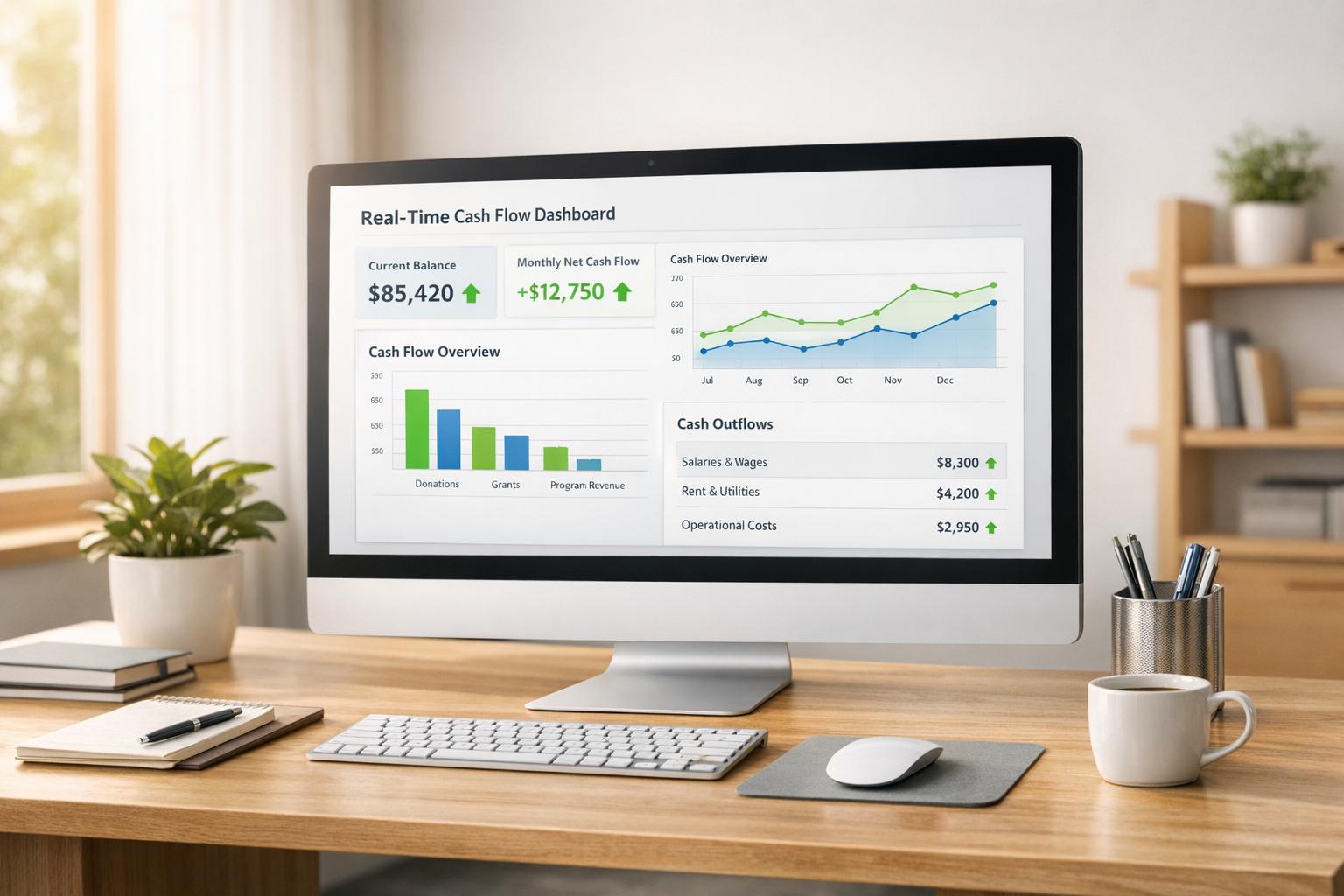
Nonprofits often face cash flow challenges due to unpredictable revenue, restricted funding, and reimbursement delays. Real-time cash flow dashboards offer a solution by consolidating financial data, providing instant insights, and enabling proactive financial management. These dashboards integrate data from accounting, fundraising, and payroll systems, offering clear visualizations of cash trends, spending, and key metrics.
Key Benefits:
Nonprofits often find themselves navigating a financial rollercoaster, as revenue rarely follows a predictable pattern. Donations tend to peak during year-end campaigns, leaving other months comparatively dry. Similarly, grants can be delayed due to funders’ budget schedules, documentation requirements, or milestone-based releases. Meanwhile, fixed expenses like payroll and rent remain constant, regardless of income fluctuations [5].
Reimbursement-based contracts add another layer of complexity. Many government grants require nonprofits to front the money, submit exhaustive documentation, and then wait 30 to 60 days - or longer - for reimbursement [5][8]. During this waiting period, organizations must juggle the costs of running daily operations while covering grant-related expenses. On top of that, individual donor behaviors are highly sensitive to economic changes and competing causes, making these contributions hard to predict [5]. Errors in billing or incomplete paperwork can further extend reimbursement delays [8].
While income might ebb and flow, expenses remain unrelenting. Rent, utilities, insurance, and payroll all demand payment on time, regardless of donation cycles. This misalignment between cash inflows and outflows forces nonprofits to constantly balance their budgets [1][5]. To make matters worse, it’s estimated that up to 90% of spreadsheets contain errors, and employees may spend as much as 30% of their time managing disconnected data [9]. Real-time financial tracking can help bridge this gap, but many organizations lack the tools to implement it effectively.
Restricted funding creates additional hurdles. A large portion of nonprofit funds are often earmarked for specific programs, leaving little flexibility to address general operational costs [8][3]. This limitation forces tough choices, such as delaying payments to vendors, draining reserves, or reallocating resources in unsustainable ways [8][3]. For nonprofits with limited reserves - 16% have only one month’s cash on hand, and 8% operate with no reserves at all - unexpected expenses can quickly spiral into a crisis [10].
Unchecked cash flow problems can snowball into larger issues. Late payments may incur penalties, further straining tight budgets [1]. Vendors and contractors might lose trust in the organization, demanding upfront payments or even cutting ties altogether. A lack of financial reserves can also signal poor fiscal management to donors and funders, potentially jeopardizing future support [8][1].
The ripple effects extend beyond immediate financial setbacks. Leaders forced into crisis mode often lose focus on advancing the organization’s mission. This can mean passing up new program opportunities due to uncertainty about cash availability [1]. In extreme cases, nonprofits may resort to emergency staff layoffs or abrupt program cuts, which not only harm the communities they serve but also erode staff morale [5][1]. With 29% of nonprofit finance leaders citing limited real-time visibility into key performance indicators as a major obstacle [2], many organizations struggle to anticipate and address cash flow challenges before they escalate. These issues highlight the urgent need for tools and strategies to manage finances more effectively.
Real-time cash flow dashboards simplify nonprofit financial management by pulling together data from multiple sources and automating the process. These dashboards act as a financial hub, automatically syncing with bank accounts, accounting tools like Sage Intacct or NetSuite, donor management platforms, and payroll systems via open APIs. Even for nonprofits using older systems, middleware and custom connectors step in to integrate legacy data seamlessly.
This automation puts an end to the chaos of scattered spreadsheets and disorganized financial data across departments and emails. By consolidating everything into a single, reliable platform, these dashboards provide CFOs, board members, and program managers with accurate, up-to-date information. Transactions are categorized using dimensions - such as program type, location, or funding source - so the system can sort and filter data automatically, eliminating the need for complex, manual reporting.
Dashboards turn raw financial data into easy-to-understand visuals like charts and graphs, focusing on the metrics that matter most. Common visualizations include real-time cash balance trends by entity or fund type, budget-to-actual variance analyses to show where spending aligns with plans, and cash runway projections that reveal how long an organization can operate without new revenue. Nonprofit-specific metrics, like the program efficiency ratio (showing the percentage of funds spent on mission work versus administration), help leaders clearly communicate impact to stakeholders.
Many dashboards also allow users to dive deeper into the data. For instance, if fundraising revenue is falling short, users can click on high-level summaries to drill down into specific campaigns and identify what’s underperforming. Some systems even use AI to detect unusual patterns, like unexpected expense spikes or gradual cash outflows, flagging potential problems before they escalate. By combining these visual tools with role-specific access, dashboards make decision-making more informed and efficient.
Top-tier dashboards are designed with role-based customization, ensuring users see only the data relevant to them. For example, a CFO might focus on liquidity ratios and audit preparedness, board members may track KPIs and fundraising progress, while program managers can monitor their specific budgets and program outcomes. This tailored approach prevents information overload and equips each stakeholder with the insights they need to act confidently.
Cloud-based platforms ensure these dashboards are accessible anytime, anywhere, on any device. This flexibility shifts financial oversight from being a periodic, static task to a continuous, dynamic process. With real-time visibility, nonprofits can move away from reactive crisis management and embrace proactive financial planning.
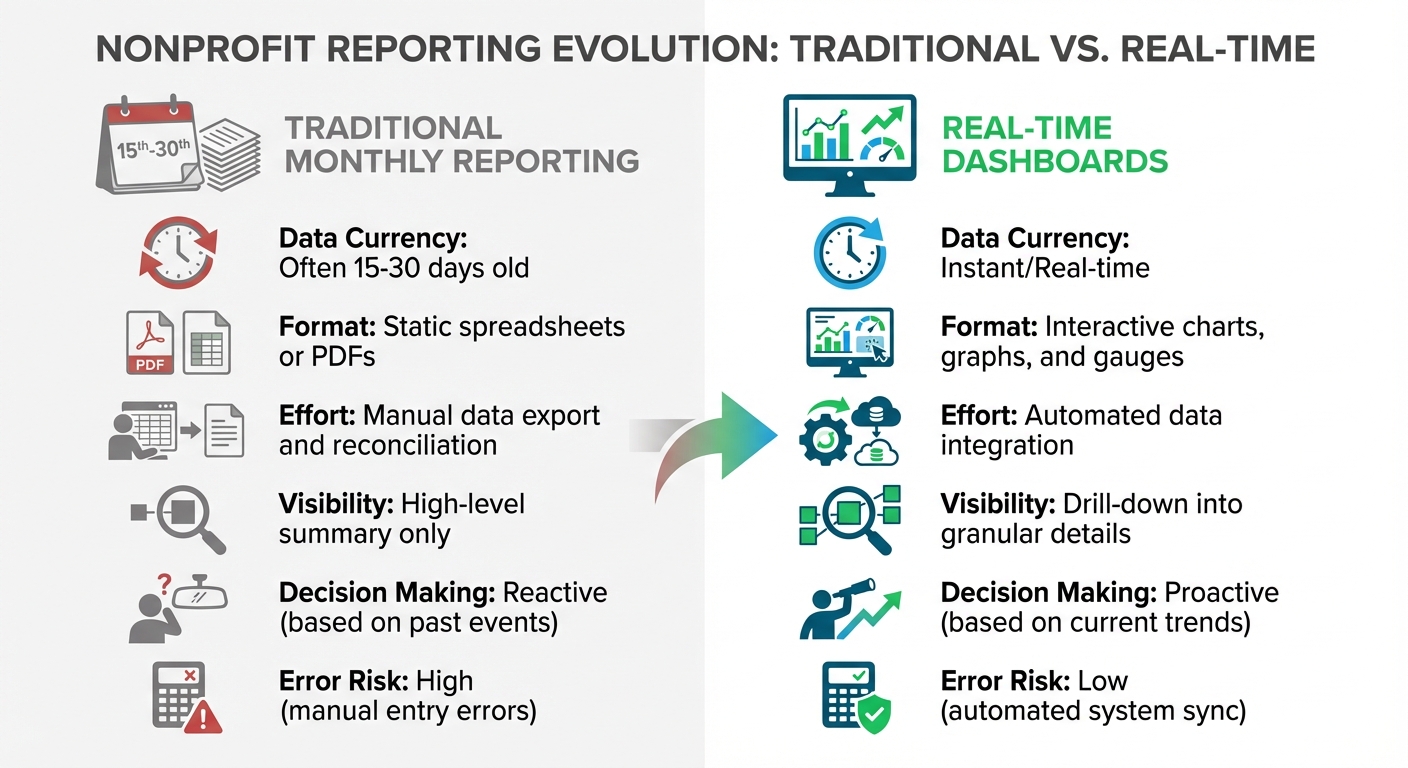
Traditional Monthly Reporting vs Real-Time Dashboards for Nonprofits
Real-time cash flow dashboards, built on automated data integration and user-friendly visualizations, offer nonprofits a powerful tool to manage their finances effectively. These dashboards provide several key advantages.
Real-time dashboards revolutionize how nonprofit leaders view their organization's financial health. They offer instant insights into cash positions, revenue patterns, and spending trends, consolidating data from accounting systems, fundraising platforms, and project management tools into a single, accessible hub.
Take Brevard Zoo, for example. CFO Frank Fieseler implemented dashboards that combine financial data with daily attendance figures. This integration allows the zoo to track metrics like food sales per visitor and attendance trends in real time. Fieseler explains:
"We monitor daily attendance from our members and the general public, and love that we can now marry the zoo's financial information with these numbers. As a result, we can react quickly versus waiting until month-end." [7]
This ability to act on real-time data helps nonprofits handle revenue fluctuations more effectively. Leaders can track progress, analyze fund ratios, and project year-end outcomes based on current trends. Considering that 29% of nonprofit finance leaders cite a lack of real-time visibility as a barrier to strategic decision-making [2], these dashboards fill a critical need for nearly one-third of the sector.
Dashboards also serve as an early warning system for financial issues. By keeping an eye on key metrics like months of cash on hand and current ratio (which should ideally be 1 or more [6]), leaders can identify potential problems before they escalate. Automated alerts flag anomalies, such as unexpected expense surges, gradual cash depletion, or underperforming fundraising efforts.
With this information, department managers can take proactive steps to control costs, helping to reduce overall expenses and maintain budgets. This approach is especially valuable now, as 58% of organizations report revenue declines [2]. Early detection can help nonprofits avoid costly setbacks like late payments, damaged vendor relationships, and operational disruptions caused by cash shortages. When 28% of business managers need data within an hour of a business event and 42% require it within a day [4], relying on monthly reports simply isn’t practical anymore.
Transparency is becoming increasingly important as donors and boards demand clear accountability for how funds are used and the impact they achieve. Dashboards address this need by offering customized, role-specific views that foster trust. Board members can track high-level KPIs like program efficiency ratios, while donors can see the outcomes tied directly to their contributions.
For example, United Way of Metropolitan Dallas faced challenges with incompatible donor and financial databases, which made reporting cumbersome. After adopting a dashboard solution, the board gained access to real-time updates on revenue, KPIs, and campaign progress. This shift not only saved hundreds of man-hours annually but also revealed resource allocation inefficiencies that had been hidden in manual reports [11].
By eliminating data silos, dashboards reduce internal confusion and build external trust. With nearly 90% of spreadsheets containing errors [9] and employees spending up to 30% of their workweek searching for scattered data [9], having a single source of truth is essential. As Jacqueline Tiso, Founder & CEO of JMT Consulting, puts it:
"Without efficiency, reliability, or consistency, how can you expect your board or your donors to be able to understand, let alone trust, your data and the decisions you made because of that data?" [4]
The shift from traditional monthly reporting to real-time dashboards represents more than just a speed upgrade - it’s a fundamental change in how nonprofits operate. Here’s how the two compare:
| Feature | Traditional Monthly Reporting | Real-Time Dashboards |
|---|---|---|
| Data Currency | Often 15-30 days old | Instant/Real-time |
| Format | Static spreadsheets or PDFs | Interactive charts, graphs, and gauges |
| Effort | Manual data export and reconciliation | Automated data integration |
| Visibility | High-level summary only | Drill-down into granular details |
| Decision Making | Reactive (based on past events) | Proactive (based on current trends) |
| Error Risk | High (manual entry errors) | Low (automated system sync) |
With real-time dashboards, nonprofits can identify and address issues as they arise, rather than reacting after the fact. This allows for smarter resource allocation, better financial stability, and a stronger foundation to support their mission.

Phoenix Strategy Group offers nonprofits a way to fully leverage the power of real-time dashboards through their specialized implementation services.
With their fractional CFO services, Phoenix Strategy Group helps finance teams evolve into strategic drivers of a nonprofit's mission. They provide regularly updated 12-month cash flow forecasts - whether weekly, monthly, or quarterly - keeping organizations ahead of potential financial challenges. These CFOs analyze trends, identify looming cash shortages before they escalate, and guide nonprofits in allocating resources effectively to maximize their impact [2][1].
The process of creating custom dashboards begins with a deep dive into how each nonprofit operates. Phoenix Strategy Group utilizes transaction tagging, categorizing every transaction based on key business drivers like program type, geographic location, specific projects, or funding sources [2]. This approach makes it easy to filter and examine financial data in detail, answering questions such as, "What were the Q4 expenses for our youth education program?" or "What’s the burn rate for our grant-funded activities?"
By integrating accounting software, fundraising databases, and other data sources, Phoenix Strategy Group ensures nonprofits have access to accurate, real-time data with drillable metrics [3][12]. Automating these data flows not only saves significant staff time but also reduces the risk of human error [12].
Role-based views ensure that each stakeholder sees only the metrics relevant to their role. For example, executive directors can focus on the organization’s overall cash position and runway, program managers can monitor budget use for their initiatives, and board members can review high-level KPIs without wading through operational details.
This tailored approach provides nonprofits with the tools for continuous financial clarity and quick, informed decision-making.
Phoenix Strategy Group doesn’t stop at implementation. They offer ongoing support through regular review sessions to monitor progress, flag financial irregularities, and refine dashboards as needs evolve [3][1]. As organizations grow or encounter changes - whether it’s launching new programs, securing new funding, or adapting to different reporting requirements - the dashboards are updated to reflect these shifts. The metrics tracked and the frequency of forecast updates are also fine-tuned based on insights gained from using the system in practice [1].
Real-time cash flow dashboards are transforming how nonprofits tackle financial challenges. By replacing outdated spreadsheets with live integrations, these tools provide leaders with instant insight into available cash and upcoming obligations. During the COVID-19 pandemic, when 58% of surveyed nonprofits faced revenue declines, organizations equipped with real-time dashboards were able to adapt more effectively - whether by adjusting spending, ramping up fundraising, or reallocating resources before issues escalated into full-blown crises.
Switching from manual reporting to automated dashboards doesn’t just save time and reduce errors - it also shifts finance teams from routine bookkeeping to strategic planning. This shift allows nonprofits to focus on forming impactful partnerships. Phoenix Strategy Group offers more than just software installation; their fractional CFO services help nonprofits interpret dashboard data and make informed, mission-driven decisions. Features like transaction tagging and role-based views ensure that every stakeholder - from program managers to board members - can access the specific metrics they need.
The benefits are clear. Alisa Brill, Chief Financial Officer at Paws Chicago, shared her experience:
Before, everyone was in the dark, but with Sage Intacct, it's a whole new world. Department managers can see precisely how they are doing with the click of a button... As a result, people are controlling their costs proactively, the organization's overall expenses are down [2].
This kind of financial transparency not only streamlines operations but also strengthens an organization’s ability to deliver on its mission.
For nonprofits struggling with cash flow and reporting issues, a customized dashboard can provide much-needed clarity and control. Phoenix Strategy Group offers the tools and guidance to help your organization thrive, ensuring real-time data drives meaningful impact.
Real-time cash flow dashboards give nonprofit leaders a crystal-clear, up-to-the-minute view of their financial standing by pulling together data from accounting systems, bank accounts, and grant management tools. By cutting out the need for manual data entry, these dashboards not only save time but also reduce errors, allowing teams to concentrate on pushing their mission forward.
With live updates, nonprofits can easily track financial trends, spot potential risks, and get alerts for issues like low balances or unexpected expenses. This allows for quick, informed decisions - whether it’s reallocating funds, adjusting spending, or ramping up donor outreach to avoid financial gaps. These dashboards also enhance forecasting and budgeting, providing actionable insights that help with strategic planning and transparent communication with board members and funders.
In short, these tools enable nonprofits to make faster, data-backed decisions about programs, staffing, and investments, safeguarding their financial health while amplifying their impact.
Nonprofits often struggle with traditional financial reporting, which tends to focus on past performance rather than providing a current snapshot of their financial situation. These reports are typically released periodically, leaving leadership without the real-time insights they need to determine if there’s enough cash on hand to cover immediate costs or seize new opportunities.
Adding to the complexity, many nonprofits rely on manual processes like exporting data into spreadsheets and reconciling it by hand. These tasks are not only time-consuming but also prone to errors. On top of that, inconsistent data formats across various teams can make the reports less reliable, creating challenges for boards, donors, and regulators to fully trust the numbers. This lack of up-to-date information often forces nonprofit leaders to make high-stakes decisions about programs, staffing, or fundraising without a clear view of their cash flow.
This is where real-time cash flow dashboards come into play. These tools offer accurate, current financial data, empowering nonprofits to make informed decisions and stay focused on their mission.
Real-time cash flow dashboards give nonprofits a clear and up-to-the-minute view of their financial health. By pulling data directly from sources like accounting software, bank accounts, and payment platforms, these tools keep key figures - like cash on hand, incoming funds, and spending forecasts - accurate and up to date. This eliminates delays and reduces the risk of manual errors.
The visual design of these dashboards, featuring elements like graphs and key performance indicators (KPIs), makes even complex financial data easy to grasp. Instead of digging through spreadsheets, stakeholders can quickly assess the organization’s performance. This level of clarity builds trust and strengthens accountability with board members, donors, and grant makers.
Dashboards can also be tailored for different audiences. For example, funders might see program-specific expenses, while board members view overall cash flow. By customizing the data for each group, nonprofits ensure stakeholders receive the insights they need to make informed decisions and stay engaged with the organization’s mission.