Published on
February 16, 2026


Vesting schedules are critical for startups to manage equity, retain talent, and increase business valuation to attract investors. Without a proper plan, "dead equity" - shares held by individuals no longer contributing - can harm your business. Here's what you need to know:
A well-structured vesting plan protects your equity, motivates your team, and ensures investor confidence.
The four-year vesting schedule with a one-year cliff is widely regarded as the standard for startup equity. In fact, 90% of private companies stick to this structure[10]. Straying from this model without a solid reason can raise concerns during investor due diligence[8].
Here’s how it works: employees earn no equity if they leave within the first year. After reaching the one-year mark, 25% of their shares vest immediately, with the remaining shares vesting monthly over the next 36 months[7]. This approach minimizes the risk of "dead equity" while allowing companies to evaluate whether a new hire is a good fit. As WilmerHale explains:
The cliff period gives the company time to determine whether the employee is working out before the person gets to keep any of his or her shares[4].
For instance, if an employee leaves after six months, they walk away with nothing, and the unvested shares return to the equity pool, keeping the company’s resources intact.
Investors also prefer this structure because it signals a commitment to the long term. By the time a company reaches its Series A funding, founders are typically expected to have vested no more than 40% of their initial shares[1]. Dan Green, Partner at Gunderson Dettmer, emphasizes this point:
This is one area where less creativity is better[2].
Using non-standard vesting schedules can lead to higher legal costs due to the custom drafting and revisions required[1]. To avoid complications, keep your vesting terms consistent across your equity plan, grant notice, and offer letter. Make sure the one-year cliff is clearly explained in all communications so candidates understand that leaving before 12 months means forfeiting their shares[9].
Finally, ensure your vesting schedule aligns with your Series A fundraising goals to maintain both investor confidence and team stability.
When structuring your vesting schedule, it’s essential to align it with your Series A milestones. Doing so not only reassures investors but also ensures your operations remain steady. Venture capitalists generally expect founders to have no more than 40% of their equity vested by the time they reach Series A. If more than 40% is vested, you might face a vesting reset, which could complicate negotiations[1].
Greg Miaskiewicz, CEO of Capbase, puts it plainly:
Investors want founders to have vested a maximum of 40% of their initial share award by the time of series A. [1]
This expectation highlights an important reality: investors are backing you as a founder, not just the product or technology you’re building. Dan Green, Partner at Gunderson Dettmer, stresses how critical aligning your cap table is:
If they have a cap table that isn't aligned with what a VC is expecting, that can be fatal to the fundraising process. [2]
To avoid these challenges, it’s wise to adopt the standard four-year vesting schedule when incorporating your company. This approach aligns with what investors expect during Series A. However, if your startup takes longer than planned to reach this stage and your vesting nears completion, it’s time to discuss a founder refresh with your board.
Additionally, as you prepare for Series A, sync your vesting schedule with the expansion of your employee stock option pool. This coordination is critical, as the dilution caused by adding to the pool directly affects equity ownership. Proper planning here ensures your cap table remains attractive and aligns with investor expectations.
Monthly vesting is a straightforward way to manage equity distribution, ensuring fairness and clarity for all parties involved.
Here’s how it works: after the initial cliff period, equity begins to vest in equal monthly installments - typically 1/48th of the total grant each month for a standard four-year vesting schedule. This approach provides employees with a clear sense of progress and ensures they’re never far from their next equity milestone. It’s a structure designed to keep everyone engaged and committed.
Take this example from Promise Legal: a co-founder with 2,400,000 restricted shares would vest 600,000 shares (25%) at the cliff. The remaining 1,800,000 shares would then vest evenly over the next 36 months, making the process predictable and transparent[9].
Dan Green, a Partner at Gunderson Dettmer, explains the rationale behind this setup:
In those first 12 months, still finding your groove and proving your value to the company. After that, you've shown that you're a well-valued member of the team. You're gonna vest thereafter in equal monthly installments.[2]
This monthly system also ensures fairness if an employee leaves mid-cycle. Instead of losing an entire year’s worth of equity by leaving at month 11, they’d still receive credit for each month worked after the cliff. This fairness fosters trust and reduces the likelihood of disputes. WilmerHale emphasizes that consistency in vesting terms for similar roles can prevent issues later on by avoiding case-by-case negotiations and potential resentment when employees compare compensation[5].
To make this process seamless, it’s essential to outline monthly vesting milestones in all relevant documents, such as offer letters, equity plans, and grant notices. This not only avoids legal complications but also lays a solid foundation for long-term retention strategies.
To build on the standard vesting structure, implementing a clear cliff period is a smart way to reduce risks. This approach strengthens the commitment required from team members in a startup. A cliff period acts as a 12-month trial, ensuring that equity only begins to vest after a full year. If someone leaves before reaching the one-year mark - even if it's month 10 or 11 - they forfeit all equity[8].
In a typical four-year vesting schedule, 25% of the equity vests at the end of the first year. Until that point, nothing is earned. Investors often see this as standard practice because it ensures the team is dedicated for the long term[8].
"The cliff exists to avoid granting meaningful equity to someone who leaves quickly." – Promise Legal [9]
Having clear documentation is critical to making this process work smoothly. The cliff period also acts as a testing phase, giving you the chance to assess whether a team member is a good fit before they become a permanent equity holder. While the broader vesting schedule protects equity distribution over time, the cliff specifically safeguards against early departures, aligning with both investor expectations and sound equity management.
It’s important to clearly outline cliff terms in offer letters to avoid any confusion. Some employees might mistakenly believe they’ll receive partial vesting at six or nine months, which can lead to unnecessary misunderstandings[9]. By clearly documenting the terms from the outset, you ensure everyone is on the same page and avoid potential conflicts.
When thinking about ways to retain top talent, extending vesting periods can be an effective strategy. While the typical vesting schedule lasts four years, some companies are now opting for five- or six-year schedules, especially for founders and key executives. This shift aligns with the reality that startups often take longer than four years to reach liquidity events like IPOs or acquisitions.
"Some companies lengthen the vesting term for founders or executives to five years to emphasize longer-term commitment and better match the expected time to scale or exit." – Kruze Consulting [11]
This approach is particularly useful for mid-stage startups in Series B or Series C funding rounds. At this stage, many early hires are approaching the end of their initial four-year vesting period. Extending their vesting schedules helps mitigate retention risks, ensuring that key team members remain engaged as the company navigates its next phase of growth. For founders, a five-year vesting schedule also sends a strong signal of long-term dedication to investors [1][13].
Another benefit? Employees can lock in a low strike price with a larger upfront equity grant. This setup, combined with future equity grants, keeps compensation competitive over time. It’s a win-win, addressing both employee satisfaction and investor priorities [12][13].
Startups often lean toward time-based vesting because it’s straightforward and predictable. With this approach, employees earn equity by staying with the company for a set period - typically over four years, with a one-year cliff. It’s a practical choice, especially for early-stage startups where the future is uncertain, and setting specific goals may be challenging.
On the other hand, performance-based vesting ties equity to hitting specific milestones, such as revenue goals, product launches, or regulatory approvals. For example, about 61% of initial management grants at private equity–backed LLCs rely on performance metrics, while venture capital–backed corporations tend to stick with time-based schedules [12]. The main distinction here is predictability versus control.
"Milestone-based vesting is less common than time-based vesting because for most new ventures, it is difficult to predict how the company may evolve, and setting meaningful milestones on day one is often not possible." – Alexander J. Civetta, Member, Mintz [3]
Performance-based vesting works best when goals are clear and employees can directly influence the outcomes. For instance, it makes sense to tie a Director of Sales' equity to revenue targets, but applying the same metric to a Chief Innovation Officer might not be practical. This challenge often encourages companies to explore hybrid models.
A hybrid vesting approach combines time-based schedules with specific performance milestones. This method offers stability while motivating employees to achieve key objectives. For early hires, however, time-based vesting is generally more manageable and reduces administrative complexity.
The choice of vesting method should align with your startup’s goals - whether it’s retaining talent, hitting strategic milestones, or reassuring investors. Striking the right balance between predictability and performance incentives can help create a vesting plan that supports long-term growth and stability.
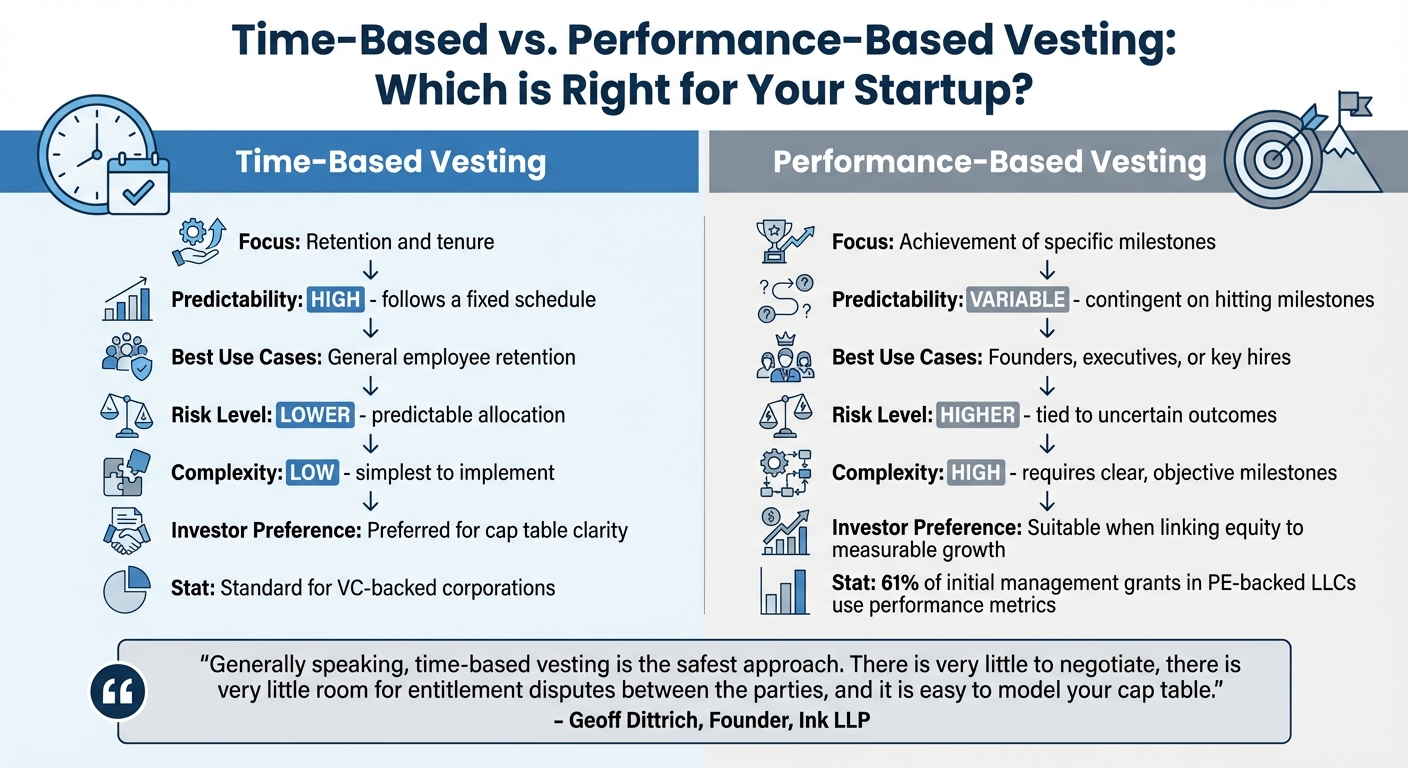
Time-Based vs Performance-Based Vesting: Key Differences for Startups
When deciding between time-based and performance-based vesting, it's essential to align your approach with both retention goals and business objectives. Time-based vesting rewards employees for their loyalty and tenure, typically following a four-year schedule with a one-year cliff. This structure ensures equity is distributed gradually over time, encouraging employees to stay with the company. On the other hand, performance-based vesting ties equity grants to specific milestones - like hitting revenue targets, launching products, or achieving market share goals. While this can motivate employees to meet critical business objectives, it also introduces uncertainty since the equity remains "at risk" if the milestones aren't achieved [6][3].
Time-based vesting offers a predictable framework, making it easier to model on a cap table. In contrast, performance-based vesting introduces variability, as the equity depends on achieving agreed-upon goals [15][3]. These differences are crucial when crafting a vesting plan that balances employee incentives with investor expectations.
"Generally speaking, time-based vesting is the safest approach. There is very little to negotiate, there is very little room for entitlement disputes between the parties, and it is easy to model your cap table."
– Geoff Dittrich, Founder, Ink LLP [15]
The risk profiles of these methods also vary. Time-based vesting poses less risk for employees since their equity is earned by staying with the company. Performance-based vesting, however, is inherently riskier because it ties compensation to outcomes that may not materialize. Interestingly, about 61% of initial management grants in private equity–backed LLCs are tied to performance metrics, whereas venture capital–backed companies lean heavily on time-based schedules [12].
Here’s a closer look at the key differences between these two vesting strategies:
| Feature | Time-Based Vesting | Performance-Based Vesting |
|---|---|---|
| Focus | Retention and tenure [6] | Achievement of specific milestones [6] |
| Predictability | High; follows a fixed schedule [6] | Variable; contingent on hitting milestones [6] |
| Best Use Cases | General employee retention [6][12] | Founders, executives, or key hires [6][14] |
| Risk | Lower; predictable allocation [6] | Higher; tied to uncertain outcomes [3] |
| Complexity | Low; simplest to implement [15] | High; requires clear, objective milestones [15] |
| Investor Preference | Preferred for cap table clarity [6] | Suitable when linking equity to measurable growth [6] |
A carefully crafted vesting schedule does more than just allocate equity - it aligns interests, safeguards your cap table, and reflects industry best practices. By adopting a four-year vesting period with a one-year cliff, tying schedules to fundraising milestones, and balancing time-based with performance-based structures, you create a system that keeps key contributors motivated during crucial growth stages. This approach not only instills confidence in investors but also simplifies equity management.
Vesting schedules are essential for avoiding "dead equity" situations, where team members who leave prematurely retain ownership they haven’t fully earned. Instead, unvested shares return to the option pool, giving you the flexibility to attract new talent without further diluting existing shareholders. This ensures your cap table remains healthy and appealing.
Phoenix Strategy Group has a strong history of guiding companies to success, offering expert advice that helps refine strategies and achieve seamless exits.
"As our fractional CFO, they accomplished more in six months than our last two full-time CFOs combined. If you're looking for unparalleled financial strategy and integration, hiring PSG is one of the best decisions you can make."
– David Darmstandler, Co-CEO, DataPath[16]
Whether you’re issuing your first equity grants or gearing up for a Series A round, working with experienced advisors like Phoenix Strategy Group ensures your vesting plans support your scaling ambitions and meet the expectations of investors during fundraising and exit events.
If you leave your job before your equity is fully vested, you typically lose the unvested portion. In other words, any shares or options that haven’t vested yet will no longer belong to you.
Vesting schedules play an important role in a Series A raise. They demonstrate to investors that founders and key team members are dedicated to the company’s long-term vision. A typical setup is a four-year schedule with a one-year cliff, widely regarded as a best practice. This structure aligns everyone with the company’s growth objectives while reducing risks. If someone exits early, their unvested equity is forfeited, helping safeguard the company’s valuation and overall stability.
Startups can benefit greatly from adopting performance-based vesting to encourage stakeholders to hit key milestones or goals. This method ensures that individual efforts are closely tied to the company’s overall performance and long-term growth plans, creating a clear alignment between personal contributions and organizational success.