Published on
February 20, 2026


Supply chain finance (SCF) helps businesses manage cash flow by extending payment terms for buyers while allowing suppliers to get paid early through third-party financing. This creates a win-win: buyers improve liquidity without increasing debt, and suppliers access affordable funds promptly. Here’s how SCF can strengthen cash flow management:
To maximize SCF benefits, businesses should segment suppliers, negotiate terms carefully, use dynamic discounting, and align finance with procurement teams. Automating processes and selecting the right SCF partner ensures smoother operations and long-term growth opportunities.
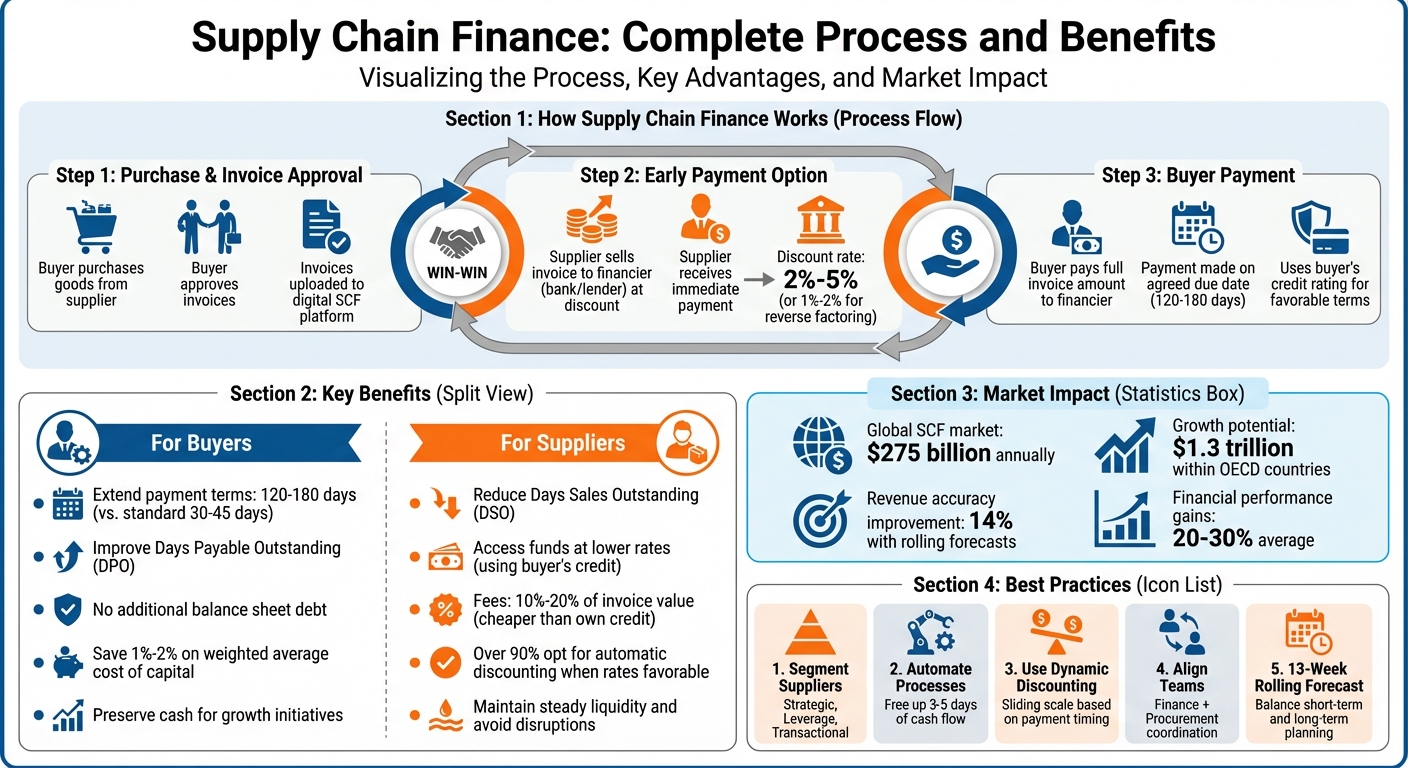
How Supply Chain Finance Works: Step-by-Step Process and Cash Flow Benefits
Supply chain finance (SCF), often referred to as reverse factoring, is a buyer-driven solution that connects companies with their suppliers through a digital financing platform. Here's how it works: buyers purchase goods, approve the invoices, and upload them to the platform. Suppliers then have the option to sell these invoices to a financier - usually a bank or specialized lender - at a discount for immediate payment. The buyer, in turn, pays the full invoice amount to the financier on the agreed due date.
What sets SCF apart from traditional factoring is that it’s initiated by the buyer, using the buyer’s credit rating to determine financing costs [2]. This allows suppliers to access funds at rates far lower than what they could secure independently.
"Supply chain finance allows suppliers to leverage the corporate buyer's credit profile to obtain financing at a much more favorable rate." - Jonathan Vojtecky, Managing Director, Global Trade & Supply Chain Finance, Bank of America [4]
This arrangement works well for both sides: buyers can extend their payment terms - sometimes from 30–45 days to as much as 120–180 days - without straining relationships with suppliers [2]. Meanwhile, suppliers gain quick access to working capital, which helps them stay financially stable. For buyers, this approach frees up cash that can be used for growth initiatives or debt reduction, all while maintaining liquidity.
These features make SCF a powerful tool for improving cash flow management across the supply chain.
SCF tackles working capital challenges head-on by allowing buyers to extend their Days Payable Outstanding (DPO) while enabling suppliers to reduce their Days Sales Outstanding (DSO) [7]. This creates a win-win situation, especially for companies in growth phases. Many businesses in this position utilize fractional CFO services to navigate these complex financing options. Buyers can preserve cash for operational needs and investments while still paying suppliers promptly. This liquidity can also be used to reduce debt, which may save 1%–2% on the weighted average cost of capital [6].
One key advantage of SCF is that it doesn’t add liabilities to the balance sheet in the same way traditional loans do, offering a financing option that doesn’t increase debt [2]. For suppliers, the benefits are equally compelling. They gain faster access to funds and typically pay lower borrowing costs. The fees for early payment - often 10% to 20% of the invoice value [7] - are generally cheaper than what suppliers might pay through their own credit facilities.
This becomes even more important in environments where over 90% of suppliers opt for automatic discounting when interest rates are favorable [4]. By ensuring suppliers have steady liquidity, SCF helps prevent supply chain disruptions, even during periods of rapid growth or scaling.
To make the most of supply chain finance (SCF) and strengthen supplier relationships, consider these strategies for optimizing payments and cash flow.
Not all suppliers can handle extended payment terms, so it's important to approach this selectively. Group your suppliers into three categories: Strategic (critical or high-risk), Leverage (high-spend commodities), and Transactional (low-spend, low-risk). For instance, strategic suppliers might require shorter terms like Net 30 to Net 45, while leverage suppliers could manage Net 60 to Net 90 terms [6][10].
When negotiating, lock in unit pricing before discussing payment terms. Studies show that extending terms by 15 to 30 days can lead suppliers to increase prices by 5% to 8%, potentially offsetting the financial benefits of the extension [6]. Even a modest 1% price hike could negate the savings from a 30-day term extension [10].
Introduce changes gradually to avoid straining suppliers. For example, transition from Net 30 to Net 45, then to Net 60 over several quarters. This phased approach gives suppliers time to adjust their working capital [6][10]. Be transparent about the reasons for extending terms, such as increasing joint capacity or preparing for supply chain disruptions. Clear communication can help suppliers see these changes as mutually beneficial rather than one-sided [8][10].
To further support suppliers, consider offering reverse factoring. This allows them to access early payment for a fee of 1% to 2%, ensuring they have liquidity when needed [9].
Dynamic discounting offers a modern twist on early payment terms by using a sliding scale. Instead of a fixed discount like 2/10 Net 30, you might offer 1% for payments made 30 days early, 2% for 45 days early, and 3% for immediate payment [12].
Take TechWare as an example. In January 2025, the UK-based electronics company introduced this sliding scale for its microprocessor and battery suppliers. By combining 60-day standard terms with flexible discounts, TechWare kept production costs low while helping medium-sized suppliers maintain liquidity during demand fluctuations [12].
Dynamic discounting also aligns payment timing with your cash flow. When liquidity is tight, third-party SCF funding can ensure suppliers still receive early payments without impacting your reserves. These tools allow you to extend your payment maturity while a financial service provider ensures suppliers are paid promptly, separating your cash flow needs from supplier relationships [13].
"Supply chain finance can play an important role in optimizing cash flow by providing businesses with the financing options they need to manage their business effectively." – KredX Editorial Team [1]
To maximize these benefits, streamline your invoicing and payment processes.
Manual invoice handling slows down approvals and eats into the time available for early payment discounts. Automation tools like OCR and invoicing software can eliminate errors and speed up the approval process [3].
Digital SCF platforms provide real-time updates on invoice status - whether it’s pending, eligible for discounts, or already paid. This visibility enables treasury, procurement, and finance teams to coordinate effectively. By syncing invoice issuance, goods-receipt posting, and payment calendars, businesses can free up 3 to 5 days of cash flow without altering payment terms [10].
"Every day you take 40 days to approve an invoice, it costs you value." – Jordan Novak, Managing Director, C2FO [11]
Choose an SCF platform that integrates seamlessly with your ERP system to eliminate duplicate data entry and automate discount calculations [12]. Consolidating payment runs to specific dates, like the 15th and 30th of each month, simplifies supplier cash forecasting and reduces administrative workload [10]. This approach not only improves efficiency but also aligns cash outflows with liquidity needs.
Pairing supply chain finance with precise cash flow forecasting is a game-changer. Without a clear view of future liquidity, it’s tough to make informed decisions about extending payment terms, taking early discounts, or using financing options wisely.
Integrating forecasting tools into supply chain finance processes can significantly refine cash flow management. Automated tools draw data directly from ERP and banking systems, cutting out manual spreadsheet tasks that can consume up to 80% of a finance team's time [15]. This automation not only saves time but also improves accuracy.
Take Peak Toolworks as an example. By adopting an automated cash flow forecasting platform in August 2025, they completely transformed their reporting process. CFO Ben Stilwell's team now wraps up their cash forecast by the end of day one instead of day four, producing flawless financial reports [15].
"Our process has improved dramatically, and we have a cash forecast complete by the end of the first business day of the week, versus the 4th day, and we are 100% sure of the accuracy." – Ben Stilwell, CFO, Peak Toolworks [15]
A 13-week rolling forecast offers the perfect balance between short-term precision and long-term planning. This approach provides enough foresight to identify potential cash shortages months in advance, giving businesses time to secure funding or adjust supplier payments [15]. Rolling forecasts also boost revenue accuracy by about 14% compared to static budgets, with organizations using them reporting financial performance gains of 20-30% on average [15].
To make these forecasts truly effective, they should cover the entire Cash Conversion Cycle (CCC) - including Days Sales Outstanding (DSO), Days Inventory Outstanding (DIO), and Days Payable Outstanding (DPO). Breaking this cycle down by business unit or product family helps pinpoint where cash gets tied up, making it easier to address inefficiencies [5].
Once accurate forecasts are in place, the next step is aligning finance and procurement teams to fully capitalize on these insights.
Finance and procurement often operate in silos, but in supply chain finance, they need to work together. Finance focuses on preserving cash by extending terms, while procurement ensures strong supplier relationships. Without alignment, these differing priorities can hurt both cash flow and supplier partnerships.
To bridge the gap, establish shared KPIs like early-payment discount usage, payment accuracy, and the balance between improving DPO and maintaining supplier satisfaction. Monthly working-capital council meetings, led by the CFO, can keep both teams aligned on liquidity and supplier strategies [5][16]. When finance and procurement are accountable for the same metrics, collaboration becomes a natural outcome.
"Achieving seamless alignment between finance and procurement is no longer a luxury, it is a necessity for organizations aiming to optimize cash flow." – Xavier Olivera, Lead Analyst, Spend Matters [16]
Standardizing payment terms across the organization can also help. Embedding default terms in ERP vendor-creation forms ensures procurement doesn’t accidentally input shorter terms without CFO approval, protecting DPO targets while maintaining consistency [5]. Additionally, involving procurement early in budgeting and forecasting cycles allows them to flag potential supplier issues and adjust payment schedules based on forecasted liquidity, preventing cash flow disruptions before they happen.
Inventory plays a key role in the Cash Conversion Cycle (CCC = DSO + DIO – DPO). When inventory levels are too high, cash gets tied up in products sitting on shelves, inflating carrying costs like warehousing, insurance, and the risk of obsolescence. This can strain a company’s cash flow and balance sheet.
The impact is clear in the numbers. In 2020, J.P. Morgan's Working Capital Index reached its highest level in nine years. Out of 19 industries analyzed, 15 experienced longer cash conversion cycles, largely due to increased inventory levels [3]. This highlights a widespread issue: cash that could fuel growth is instead locked in warehouses. To address this, precise inventory management becomes essential for freeing up cash and driving operational efficiency.
Start by evaluating inventory through ABC Analysis, which prioritizes high-value items. Combine Just-in-Time (JIT) ordering with strategic reserves and SKU rationalization to minimize holding costs and release tied-up cash.
For example, in October 2024, a New Zealand-based FMCG company implemented a working capital optimization strategy using demand planning software, supplier collaboration, and JIT practices. This initiative improved cash flow by 20% and cut holding costs by 15%, all while boosting supply chain efficiency and reducing lead times [18].
"Optimising working capital through effective supply chain and inventory management is essential for CFOs... to improve cash flow, reduce costs, and enhance operational efficiency." – Trace Insights [18]
Leverage IoT and RFID technologies to track inventory in real time, identifying bottlenecks and excess stock early. Integrated ERP and Inventory Management Systems (IMS) can automate these processes, reducing manual intervention and catching inefficiencies before they escalate. These tools not only lower holding costs but also help maintain cash flow for critical operations.
Effective inventory management goes hand-in-hand with cash forecasting, ensuring stock levels match liquidity goals. Overstocking drains cash and increases the risk of obsolescence, while understocking can lead to missed sales opportunities. Since inventory often represents a significant portion of the balance sheet, finding the right balance is crucial for both working capital and profitability.
Use data-driven demand forecasting to avoid overstocking and stockouts. Regularly update safety stock levels to reflect current demand trends and supply chain fluctuations [19]. This approach ensures you’re not holding more inventory than necessary while still meeting customer expectations.
Collaboration across treasury, procurement, and finance teams is key. Align purchasing decisions with cash flow forecasts to avoid overextending payables or cutting inventory to unsustainable levels. Partner with suppliers to develop plans that maintain supply chain stability without jeopardizing liquidity [19].
"Sustainable savings will most likely require fundamental improvements in end-to-end supply chain inventory visibility, demand planning, inventory and safety stock policies, production planning and scheduling, lead-time compression, networkwide available-to-promise, and SKU rationalization." – Deloitte [19]
Supply chain finance can further enhance liquidity by enabling buyers to extend payment terms while offering suppliers early payment options. This flexibility supports inventory management and fuels growth without disrupting the supply chain.
With operational processes optimized, selecting the right supply chain finance partner becomes crucial for maintaining steady cash flow. The wrong partner can lead to hidden fees, delayed payments, and supplier dissatisfaction. On the flip side, the right partner acts as a growth enabler, strengthening your supply chain while scaling with your business.
Start by evaluating financial aspects. Take a close look at the pricing structure, including transaction fees and any potential hidden costs [21]. Supplier financing rates can be as low as 0.5% per month [20]. Equally important is assessing the provider’s financial health to ensure they can support your business during critical growth phases.
Technology plays a major role in differentiating providers. Look for cloud-based platforms offering automated workflows, real-time analytics, and seamless integration with your existing ERP and accounting systems [20][21]. Features like mobile access and robust data security measures, such as SOC 2 compliance, are essential. Providers with modern platforms can often process payouts within 48 hours - an invaluable feature when suppliers need quick access to funds [20].
Operational efficiency is another key factor. Evaluate how quickly the provider can onboard suppliers. Many supply chains follow the 80:20 rule, where 80% of procurement value comes from just 20% of vendors [14]. Ask about their approach to onboarding and educating these critical suppliers.
Scalability and global reach are also important. Your partner should handle increasing transaction volumes and have expertise in international trade, including currency management and compliance with local regulations in emerging markets [20][21][14].
| Criteria Category | Key Factors to Evaluate |
|---|---|
| Financial | Interest rates, fees, provider stability, funding limits [20][21] |
| Technology | ERP integration, automation, mobile access, data security (SOC 2), real-time reporting [20][21] |
| Operational | Payout speed, onboarding support, ease of use for suppliers, customer service [20][14] |
| Strategic | Geographic coverage, industry expertise, ESG initiatives, scalability [20][21][22] |
Before finalizing a partner, conduct thorough due diligence. Review performance guarantees, termination clauses, and references from businesses similar to yours. Include representatives from finance, procurement, and IT in the decision-making process to ensure alignment across departments.
A partner with advanced technology and operational efficiency can amplify the cash flow benefits discussed earlier. Once you’ve narrowed down your options, focus on building partnerships that can adapt as your business evolves.
Selecting a partner is only the first step - maintaining a strong, long-term relationship requires ongoing effort. Successful supply chain finance programs thrive on collaboration. Kaylee Karumanchi, Vice President of Global Trade and Supply Chain Finance at Bank of America, emphasizes this point:
"The single most important factor to achieving program goals is the buyer's engagement" [23].
Regular check-ins and appointing an internal champion can help ensure alignment across departments and address issues quickly. These routine updates allow you to track progress, identify new opportunities, and resolve problems before they become major setbacks. Supply chain finance relies on coordination across Treasury, Procurement, Accounts Payable, and IT teams.
Even banks that lack their own supply chain finance technology can sometimes offer funding via third-party platforms [14].
Over time, a strong partnership can lead to tangible benefits. Providers that truly understand your business may offer better terms, faster responses during critical periods, and proactive solutions as your needs evolve. Daniel Schmand, Global Head of Trade Finance & Lending at Deutsche Bank, highlights another advantage:
"While buyers have traditionally used supply chain finance programmes to increase the efficiency of their supply chains, they are now turning their attention to one of the technique's secondary benefits: helping to facilitate and improve supply chain resiliency" [22].
A reliable partner becomes more than just a funding source - they’re part of your risk management strategy. Cultural alignment also plays a role. Partners who share your values and communication style can make collaboration smoother, especially during challenges. This alignment sets the stage for strategic discussions about future growth, from supporting supplier health to mitigating supply chain risks [20][21].
Supply chain finance turns cash flow management into a powerful tool for growth. By extending payment terms without straining supplier relationships, capturing early payment discounts, automating invoice tracking, and aligning forecasting with procurement, businesses can streamline their cash conversion cycle. The result? Buyers extend their Days Payable Outstanding while suppliers shorten their Days Sales Outstanding through early payments - creating a win-win situation for both sides [17].
The numbers highlight its potential. Globally, the supply chain finance market processes $275 billion annually, with the capacity to grow to $1.3 trillion within OECD countries alone [2]. This isn't just about holding onto cash - it’s about channeling funds into areas that drive growth. As Kerri Thurston, CFO at C2FO, aptly states: "A dollar of EBITDA is more important to investors than a dollar of cash on the balance sheet" [11].
To pivot from simply preserving cash to investing in expansion, R&D, or infrastructure, businesses need a comprehensive approach. By integrating supply chain finance with tools like dynamic discounting and virtual cards, companies can tailor strategies to different supplier groups, improving both liquidity and profit margins [3][17]. Automation plays a critical role too, eliminating administrative delays, speeding up processes, and freeing teams to focus on strategic goals rather than invoice management.
But the benefits go beyond immediate cash flow improvements. Supply chain finance can fortify your entire supply chain. Offering suppliers access to lower-cost financing - based on your credit rating - helps stabilize their operations and ensures uninterrupted production [2][17]. This is especially vital during economic downturns when smaller suppliers are most vulnerable to disruptions.
The real challenge lies in execution. Success depends on segmenting suppliers thoughtfully, standardizing payment terms, and appointing a senior leader to bridge treasury, procurement, and accounts payable. With the right partner and a focus on collaboration, supply chain finance evolves into more than a financial tool - it becomes a competitive edge that drives sustainable growth.
Supply chain finance doesn’t show up as a loan on your balance sheet. Instead, it’s a set of financial tools - like early payments or receivables financing - that help boost cash flow. The key difference? These solutions aim to streamline working capital rather than add to your debt.
Start by focusing on your most essential suppliers - those critical to your operations or handling a high volume of transactions. These suppliers can have the biggest influence on your cash flow and overall supply chain stability. Give priority to partners who are financially stable, have consistent cash flow requirements, and are open to early payment arrangements. Taking this step-by-step approach ensures a solid foundation, keeps onboarding manageable, and highlights the advantages, making it easier to encourage more suppliers to join.
To predict cash flow using supply chain finance, you’ll need to gather information on a few key areas: accounts receivable, accounts payable, payment terms, and liquidity metrics. These factors are essential for understanding when cash will be available and how it moves, making it easier to plan finances effectively.