Published on
January 1, 2026


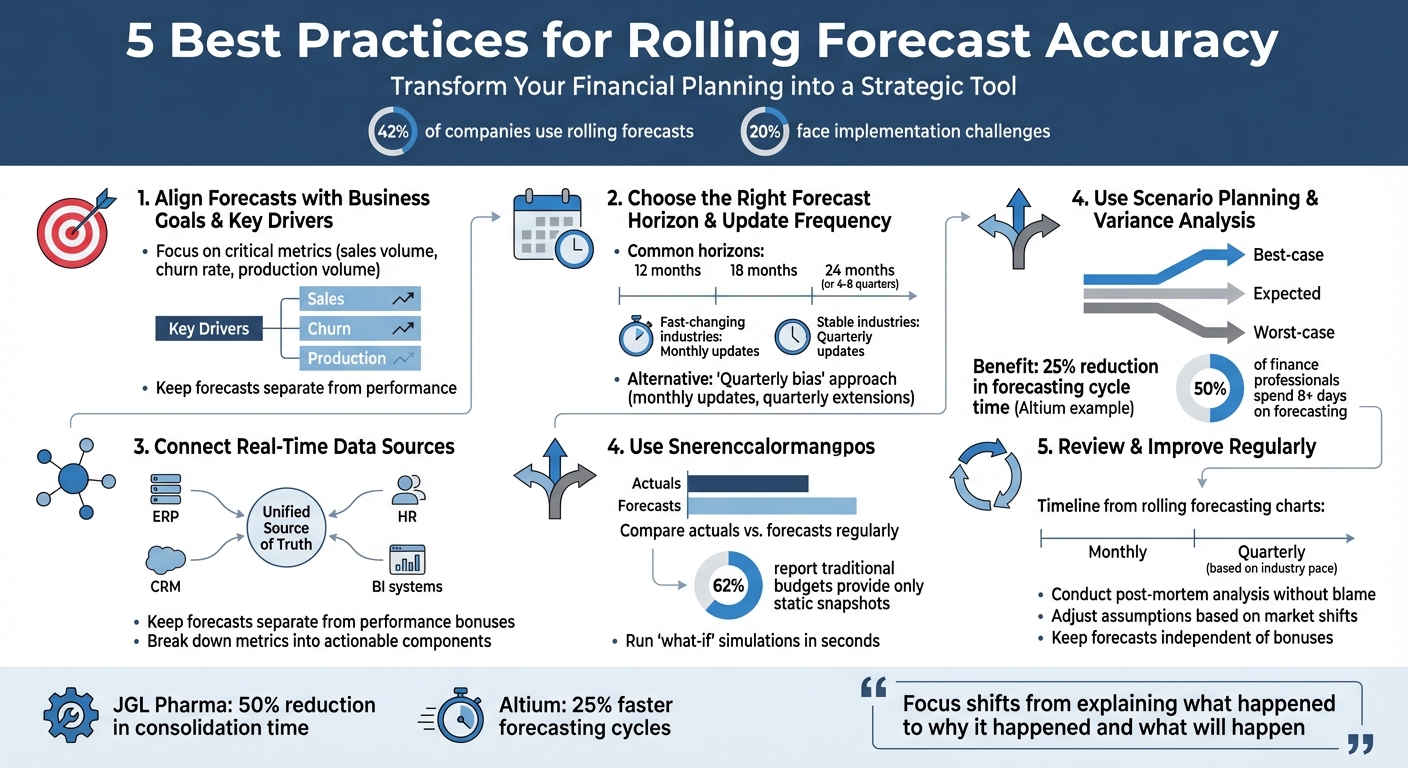
Rolling forecasts keep your financial planning relevant by updating projections regularly, maintaining a consistent outlook (12–18 months). They’re especially useful for businesses in fast-changing industries. Despite their benefits, only 42% of companies use them, and 20% face challenges implementing them. Here’s how to make rolling forecasts work effectively:
These steps help transform rolling forecasts into a tool for better decision-making and resource allocation.
5 Best Practices for Rolling Forecast Accuracy
The best rolling forecasts zero in on the operational metrics that truly impact financial performance. This means focusing on the "critical few" drivers - the numbers that directly shape your financial outcomes. For instance, a SaaS company seeking funding might prioritize metrics like user growth and churn rate, while a manufacturing firm considering an acquisition might concentrate on production volume and average purchase value [3].
Philip Peck, Vice President at The Peloton Group, sums it up well:
"The focus shifts from explaining what happened to why it happened, what will happen and what can we do to make it happen more favorably in the future" [3].
By centering your forecasts on drivers like headcount, sales volume, or market share - rather than smaller, less impactful items like office supplies - you create key pivot points. These pivot points allow your model to adapt when market conditions change and help uncover the reasons behind missed targets, not just the fact that they were missed. This focus on critical drivers simplifies the forecasting process and makes it more effective.
To identify these key drivers, ask yourself: What drives revenue and expenses? Which metrics align with our current business goals? And consider, Who in the organization - like sales managers - has the closest insight into these drivers? Engaging leaders from operations, supply chain, and sales ensures your chosen drivers reflect the actual dynamics of your business, not just theoretical spreadsheet data [1].
Here’s an important consideration: keep forecasts separate from performance bonuses. When managers know their compensation is tied to forecast accuracy, they may lean toward conservative estimates to ensure targets are met. As Elena Kiristova, Finance Adviser and former CFO, advises:
"Forecasts should not be used by executive management as a tool for questioning or reassessing performance targets. This means forecasts and targets must be independent if you want to obtain both relevant action plans and reliable forecasts" [4].
Break down your metrics into smaller, actionable components. For example, instead of broadly forecasting that "revenue will grow 5%", break it into its parts: the number of units sold multiplied by the price per unit [2]. This detailed approach makes it easier to pinpoint whether missed targets stem from lower sales volume or pricing challenges. It also allows for more precise adjustments, which is critical for strategic planning. By honing in on key drivers and breaking metrics into their components, you’ll ensure your rolling forecasts remain accurate, paving the way for determining the best forecast horizon and update frequency.
After pinpointing your key drivers, the next step is figuring out how far into the future to forecast and how often to refresh those numbers. Many organizations opt for rolling forecasts that extend 12, 18, or 24 months ahead - or, in some cases, 4, 6, or 8 quarters [3][2]. The ideal horizon depends on how long it takes your strategic decisions to show results. For instance, if a capital investment takes 15 months to influence sales, your forecast should cover at least that timeframe to reflect the impact [4]. Once your horizon is set, the next decision is how frequently to update it, ensuring it aligns with the pace of your industry.
Update frequency plays a crucial role here. Industries with fast-changing conditions, like airlines or tech startups, often need monthly updates to keep up with shifting markets. On the other hand, more stable industries, such as pharmaceuticals, can usually manage with quarterly updates [3][1]. As Martina Pranjić from Farseer explains:
"The trick is finding the sweet spot: frequent enough to stay relevant, but not so frequent it burns everyone out" [1].
Monthly updates provide flexibility but can strain teams without proper automation, while quarterly updates reduce workload but may slow down decision-making [3][4]. A balanced alternative is the "quarterly bias" approach - updating forecasts monthly but only extending the horizon by a quarter at the end of each quarter. This method avoids "forecast fatigue" while maintaining a steady 15–18 month outlook [4]. Test your chosen forecast horizon and update cadence in specific departments before rolling it out across your entire organization [4].
To make your forecasts more reliable, it's crucial to pull live, accurate data directly from your systems rather than relying on outdated spreadsheets. By integrating tools like ERP, CRM, HR, and BI systems into your forecasting model, you can eliminate the need for manual data transfers [1]. When departments work with isolated data sets, finance teams often waste time reconciling figures instead of focusing on analyzing trends and offering strategic guidance [1].
Automated data feeds create a unified source of truth across your organization. This ensures that finance, sales, and operations teams are aligned, all working from the same real-time data. This approach allows you to build driver-based forecasts that reflect current realities - like changes in headcount, shifts in the sales pipeline, or inventory levels - rather than relying solely on historical trends [1][3]. A great example is Altium, which in September 2025 reduced its forecasting cycle time by 25% by switching to a modern planning platform. This platform replaced manual data exports with automated updates from core business systems [1].
Real-time integration also helps organizations spot issues early. Frequent imports of actual data - such as labor costs, purchase prices, or selling prices - allow you to quickly identify cost spikes or revenue fluctuations [3]. This immediate insight not only improves data accuracy but also supports robust automated forecasting.
As Rami Ali, Senior Product Marketing Manager at Oracle NetSuite, puts it:
"Rolling forecasts are only as good as the data they use. This methodology requires frequent imports of actuals... into the models for variance analysis to ensure things are on track" [3].
Automated systems also free up time for scenario analysis. For instance, you could test how a 15% increase in raw material costs would impact your P&L in just seconds [1]. This kind of agility is critical, especially since nearly 50% of finance professionals report that their forecasting processes take more than eight days to complete [5].
To get started, connect your core systems - ERP for actuals, CRM for pipeline data, and HR for headcount. From there, you can gradually integrate other operational tools [1][3]. Focus on the key drivers that have the most significant impact on performance instead of trying to automate every minor detail. This step-by-step approach helps establish a solid routine before scaling the process across your organization.
At Phoenix Strategy Group, leveraging integrated data sources has enabled growth-stage companies to create agile and accurate forecasts. This approach demonstrates the power of real-time data in driving smarter, faster decisions.
When forecasting over an 8-quarter horizon, it’s wise to prepare for multiple possibilities. Crafting best-case, worst-case, and expected scenarios helps you anticipate a range of outcomes. In unpredictable markets, pinning everything on one "perfect" forecast simply isn’t practical. Scenario planning enables you to assess the impact of potential events before they happen - like a 15% spike in raw material costs, losing a key contract, or entering a new market [1]. This approach also lays a solid foundation for effective variance analysis.
So, what’s the role of variance analysis? It’s all about uncovering insights by comparing actual performance against your forecasts and historical data. This practice helps you identify patterns and adjust your assumptions where needed [2]. Mistakes in forecasting aren’t failures - they’re opportunities to improve. As Elena Kiristova, Finance Adviser and former CFO, puts it:
"The objective is not to punish the guilty but to better understand how to do better, what changed, what were we surprised about, and what should we do differently" [4].
Conducting regular reviews of forecast accuracy sharpens your projections and reduces errors over time. Just make sure your forecasting assumptions are independent of performance-based incentives to maintain objectivity.
Thanks to modern tools, running "what-if" simulations takes only seconds, removing the hassle of manual updates [1]. This kind of flexibility is essential in today’s fast-moving markets. In fact, 62% of finance professionals report that traditional budgets provide only a static "snapshot" that doesn’t adapt to external changes [3]. At Phoenix Strategy Group, we recommend that growth-stage companies integrate these dynamic planning techniques into their rolling forecasts to remain flexible and responsive in an ever-changing business landscape.
Rolling forecasts thrive on consistent and periodic reviews. Most businesses revisit their forecasts either monthly or quarterly, but the ideal schedule depends on your industry's pace. If you're in a fast-moving market or experiencing rapid growth, weekly or monthly reviews might be necessary. On the other hand, more stable industries can often stick with quarterly updates [4][3].
At the end of each review period, compare your actual results to the forecast, identify any gaps, and adjust your assumptions accordingly. This "post-mortem" approach isn’t about assigning blame - it’s about learning and improving. Over time, these regular evaluations sharpen your forecasting skills and make your process more reliable. Interestingly, only 42% of companies use rolling forecasts, and of those, 20% reported struggles with implementing the process [4][2].
One key tip: avoid tying forecasts to performance bonuses. When managers know their compensation depends on meeting forecast goals, they may intentionally lowball their estimates to ensure targets are met. This can skew the accuracy of your forecasts and undermine their purpose [4].
It’s also essential to keep your assumptions current. Factor in shifts in the market, inflation, and changes in customer behavior. By integrating real-time data and scenario planning into your reviews, you can ensure your model stays relevant. The focus should evolve from merely explaining past performance to anticipating future trends and identifying actionable steps to influence outcomes positively [3].
At Phoenix Strategy Group, we specialize in helping growth-stage companies establish a review rhythm that keeps their forecasts both precise and actionable.
Creating accurate rolling forecasts hinges on aligning them with your business goals, updating them at the right frequency, incorporating real-time data, running scenario analyses, and consistently reviewing your process. When these practices come together, forecasting evolves from a static, one-time activity into a dynamic tool - a reliable compass guiding you through opportunities and challenges alike.
For growth-stage companies, this approach is a game changer. As Philip Peck, Vice President at The Peloton Group, explains:
"The focus shifts from explaining what happened to why it happened, what will happen and what can we do to make it happen more favorably in the future" [3].
This shift in focus doesn’t just change how companies plan - it delivers real, measurable results. For instance, JGL Pharma managed to cut its consolidation time in half across over 60 markets by adopting automated rolling forecast practices. Similarly, Altium reduced its forecasting cycles by 25% [1].
Beyond operational improvements, precise forecasting strengthens investor confidence. Accurate forecasts show a clear grasp of business drivers and demonstrate the ability to manage risks effectively. Regular scenario planning and disciplined reviews signal to investors that your business is predictable and well-prepared - qualities that are crucial when seeking funding or gearing up for an exit [6].
At Phoenix Strategy Group, we specialize in helping growth-stage companies implement these practices through our FP&A services. By keeping forecasts precise and actionable, we ensure they serve as a powerful tool for both daily decision-making and long-term strategy. When finance, sales, and operations teams operate from the same real-time data, they align around achievable goals - and that alignment transforms accurate forecasts into exceptional business outcomes.
Rolling forecasts offer businesses a constantly updated perspective on their financial and operational performance. Unlike static annual plans, they act as a dynamic tool, using current data - like sales figures, costs, and market trends - to evaluate how changes such as shifts in consumer demand, new regulations, or supply chain challenges might affect cash flow and profitability.
This up-to-the-minute insight allows leaders to adjust spending, hiring, and resource allocation in real time, helping them reduce risks and seize opportunities as they emerge. Since the forecast horizon (typically 12–18 months) shifts forward on a regular basis, companies can spot deviations from goals early, perform scenario analyses, and keep teams focused on shared objectives. This flexibility not only supports quicker, more confident decisions but also provides an edge in fast-changing markets.
Integrating real-time data into rolling forecasts keeps your projections aligned with the latest business metrics. By automatically incorporating updates on sales, expenses, and operational data, you move away from outdated assumptions, paving the way for more precise and actionable insights. This approach also flags potential cash flow challenges early, providing an opportunity to address funding needs before they become critical.
Real-time data enhances agility by allowing businesses to react swiftly to shifts in the market, supply chain hiccups, or unexpected surges in demand. With regularly updated forecasts, teams in sales, marketing, and operations can work from the same accurate data, fostering stronger collaboration and quicker decision-making.
On top of that, automating data integration cuts down on manual errors and eliminates the time-consuming task of reconciling spreadsheets. This not only simplifies the forecasting process but also frees up FP&A teams to concentrate on strategic analysis, helping businesses thrive in a fast-moving market.
Scenario planning sharpens the accuracy of rolling forecasts by allowing finance teams to explore multiple possible outcomes instead of relying on just one prediction. By running "what-if" scenarios, businesses can test critical assumptions - like sales growth or hiring trends - against both optimistic and pessimistic conditions. This approach helps uncover risks and opportunities that might otherwise go unnoticed, making forecasts more flexible and grounded in reality.
Variance analysis works hand-in-hand with scenario planning by comparing actual results to forecasts and pinpointing where discrepancies occurred. By digging into these differences, teams can refine their assumptions, fill in data gaps, and tweak future forecasts accordingly. Together, these methods create a continuous feedback loop that not only improves accuracy but also keeps forecasts adaptable to real-world shifts.