Published on
June 1, 2026


When companies pursue cross-border mergers and acquisitions (M&A), trade agreements play a major role in shaping deal outcomes. These agreements, whether bilateral (between two countries) or multilateral (involving multiple nations), define rules for market access, investment protections, and dispute resolution. Here's a quick breakdown:
Each type has distinct advantages and challenges. Bilateral deals are faster to negotiate and highly specific but can create fragmented rules. Multilateral agreements provide consistency across regions but require longer negotiations and complex coordination.
| Metric | Bilateral Agreements | Multilateral Agreements |
|---|---|---|
| Scope | Limited to two nations | Covers three or more nations |
| Market Access | Targeted and preferential | Broader, standardized access |
| Legal Predictability | High for specific countries | High across multiple countries |
| Negotiation Speed | Faster | Slower due to multi-party consensus |
| Dispute Resolution | Ad hoc mechanisms | Centralized, formal systems (e.g., WTO) |
Trade agreements directly impact M&A strategies, from valuation to integration planning. Understanding their nuances is critical for navigating risks like regulatory hurdles, national security concerns, and tariffs. Whether leveraging bilateral deals for targeted investments or multilateral frameworks for regional synergies, aligning deal structures with trade rules is essential for success.
A bilateral trade agreement is essentially a deal between two countries aimed at boosting trade, increasing investment, and establishing clear economic rules between them [7]. Think of it as a custom-made guidebook that outlines how the two nations will interact economically. These agreements typically cover areas like market access, intellectual property rights, dispute resolution, and investment protections. One of their standout features is the National Treatment principle, where both countries agree to treat each other's goods, services, and investors just as favorably as their own. This focused approach sets bilateral agreements apart from the broader scope of multilateral agreements, which we’ll dive into later.
For mergers and acquisitions (M&A) teams, bilateral agreements simplify the process by removing non-tariff barriers and streamlining customs procedures, which adds a layer of legal clarity. Research even shows that signing a preferential trade agreement can boost bilateral foreign direct investment (FDI) stocks by about 30% on average [2].
Modern bilateral deals go beyond just slashing tariffs. They often include provisions on government procurement, anti-corruption measures, and digital trade, which opens up fresh opportunities for M&A. Take the UK-India Free Trade Agreement (FTA) signed in May 2025 as an example. It locked in a 74% foreign investment cap for India’s insurance sector and granted UK companies access to India’s £38 billion annual government procurement market [8].
"The UK-India FTA represents a transformative step in the bilateral relationship, offering a new framework for trade, investment, and cooperation in a rapidly changing global economy." - Mayer Brown [8]
In uncertain environments, these agreements also shape how contracts are structured by assigning trade policy risks. For instance, in April 2026, Canadian M&A teams started using "trade impact indemnities" in deals to manage risks tied to the Canada-U.S.-Mexico Agreement (CUSMA). These clauses required sellers to compensate buyers for losses caused by specific events, such as new tariffs - 25% on autos or 35% on softwood lumber - while keeping the deal price intact [9].
"Success hinges on thoughtfully negotiating who bears trade policy risk at each deal stage, from signing through post-closing integration, rather than accepting standard boilerplate provisions." - Kyle Denomme, Partner, BLG [9]
Recent bilateral agreements showcase how these deals can directly influence M&A strategies and capital flows:
| Agreement | Key Sectors Affected | Notable M&A Impact |
|---|---|---|
| U.S.-Japan Strategic Trade and Investment Agreement (July 2025) | Semiconductors, pharmaceuticals, shipbuilding | $550B Japanese investment commitment targeting the U.S. industrial base [11] |
| UK-India FTA (May 2025) | Insurance, government procurement, digital trade | 74% foreign investment cap in insurance; access to a £38B procurement market [8] |
| U.S.-Taiwan Agreement on Reciprocal Trade (February 2026) | Semiconductors, AI, energy, medical devices | Taiwan eliminating 99% of tariff barriers; over $185B in annual bilateral trade [10] |
The U.S.-Taiwan deal is particularly noteworthy for M&A teams working in high-tech industries. A related Memorandum of Understanding (MOU) signed on January 15, 2026, explicitly encourages Taiwanese companies to increase investments in the U.S. semiconductor supply chain and electronics manufacturing services, especially in AI applications [10].
"The MOU contemplates that Taiwan companies will significantly increase their investments in the semiconductors supply chain, electronics manufacturing services (including AI applications), energy, and other sectors in the United States, with financial support from the Taiwan side." - USTR [10]
For M&A professionals, bilateral agreements aren’t just policy documents - they’re strategic tools that define access to specific sectors, outline investment rules, and ensure legal protections. Up next, we’ll look at how multilateral agreements provide an even broader platform for cross-border M&A opportunities.
While bilateral agreements focus on trade between two countries, multilateral trade agreements bring together multiple nations under a unified framework. These agreements establish consistent trade rules and aim to eliminate discrimination among member states. The Agreement Establishing the World Trade Organization (WTO) highlights this role:
"The WTO shall provide the common institutional framework for the conduct of trade relations among its Members in matters related to the agreements and associated legal instruments..." [12]
These agreements are binding for all members and cover diverse areas such as goods, services, and intellectual property rights. The WTO framework also includes a centralized Dispute Settlement Understanding (DSU), offering a more predictable and streamlined approach to resolving disputes compared to the often fragmented methods seen in bilateral deals. For M&A teams, this predictability simplifies navigating regulatory landscapes across multiple markets.
Multilateral agreements bring uniformity to regulatory compliance, which is a major advantage for M&A teams. Instead of handling separate legal frameworks for each country, companies operating within a trade bloc can apply consistent due diligence and regulatory standards across all member markets.
These agreements also influence domestic policies, such as intellectual property enforcement, competition rules, and product standards. These elements directly impact how target companies are valued and how smoothly post-merger integration can proceed. Provisions like those for digital trade and "behind-the-border" policies further ease integration into global value chains.
Data backs up the benefits. Deals within regional trade blocs - where regulatory frameworks are aligned - outperform others. For example, intra-regional transactions show a two-year relative total shareholder return (rTSR) of 1.2%, compared to 0.6% for inter-regional deals and -0.9% for domestic mergers [3]. As BCG explains:
"Intra-regional deals significantly outperform the market... These deals allow companies to capitalize on cross-border synergies while navigating familiar cultural landscapes and regulatory environments." [3]
The evolution of multilateral agreements has significantly reshaped cross-border M&A strategies. A great example is the transformation from NAFTA to its successor, the USMCA, which illustrates how such agreements can influence M&A activity.
| Feature | NAFTA | USMCA |
|---|---|---|
| Auto Rules of Origin | 62.5% North American content | 75% North American content |
| Digital Trade | No specific commitments | Prohibits data localization and protects cross-border data flows |
| Copyright Term | 50 years | 70 years |
| ISDS | Trilateral commitments | Eliminated for Canada; limited to specific sectors for Mexico |
| Labor/Environment | Side agreements | Fully integrated and enforceable chapters |
(Source: [14])
For instance, the increase in automotive rules of origin from 62.5% to 75% North American content prompted manufacturers to reorganize supply chains to maintain duty-free status. This shift led to a surge in intra-regional M&A activity [14]. Similarly, the USMCA's digital trade provisions, which safeguard data flows and prohibit data localization requirements, have created new opportunities for acquisitions in technology and services across the U.S., Canada, and Mexico.
Investment trends further highlight the impact. In 2022, U.S. foreign direct investment (FDI) stock in USMCA partner countries grew to $569.0 billion, a 9.5% increase from 2021. Meanwhile, inbound FDI from USMCA partners into the U.S. reached $623.1 billion, up 8.0% year-over-year [13]. These figures demonstrate how multilateral agreements can drive sustained cross-border investment activity.
M&A teams should also note the USMCA's Joint Review process, with the first review set for July 2026. This built-in mechanism ensures that regulatory updates are part of an ongoing process, requiring deal teams to monitor changes regularly as part of their portfolio management strategy [14].
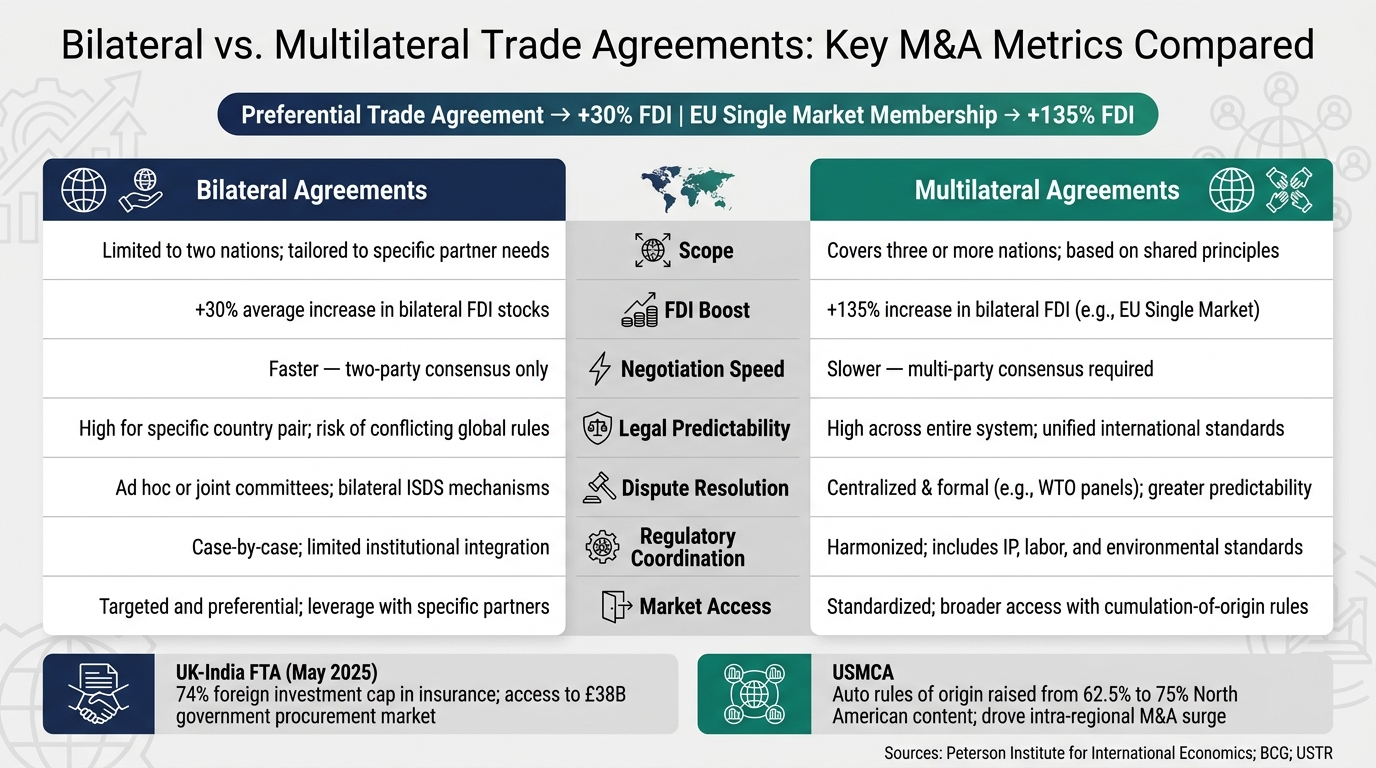
Bilateral vs. Multilateral Trade Agreements: Key M&A Metrics Compared
Let’s take a closer look at how bilateral and multilateral trade agreements differ and their impact on cross-border M&A. The table below outlines some critical metrics that influence dealmaking strategies.
| Metric | Bilateral Agreements | Multilateral Agreements |
|---|---|---|
| Scope | Limited to two nations; tailored to specific partner needs | Covers three or more nations; based on shared principles |
| Legal Predictability | High for the specific country pair, but creates a web of conflicting rules globally | High across the system; unified international standards |
| Market Access | Targeted and preferential; often used to gain leverage with smaller partners | Standardized; provides broader access and "cumulation" of origin rules |
| Regulatory Coordination | Addressed case-by-case; lacks deep institutional integration | Harmonized; often includes standard-setting in areas like IP, labor, and environment |
| Negotiation Speed | Faster between two parties | Slower due to the need for multi-party consensus |
| Dispute Resolution | Ad hoc or via joint committees; often uses bilateral ISDS mechanisms | Centralized and formal, such as WTO panels, offering greater predictability |
Here’s a striking statistic: signing a Preferential Trade Agreement typically increases bilateral Foreign Direct Investment (FDI) stocks by an average of 30%. Compare that to the estimated 135% boost in bilateral FDI for members of a deep multilateral framework like the EU Single Market [2]. This stark difference highlights how regulatory depth and market scale can significantly impact cross-border capital flows. These factors directly shape the M&A strategies discussed in earlier sections.
The type of trade agreement has a profound effect on how deals are structured and risks are managed throughout the M&A process. From initial screening to post-deal integration, the agreement type sets the tone for navigating challenges and opportunities.
Bilateral agreements offer a highly specific legal framework tailored to particular markets. For instance, bilateral investment treaties often include ISDS (Investor-State Dispute Settlement) mechanisms that streamline dispute resolution and mitigate political risks. This can be a game-changer when acquiring assets in regions with volatile markets. A real-world example is the case of First Quantum Minerals Ltd., which initiated arbitration proceedings in August 2024, seeking US$20 billion in damages from Panama. This was based on the bilateral investment protection treaty between Canada and Panama, following the shutdown of the Cobre Panamá copper mine [1]. Without this treaty, the company’s legal options would have been far more restricted.
That said, bilateral agreements can also lead to a tangle of overlapping and sometimes conflicting rules. As Gary Clyde Hufbauer from the Peterson Institute for International Economics explains:
"The various [bilateral] agreements might [have provisions that are] slightly different from one another... you end up with a more confusing array of agreements that firms must deal with." [15]
For M&A teams working across multiple bilateral agreements, this can mean higher compliance costs and delays in integrating assets due to inconsistent rules on origin, IP, and digital trade.
Multilateral agreements, on the other hand, prioritize consistency over customization. Regulatory harmonization simplifies due diligence when deals span multiple member countries. A key feature of multilateral frameworks is "cumulation" rules, which allow components sourced from various member nations to collectively meet origin requirements. This can significantly lower tariff costs by enabling acquirers to reconfigure supply chains after closing a deal.
However, as researchers Alexander Thompson and Daniel Verdier point out, there’s a tradeoff: "Multilateralism is wasteful in incentives whereas bilateralism increases transaction costs." [16] Neither approach is universally better - the choice depends on the deal’s geographic reach, industry specifics, and risk considerations.
When it comes to cross-border M&A, the type of trade agreement in place plays a major role in choosing where to pursue deals. M&A teams often favor jurisdictions covered by Bilateral Investment Treaties (BITs) or Foreign Investment Promotion and Protection Agreements (FIPAs). These agreements provide legal clarity and stronger protections for investors.
As Jeffrey K. Merk, Partner at Aird & Berlis, puts it:
"FIPAs, as bilateral trade agreements, create more predictable and fair conditions for foreign investors by limiting the circumstances where an investment may be negatively affected." [1]
Foreign Direct Investment (FDI) data backs up this approach. A typical Preferential Trade Agreement can boost bilateral FDI stocks by around 30%. Meanwhile, deeper multilateral arrangements - like participation in the EU Single Market - can increase FDI by as much as 135% [2]. However, Free Trade Agreements can sometimes lower M&A activity in specific sectors by making Greenfield investments a more attractive option [6]. These market entry factors naturally lead to more detailed regulatory assessments in cross-border deals.
Trade agreements influence the entire regulatory landscape that deal teams must navigate. Bilateral agreements often include direct investor-state dispute settlement mechanisms, giving investors a clear route to arbitration if a host government takes adverse actions. On the other hand, multilateral frameworks tend to cover a wider range of regulatory topics, such as intellectual property, public procurement, and environmental standards. This broader scope can make dispute resolution more complex and multi-jurisdictional [1][2]. These differences often come into sharp focus during regulatory reviews.
National security screenings have become a key factor in this process. Regulatory bodies like CFIUS in the US, the NSI Act in the UK, and FIRB in Australia require early planning to secure approvals. A single unresolved review can delay a transaction long after other steps have been completed.
"A foreign buyer approaching a US target must understand from the outset that the US regulatory framework is not negotiable and cannot be contracted around." - Alex Lubyansky, Esq. [17]
To avoid costly delays, deal teams need to identify and address all required approvals - whether related to specific sectors, antitrust concerns, or national security - early in the process.
Once regulatory clearances are secured, the focus shifts to integration planning. Trade agreements play an important role here, particularly in supply chain restructuring. Under multilateral frameworks, components sourced from multiple member countries can often meet rules-of-origin requirements, reducing tariff costs. However, capturing these savings requires immediate action: verifying product eligibility, updating supplier documentation, and implementing compliant self-certification systems.
A good example is the EU-Mercosur Interim Trade Agreement, which began provisional application in May 2026. Companies in industries like automotive and chemicals had to adopt REX-compliant self-certification and update supplier documentation to benefit from the new preferential tariff rates [18]. As the Baker McKenzie Global Customs and Trade Team noted:
"Companies that rely on the agreement without these preparations expose themselves to compliance risk rather than capturing sustainable tariff savings." [18]
Failing to take these steps can lead to compliance issues and missed opportunities for tariff savings.
Timing is another critical factor. Preemptively coordinating operations or pricing strategies before receiving full regulatory clearance - known as "gun-jumping" - can result in steep penalties. For instance, in January 2025, the FTC fined XCL Resources, Verdun Oil, and EP Energy a combined $5.6 million for unlawful pre-closing coordination during the HSR Act waiting period [20]. Properly sequencing integration activities by jurisdiction isn’t just smart - it’s legally required.
Trade agreements are anything but static. They evolve quickly, and policy changes can disrupt the economic foundations of a deal. Ignoring these shifts is no longer an option.
"The era of treating trade policy as background macroeconomic noise is over." - Origin Law Corporation [21]
Take bilateral agreements, for instance. They often include sunset clauses, which can introduce long-term uncertainty. A prime example is CUSMA (the Canada-U.S.-Mexico Agreement), which undergoes periodic reviews. The next major review is set for July 2026. These reviews can be used as bargaining tools, adding layers of unpredictability that make it harder for M&A teams to confidently model outcomes [21].
Multilateral agreements come with their own set of hurdles, particularly regulatory gaps. Frameworks like the EU-Mercosur Partnership Agreement (EMPA) and the EU-Mexico Modernized Global Agreement lack robust investment chapters or ISDS (Investor-State Dispute Settlement) mechanisms. This forces companies to rely on a patchwork of bilateral treaties, each with its own procedural quirks and varying levels of protection [19]. Without ISDS, investors often have to navigate local courts, which can involve language barriers, procedural uncertainty, and concerns about impartiality. To address these risks, deal teams are now negotiating tariff-specific Material Adverse Change (MAC) clauses that kick in if tariffs on key goods surpass agreed thresholds [21][23].
"Parties are seeking greater contractual protection in an environment where political decision-making is less predictable and regulatory processes more protracted." - Arlene J. Ortiz-Leytte, Partner, Herbert Smith Freehills Kramer [5]
These regulatory uncertainties mean M&A teams need to account for potential shifts and sector-specific pressures at every stage of the deal process. This broader instability sets the stage for challenges that vary by industry.
Regulatory uncertainties don’t hit every industry the same way. Some sectors face unique challenges that can reshape deal strategies or even jeopardize feasibility altogether.
Take the softwood lumber industry as an example. By early 2026, U.S. duties on Canadian softwood lumber - including anti-dumping and Section 232 tariffs - had climbed to over 45%. Companies like Canfor and West Fraser saw their levies increase dramatically under 2025 administrative reviews, with Canfor facing a total of 46.48% (up from 16.58%) and West Fraser at 26.05% (up from 11.89%) [21]. These steep costs led both companies to adopt a "tariff jumping" strategy, shifting production to the U.S. and Europe rather than absorbing the financial hit. By 2026, West Fraser operated more sawmills in the U.S. (16) than in Canada (13) [21].
The technology and semiconductor sectors face entirely different risks. In January 2026, President Trump ordered the divestiture of digital chip businesses acquired by HieFo, a Delaware corporation controlled by a PRC citizen, citing national security concerns. This action came nearly two years after the $3 million acquisition of these businesses from EMCORE in April 2024 [21][22]. The message was clear: even completed deals are not immune to being unwound. In 2025, 85% of technology-related transactions required mandatory CFIUS (Committee on Foreign Investment in the United States) declarations, with review timelines stretching from 3–4 months to as long as 6–9 months [24].
The table below highlights how trade and regulatory risks affect various sectors:
| Sector | Primary Risk | Key M&A Impact |
|---|---|---|
| Semiconductors | Export controls & tech transfer restrictions | High mitigation costs; potential forced divestiture [24] |
| Automotive | Rules of Origin (CUSMA) compliance | Margin erosion if inputs fail regional content tests [21] |
| Softwood Lumber | Countervailing & anti-dumping duties | Heavy cash deposit burdens; pressure to relocate production [21] |
| AI & Data | Data sovereignty & transparency rules | Operational limits on employee data access post-close [24][22] |
| Critical Minerals | National security "call-in" risks | Prolonged closing timelines of 9–18 months [24] |
Governments are also becoming more aggressive in reviewing transactions for national security concerns, even when deals don’t meet mandatory notification thresholds [5]. In 2025, Australia’s FIRB (Foreign Investment Review Board) blocked Cosette Pharmaceuticals from acquiring Mayne Pharma’s manufacturing site. The reasoning? Cosette planned to shut down a domestic pharmaceutical facility, a move deemed against the national interest [5]. This underscores how sector sensitivity, not just deal size, is now driving regulatory scrutiny.
"With transactions facing increasingly complex regulatory oversight, deal dynamics (particularly auctions) are being reshaped as parties are pushed to allocate regulatory risk earlier and more transparently." - Heidi Gallagher, Partner, Herbert Smith Freehills Kramer [5]
The type of trade agreement at play can significantly influence key aspects of cross-border M&A - such as valuation, regulatory timelines, integration challenges, and risk distribution. As highlighted earlier, understanding the nuances of trade agreements is critical for navigating every stage of a deal. Tailoring deal structures to align with the specific trade framework is not just beneficial - it’s essential.
For instance, bilateral agreements often provide quicker, more targeted benefits. Take the U.S.–EU political framework agreement finalized on July 27, 2025. It established a 15% base tariff on most EU goods, offering industrial and automotive buyers much-needed pricing predictability. This move directly contributed to a surge in transatlantic M&A activity during Q4 2025 [4]. On the other hand, multilateral agreements offer broader coverage but come with added complexities, such as extended renegotiation periods and overlapping regulations. A relevant example is the EU Data Act, which introduced new compliance requirements that altered the valuation of data-heavy companies [4].
To successfully close deals in this environment, deal structures must be carefully designed to reflect the target’s trade landscape. This includes conducting in-depth supply chain analysis, crafting tailored Material Adverse Effect (MAE) clauses, and incorporating trade impact indemnities.
Moreover, aligning financial and strategic operations with these trade realities is critical. Firms like Phoenix Strategy Group specialize in identifying trade-related risks early in the process, ensuring smoother and more secure deal execution.
Despite tariff volatility, global M&A activity reached $4.5 trillion in 2025 [4], proving that cross-border deals are still achievable. However, success hinges on treating trade agreement dynamics as a central consideration rather than an afterthought. Teams that prioritize these factors are better positioned to thrive in the complex world of international mergers and acquisitions.
The right trade agreement for you hinges on your specific objectives. If tax efficiency is your priority, double taxation agreements (DTAs) are key. They reduce withholding taxes on dividends, interest, and royalties, helping you keep more of your earnings.
For those focused on safeguarding investments, bilateral Foreign Investment Promotion and Protection Agreements (FIPAs) provide enforceable rights and mechanisms for resolving disputes - offering peace of mind in international ventures.
If your goal is to expand market access, Free Trade Agreements (FTAs) are the way to go. These agreements break down trade barriers, making it easier to do business across borders.
Navigating these agreements can be tricky, but Phoenix Strategy Group specializes in guiding businesses through these complexities, ensuring they’re well-prepared for successful exits.
Rules of origin play a critical role in trade policy, directly influencing a target company's valuation. Why? Because they determine whether a product qualifies for preferential tariffs under trade agreements. This eligibility can significantly impact production costs, pricing, and even customer demand.
Changes to these rules can shake things up - potentially altering the economics of sourcing materials and affecting cash flow. For dealmakers, this means it's essential to dig deep into the supply chain. Understanding the nuances ensures that any projected synergies, especially those tied to cross-border sourcing, are realistic and not just optimistic assumptions on paper.
Dealmakers often rely on inventive strategies to handle tariff and policy risks. Popular methods include simultaneous sign-and-close structures to reduce the risks tied to delayed closings, tariff-adjusted pricing, and clawback escrow arrangements. Additionally, parties may agree on customized MAE (Material Adverse Effect) clauses or standalone indemnities to address tariff-related impacts directly. Phoenix Strategy Group helps businesses tackle these challenges by offering expert financial advisory and M&A execution services, providing stability through tailored strategies like calibrated interim operating covenants.