Published on
May 6, 2026


When raising venture capital, board composition is one of the most critical terms to negotiate. It directly impacts who controls key decisions like budgets, executive hires, and company exits. Even if you own the majority of your company, losing control of the board can undermine your authority as a founder.
Key takeaways:
The structure you set now will shape your company's future. Always map out voting dynamics before signing a term sheet.
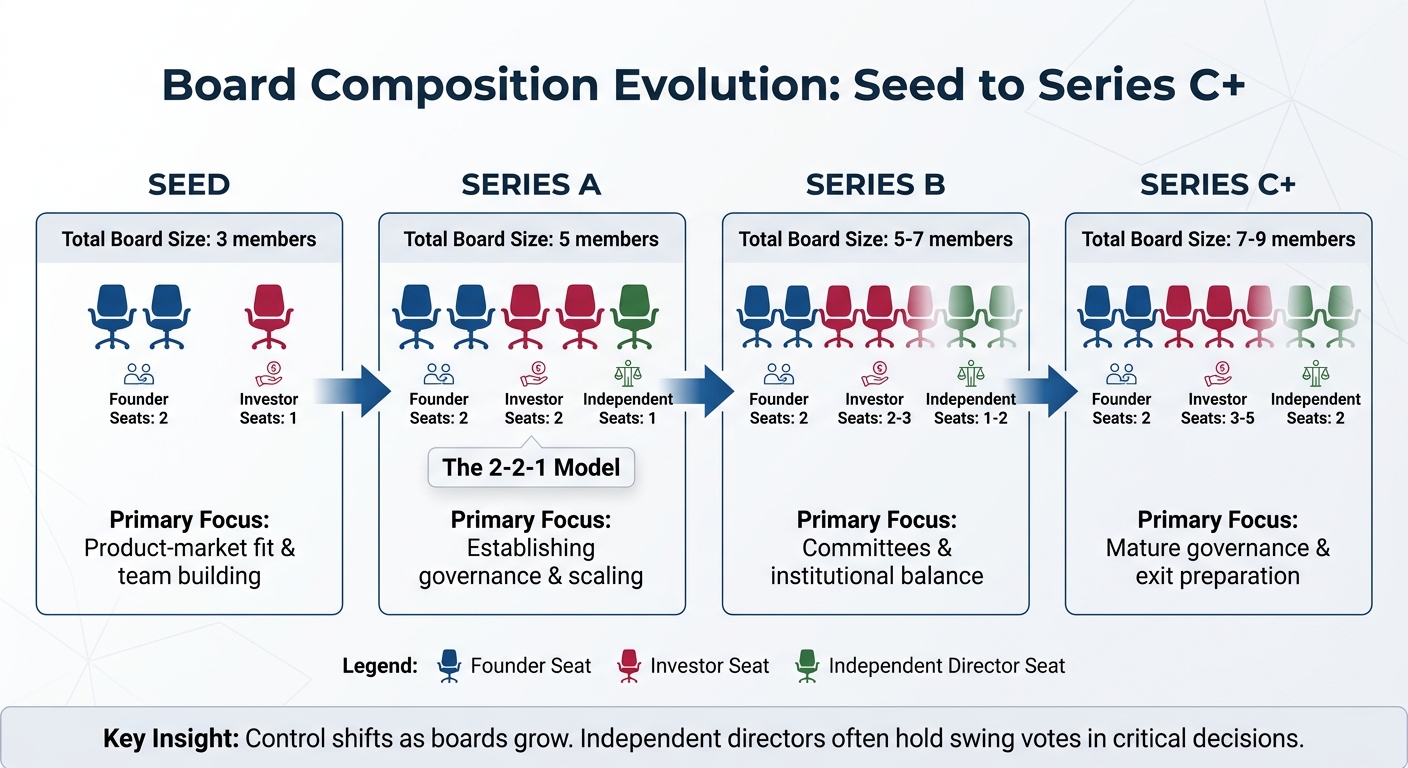
Board Composition Evolution from Seed to Series C+ Funding Stages
Board composition shifts as companies progress through funding stages, reflecting changes in decision-making dynamics and the need for more structured governance. Starting as a three-member seed board, it typically grows to five members at Series A and up to seven members or more by Series B. Here's a closer look at how boards evolve from seed stage to later funding rounds.
In the seed stage, boards are usually small, with three members: two founders and one investor representative. This setup allows founders to maintain voting control while benefiting from external guidance [1] [6]. Some seed-stage companies may not establish a formal board until a lead investor requests a seat. However, creating a board early can prepare founders for the governance complexities that come with Series A.
When multiple investors express interest in joining the board, offering observer status is a practical solution. Observers can attend meetings and stay informed without altering the voting balance. At this stage, the primary focus remains on finding product-market fit and building the core team [1] [6].
Series A introduces a more structured board with five members, often following a "2‑2‑1" model: two founders, two investors (typically from the seed and Series A rounds), and one independent director [1] [4] [6]. The independent director plays a pivotal role, often serving as the swing vote in critical decisions.
"The independent seat is where control shifts hide. A term sheet that says 'one independent director mutually agreed' is very different from 'one independent director approved by the investors'."
- Ryan Roberts, Startup Lawyer [1]
It's vital to ensure that the independent director is selected through mutual agreement, rather than being solely investor-approved. This role often influences key votes on budgets, executive hiring, and exit strategies [1] [4]. The balance of power in this stage can shape the company's trajectory, so founders should carefully consider the terms outlined in the term sheet.
As companies grow, board structures expand to address increased operational demands. In Series B, boards typically include five to seven members, with a mix of founders, investor representatives (from Series A and Series B), and one or two independent directors [5] [6]. This stage often marks the formation of formal committees, such as Audit and Compensation, to enhance oversight and governance.
Later rounds see boards becoming even more complex, with additional investor-appointed and independent directors. Once founders lose voting control at the board level, it becomes nearly impossible to regain. This underscores the importance of thoughtful board composition early on, as these decisions have lasting implications for company control [1].
| Stage | Typical Size | Founder Seats | Investor Seats | Independent Seats | Primary Focus |
|---|---|---|---|---|---|
| Seed | 3 members | 2 | 1 | 0 | Product-market fit & team building |
| Series A | 5 members | 2 | 2 | 1 | Establishing governance & scaling |
| Series B | 5–7 members | 2 | 2–3 | 1–2 | Committees & institutional balance |
| Series C+ | 7–9 members | 2 | 3–5 | 2 | Mature governance & exit preparation |
How a board is structured and operates plays a huge role in determining who holds the reins of a company. It's not just about counting seats; the rules for appointing and expanding board members often conceal the true dynamics of power.
Term sheets typically lay out the number of board seats and who gets to elect them. For Series A companies, a 5-person board is standard, while seed-stage startups usually stick with 3 members [1][5]. But the real kicker isn't just the size - it's about who gets to add seats when the board grows.
For example, if a term sheet allows a 5-person board to expand to 7 through a board vote, investors could gain control without needing the founders' approval [1]. To prevent this, protective provisions often require the majority consent of preferred stockholders to change the board's size, ensuring founders aren't sidelined [2][5].
"Board composition is where 'control' becomes a number you can count."
- Ryan Roberts, Startup Lawyer
Another factor to watch is investor rights to replace vacant seats. Founders should push for clear conditions - like hitting specific milestones or reaching a new funding round - before any board expansion happens.
Experts advise keeping boards small, ideally between three and five members, to streamline decision-making. Odd numbers are also favored to avoid deadlocks during votes [2][5]. These mechanics directly affect how decisions are made, setting the stage for the next layer of governance: voting rights.
Board seats don't just symbolize ownership - they translate into decision-making power. A founder might hold most of the company's equity but lose control if they don't secure a majority of the board seats [1]. This is why board composition is so crucial for decisions like budgets, hiring, and acquisitions.
Preferred stockholders often vote on an "as-converted" basis alongside common stock, giving their influence a direct tie to potential ownership [4]. Additionally, class-specific veto rights (through protective provisions) allow preferred stockholders to block major actions even if they lack a board seat.
In a typical Series A setup with a 5-person board (2 founders, 2 investors, and 1 independent director), the independent director often acts as the swing vote. If investors control the process for selecting this director, they could secure a 3–2 majority [1]. To avoid losing control, founders should ensure the independent director's selection is based on genuine mutual consent, not unilateral investor approval.
Mapping out who elects each seat and setting clear rules for board expansion can help founders maintain their influence over time.
Protective provisions add another layer of control, allowing preferred stockholders to veto certain actions even if the board approves them. These provisions often cover major moves like amending the corporate charter, issuing new shares, selling the company, changing board size, or taking on significant debt [4].
While these safeguards are designed for big decisions, some investors might try to use them to interfere in daily operations. To prevent this, founders should keep the list of protective provisions focused on structural changes, avoiding vague terms like "any material transaction" that could grant excessive control. Setting reasonable thresholds for debt and spending can also help avoid unnecessary bottlenecks [4][5].
Choosing an independent director is a pivotal decision, as this person often holds the balance of power. Term sheets should clearly define whether the director is chosen by mutual agreement between founders and investors or if investors have fallback rights to make the appointment.
Be wary of fallback clauses that allow investors to install their preferred candidate if a mutual decision isn't reached quickly. Since the independent director influences critical votes, it's essential to outline their selection process and criteria explicitly.
Think of it this way: even if founders hold most of the equity (or "own the ball"), control over the independent seat can shift the game's outcome. Ensuring mutual agreement on this position is key to maintaining a fair balance of power.
Negotiating board terms is just as important as securing the right valuation. While valuation grabs attention, board terms shape the future of your company. They affect your ability to make decisions, hire, and navigate challenges. As one expert from Beancount.io explains:
"Price is headline; control is trajectory. A higher valuation feels good, but governance terms dictate your ability to operate, hire, and steer the company through challenges." [7]
To ensure founder-friendly terms, focus on these key strategies:
Your strongest leverage comes in the first 72 hours after receiving a term sheet. Use this window to set the foundation for governance principles [3]. Begin by addressing the independent director selection process. Avoid vague phrases like "mutually agreed" and establish a clear process instead. For example:
Protective provisions should only apply to major decisions, such as mergers, charter amendments, or senior debt agreements. Avoid giving investors veto power over operational matters like budgets or hiring. Additionally, set financial thresholds that align with your company's growth. For instance, if you're raising $5 million, a debt threshold of $500,000 is reasonable, but $50,000 could hinder growth down the line [7][4].
To maintain control, offer secondary investors observer rights with enhanced access to information instead of voting seats [7]. This keeps governance streamlined while still keeping investors informed.
Drag-along rights can force founders into a sale, so negotiate carefully. Aim for a high threshold, such as requiring board approval along with a majority vote from both common and preferred stockholders [7][4].
Investors may push for a full four-year vesting schedule for founder shares. Instead, negotiate to have 25–50% of your shares vest at closing [4]. This ensures you retain a significant stake in the company from the start.
A balanced board ensures no single group has unchecked authority, encouraging teamwork while maintaining strong governance. At the Series A stage, boards typically have five seats[4]. This structure creates a natural system of checks and balances, ensuring neither side dominates decision-making.
The independent director plays a pivotal role in this setup, often acting as the swing vote. To maintain fairness, it's crucial to have a well-defined process for selecting this independent member, preventing the board from becoming overly influenced by investors.
Boards should always have an odd number of members - three, five, or seven - to avoid deadlocks in voting[5]. For example, at the Seed stage, a three-person board (two founders and one investor) provides a balance of control and external input[1]. As the company grows to Series B and beyond, the board might expand to seven members. However, experts caution against exceeding nine directors, as larger boards can become inefficient and slow-moving[5].
Independent directors can be strategically chosen to fill gaps in expertise. Look for individuals with skills in areas like finance, regulatory compliance, or mergers and acquisitions (M&A)[5]. At Series A, independent directors typically receive equity between 0.5% and 1.0% on a fully diluted basis, vesting over four years[5]. To foster transparency and open communication, consider holding executive sessions where directors can meet without the CEO to discuss performance. Similarly, founders can meet with independent directors without investors to address board dynamics[5].
Here's a breakdown of different board structures, their pros and cons, and when they work best:
| Board Type | Composition | Advantages | Disadvantages | Ideal Stage |
|---|---|---|---|---|
| Founder-Controlled | 2 Founders, 1 Investor | Quick decision-making; preserves founder vision; avoids premature exits | Limited external insights; may deter institutional investors | Seed / Early Series A (with leverage) |
| Balanced | 2 Founders, 2 Investors, 1 Independent | Promotes collaboration; independent acts as mediator and tiebreaker | Independent selection can become contentious; requires consensus-building | Series A / Series B |
| Investor-Controlled | 1 Founder, 2 Investors, 2 Independents | Strong governance; oversight for scaling; protects investor interests | Founders risk losing control; may prioritize investor goals over company mission | Series C+ / Pre-IPO / Rescue Rounds |
Board composition isn't just a line item in your term sheet - it’s the backbone of your company’s governance. The structure you establish now determines who holds the reins on critical decisions, from executive hires to potential acquisitions. As startup lawyer Ryan Roberts explains:
"Board composition is a one-way door more often than founders expect. Economics can be renegotiated in later rounds. Governance rarely resets unless something breaks" [1].
Since the founder-friendly days of 2021, the landscape has shifted. By 2026, balanced governance structures have become the norm, with the five-person board - two founders, two investors, and one independent director - emerging as the standard for Series A rounds [2]. This setup fosters checks and balances, assuming the independent director maintains true neutrality.
Consider this: around 60% of venture-backed exits result in valuations lower than the last funding round [3]. A well-balanced board ensures that decisions are made in the company’s best long-term interest, not just to serve one group of stakeholders.
As your company grows from Seed to later stages, your board structure should evolve strategically. A three-person board may suffice early on, but as you move through Series A and beyond, expanding the board thoughtfully can add valuable expertise while maintaining efficiency. Sticking to an odd number of seats - three, five, or seven - can also help avoid deadlocks and ensure decisions are made effectively.
The board you build today plays a pivotal role in shaping your company’s future. Approach the process with intention, and establish clear selection criteria to ensure every seat supports your long-term vision. For tailored advice on creating a board structure aligned with your goals, consider consulting Phoenix Strategy Group (https://phoenixstrategy.group).
Maintaining control of your company while holding onto a majority stake means navigating term sheet negotiations with precision. One key area to focus on is board composition. By ensuring you hold majority influence on the board, you can steer critical decisions in the direction you believe best aligns with your vision.
It’s also essential to negotiate voting rights and protective provisions. These can safeguard your ability to approve or block major actions, such as mergers, acquisitions, or additional funding rounds. Structuring the board thoughtfully - whether that means reserving seats for founders or bringing in independent directors - can strike a balance between attracting investors and retaining control.
The best way to go about this is to choose an independent director who both the CEO and the majority of Series Seed investors agree on. This creates a sense of trust, alignment, and ensures decisions are made with balance.
Protective provisions make sense when they cover major decisions, such as issuing new shares or selling key assets, and require investor approval. However, giving veto power over everyday or minor decisions often goes too far, restricting the company’s ability to function smoothly. Provisions that are carefully limited can protect investor interests while ensuring the company has the flexibility it needs to run efficiently.