Published on
May 6, 2026


When planning a business exit, the big question is: should you wait for the perfect market conditions or focus on getting your company ready for sale? Here's the answer: business readiness comes first, market timing comes second.
Key takeaway: Timing the market can amplify value, but it won’t fix a poorly prepared business. A ready business sells well in any market, while an unprepared one struggles even in a seller’s market.
Quick Comparison:
| Factor | Market Timing | Business Readiness |
|---|---|---|
| Control | External, unpredictable | Internal, within your control |
| Preparation Time | Reactive, depends on conditions | Proactive, takes 18–36 months |
| Success Impact | Multiplies existing value | Creates base value, reduces risks |
| Risks | Market shifts, economic changes | Weak processes, messy finances |
Bottom line: Focus on readiness first. A well-prepared business gives you the flexibility to sell when the market is right, without rushing or compromising on value.
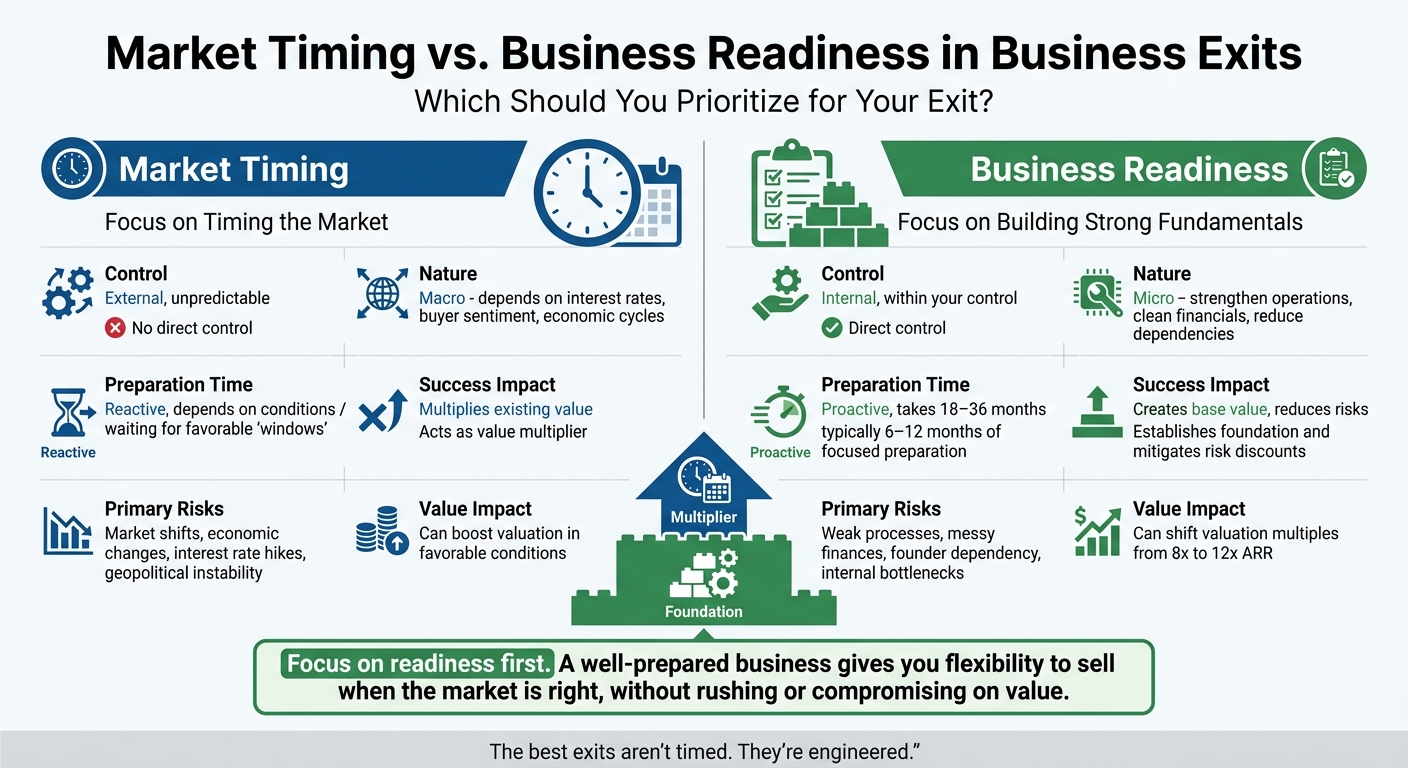
Market Timing vs Business Readiness: Key Factors Comparison for Business Exits
Timing the market can certainly enhance exit valuations, but its unpredictable nature makes having a well-prepared business even more crucial. In essence, market timing involves planning your exit during favorable external conditions - times when buyers are highly competitive, valuations are at their peak, and capital is abundant. While these factors can amplify outcomes, they are inherently difficult to predict.
There are several economic signals that can hint at favorable conditions for sellers. One major indicator is the rise in deal values. Buyers are increasingly focusing on acquiring fewer but higher-quality assets, which drives up prices even when the overall number of deals remains controlled [4]. Private equity firms also contribute to this dynamic, as they face pressure to deploy their undeployed capital within strict fund timelines. This urgency can lead to better pricing and more flexible deal structures [4].
Corporate buyers, particularly those seeking to acquire AI and technology capabilities, add further momentum. Broader economic factors like stable interest rates, inflation trends, and geopolitical stability also play a role [4]. Additionally, industry-specific growth cycles - such as booms in cybersecurity or fintech - can create windows of opportunity where valuations soar [3].
While these indicators signal potential opportunities, they also highlight the risks of relying solely on market timing.
When market conditions are strong, sellers can benefit from higher valuations driven by intense buyer competition. These favorable conditions can also speed up buyer confidence, reduce the need for complex deal mechanisms like earn-outs, and result in simpler, cleaner deal terms [2].
"In markets like this, buyers aren't paying for perfection, they're paying for predictability. Businesses that reduce execution risk for buyers tend to separate themselves quickly" [4].
However, there are risks tied to depending too much on market timing. Conditions can change rapidly between the start of the sale process and its conclusion.
"Most owners underestimate how long a sale process actually takes. Market conditions rarely stay static from launch to close. Positioning early, while performance is strong, gives you margin for error if demand softens or buyer underwriting tightens along the way" [4].
Waiting for the "perfect" market can also become an excuse to delay the necessary preparation of the business [2][3].
Understanding the trade-offs of market timing is essential before diving into historical insights.
Looking at past outcomes reveals the challenges of relying purely on market timing. During cautious or restrictive markets, buyers tend to be highly selective, favoring businesses that are fully prepared and "buyer-grade" [2]. On the other hand, in booming markets, even average companies may attract buyers. However, the best results still go to those that are ready to stand out. By the time the market is widely recognized as "perfect" for selling, the best opportunities are often already gone [1].
Unlike market timing, which depends on external factors beyond your control, business readiness is something you can actively shape. It's about laying a strong foundation that transforms a company from merely sellable to highly attractive for buyers. This requires a deliberate and structured approach.
Business readiness is built on several critical pillars:
Once these elements are in place, the focus shifts to the timeline required to achieve readiness.
Preparing a business for an exit typically takes 18–36 months of focused effort [5]. Unlike market timing, which is reactive and unpredictable, readiness is proactive and ensures you're prepared to seize opportunities when they arise [3]. Experts often recommend starting this process years in advance to address risks like customer concentration or technical debt [3].
The timeline depends on your current state and goals. For businesses aiming to exit within three years, the focus should be on formal exit planning, tax modeling, and transaction preparation. A five-year timeline allows for building operational efficiency and growing recurring revenue. Companies with a ten-year horizon can concentrate on broader goals like leadership succession and vision-setting [7]. Regardless of the timeframe, starting early is critical - rushing to prepare during a favorable market period often leads to suboptimal outcomes.
A well-thought-out timeline not only mitigates risks but also enhances the opportunities available during the exit process.
Focusing on readiness brings value even if an exit isn't immediate. The process strengthens operations, reduces risks, and increases the overall value of the business. Yet, only about 20% of closely held business owners have a written, actionable exit plan, leaving significant room for improvement [7].
Readiness also gives you flexibility. When your business is prepared, you can choose the best time to sell, rather than being forced to act during market downturns or financial crises. As one expert put it, preparation allows you to act strategically when market conditions are favorable, instead of scrambling to get ready at the last minute [8]. Buyers are particularly drawn to businesses that show momentum and growth potential.
"Exit readiness isn't a checklist - it's a value creation strategy that sets sponsors apart when it matters most." – Roland Berger [9]
Finally, readiness increases the likelihood of a successful deal. Conducting a sell-side Quality of Earnings report before going to market helps uncover and address financial discrepancies. This not only prevents value leakage but also positions your business as a premium asset in the eyes of potential buyers [10].
Market timing hinges on external factors, while business readiness is something you can control. Think of market timing as reactive - it depends on things like interest rates, buyer sentiment, and economic cycles, all of which are outside your influence. On the other hand, business readiness is proactive. It’s about strengthening your operations, cleaning up your financials, and reducing reliance on any single factor or individual.
| Factor | Market Timing | Business Readiness |
|---|---|---|
| Nature | External and uncontrollable (Macro) | Internal and controllable (Micro) |
| Preparation Time | Reactive; waiting for favorable "windows" | Proactive; typically 6–12 months of preparation [2] |
| Success Rates | Lower; dependent on buyer sentiment [2] | Higher; builds consistent buyer confidence [2] |
| Value Impact | Acts as a multiplier of existing value | Establishes base value and mitigates risk discounts [2] |
| Primary Risks | Market shifts, interest rate hikes, geopolitical instability [3] | Internal bottlenecks, founder dependency, messy data [2] |
This comparison shows that while market timing can boost value, it’s your internal readiness that lays the groundwork for a successful exit.
Although external factors are beyond your control, you can focus on areas like achieving GAAP-compliant financials, diversifying your client base, and ensuring operational independence. These steps are critical because they reduce risk and build trust with potential buyers, regardless of market conditions.
In the financial services sector, business readiness often trumps market timing. Why? Buyers don’t stop acquiring during tighter markets - they just become more selective [2]. When conditions are favorable, a well-prepared business sells. When markets tighten, only the most prepared businesses secure strong terms. Due diligence will always uncover and price in weaknesses [2].
"A cycle doesn't buy your business. A buyer does." - Succeed [2]
For financial services firms, transferability stands out as the most reliable value driver, no matter the market conditions [2]. If your business depends too heavily on the founder, buyers will apply discounts - even in a seller’s market. High readiness gives you the flexibility to make decisions based on your goals, rather than being at the mercy of market trends.
In the financial services industry, being thoroughly prepared internally consistently beats trying to time the market. This sector operates under intense scrutiny, making it clear that market conditions alone can't guarantee success. When the market is favorable, businesses that are well-prepared thrive. When the market tightens, only those with clean financial records, strong processes, and operational independence can negotiate favorable terms.
The data backs this up: tackling readiness factors like customer concentration and automation can significantly boost valuation multiples - for instance, shifting from 8x to 12x ARR [3]. This isn't about waiting for the stars to align; it's about building a business that commands top-dollar regardless of market trends. As Wayne Horkan puts it, "Poor preparation leads to a challenging due diligence process and lower valuations" [3].
"Diligence isn't where you fix weaknesses. It's where weaknesses get priced." - Succeed [2]
Exiting in financial services requires rigorous due diligence, which exposes every operational flaw [3]. Issues like messy financial records, over-reliance on founders, or unresolved technical debt don’t get ignored in a booming market - they get penalized. A simple readiness test can reveal whether timing even matters: Can you assemble a clean data room in 14 days? Can your business run smoothly for 30 days without you? If the answer is no, market conditions won’t save you [2].
Specialized advisory services can help businesses address these gaps and ensure they’re truly ready.

Phoenix Strategy Group works closely with financial services firms to develop exit readiness through focused financial and strategic support. They tackle the critical areas that buyers scrutinize most: Truth (GAAP-compliant financials), Transferability (operational independence), and Tightness (controlled risks).
Their services include fractional CFO and FP&A systems that create a unified financial record, reducing the risk of deal delays during due diligence [2]. Their data engineering solutions ensure all financial data reconciles accurately, while their Integrated Financial Model delivers clear margin explanations and KPI insights that instill confidence in buyers.
With these readiness measures and expert guidance, firms are well-positioned to take advantage of exit opportunities when they arise.
Readiness provides flexibility. A business that meets buyer-grade standards allows you to choose whether to sell, raise capital, or hold - putting you in control, not the market [2]. While market timing can enhance value, it can’t create it. That starts with a solid foundation.
"The best exits aren't timed. They're engineered." - Succeed [2]
In financial services - where compliance, data accuracy, and operational reliability are non-negotiable [3] - waiting for the perfect market moment is a risky gamble. The firms that succeed invest 6–12 months in building operational independence, cleaning up their financials, and documenting processes [2]. When opportunity knocks, whether the market is thriving or cautious, they’re ready to act.
To figure out if your business is ready to sell, take a close look at both how your company is performing internally and what's happening in the market. Pay attention to key areas like growth potential, how smoothly your operations run, financial health, and whether your leadership team is solid and dependable. It's crucial to have strong basics in place and a sense of forward momentum.
Timing matters - a lot. The best time to sell is when your business is on an upward trajectory but hasn’t yet reached its peak. Make sure to tackle any gaps in profit, wealth, or overall value early on. Over time, work on building reliable systems and a capable leadership team to make your business more appealing and ready for potential buyers.
Several market signals can help you gauge whether it’s the right time to sell. Keep an eye on increased buyer confidence and activity, which often signals a healthy market. Another key indicator is rising deal values, showing that buyers are willing to pay a premium.
Additionally, the presence of abundant private equity capital suggests there’s plenty of funding available to close deals. On top of that, pressure from strategic buyers, often driven by advancements in technology like AI, can create a sense of urgency for acquisitions.
While these factors point to a strong selling environment, success ultimately hinges on how well you align these external market conditions with your business’s internal readiness.
In the first 90 days of preparing for an exit, the priority should be getting your business internally ready rather than trying to time the market. Concentrate on critical areas like operational stability, financial health, and hitting strategic goals. Pay close attention to strengthening essentials such as your team, systems, customer relationships, and networks. Building a solid foundation ensures you're in a position to act when the right market conditions arise. Remember, successful exits are typically built with intention, not left to chance.