Published on
February 25, 2026


Growth-stage companies face unique financial challenges - static budgets often fail to keep up with rapid changes. To stay ahead, businesses need flexible and precise budgeting strategies that align with their goals and market realities. Here are five key approaches:
Each method offers distinct benefits, from improving resource allocation to supporting better decision-making in uncertain markets. Choosing the right one depends on your company’s size, growth pace, and financial goals.
Zero-based budgeting (ZBB) starts from scratch - literally. Instead of building on last year’s numbers, every department begins with a clean slate and must justify every dollar they plan to spend. The goal? To ensure that every expense aligns with current business priorities and delivers measurable value [1].
This approach flips the usual budgeting mindset. Instead of asking, "How much more can we spend this year?" the focus shifts to, "What value does this expense bring?" Traditional budgets often carry over outdated costs, but ZBB eliminates that issue. In fact, an Accenture study showed that traditional budgeting methods only help about 50% of companies sustain cost savings beyond one or two years [2].
Billy Russell, FP&A Strategist at Cube, sums it up well:
"Where traditional budgeting is rigid, zero-based budgeting is flexible. The ability to quickly pivot expenses can be critical for companies that need to react quickly to market changes." [3]
For companies in growth stages, ZBB offers the agility they need. Unlike static budgets that rely on outdated assumptions, ZBB allows businesses to adapt their plans as circumstances shift. Some companies take this a step further with Agile Zero-Based Budgeting (AZBB), applying ZBB selectively to areas with high cost variability or strategic importance. This lets them focus on quick wins while staying aligned with long-term goals [4].
By rebuilding budgets in real-time, ZBB ensures that spending stays tightly connected to strategic KPIs.
Traditional budgeting can lead to "budget drift", where recurring costs stray from a company’s current priorities. ZBB prevents this by requiring every dollar spent to have a clear purpose, an accountable owner, and measurable outcomes. Luke Pototschnik, Managing Director at Boston Consulting Group, highlights this benefit:
"The clean-sheet approach to budgeting... allows [finance chiefs] to cut costs surgically. It also helps chief financial officers budget for longer-term changes in their business." [5]
Using spend packages - categorized as minimum, target, and stretch levels - makes it easier to align spending with critical KPIs while keeping room for flexibility [6].
ZBB doesn’t just align spending with goals; it also sharpens resource allocation. Because every expense must be justified, revenue-generating activities naturally take priority. This process often uncovers hidden inefficiencies. For example, during budget reviews, you might realize that a costly manual task could be replaced by a more affordable tech solution, boosting operational efficiency.
By scrutinizing every expense, ZBB helps organizations identify waste and allocate resources more effectively.
For companies facing rapid changes, ZBB’s focus on current realities provides a strategic edge. Traditional budgets, rooted in historical trends, can be misleading when market conditions shift quickly. ZBB, on the other hand, prioritizes what matters now. As Bennett Financials puts it:
"ZBB doesn't mean 'cut everything.' It means 'fund what matters.' Some costs will stay, some will shrink, and some will increase - because the point is prioritization, not austerity." [6]
This approach ensures that when revenue dips unexpectedly, you’re prepared. With clearly defined minimum, target, and stretch spending levels, you can pause lower-priority initiatives without derailing your financial plan. This clarity helps leaders make tough calls with confidence, even in uncertain times.
Phoenix Strategy Group specializes in helping growth-stage companies implement ZBB and other advanced budgeting methods. Their FP&A and fractional CFO services provide the expertise and tools needed to maintain detailed financial oversight during periods of rapid scaling.
Rolling forecasts update your financial plan at the close of each period. Instead of sticking to a fixed annual projection, you add a new period - usually a month or a quarter - as the current one ends. This keeps your forecast horizon consistent, typically covering 12 to 18 months, and ensures your financial plans reflect the latest realities rather than outdated assumptions. It’s a proactive way to keep your financial outlook flexible and ready for quick adjustments.
For growth-stage companies, this method is particularly effective in fast-changing markets where annual budgets can quickly become irrelevant. In fact, a 2023 Deloitte survey revealed that 68% of growth-stage businesses using rolling forecasts reported greater agility during economic uncertainty compared to those relying on traditional annual budgets. Accuracy is another advantage - rolling forecasts achieve 85–90% accuracy compared to the 60–70% seen with static budgets.
Rolling forecasts let you pivot quickly. Whether it’s a sudden spike in costs or an unexpected growth opportunity, you can adjust spending on marketing, hiring, or product development in weeks instead of months. A 2024 Gartner report found that mid-market growth companies (with 50 to 500 employees) using rolling forecasts reallocated resources four times faster, saving approximately $1.2 million annually.
This adaptability is crucial when scaling a business. For example, if your company gains rapid traction, you might need to expand your team immediately. Rolling forecasts ensure your financial planning stays aligned with your growth needs, keeping you ahead of the curve. Next, we’ll dive into how this approach improves resource allocation and decision-making.
The real strength of rolling forecasts lies in connecting projections to key performance indicators (KPIs) like monthly recurring revenue (MRR), customer lifetime value (LTV), or customer acquisition cost (CAC). Instead of guessing next quarter’s revenue, you can base your forecasts on measurable metrics, offering a clearer view of your business’s performance. For instance, if customer acquisition costs drop, your rolling forecast can show how much additional budget is available for reinvestment in growth while maintaining profitability.
Start with a 12-month rolling horizon, updated quarterly, and focus on three to five core KPIs. Regular reviews with teams across finance, sales, and operations ensure spending decisions align with strategic goals rather than just historical trends.
Frequent updates mean you can allocate resources more effectively. By regularly reviewing your financial plan, you can quickly spot inefficiencies and reallocate funds before minor issues escalate into major problems. Tools like Adaptive Insights or Anaplan make this process easier by automating real-time scenario modeling. Whether your outlook is optimistic, pessimistic, or somewhere in between, these tools help you prepare for a range of growth scenarios. For companies scaling quickly, this translates to both cost savings and strategic flexibility.
When static budgets fail to account for changing conditions, rolling forecasts offer a more dynamic solution. They provide a clear comparison of actual performance versus expectations, which is especially valuable during unpredictable market shifts. Unlike traditional budgets that lock you into assumptions made months ago, rolling forecasts integrate fresh data with every update. This reduces the risk of relying on outdated projections and gives leadership the confidence to make informed decisions, even in uncertain times.
Companies that combine rolling forecasts with driver-based planning often see 15–25% improvements in forecast accuracy within six to 12 months. These gains lead to better cash flow management, smarter hiring, and more strategic investments. Encouraging teams to analyze past data critically and explain variances ensures forecasts remain practical and actionable.
Phoenix Strategy Group specializes in helping growth-stage companies implement rolling forecasts. By integrating real-time financial data with strategic KPI development, they ensure your forecasts stay aligned with your business goals as you scale.
Scenario planning involves creating multiple budget versions to prepare for different potential outcomes - typically a conservative case, a base case, and an optimistic case. Instead of relying on a single forecast, this method allows you to plan for various scenarios, ensuring that funds are allocated in advance for changing conditions. It also ties directly into aligning spending with measurable KPIs, which we'll explore next.
Much like rolling forecasts, scenario planning equips you to handle a range of market conditions, boosting financial adaptability. Growth-stage companies often face unpredictable challenges: customer acquisition costs might surge, a major client could leave, or a competitor might disrupt your market. By modeling these possibilities ahead of time, you’re ready to act. For instance, you might plan for a worst-case scenario where revenue drops by 20%, a base case with steady 15% growth, and an optimistic case projecting 40% expansion. As actual data emerges, you can refine your approach and make adjustments within weeks, rather than waiting for the next budget cycle.
Each scenario ties directly to key performance indicators (KPIs) like ARR growth, customer acquisition, cash runway, and burn multiple. For example, if your base case assumes adding 50 new customers per quarter, your budget will reflect the necessary investments in sales hires, marketing efforts, and product development to achieve that goal. A conservative scenario might aim for 30 customers with scaled-back spending, while the optimistic scenario could budget for 75 customers with more aggressive investments. This approach ensures spending aligns with growth projections, helping you stay fundraising-ready and hit milestones without depleting cash reserves. By linking every dollar to measurable outcomes, you create a roadmap that supports your strategic objectives. This naturally complements the resource allocation strategies discussed later.
Scenario planning forces you to prioritize. By conducting cost-benefit analyses, you can pinpoint high-return investments, whether that’s expanding your sales team, launching a new product feature, or upgrading infrastructure. Growth-stage companies often direct more resources toward revenue-generating activities like sales and marketing in optimistic scenarios, while maintaining contingency funds for support functions such as HR and IT in more conservative ones. This approach prevents misaligned spending and avoids common mistakes, like over-investing in operations before revenue justifies it. Phoenix Strategy Group specializes in helping scaling businesses optimize resource allocation using advanced scenario modeling and proprietary data.
When market conditions shift - whether due to an economic downturn, supply chain issues, or sudden competitive pressures - scenario planning provides a clear decision-making framework. You’ll already have modeled the financial impact and identified which expenses to cut or which opportunities to seize. For instance, if a SaaS company experiences a 20% revenue drop, a conservative scenario might reallocate 15% from marketing to R&D, extending the cash runway by four months. To stay proactive, begin scenario planning early in Q4, review three to five scenarios each quarter, and track metrics like cash runway monthly to guide real-time decisions.
Activity-based budgeting (ABB) takes a closer look at what drives costs by focusing on the activities behind them, rather than relying on past spending data. This method is particularly useful for growth-stage companies that may not have a lot of historical data to reference. Instead, ABB zeroes in on current operational needs and anticipated activity levels, making it a flexible approach for businesses aiming to align their budgets with real-time demands [7][10]. Similar to rolling forecasts and scenario planning, ABB equips companies with tools to optimize spending based on up-to-date data.
The process involves three main steps: identifying activities that generate revenue or incur expenses (like customer support, sales calls, or production processes), estimating the volume of these activities, and calculating the cost per unit before multiplying it by the projected activity level [7][8]. This structured method provides a detailed view of how and why funds are allocated, giving businesses greater control over their budgets.
ABB helps pinpoint which activities add value - such as customer acquisition or product development - and which are less impactful, like redundant processes or excessive administrative tasks [9]. Studies suggest that around 20% of an organization’s activities can account for 80% of its total costs [9]. By mapping out activities, businesses can identify inefficiencies and redirect resources to areas with higher returns. This kind of cost mapping naturally ties into aligning every activity with strategic performance indicators.
One of ABB’s strengths lies in its ability to connect activity-level costs to specific outcomes. For example, if improving customer retention is a priority, ABB links support expenses to metrics like average resolution time or first-contact resolution rates [9]. To avoid overcomplicating the process, it’s best to track no more than five KPIs per major activity category. Collaboration is also key - bringing in department heads and frontline staff ensures that cost assignments reflect operational realities [9]. Phoenix Strategy Group uses activity-based frameworks to tie financial planning and fractional CFO services directly to operational processes, making budgets both transparent and strategically focused. By linking detailed activity costs with clear KPIs, businesses gain actionable insights that help them adapt during periods of uncertainty.
When market conditions change, ABB offers the detailed cost breakdowns needed to make quick, informed decisions. Knowing the cost per unit of each activity allows businesses to model different scenarios, like a sudden increase in customer support demand or adjustments in marketing spend. This granular insight makes it easier to tweak budgets in real-time without jeopardizing critical operations. By adding activity-level detail to the budgeting process, ABB enhances a company’s ability to stay agile and maintain growth, even in unpredictable environments.
Driver-based budgeting shifts the focus to the activities that fuel revenue growth. Instead of asking, "What did we spend last year?", this method digs deeper, asking, "What specific actions drive our success, and how should we allocate resources to them?" Josh Krissansen, a contributor at Finmark, explains it well:
"Driver-based budgeting is an approach to company budgeting that focuses heavily on identifying the key revenue drivers your business can use to generate more revenue" [11].
This method, much like rolling forecasts and scenario planning, turns budgeting into a more dynamic and strategic process. It directly connects operational efforts to financial outcomes, making it a powerful tool for businesses aiming to stay agile.
At the core of driver-based budgeting lies the "driver tree", a structured framework that links high-level financial goals to detailed operational metrics [12]. For instance, revenue might break down into elements like new customers, average contract value, and retention rates. These can then be further dissected into factors such as website traffic and conversion rates. Advanced driver trees can cascade through three to five levels, incorporating over 50 inputs for a single revenue target [12]. This detailed structure allows companies to quickly adjust budgets when critical metrics - like customer churn - fluctuate, a crucial feature for businesses navigating rapid growth.
This budgeting approach starts with clear, measurable goals, such as "Increase expansion revenue by $1.3 million this year." These broad objectives are then translated into 10 to 15 key operational metrics that directly influence financial results. Driver-based budgeting differentiates between internal factors (e.g., workforce efficiency or marketing spend) and external influences (e.g., inflation or competitive pressures). By pooling data from tools like sales CRMs, marketing platforms, and financial systems into one centralized hub, companies ensure all departments operate on the same assumptions. This alignment turns finance teams into strategic collaborators, offering insights that drive company-wide decision-making [12][14].
One standout feature of driver-based budgeting is its ability to identify diminishing returns. For example, spending $20,000 on ads might generate $80,000 in revenue, but increasing the spend to $100,000 may only yield $150,000 [11]. By modeling these relationships, businesses can focus their investments on areas with the highest impact, avoiding wasteful spending. Companies with advanced financial forecasting processes can achieve up to 94% accuracy in their projections and pivot 23% faster than those using traditional methods [13]. This approach also uncovers hidden challenges, like "step-function" costs - expenses that remain stable until a specific threshold is crossed, such as needing a new warehouse or additional management staff due to revenue growth [13]. Organizations like Phoenix Strategy Group integrate driver-based systems into FP&A processes, helping companies allocate resources with precision and ensuring every dollar spent delivers measurable results.
Driver-based budgeting shines in uncertain conditions, enabling rapid scenario planning. Teams can simulate "what-if" scenarios, such as how a 10% increase in foot traffic or rising customer acquisition costs might affect profitability. Before committing to a budget, companies can test driver models with small-scale experiments to validate assumptions like conversion rates and costs. Cross-functional feedback helps identify potential risks, such as underestimating the time needed for new sales hires to ramp up. By linking operational metrics directly to financial statements, this approach highlights how rapid growth can strain cash flow. As CFO Pro Analytics warns:
"Profitable growth can destroy your company through cash consumption" [13].
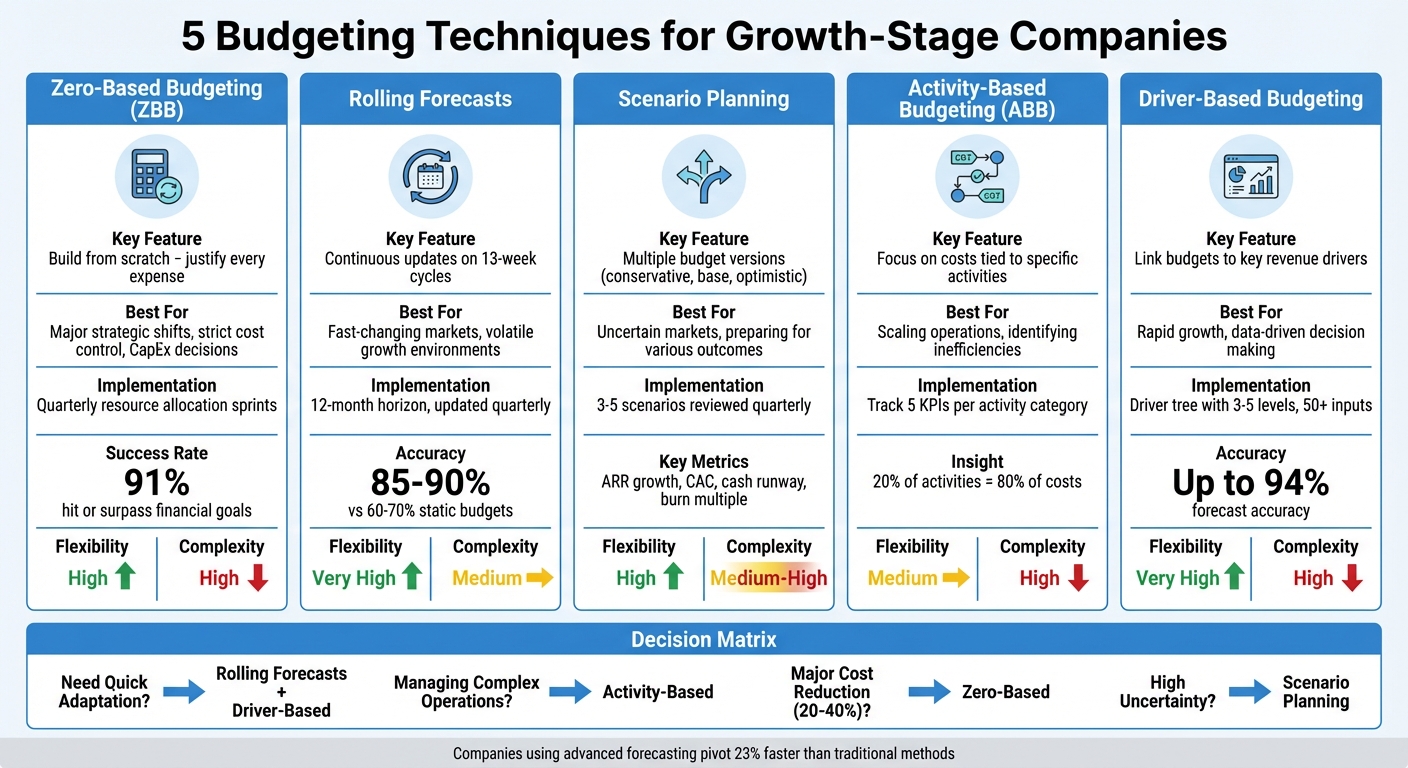
5 Budgeting Techniques for Growth-Stage Companies Comparison Chart
After exploring various budgeting methods, let’s dive into a side-by-side look at how these approaches stack up and when they’re most effective for growth-stage companies. Choosing the right method depends largely on your company’s growth phase and the challenges you’re tackling.
Zero-based budgeting starts from scratch, requiring every expense to be justified anew. For growth-stage companies, this can be applied through quarterly resource allocation sprints, where funding is refreshed based on actual performance metrics [15]. This method is particularly effective during periods of major strategic shifts or when strict cost control is needed for CapEx decisions.
Here’s how the different methods compare based on their strengths:
For companies in volatile growth markets, rolling forecasts and driver-based budgeting provide the flexibility to adapt quickly. Activity-based budgeting is ideal for scaling operations, while zero-based budgeting with quarterly sprints is best suited for managing significant cost shifts.
Phoenix Strategy Group specializes in helping growth-stage companies identify and implement the budgeting method that aligns with their scaling needs and strategic goals.
Picking the right budgeting approach lays the groundwork for financial stability and growth. Techniques like zero-based budgeting, rolling forecasts, scenario planning, activity-based budgeting, and driver-based budgeting help growth-stage companies strike a balance between managing costs and investing in areas that fuel expansion.
Here’s a key takeaway: Companies using zero-based budgeting hit or surpass their financial goals 91% of the time[17]. Even better, over one-third of the savings achieved is reinvested into sales initiatives and customer-focused activities that drive growth[18]. This highlights how budget flexibility paired with precise cost management can lead to meaningful progress.
The best budgeting method depends on your specific circumstances. For businesses navigating unpredictable markets, rolling forecasts and driver-based budgeting allow for quick adjustments. Meanwhile, activity-based budgeting provides detailed insights for managing complex operations. If your company is facing major disruptions or needs to cut costs significantly - by 20% to 40% - zero-based budgeting becomes a critical tool[19].
Success, however, requires more than just picking a method. It demands collaboration across departments and a shared commitment to financial priorities. While cloud-based tools can enhance real-time coordination, true effectiveness comes from aligning every team around the same goals.
Aligning your budgeting strategy with your company’s needs isn’t just about meeting financial targets - it’s about creating a lasting competitive edge. Phoenix Strategy Group specializes in helping growth-stage companies navigate these decisions. Whether you’re aiming to scale up to $20 million in revenue or preparing for a Series A funding round, the right budgeting framework, combined with expert support, turns financial planning into a strategic advantage. With the right tools and guidance, your company can achieve the agility and focus needed for sustained success.
The right budgeting approach hinges on your company's need for flexibility. Rolling forecasts work well for growth-stage businesses because they let you update financial projections regularly, ensuring you can adjust to market shifts. Similarly, dynamic budgeting, which incorporates scenario planning, helps maintain both agility and control during periods of rapid expansion. On the other hand, static budgets can fall behind quickly in fast-paced environments, making them less suitable for companies experiencing constant change.
Rolling forecasts are usually updated either monthly or quarterly, keeping a forward-looking view of 12 to 18 months. The update frequency often depends on your industry and how quickly decisions need to be made. Regular updates help ensure your financial plans stay in sync with shifting business conditions and objectives.
When it comes to driver-based budgeting, the focus is on tracking metrics that have a direct influence on financial performance. These key performance indicators (KPIs) include:
By identifying and monitoring these operational metrics, you can ensure your budgeting process stays connected to the key elements that drive your business's performance.