Published on
May 19, 2026


Scaling your business requires smart spending decisions. Capital expenditures (CapEx) - investments in long-term assets like equipment or software - can fuel growth or strain resources if not managed properly. Here's what you need to know:
Why it matters: Without a clear CapEx plan, overspending or poor investment choices can derail your business growth. Follow a structured approach to ensure every dollar spent supports your scaling objectives.
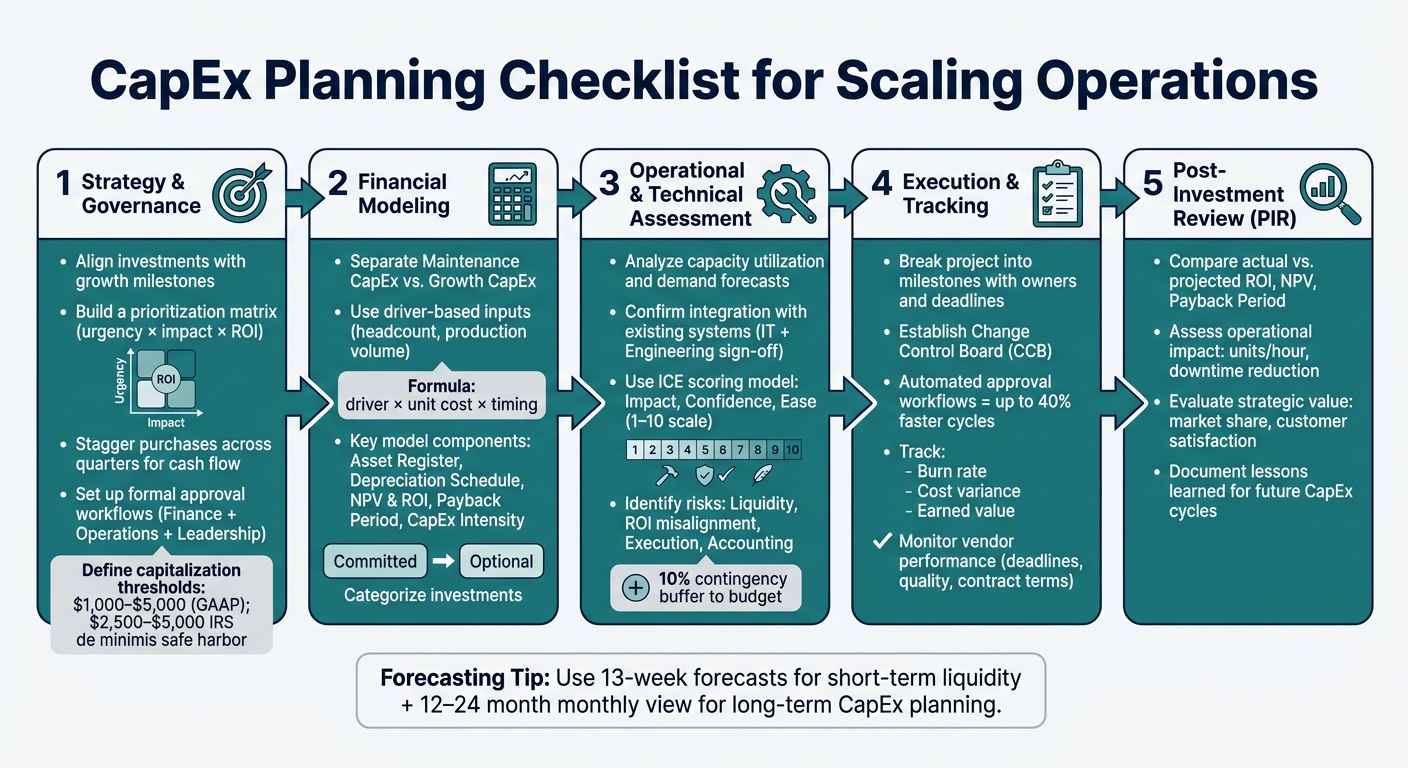
CapEx Planning Process: From Strategy to Post-Investment Review
Every CapEx investment should tie directly to a key scaling milestone. This ensures that major purchases actively support your growth goals. To manage priorities, consider using a prioritization matrix that evaluates investments based on urgency, impact, and ROI. By focusing on initiatives that drive growth, you can make smarter spending decisions. Another useful approach is to stagger large purchases across quarters, which can ease cash flow challenges during slower periods. Finally, put in place a solid approval process to ensure these strategic guidelines are consistently followed.
For significant purchases, a formal approval process is essential to avoid impulsive decision-making. As The MB Group highlights:
"Formal approval ensures that large purchases are necessary, aligned with goals, and thoroughly vetted." [3]
A well-designed approval workflow should include input from Finance, Operations, and Leadership teams to ensure transparency about what is being purchased and why. Each request should provide detailed documentation, including the asset description, business case, cost, and timing. This creates a clear audit trail and keeps all stakeholders informed.
Establishing a capitalization threshold is key to distinguishing between capital assets and operating expenses. For small-to-mid-sized businesses, this threshold typically ranges from $1,000 to $5,000 under U.S. GAAP. The IRS also offers a de minimis safe harbor limit of up to $2,500 per item (or $5,000 if financial statements are applicable).
Your policies should also specify asset categories, such as machinery, enterprise software, leasehold improvements, and hardware for new locations. Each category should have a defined depreciation schedule to map out the financial impact over time. Setting these schedules during the approval process eliminates surprises down the line. As The MB Group aptly puts it, "Surprises are for birthdays, not budgets." [3]
Once these policies are in place, the next logical step is to model the financial impact of your CapEx decisions effectively.
Creating a CapEx model that supports decision-making starts with a clear distinction between Maintenance CapEx (used for replacing or repairing existing assets to sustain operations) and Growth CapEx (investments in expanding capacity, technology, or new product lines). This separation not only clarifies ROI discussions but also ensures leadership understands how funds are allocated.
Instead of relying on static amounts, use driver-based inputs like headcount growth or production volume. For scalable items, apply the formula: driver × unit cost × timing. This approach allows your forecast to adjust automatically as business assumptions evolve. Additionally, include a comprehensive depreciation schedule for each asset. This maps out the non-cash expense over the asset's useful life, illustrating both the long-term impact on net income and the immediate cash outflow.
| Component | Purpose in Financial Model |
|---|---|
| Asset Register | Tracks current assets and their remaining useful life to plan renewals effectively |
| Depreciation Schedule | Shows the P&L impact by mapping non-cash expenses over each asset's useful life |
| NPV & ROI | Analyzes the profitability and net present value of individual investments |
| Payback Period | Calculates how long it takes to recover the initial investment cost |
| CapEx Intensity | Measures the ratio of CapEx to revenue, helping benchmark reinvestment requirements |
Once the model is in place, use these metrics to assess the financial value of each investment.
To prioritize spending decisions, rank investments based on ROI, payback period, and net present value (NPV). Connect each investment to a specific business outcome. For example, weigh the cost of upgrading a platform against the potential revenue loss from customer downtime.
For major projects, model both high-cost and low-cost scenarios and assign a confidence score to each. Categorizing investments as either "Committed" or "Optional" gives leadership the flexibility to adjust plans swiftly if market conditions shift or cash reserves tighten.
The next step is to analyze how these investments will impact cash flow and liquidity over time.
Timing is everything when scaling operations. Instead of treating each project as a lump sum, model CapEx as scheduled investments with payment milestones - like deposits, staged draws, and retention payments. This approach reveals the cash flow impact more accurately.
Coordinate your financing strategy with the projected low point in cash flow - the point where cumulative outflows peak before investment revenue starts flowing in. Add a contingency buffer of at least 10% to cover unexpected costs, such as labor inflation or supply chain delays [4]. For short-term liquidity, use a 13-week forecast, and for longer-term planning, rely on a 12–24 month monthly view. These forecasts should align with your overall growth strategy to ensure liquidity remains intact throughout scaling.
For growth-stage companies, managing these complexities can be challenging. Partnering with a fractional CFO - such as those at Phoenix Strategy Group - can help integrate CapEx planning into rolling cash flow forecasts, ensuring no details are overlooked.
Before allocating funds for capital expenditures, it’s critical to ensure the investment meets a clear operational need. Start by analyzing current capacity utilization and demand forecasts. For example, if your production lines are running well below capacity, justifying a new facility becomes challenging. Conversely, if operations are nearing full capacity, the investment might make more sense.
Every investment should directly tie to measurable operational goals - whether it's boosting profits, driving growth, or enhancing service quality. This alignment is essential for achieving broader milestones. As Axos Bank succinctly states:
"If capex projects do not further long-term goals, the decision is simple: they do not get funded." [1]
Don’t overlook indirect costs like training employees or dealing with transitional downtime. These factors can affect ROI and should be factored into your calculations. Additionally, confirm that the new asset will integrate smoothly with your existing systems to avoid technical complications.
Even the most promising CapEx projects can run into trouble if technical compatibility isn’t addressed early. Involve your IT and engineering teams from the start to confirm that the new asset can integrate with your current systems without requiring expensive upgrades or overhauls.
One effective method to assess feasibility is the ICE scoring model, which evaluates Impact, Confidence, and Ease on a 1–10 scale. The "Ease" factor specifically measures the time, effort, and cost required for seamless integration. For rapidly changing assets like software or specialized hardware, leasing may be a smarter option. Leasing can offer flexibility while minimizing long-term maintenance risks.
Once the technical groundwork is solid, it’s time to examine potential risks and develop strategies to minimize them.
Capital projects often come with risks. Common ones include:
NetSuite highlights this challenge:
"Capital expenses are long-term commitments that may be costly to unwind... the market for used capital equipment tends to be weak and resale values are low." [2]
To address these risks, assign an impact rating to each one and create contingency plans. For instance, staggering large purchases over multiple quarters can reduce liquidity strain. Similarly, building a contingency buffer into your budget can help manage unexpected costs. Regular risk reviews during quarterly planning are also essential, as they allow you to adapt strategies to changing market conditions.
Once a project gets the green light, having a structured execution plan is what separates success stories from projects that go over budget or fail to deliver.
Start by breaking the project into clear milestones, assigning specific owners, deadlines, and deliverables to each. At the same time, establish a change management plan to handle scope changes. A Change Control Board (CCB) - a small, focused group with authority to approve or reject changes - can help maintain discipline. This ensures every proposed adjustment is evaluated for its impact on budget, timeline, and quality before moving forward. Interestingly, organizations using automated approval workflows report that approval cycles can be up to 40% faster [5].
Stakeholder engagement is equally important. Communicate openly and early about any changes. When people understand the "why" behind decisions, they’re less likely to resist them.
Keeping a close eye on progress is critical for successful execution. Regularly monitor key financial metrics such as:
Tools like Jira, Trello, or Microsoft Project can provide real-time updates on milestones and flag potential delays before they snowball into bigger issues. Centralized documentation - covering invoices, contracts, and change requests - also ensures your records are organized and ready for audits.
Vendor performance is another area that deserves attention. Track whether vendors meet deadlines, deliver high-quality work, and stick to the terms of their contracts. Consistent issues like missed milestones can lead to financial risks beyond just operational hiccups.
With proper execution and tracking in place, the final step is to evaluate the project’s outcomes through a detailed post-investment review.
A post-investment review (PIR) wraps up the process by comparing the project’s actual results to the original expectations. This includes evaluating metrics like ROI, payback period, net present value (NPV), and operational benefits such as increased efficiency or reduced downtime.
NetSuite offers a simple but effective recommendation:
"After completing a capital project, perform a thorough review to evaluate its actual performance against initial projections." [2]
The table below highlights the four key elements of a PIR:
| PIR Component | What to Evaluate | Key Metrics |
|---|---|---|
| Financial Performance | Compare actual costs and returns to projections | ROI, NPV, Payback Period |
| Operational Impact | Assess gains in efficiency or capacity | Units per hour, Downtime reduction |
| Strategic Value | Check alignment with business goals | Market share, Customer satisfaction |
| Process Review | Evaluate project execution and vendor reliability | Schedule variance, Vendor performance |
Documenting lessons learned during this review is essential. These insights can improve future CapEx proposals, forecasts, and budgets, turning capital expenditure planning into a refined, repeatable process over time.
CapEx planning is an evolving discipline that combines strategic objectives, financial modeling, risk assessments, and post-investment reviews to make smarter capital decisions.
Growing businesses treat capital spending as a system. This means staggering purchases to safeguard cash flow, aligning teams to ensure oversight, and making CapEx reviews a regular part of quarterly planning to stay responsive to market changes.
This structured approach weaves financial discipline into your growth strategy.
As The MB Group explains:
"Capital expenses change the shape of your business - more capacity, better systems, cleaner operations. But they also touch cash flow, taxes, and reporting, so the plan matters as much as the purchase." [3]
Creating a reliable CapEx process takes work, especially for growth-stage companies juggling competing priorities. That’s where Phoenix Strategy Group comes in. Their fractional CFO and FP&A services are designed for businesses in growth mode, offering structured financial governance without the cost of a full in-house finance team. From prioritization frameworks and approval workflows to integrating CapEx planning with cash flow forecasting, they help lay the foundation for disciplined, scalable growth.
A CapEx request needs to provide a thorough breakdown of the investment. It should explain the purpose of the expenditure, outline the estimated costs, and detail the expected benefits. Additionally, it must include a return on investment (ROI) analysis, a risk assessment, and a review of alternative solutions. Finally, establishing clear success metrics is essential to measure the proposal's impact and ensure it aligns with the company's objectives.
When setting a CapEx capitalization threshold, you’re essentially deciding the minimum expense amount that qualifies as a capital expenditure. Here’s how to approach it:
By setting and adhering to a clear threshold, businesses can better manage their financial reporting and investment tracking.
To accurately predict the cash impact of CapEx, it's essential to break down project plans into detailed, time-phased financial projections. Start by leveraging structured data - such as pre-populated budgets, actual expenditures, and previous forecasts - to create a reliable baseline.
From there, keep a close eye on actual spending compared to your forecasts. Regular updates are key, especially when there are changes in project progress or scope. Centralizing these forecasts ensures better visibility and allows for proper validation.
For precision, align cost estimates, depreciation schedules, and timing with your revenue cycles. This approach helps maintain accuracy and prevents unexpected financial gaps.