Published on
May 19, 2026


Scenario modeling is a key tool for venture-backed companies to navigate uncertainty and make informed financial decisions with fractional CFO services. It involves creating multiple financial scenarios - base, upside, and downside - to prepare for varying market conditions. Unlike traditional budgets, this method evaluates interconnected factors like sales cycles, customer acquisition costs, and funding delays.
Why it matters: Growth-stage companies face high cash burn and depend on external funding. Scenario modeling helps answer critical questions like when to secure funding, how to adjust spending, and where to invest if growth accelerates. Companies using structured scenario planning are 1.5x more likely to outperform during economic shocks.
Core benefits include:
Venture-Backed Scenario Modeling: Exit Distributions & Key Metrics
These scenarios offer a framework for balancing capital allocation with growth opportunities and risk considerations.
Revenue scenarios map out potential growth paths by examining critical business drivers like unit economics, pricing models, and hiring constraints. These factors directly influence cash burn and determine when additional funding might be required.
"Building a simple P&L, even at the seed stage, isn't about foreseeing the future. It is helpful to get a better grasp of a business, be it to better understand unit economics (and thus pricing) or talent acquisition constraints." - Willy Braun, Founder, Galion.exe [1]
For instance, a slower sales cycle might drive up customer acquisition costs, leading to thinner margins and a quicker need for another fundraising round. By modeling these combined effects, founders can better anticipate adjustments to hiring plans and capital needs.
This groundwork is essential for evaluating funding strategies and cost structures in the next steps.
Every funding decision impacts long-term ownership. By modeling different equity rounds side by side, founders can see how each option affects dilution and ownership before making final decisions. Surprisingly, 73% of founders do not model dilution scenarios [4], leaving many to negotiate funding terms without fully understanding the long-term impact on their cap table.
Investment terms matter just as much as valuations. For example, participating preferred stock - where investors receive their liquidation preference plus a share of remaining proceeds - can reduce a founder's exit value by 15–25% compared to non-participating preferred stock [4]. Running these scenarios ahead of negotiations gives founders a clearer picture of potential outcomes.
Next, consider how operating costs and hiring plans interact with these funding scenarios.
Cost structure scenarios explore how different hiring strategies and spending levels affect unit economics, efficiency metrics like burn multiple, and cash runway. Comparing a "lean" approach (slower hiring and reduced spending) to a "growth" approach (faster hiring and aggressive expansion) helps founders weigh the tradeoffs.
This kind of modeling is especially valuable when revenue growth is uncertain. If the optimistic growth scenario doesn't pan out, a leaner strategy might extend the runway by several months - enough time to hit crucial milestones before the next funding round. These insights are key for managing cash effectively and planning strategic hires.
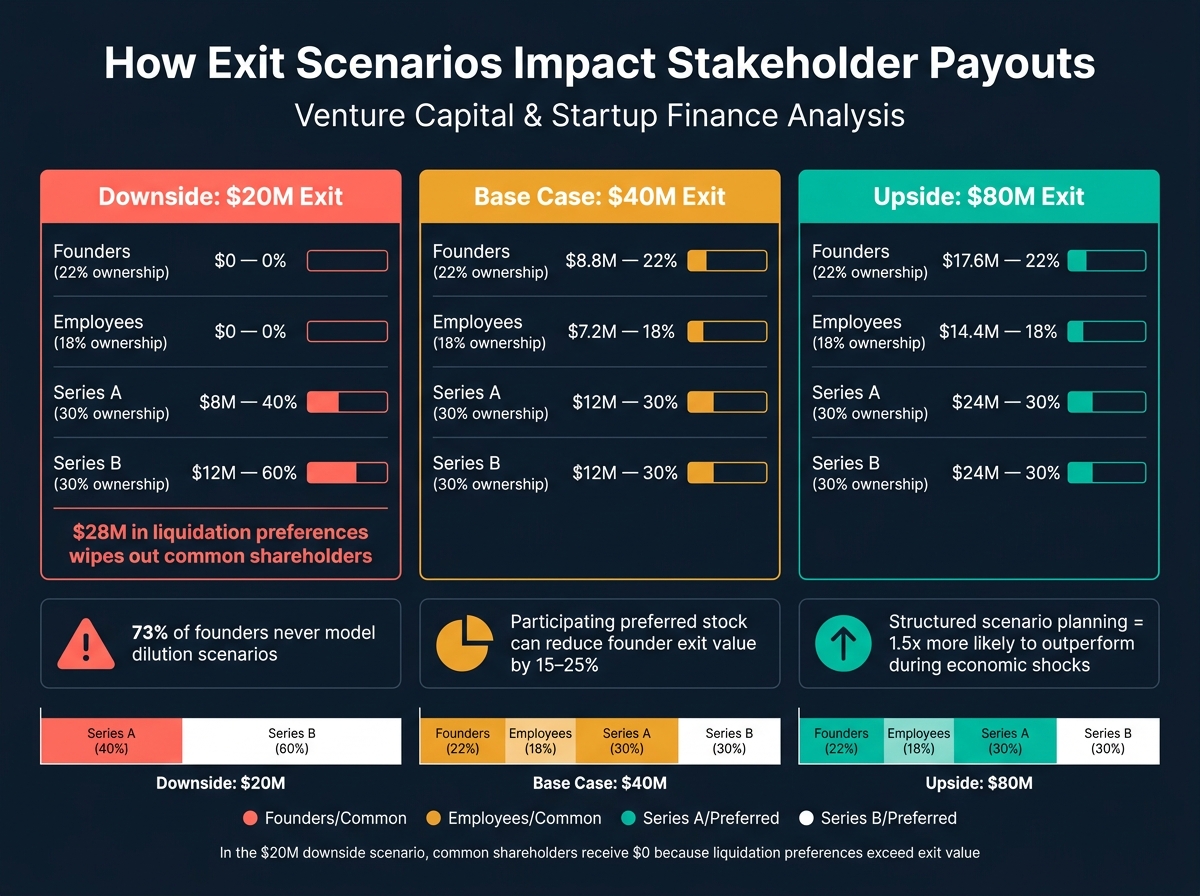
Exit scenarios highlight how headline valuations can differ drastically once factors like liquidation preferences, earn-outs, investment bank fees, and IPO lock-up periods are included. The table below illustrates how exit distributions might look across different scenarios:
| Exit Value | Founders (22% ownership) | Employees (18% ownership) | Series A (30% ownership) | Series B (30% ownership) |
|---|---|---|---|---|
| $20M (Downside) | $0 (0%) | $0 (0%) | $8M (40%) | $12M (60%) |
| $40M (Base Case) | $8.8M (22%) | $7.2M (18%) | $12M (30%) | $12M (30%) |
| $80M (Upside) | $17.6M (22%) | $14.4M (18%) | $24M (30%) | $24M (30%) |
In the $20M downside scenario, common shareholders receive $0 because the $28M in total liquidation preferences exceeds the exit value [4].
"If you focus only on the big valuation number at the end, you're missing everything in between. For a founder, that's when the money arrives and how much of it is actually guaranteed." - Ruben Dominguez, Author, The VC Corner [2]
For example, a strategic sale with earn-outs means some proceeds depend on hitting post-sale performance milestones, while an IPO might lock up shares for months. Modeling these scenarios helps founders and investors plan for not just how much money they’ll receive, but when it will actually arrive. This insight is invaluable for making informed decisions about timing, deal structure, and liquidity.
A well-constructed scenario model is a decision-making framework designed to produce timely, actionable insights. These components are essential for venture-backed companies looking to make informed capital allocation decisions with the guidance of a fractional CFO amid uncertainty.
At the heart of any scenario model are integrated financial statements where every line item ties back to an operational driver. For example, revenue isn't just a static figure - it stems from measurable inputs like lead volume, conversion rates, average contract value, and churn rates. Similarly, expenses are linked to factors such as headcount plans, marketing budgets aligned with sales targets, and R&D investments tied to the product roadmap.
"The revenue element of a venture capital financial model... is considered to be the most important part of the model." - Mike Hinckley, Founder, Growth Equity Interview Guide [6]
This driver-based approach relies on clearly defined assumptions. Switching between scenarios doesn't just tweak growth rates - it adjusts core business assumptions. This makes the model an effective tool for testing strategic decisions under various conditions. Additionally, this foundation integrates seamlessly with modules that evaluate capital structure and fundraising strategies.
Once the operating model is in place, the capital structure module adds a layer that examines how funding decisions affect ownership over time. A robust fundraising module tracks equity ownership across founders, employees, and investors through multiple funding rounds, highlighting the cumulative effects of dilution from seed funding to Series B and beyond.
This module allows for side-by-side comparisons of funding options. For instance, if a company requires $2M at the Series A stage, the dilution impact of an equity round (15–25%) versus venture debt (2–4% through warrants) can be substantial [4]. By integrating these comparisons directly into the model, decision-makers can see how funding choices influence the broader capital allocation strategy. It also considers elements like anti-dilution provisions, option pool adjustments, and liquidation preferences to show their effects on the cap table and exit outcomes.
The final piece transforms the model into a practical governance tool. Using features like Excel's CHOOSE or OFFSET functions, decision-makers can toggle between Base, Worst, and Best Case scenarios without rebuilding the model [5]. Each scenario uses its own set of inputs but feeds into a unified dashboard for easy side-by-side comparisons.
Key metrics are typically grouped into these categories:
| Metric Category | Key Metrics | What They Tell You |
|---|---|---|
| Growth & Efficiency | ARR, Burn Multiple, LTV/CAC | Whether growth is sustainable and capital-efficient |
| Liquidity | Runway, Cash Flow | How long the company can operate without additional funding |
| Returns | MOIC, IRR, Exit Multiple | The potential returns under various exit scenarios |
| Capital Structure | Ownership %, Dilution | The impact of future fundraising on stakeholder economics |
These metrics consolidate diverse scenarios into a single dashboard, allowing for quick, informed strategic adjustments. Research shows that companies using this structured, scenario-based approach are 55% more efficient in reallocating capital compared to those relying on static annual plans [3]. The objective isn't to predict the future but to ensure you're always prepared for it.
A structured planning rhythm is essential for aligning strategy with capital allocation. A three-tiered approach works well: annual strategic baselines, quarterly updates tied to current performance, and ad hoc modeling for significant decisions like funding rounds, key hires, or market expansions. This ensures the model stays relevant and reflects the latest operational insights.
Ownership plays a big role here. While finance typically leads the charge in building models, they rely on input from other teams. For example:
This cross-functional collaboration adds credibility to the model, allowing leadership to stress-test assumptions in real time instead of receiving a static, finalized report. It also sets the stage for the governance practices discussed in the next section [10][11].
Scenario models shine in decision-making contexts, especially during board meetings, by clarifying the reasoning behind key choices. Documenting assumptions - like growth rates, churn, and fundraising timelines - ensures teams can trace outcomes back to their original inputs [7][9].
For venture-backed companies, this documentation becomes even more critical during investment reviews or headcount planning. For instance, a board evaluating a Series B extension will want to see that leadership has stress-tested the business at scales of 2x, 5x, and 10x. They’ll also want assurance that potential failure points in the model have been identified and addressed before they occur [8].
"When the pace of your decision-making is limited by how fast someone can edit Excel, you're not planning strategically - you're reacting slowly." - Drivepoint [11]
Governance isn't just about oversight - it's about proving that leadership has a clear understanding of various outcomes and actionable plans for each.
Strong governance relies on robust technology integration to support accurate scenario modeling. A common challenge is managing scattered data sources: accounting in QuickBooks, sales data in Salesforce, and headcount tracked in separate spreadsheets. This fragmentation forces finance teams to spend more time reconciling data than analyzing it. Advanced planning tools can cut data aggregation time by up to 80%, enabling scenario creation 6 days faster compared to manual processes [10].
The solution? Integrate systems like ERP, CRM, and HR software into a single, unified data source that feeds directly into financial models. This ensures that when toggling between base and worst-case scenarios, you're working with up-to-date operational data - not outdated exports from last quarter. Relying on stale data can lead to costly mistakes in hiring or fundraising decisions [7].

Turning a solid data infrastructure into actionable models requires a blend of financial and technological expertise, and that’s exactly where Phoenix Strategy Group shines. Building on the scenario frameworks discussed earlier, their services ensure that modeling directly informs strategic decisions around capital allocation.
Phoenix Strategy Group creates financial models that incorporate scenario modules for key areas like revenue trajectories, operating costs, fundraising schedules, and exit strategies. This gives leadership a comprehensive view of the business under various conditions. Their FP&A systems have supported over $300 million in revenue through financial operations projects [13]. These models are tailored to focus on the growth drivers that matter most to scaling businesses.
Using these integrated models, Phoenix Strategy Group's fractional CFO services guide scenario planning, deliver board-ready analyses, and align capital allocation with growth objectives - all without the expense of a full-time CFO.
"As our fractional CFO, they accomplished more in six months than our last two full-time CFOs combined. If you're looking for unparalleled financial strategy and integration, hiring PSG is one of the best decisions you can make." - David Darmstandler, Co-CEO, DataPath [12]
For scenario modeling to be accurate, data must be clean and interconnected. Phoenix Strategy Group’s data engineering team develops ETL pipelines and data warehouses that consolidate information from ERP, CRM, and HR systems into a single, reliable source [12][13]. Their Monday Morning Metrics system delivers real-time dashboards, ensuring that every scenario adjustment reflects the latest operational data and supports timely decisions around capital allocation.
With experience in over 100 M&A transactions and 5+ IPOs since 1998 [12], Phoenix Strategy Group brings deep expertise to exit planning. For example, when the Los Angeles-based fund Assembled Brands ($100M+ AUM) needed to analyze thousands of portfolio companies, Phoenix Strategy Group developed automated data integrations that sped up due diligence and improved risk assessments [13]. These tools not only streamline the M&A process but also enhance exit strategies, reinforcing the scenario-based approach central to their services.
Scenario modeling isn’t something you do just once and forget about. For venture-backed companies, it’s an ongoing process that helps guide decisions, especially when things change - whether it’s a slower sales cycle, a delayed funding round, or a broader economic downturn affecting valuations.
The guiding principle is simple: always aim for 12–18 months of runway visibility under both base and downside scenarios. Factor in dilution explicitly with every funding decision, and ensure that major expenses - like hiring, go-to-market efforts, or product investments - are tied back to a specific scenario. For example, if you’re planning to spend an extra $500,000 on paid media this quarter or hire 10 new account executives, your model should clearly show how these choices impact burn rate and runway.
Consistency is key. Monthly updates help track current cash flow, while quarterly reviews allow you to refresh your Base, Upside, and Downside scenarios with the latest data. Unexpected events - like losing a key customer, securing a new term sheet, or facing a market downturn - call for ad hoc reviews to quickly reassess plans. It’s no surprise that 67% of CFOs, according to KPMG, have found scenario planning to be increasingly important over the past three years, especially for decisions around capital allocation and liquidity.
The biggest pitfall isn’t building a flawed model - it’s failing to maintain or act on it. The solution is straightforward: every major capital decision should be tied to a specific scenario and its effects on cash and dilution. Consistently applying this approach can make the difference between navigating uncertainty with confidence or being forced into reactive, last-minute decisions.
When building a scenario model, some key inputs are essential to ensure its accuracy and usefulness. These include financial data like historical income statements, balance sheets, and cash flow statements. Beyond that, assumptions play a huge role. Factors such as growth rates, costs, customer acquisition, churn rates, and external market trends significantly impact how reliable and precise the model turns out to be.
Scenarios should be reviewed and updated on a regular basis - ideally every month or quarter. This helps incorporate business changes, fresh data, and market fluctuations, ensuring your forecasts remain accurate and aligned with current conditions.
To analyze dilution alongside liquidation preferences, it's essential to integrate their effects into scenario modeling. This means examining how terms like liquidation preferences (such as 1x, participating, or non-participating) and ownership dilution from issuing equity influence the returns founders might receive in different exit scenarios. By doing this, you can better prepare for negotiations and make informed strategic decisions.