Published on
January 1, 2026


Managing finances for SaaS companies is complex, but cloud FP&A automation simplifies it. Here's how it transforms financial planning:
Cloud FP&A automation connects systems like CRM, ERP, and billing platforms, enabling smarter decisions with "what-if" analysis and real-time dashboards. For growth-stage SaaS companies, it's a game-changer, ensuring scalability and efficiency while reducing financial risks. Many companies manage these complexities by partnering with a fractional CFO to oversee the transition.
Cloud FP&A automation is transforming financial operations for SaaS companies by introducing faster processes, improved accuracy, and better collaboration. It aligns perfectly with the expert growth strategies that are essential in today’s competitive market.
Budgeting manually is not only time-consuming but also prone to errors, especially in the intricate financial models SaaS companies rely on. Cloud automation eliminates tedious tasks like repetitive data entry and formula-checking, freeing up days - or even weeks - each month. Instead of waiting for the month-end close to assess performance, finance teams gain instant visibility into how actual figures compare to the budget.
The improvements in accuracy are striking. David Appel from Sage highlights this shift, stating, "Adopting tools to automate SaaS budgeting and FP&A is a significant step that affects multiple aspects of your business" [1]. By integrating FP&A systems with CRM, ERP, and billing platforms, companies can automate tracking metrics like CAC, churn, and ARPU.
A real-world example? In 2022, the Kansas City Chiefs replaced their manual processes with Vena's agile FP&A solution. The result? They produced financial reports 95% faster than before [2]. This kind of efficiency allows finance teams to focus on strategic analysis instead of getting bogged down by data collection.
Static budgets just don’t cut it in the fast-moving SaaS world. Real-time data enables rolling forecasts, offering a continuous 12-month view that adapts to changes as they happen. For example, if your MRR suddenly dips or a new pricing tier outperforms expectations, you’ll know immediately - rather than weeks later when the damage (or missed opportunity) has already occurred.
This level of visibility changes how CFOs approach decision-making. Kirk Kappelhoff, Director of Strategic Finance at Drivetrain, explains: "The most powerful budgeting approach isn't one-size-fits-all. Forward-thinking CFOs select methodologies that match their business model and stage of growth, whether that's zero-based to drive efficiency, driver-based for scale, or activity-based for operational clarity" [3]. With real-time dashboards, finance teams can pinpoint which customer segments or pricing tiers are driving revenue growth and adjust resources accordingly.
The benefits of cloud FP&A automation go beyond data and speed - it also fosters collaboration. Finance doesn’t work in a vacuum; it supports other departments like sales, marketing, and operations. Sales needs accurate pipeline projections, marketing relies on timely budget approvals, and operations depends on headcount forecasts. Cloud FP&A platforms provide a single source of truth that all departments can access simultaneously, eliminating the chaos of outdated spreadsheets and version control issues.
The numbers back this up: over the last 15 years, finance leaders have seen a 30% increase in cross-department collaboration [1]. Bill Primerano, Worldwide Tech Sales Leader at IBM, notes, "By having systems in place to do the heavy lifting in your planning and forecasting processes, you empower your workforce to move from data mining to data analyzing" [5]. Automated tools allow teams to focus on strategic insights rather than wasting time on manual data collection.
This collaborative approach is becoming the norm. In fact, 92% of finance leaders plan to automate at least half of their processes within the year [6]. The shift toward extended planning and analysis (xP&A) integrates financial planning across sales, HR, and marketing into a unified platform, breaking down silos and speeding up decision-making [2][5].
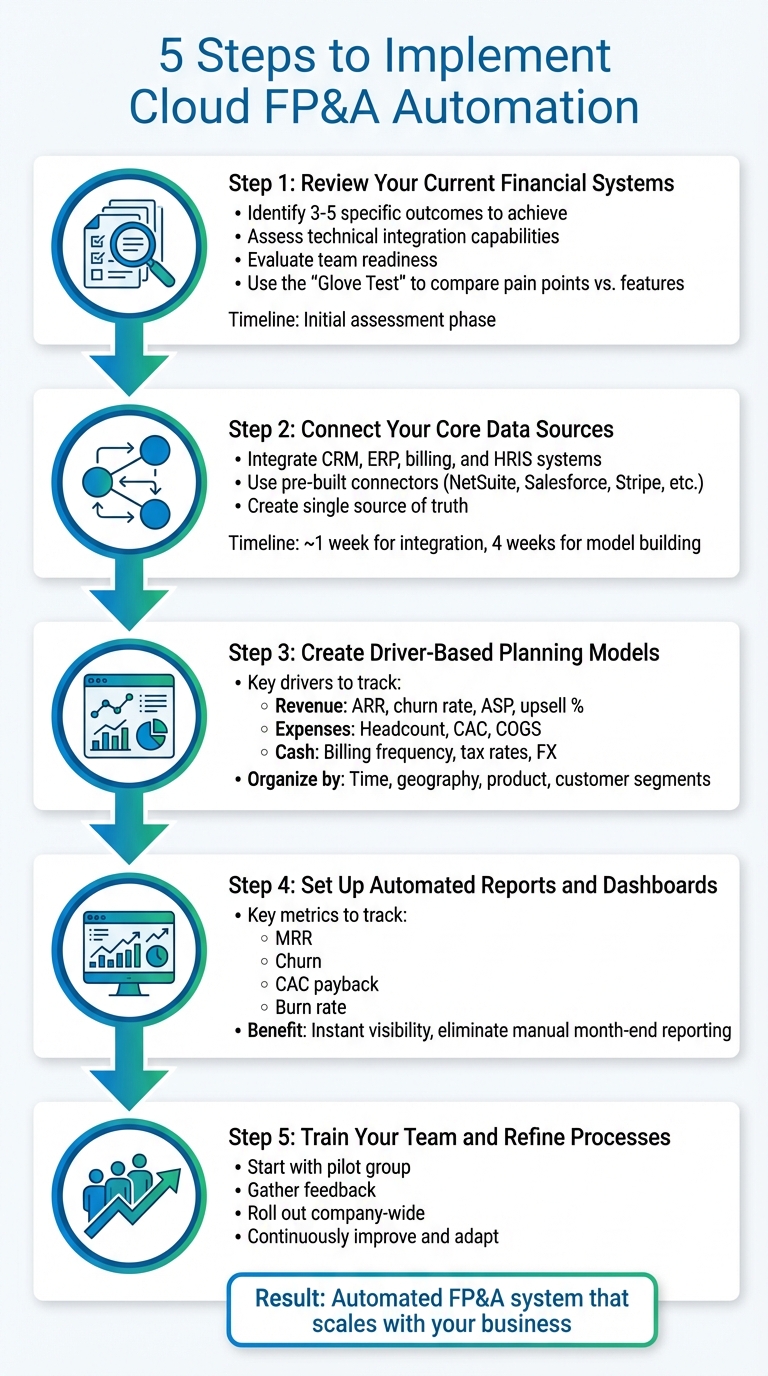
5-Step Cloud FP&A Automation Implementation Process for SaaS Companies
Implementing cloud FP&A automation might seem daunting at first, but breaking it into clear, actionable steps can make the process much smoother. Tailoring the approach to fit your SaaS company’s needs and growth stage is key. Here’s a practical guide to get started.
Start by taking a close look at your existing financial processes. Are you spending too much time manually updating forecast models or dealing with spreadsheet errors? These inefficiencies are a clear sign of where improvements are needed. Pinpoint 3–5 specific outcomes you want to achieve, like quicker month-end closes or real-time ARR tracking, to measure your progress [2].
Next, assess the technical landscape. Can a new FP&A solution integrate with your current tools, such as Stripe for billing or Salesforce for CRM? [2][8]. Consider scalability, too - will the system handle future needs like adding entities, switching ERPs, or expanding into new markets? [2][7]. And don’t forget your team’s capabilities. Will they need an Excel-like interface, or are they ready to adapt to a completely new platform? [2].
To simplify the process, try the "Glove Test." List your pain points in a spreadsheet and directly compare them to the features of potential FP&A tools. This ensures you’re choosing a solution that fits your needs [2]. Once you’ve evaluated your current setup, the next step is integrating your core data sources.
Integration is where cloud FP&A automation truly starts to deliver. Modern platforms offer hundreds of pre-built connectors for popular SaaS tools like NetSuite, Salesforce, HubSpot, Stripe, and Workday [8][9]. These connectors create a seamless ecosystem, merging accounting data with operational data to serve as a single source of truth for planning and forecasting [8].
Typically, integrating core data sources takes about a week, with another four weeks needed to build out models [9]. For SaaS companies with multiple subsidiaries, it’s important to account for complexities like intercompany eliminations, currency translations, and local tax regulations [7][8]. As Sarah Schlott from The Schlott Company aptly puts it:
"The effort shows in the forecast. If consolidation feels like duct tape, the story will unravel at scale" [7].
With your data integration complete, the focus shifts to building driver-based models that transform raw data into actionable insights.
Using the integrated data, build driver-based models centered on the metrics that are critical to your business. For SaaS companies, this often includes ARR, churn rate, customer acquisition cost, and average selling price. If you operate across multiple entities, standardize key drivers at the entity level. For example:
Organize forecasts with clear dimensions like time (monthly), geography, product, and customer segments. This structure simplifies consolidation and helps uncover trends across your business. The ultimate goal is to create models that automatically update as new data flows in from your integrated systems.
Once your models are operational, it’s time to configure automated reporting. Set up real-time dashboards to track essential SaaS metrics like MRR, churn, CAC payback, and burn rate. These dashboards should be accessible to all relevant stakeholders, not just the finance team or fractional CFO.
Automation eliminates the need for manual month-end reporting by providing instant visibility into how actuals compare to forecasts. This frees up your team to focus on strategic insights, such as identifying profitable customer segments, analyzing pricing tiers that boost retention, or deciding where to allocate resources for maximum impact.
For automation to succeed, your team needs to fully embrace the new platform. Invest in training that highlights how the system simplifies their daily tasks rather than complicating them. Start small with a pilot group, gather feedback, and refine the process before rolling it out company-wide.
Continuous improvement is key. As your SaaS business grows, your FP&A processes should evolve alongside it. Regularly assess which reports are being used, which metrics are most valuable to decision-makers, and where bottlenecks still exist. By consistently refining your processes, you’ll create a system that becomes smarter and more aligned with your business needs over time.
Selecting the right cloud FP&A platform is a game-changer for SaaS companies. Not all tools cater specifically to the SaaS business model, so it's important to focus on features that support your growth and operational needs. Here’s a closer look at the must-have capabilities for SaaS-focused FP&A tools.
Metrics are the backbone of effective FP&A for SaaS businesses. Your platform should track critical metrics like Committed Monthly Recurring Revenue (CMRR), Gross/Net Burn, CAC Payback Period, Customer Lifetime Value (CLTV), and Churn [10]. Among these, CMRR stands out as the most crucial metric for monitoring a cloud business’s financial health [10].
For companies in growth stages, tools must also handle Annual Recurring Revenue (ARR), Annual Run Rate Revenue (ARRR), and Average Revenue Per User (ARPU) [10][1]. Advanced platforms offer multi-dimensional modeling that spans departments, entities, regions, and products [4]. This feature helps uncover valuable insights - like identifying high-value customer segments or pinpointing regions where acquisition costs are rising.
The best tools also provide automated variance analysis down to the vendor level. Ben P., Director of FP&A at Runway, highlights this capability:
"Runway has allowed me to immediately reference any part of our model with ease, and to segment in any way I can imagine. We can now get down to vendor level BvA analysis" [9].
Top-performing SaaS companies aim for annual logo churn rates below 7% and CMRR churn rates under 5% [10]. The right FP&A platform simplifies tracking these benchmarks, ensuring your business stays on course. These precise metrics also set the foundation for seamless data integration.
Modern FP&A platforms should include no-code connectors that integrate seamlessly with your tech stack - whether it's your CRM (like Salesforce or HubSpot), ERP (such as NetSuite, Sage Intacct, or QuickBooks), HRIS (like Workday or BambooHR), or billing systems [4][1][11]. These integrations create a unified source of truth, with automatic updates that can reduce error rates by up to 94%.
This real-time synchronization transforms finance teams from backward-looking record keepers into strategic partners. Omar Asghar, Director of FP&A, describes this shift:
"The first two years, finance was seen as a gatekeeper. Now, with Aleph, we're viewed as trusted partners who bring insights in real time. That's priceless" [11].
The speed advantage is undeniable. Chris Brubaker, VP of Finance at Aleph, shared:
"Implementing Aleph was insanely fast. We did all of our quarter-end reporting with Aleph less than 3 weeks after signing" [11].
Look for platforms that support bi-directional data synchronization with spreadsheets and databases. This ensures your team can continue working in familiar tools while maintaining consistent, accurate data across all systems.
In an unpredictable market, scenario planning is a must-have feature. Your FP&A tool should enable you to create and compare multiple forecast scenarios - such as Base Case, Best Case, and Worst Case - in real time [4][9]. For SaaS companies managing complex pricing models (like usage-based or tiered subscriptions) or adhering to ASC 606 revenue recognition standards, this flexibility is essential [12].
Quickly testing assumptions can provide a proactive edge. Whether you're analyzing the impact of a price adjustment, changes in churn rates, or fluctuations in operational costs, your platform should instantly display how these variables affect revenue, burn rate, and runway. It's not about predicting the future with certainty - it’s about being ready for whatever comes next.
Growth-stage SaaS companies often face a unique hurdle: scaling their financial operations as quickly as their revenue grows. This challenge becomes even more pressing when juggling fundraising rounds, mergers and acquisitions, or expanding into new markets. Phoenix Strategy Group steps in to help these companies integrate automation seamlessly, ensuring operations remain smooth throughout the process [15].
Phoenix Strategy Group (PSG) takes FP&A automation a step further by tailoring it to the specific needs of growth-stage SaaS businesses. One of their key strategies is breaking down the silos that often exist between finance and revenue teams - silos that can easily derail growth [13]. Instead of treating FP&A as a back-office task, PSG integrates revenue and operational data into a cohesive system designed to tackle the challenges of rapid scaling. This approach not only enhances the benefits of automation but also strengthens financial strategies by fostering collaboration between revenue and finance teams. Over the past year, PSG has supported more than 240 portfolio companies and helped clients secure over $200 million in funding [13].
What sets PSG apart is their leadership team, made up of founders who’ve built and scaled companies themselves [13]. This "by founders, for founders" mindset translates into practical, results-driven solutions. For example, they deliver automated KPI reports on a weekly basis and use their Victory Plan methodology, which leverages historical data to create realistic growth forecasts aligned with business goals [13]. David Darmstandler, Co-CEO of DataPath, highlighted their impact:
"As our fractional CFO, they accomplished more in six months than our last two full-time CFOs combined" [13].
PSG’s expertise extends to KPI-driven modeling for critical SaaS metrics, including ARR, churn, CAC payback, and unit economics [14]. They manage complex transitions with precision, ensuring data accuracy even during periods of rapid growth [15]. Their service offerings include data engineering for building ETL pipelines, implementing HubSpot for revenue operations, and crafting investor-ready financial models that simplify due diligence [13].
The results speak volumes. Norman Rodriguez, Founder and CEO of ElevateHire, shared his experience:
"PSG saved my dream. They helped us streamline our financials and secured better lending terms" [13].
For SaaS companies looking to move beyond spreadsheets and embrace true FP&A automation, Phoenix Strategy Group offers both the technical tools and strategic insights to make it happen. With their expertise, even the most common FP&A challenges can be tackled with ease.
To maximize the benefits of cloud FP&A automation for SaaS growth, it's important to navigate the challenges that come with implementation. Even with a well-thought-out plan, obstacles can arise. The good news? Many of these problems can be addressed with clear solutions once you know where to focus.
Fragmented data can make it tough for SaaS companies to get a clear financial picture. Financial data might sit in an ERP system, customer details in a CRM, billing information in another platform, and HR metrics elsewhere. When these systems don’t communicate, finance teams are left manually piecing together data - a slow, error-prone, and frustrating process. In fact, 15% of finance professionals cite poor integrations as the biggest hurdle in their FP&A automation tools [2].
The issue becomes even more complicated as companies grow, often acquiring subsidiaries with different charts of accounts, currencies, and ERP systems. Take the example of a $150 million ARR SaaS client who worked with The Schlott Company in October 2025. They implemented a Consolidation Forecasting Operating System that initially produced clean consolidated reports. However, entity-level analysis revealed stark regional differences: North America was outperforming its plan by 12%, while EMEA fell short of ARR targets by 18% and doubled its CAC. This granular insight enabled leadership to shift investments back to North America, avoiding a potential down round [7].
The solution? Start by standardizing inputs across all entities. Use driver-based models - such as seats, average selling price, and churn percentage - to ensure consolidated reports accurately reflect each segment’s performance. As Sarah Schlott, Founder of The Schlott Company, puts it:
"Forecast consolidation isn't about adding numbers together. It's about designing an architecture where numbers reveal truth instead of hiding it" [7].
Connecting core systems like CRM, ERP, billing, and HR to a centralized platform eliminates manual data gathering and establishes a single source of truth. But even with the right tools in place, another challenge can arise: getting your team on board.
Finance teams often rely heavily on Excel, with its familiar formulas, shortcuts, and workarounds. Introducing a new system can lead to resistance, driven by fears of losing control, a steep learning curve, or concerns about job redundancy. Nicole Bennett from Vena Solutions captures this sentiment:
"The only challenge initially will be adoption as people learn how to use the new system" [2].
You can ease this transition by involving your team early in the process. Survey your finance and IT teams to identify pain points and select tools that integrate seamlessly with your existing tech stack. Platforms with Excel-based interfaces or integrations can make the shift smoother. Reframe the conversation from "replacing tasks" to "empowering strategy" by showing how automation reduces repetitive work, enabling the team to focus on meaningful analysis and strategic contributions. Partnering with software vendors who offer FP&A experts for ongoing support and creating clear implementation timelines can further streamline adoption [2][3].
Even after overcoming resistance, many SaaS companies face another hurdle: customizing FP&A tools to meet their unique needs.
Most generic FP&A tools aren’t designed to handle SaaS-specific metrics like CAC efficiency, churn rates, net revenue retention, or complex revenue recognition models. These tools often cater to industries like manufacturing or retail, leaving SaaS companies struggling to adapt.
To find the right fit, perform the "Glove Test" to see how well a potential FP&A tool aligns with your existing systems and billing models [2]. Look for platforms that support multi-dimensional modeling, allowing you to analyze data by department, region, product, or billing tier [4][16]. Leverage statistical accounts in your General Ledger to track non-financial data alongside financial transactions. This makes it easier to calculate metrics like customer lifetime value [16].
Choose tools that allow you to maintain custom logic while syncing with a centralized, auditable cloud database. This hybrid approach ensures flexibility for modeling unique scenarios without compromising data accuracy. Finally, set up role-based dashboards that highlight critical profit drivers - such as churn rates and average revenue per user - so every stakeholder can focus on the metrics that matter most to them [1].
Cloud FP&A automation is changing the game for SaaS companies, revolutionizing how they plan, forecast, and make critical decisions. By pulling together data from your CRM, ERP, and billing systems into one place, you can cut out the manual processes that bog down your finance team and lead to errors. The result? Faster budgeting, more accurate forecasts, and real-time insights to stay ahead of market changes. It’s a shift that enables finance teams to take a proactive approach.
Getting started is simpler than you might think. Focus on identifying key drivers like churn rate, CAC, and ARPU, then build models that grow with your business. Standardizing inputs across all entities ensures that your consolidated reports tell a clear, accurate story. As Sarah Schlott, Founder of The Schlott Company, puts it:
"The effort shows in the forecast. If consolidation feels like duct tape, the story will unravel at scale" [7].
These foundational steps, discussed earlier, are the backbone of successful FP&A transformations today.
For SaaS companies in the growth stage - whether managing multi-entity consolidation, expanding internationally, or preparing for fundraising - customized FP&A automation is a must. Phoenix Strategy Group specializes in building cloud-based FP&A platforms that bring together revenue forecasting, expense planning, and cash flow management into a single, automatically updated system. This ensures clean, consistent data integration, while tools like Monday Morning Metrics provide leadership with actionable insights every week.
Over the past 15 years, finance leaders have increased collaboration with other departments by 30%, thanks to integrated tools that break down data silos [1]. By automating repetitive tasks, your team can dedicate more time to what truly matters: driving growth, improving unit economics, and setting your company up for long-term success.
Cloud FP&A automation brings a host of benefits to SaaS companies by simplifying budgeting and forecasting tasks. It takes over repetitive processes, minimizes manual errors, and delivers real-time financial insights, empowering businesses to make quicker, data-backed decisions.
With AI-powered tools, SaaS firms can achieve more precise revenue forecasts, keep a close eye on cash flow, and instantly track subscription metrics. On top of that, cloud-based solutions connect effortlessly with various revenue streams, freeing up finance teams to concentrate on driving strategic growth rather than getting bogged down in administrative duties.
To get started with cloud FP&A automation, begin by evaluating your current financial workflows. Take stock of all your data sources, such as subscription billing systems, CRM tools, ERP platforms, and bank feeds. Map out the manual steps involved in budgeting, forecasting, and reporting to identify where inefficiencies are slowing things down.
Next, select a cloud-based FP&A platform that includes features like AI-driven modeling, real-time dashboards, and smooth integration with your existing systems. Once you’ve chosen the right platform, connect your tools to create a centralized data hub that updates continuously. This approach eliminates data silos and ensures your financial information stays consistent across the board.
To ensure the system runs smoothly, define clear governance rules. Set user permissions, implement version control policies, and incorporate security best practices. After the system is up and running, focus on automating critical tasks like rolling forecasts, scenario analysis, and variance reporting. Regular reviews of the setup will help keep everything aligned with your company’s growth targets and shifting market dynamics.
SaaS companies moving to cloud-based FP&A automation often encounter hurdles tied to their reliance on outdated, spreadsheet-heavy workflows. Transitioning involves migrating data, redesigning financial models, and adapting to unfamiliar tools - tasks that demand time, effort, and a shift in mindset from established routines. The process can be especially tricky when consolidating data from diverse systems like sales platforms, subscription management tools, and product databases, increasing the risk of errors.
On top of that, many SaaS businesses juggle multiple accounting systems and lack uniform reporting standards, which complicates ensuring clean and consistent data for automation. There’s also the issue of data security - granting broader cloud-based access can raise concerns about confidentiality if strong governance policies aren’t in place. To make matters more complex, finance teams often need extra training to understand AI-driven insights and handle automated workflows. This highlights the critical role of effective change management during the implementation phase.