Published on
June 7, 2026

Cross-border data compliance in finance is complex but essential. Financial organizations face risks like hefty fines, reputational damage, and operational disruptions if they fail to meet global data transfer laws. This guide breaks compliance into four actionable steps:
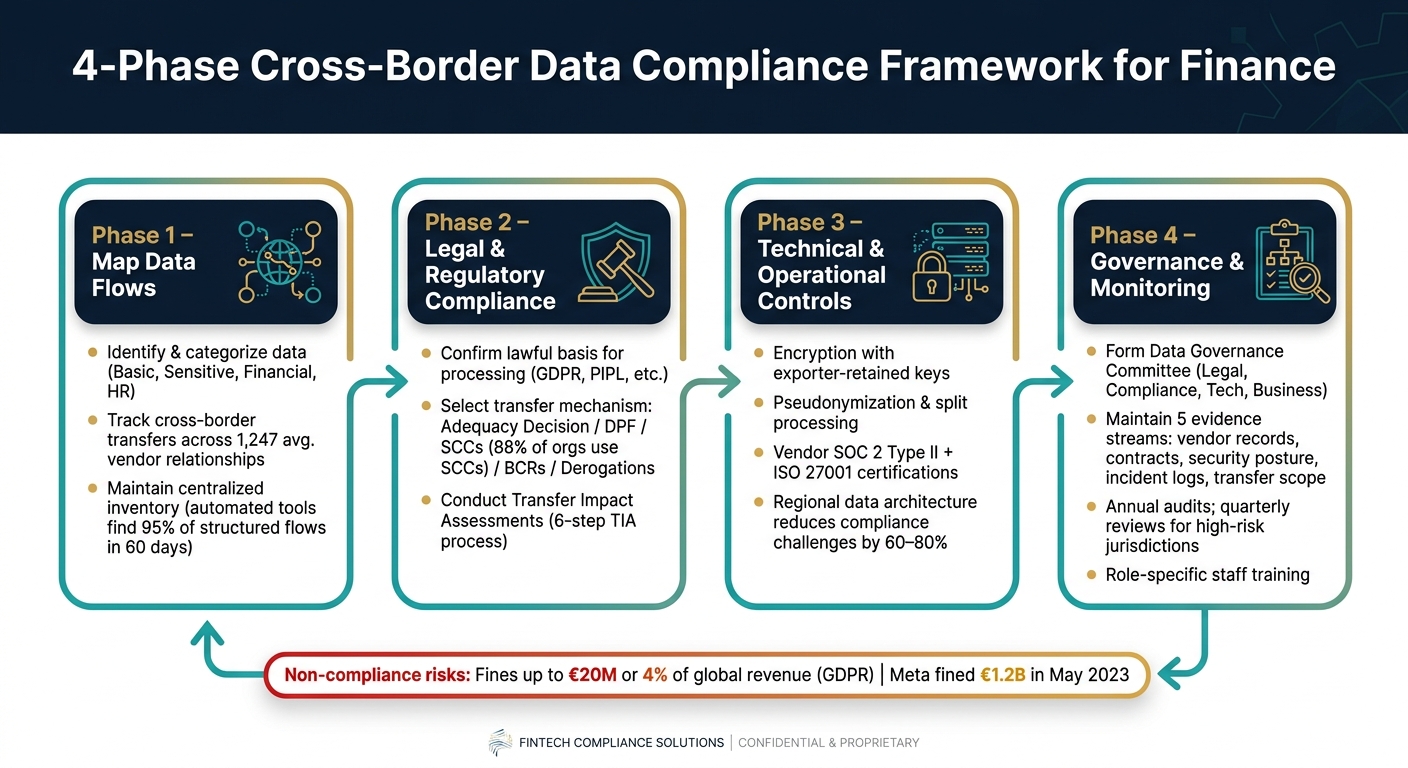
4-Phase Cross-Border Data Compliance Checklist for Financial Firms
The first step in ensuring cross-border data compliance is understanding how financial data moves within and beyond your organization. This means identifying what data you hold, where it travels, and how it’s processed. A clear map of these flows lays the groundwork for compliance.
Start by creating a detailed inventory of all personal and financial data. This includes everything from customer identifiers and transaction records to payroll details and even biometric or health-related data tied to financial services. Once you’ve listed all data types, sort them based on their sensitivity. This is critical because different data categories come with different regulatory requirements.
| Data Category | Examples | Sensitivity Level | Key Regulations |
|---|---|---|---|
| Basic Personal Data | Name, email, address | Standard | GDPR Art. 44–49; PIPL Art. 38 |
| Sensitive Personal Data | Biometric data, health records | High | GDPR Art. 9; PIPL security assessment trigger |
| Financial Data | Transaction records, credit scores | Medium | PCI DSS; sector-specific financial regulations |
| Employee HR Data | Payroll, performance reviews | Standard | Employment context affects consent requirements |
Pay attention to volume thresholds as well. For instance, under China’s PIPL, handling over 100,000 sensitive records requires a government security assessment [4].
After categorizing, the next step is to track how this data moves across borders.
Mapping data transfers involves tracing every step in the data’s journey - from where it originates to all intermediary stops and subprocessors. This is no small task, especially since financial firms manage an average of 1,247 vendor relationships involving cross-border data flows [1].
Document the technical details of these transfers, such as API calls, batch processing, backup systems, and disaster recovery protocols. Also, be aware of data localization rules, which may require certain data to remain stored within specific countries. For example, Russia’s Federal Law No. 152-FZ and China’s regulations mandate that certain data types stay within national borders. Any outbound transfer of such data could violate these laws, even if other safeguards are in place [1].
"Data mapping forms the foundation of cross-border transfer compliance." - Finantrix Editorial Team [1]
Once you’ve mapped these flows, centralize the information for easier tracking and updates.
A centralized, version-controlled inventory is essential for staying compliant during audits or regulatory reviews [1]. For every data transfer, document key details such as:
Automated tools can make this process easier by identifying 95% of structured data flows within 60 days [1]. However, unstructured data - like emails, PDFs, or internal documents - still requires manual effort. Keep the inventory updated whenever there are changes to subprocessors, processing scope, or vendor certifications [2].
"The TIA presupposes a complete inventory... For most companies, this inventory does not exist. Building it is the gateway: 80% of TIA work is preliminary mapping." - Dr. Thiébaut Devergranne, Founder of Legiscope [2]
After mapping out your data flows, the next priority is ensuring that every data transfer is backed by a solid legal framework. This involves confirming that you have the necessary rights to process and transfer the data and that your chosen mechanisms can withstand legal scrutiny.
Every cross-border data transfer must rest on a lawful basis. Under GDPR, this could include explicit consent, fulfilling a contract, or meeting a legal obligation. For financial services, data requests from public authorities for general-interest purposes (when properly documented) are not considered transfers.
If you’re relying on "important reasons of public interest" - like obligations tied to anti-money laundering or criminal investigations - those reasons must be explicitly recognized by EU or Member State law. Assumptions won’t cut it [5]. Be sure to document the legal basis for every data flow identified in Phase 1.
Once you’ve established the legal foundation, the next step is to implement the appropriate transfer mechanisms.
With the legal basis in place, you’ll need to identify the right mechanism to ensure compliance. Here's a summary of the main options:
| Mechanism | Best Suited For | Operational Burden |
|---|---|---|
| Adequacy Decision | Transfers to countries like the UK, Canada, or Japan | Low |
| EU-U.S. Data Privacy Framework (DPF) | Certified U.S. SaaS and cloud providers | Low |
| Standard Contractual Clauses (SCCs) | Standard vendor or processor relationships | Medium |
| Binding Corporate Rules (BCRs) | Large multinationals with frequent intra-group flows | High |
| Derogations (Art. 49) | One-off, exceptional transfers only | High (case-by-case) |
Most organizations - 88%, to be exact - rely on the 2021 version of SCCs to secure their transfers [6]. If you’re using SCCs, it’s critical to select the correct module. For example, Module 2 applies to controller-to-processor SaaS relationships. Using the wrong module can render the safeguard invalid [7].
For transfers to the U.S., ensure the recipient is certified under the DPF by checking dataprivacyframework.gov [7]. However, due to ongoing legal challenges - such as the La Quadrature du Net case (C-078/25), with a decision expected by 2026 or 2027 - many organizations are layering SCCs as a backup, even when relying on the DPF [3].
After setting up your transfer mechanisms, the next step is to conduct a thorough TIA to ensure compliance under local laws.
Transfer Impact Assessments (TIAs) are essential for verifying that each cross-border transfer complies with local regulations. These assessments are required for transfers using SCCs or BCRs and focus on whether local laws could prevent the data importer from meeting their protection commitments [8].
"The core question is practical, not theoretical: can the data importer comply with the transfer mechanism given local laws?" - AuditFront [8]
The TIA process includes six steps: mapping the transfer, confirming the safeguard in use, evaluating local surveillance laws, identifying supplementary measures, implementing those measures, and scheduling regular re-evaluations [8]. Each step should be meticulously documented in your centralized data inventory.
For high-risk jurisdictions, end-to-end encryption with the exporter retaining the decryption keys is one of the most effective technical safeguards [3][7]. It’s also important to revisit each TIA annually. The €1.2 billion fine levied against Meta by the Irish Data Protection Commission in May 2023 highlights the consequences of inadequate supplemental measures, even when SCCs are in place [9].
Once your legal framework is in place, the next step is to ensure your technical infrastructure aligns with and enforces your compliance policies effectively.
Encryption is a key defense mechanism. When transferring data to countries without adequacy decisions, the GDPR mandates that encryption keys must remain under the control of the data exporter. For example, EU data must rely on EU-based encryption keys, even if the data is stored on servers in the U.S. Without this key sovereignty, encryption alone won't meet the "essentially equivalent protection" standard.
Other measures like pseudonymization and split processing can further mitigate risks. Pseudonymization ensures that data can't be linked back to specific individuals without access to separate reference information. This is especially helpful for analytics or reporting when data crosses borders. Split processing takes this a step further by dividing tasks across jurisdictions, ensuring no single entity in a country without an adequacy decision holds a complete dataset that can identify individuals.
To prevent unauthorized access, implement role-based access management and monitor privileged sessions, particularly in regions with higher surveillance risks. Automated workflows for vulnerability response and incident handling are also critical for quickly detecting and containing breaches during data transfers.
Once technical safeguards are in place, the focus should shift to managing risks associated with vendors.
After securing your infrastructure, ensure that your vendors meet equivalent compliance standards. Vendor management is especially important due to the interconnected relationships involved in cross-border data transfers [1]. Before entering into any arrangement, require vendors to provide SOC 2 Type II reports and ISO 27001 certifications as evidence of their compliance. Map all subprocessors and integrations to specific control requirements, and maintain detailed documentation in a centralized inventory.
"Teams that treat compliance as a sales-aligned operating function outperform teams that treat audits as episodic projects." - Auditsuisse [10]
Assign specific control responsibilities to roles within your organization to maintain accountability, even during staff transitions. Conduct monthly reviews with engineering, security, and compliance teams to identify and address any "control drift" before it escalates into a regulatory issue.
Building on localization requirements, configure your infrastructure to meet local data storage laws. For instance, China's Cybersecurity Law and Russia's Federal Law 152-FZ require that citizen data is initially collected, processed, and stored on domestic servers. For EU data, using cloud regions such as AWS Frankfurt or Azure West Europe ensures data remains within the EEA, simplifying compliance efforts.
Adopting a regional data architecture, where data stays within its region of origin instead of flowing to a centralized global store, can reduce compliance challenges by 60% to 80% compared to centralized strategies [4]. In China, this may involve deploying dedicated local cloud instances like AWS China or Alibaba Cloud rather than routing traffic through nearby regions.
It’s also important to note that remote access qualifies as a transfer. For example, if a support engineer in India accesses an EU-hosted database, this constitutes a cross-border data transfer under GDPR - even if no data is downloaded [11]. To address this, configure systems so users can only view masked or pseudonymized data. Document all regional configurations carefully and review them regularly, especially when your cloud provider updates its infrastructure or your operations expand into new markets.
Once your technical controls are in place, the real challenge begins: ensuring compliance remains intact over time. This phase focuses on clear ownership, up-to-date documentation, and regular reviews to catch issues before they escalate into regulatory concerns.
Start by forming a Data Governance Committee that includes representatives from legal, compliance, technology, and business units. This committee ensures accountability by assigning specific roles, such as IT Manager, Security Lead, and Data Protection Officer (DPO). These roles are critical for maintaining oversight and ensuring responsibilities don’t fall through the cracks, even during staff changes [10]. The committee’s responsibilities include evaluating new data transfer requests and approving changes to existing data flows [1].
The Data Protection Officer and legal counsel should review and approve all Transfer Impact Assessments (TIAs), while an executive sponsor provides direction and ensures alignment with broader organizational goals. High-risk transfers and potential exposure to GDPR penalties - up to €20 million or 4% of global annual revenue - should be communicated to the board for transparency and risk management [3].
Internal audits play a crucial role here. Conduct a comprehensive review of cross-border transfer compliance at least once a year, with quarterly reviews for transfers involving high-risk jurisdictions [1].
Effective governance relies on maintaining accurate and up-to-date records. Think of your compliance documentation as a living record that evolves with changes like sub-processor updates, contract renewals, and security certifications.
To stay audit-ready, focus on five key evidence streams:
Each piece of documentation should clearly show who performed the control, when it was completed, and how exceptions were handled. Using standardized templates for tasks like access certifications and incident tests can minimize errors and simplify transitions when control ownership changes [10].
Store all records in a centralized, well-organized repository with consistent naming conventions and version control. This makes it easier to track changes over time and respond quickly to regulator inquiries, which often come with tight deadlines. Having pre-assembled, audit-ready evidence can mean the difference between a smooth process and a compliance headache.
Regular monitoring is essential to prevent compliance from slipping. Conduct monthly reviews with teams from engineering, security, and compliance to identify and address control drift or documentation gaps before they grow into larger issues [10]. Update TIAs annually or whenever there are regulatory changes, such as shifts in a destination country’s surveillance laws or increases in government access requests [1][3].
For EU-to-US data transfers, regularly verify the certification status of sub-processors using the official registry at dataprivacyframework.gov [3]. Even if you rely on the Data Privacy Framework (DPF), keep Standard Contractual Clauses (SCCs) in place as a backup. This ensures your operations won’t be disrupted if the DPF’s adequacy decision is invalidated.
"The prudent legal strategy is to treat the DPF as a convenience mechanism for the period during which it remains valid, while maintaining robust SCC and TIA infrastructure as the permanent baseline." - Morvantine [3]
Finally, provide role-specific training to employees on cross-border data protocols. Ensure they understand what qualifies as a transfer, when a TIA is necessary, and how to escalate potential breaches. This training helps reinforce both technical and legal safeguards, keeping your compliance measures effective over time.
Cross-border data compliance isn’t a one-and-done task - it’s a continuous process that requires attention and adaptation. The four phases outlined here - data flow mapping, legal and regulatory alignment, technical controls, and governance - work together as an interconnected system. Ignoring even one of these areas can leave your organization vulnerable to regulatory penalties and financial consequences. To keep up with evolving rules, these phases need regular updates and reviews.
Companies that succeed in compliance treat it as an integral part of their business operations. This means assigning clear responsibilities, maintaining up-to-date documentation, and conducting routine internal checks - not just reacting when authorities come knocking.
By embedding compliance into daily operations through defined roles and ongoing monitoring, your organization can stay ahead of risks. For growth-stage financial firms, navigating the intricate web of cross-border data regulations can feel overwhelming. That’s where experts like Phoenix Strategy Group come in, helping to create solid financial and data systems that turn compliance into a strength.
While this checklist gives you a framework, achieving lasting compliance takes consistent effort, well-defined responsibilities, and reliable systems. Use these four phases - mapping, legal alignment, technical measures, and governance - as your guide to staying compliant in the complex world of cross-border data management.
A cross-border data transfer occurs when personal or sensitive information is sent, accessed, or made available outside its originating country or jurisdiction. This can involve scenarios like hosting data on cloud servers located abroad, allowing overseas teams to remotely access databases, processing international payments, or using software tools with backend systems based in other nations. Mapping data flows is a key step to ensure adherence to regulations such as GDPR and CCPA, especially in global financial operations.
A Transfer Impact Assessment (TIA) is necessary when personal data is transferred outside the European Economic Area (EEA) using an Article 46 GDPR transfer mechanism, like Standard Contractual Clauses (SCCs) or Binding Corporate Rules (BCRs). However, if the destination country benefits from an adequacy decision by the European Commission or the transfer falls under an Article 49 GDPR exception, a TIA isn’t required.
Phoenix Strategy Group supports businesses in navigating these compliance requirements effectively.
If the EU-U.S. Data Privacy Framework (DPF) undergoes changes, you need to ensure your compliance strategy remains strong and adaptable. Think of the DPF as a helpful tool, but don’t rely on it as your only safeguard.
Keep using Standard Contractual Clauses (SCCs) and make it a habit to perform regular Transfer Impact Assessments (TIAs). These practices will help you stay prepared for any shifts in regulations. Additionally, assess potential risks tied to U.S. surveillance laws, such as FISA 702, and implement measures like Customer-Managed Encryption Keys. This way, your data stays secure, even if the legal landscape evolves.