Published on
April 17, 2026


Data-driven negotiation is transforming how businesses work with suppliers. By using analytics, companies gain a clear edge in setting terms, reducing costs, and improving supplier relationships. Here's the key takeaway: replace guesswork with data. This shift is often led by a fractional CFO who specializes in cost optimization.
Businesses using these strategies report 12–18% better negotiation outcomes and faster preparation times. By feeding negotiation results back into analytics, companies create a system that continuously improves over time.
Bottom Line: Data-driven negotiation isn’t just about cutting costs - it’s about making smarter, more informed decisions that benefit both sides.
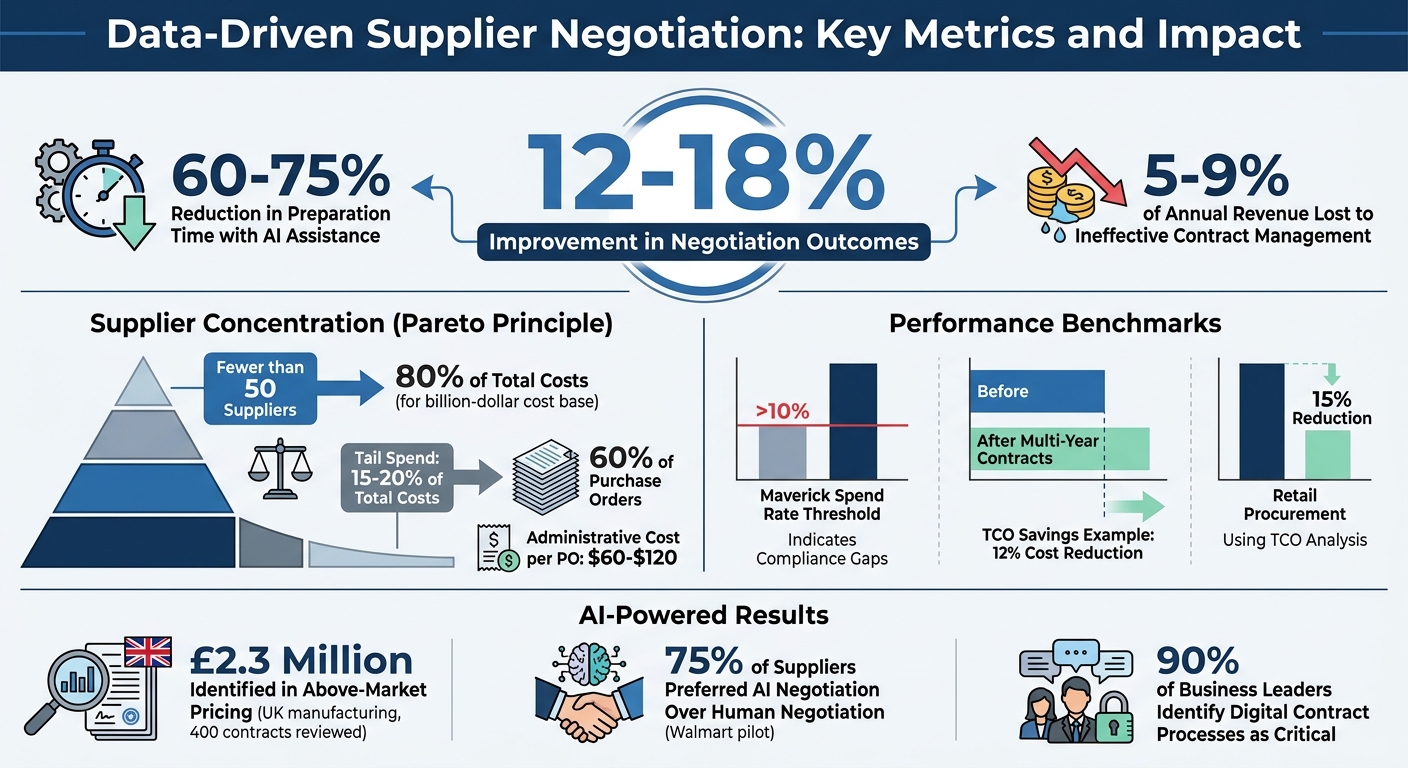
Data-Driven Supplier Negotiation: Key Metrics and Impact Statistics
Before you dive into negotiations, it's essential to gather and analyze three key data sets: historical spend, performance metrics, and market benchmarks. These data points help you uncover spending trends, evaluate supplier strengths, and identify opportunities for improvement. For example, spend analytics reveal which suppliers consume the biggest chunk of your budget and highlight areas where consolidating purchases could lead to volume discounts. Performance history provides measurable insights to back up demands for better service, while market benchmarks transform subjective opinions into fact-based arguments.
"Spend analysis is the diagnostic engine of strategic sourcing. It converts millions of raw procurement transactions into a panoramic, data-driven picture of how money actually flows through the enterprise and where value leaks occur." - Umbrex [6]
Interestingly, fewer than 50 suppliers often account for 80% of a billion-dollar cost base [6]. Meanwhile, smaller, scattered purchases - known as tail spend - typically make up 15–20% of total costs but involve around 60% of open purchase orders [6]. With administrative costs per purchase order ranging from $60 to $120 [6], addressing tail spend through consolidation or automation can significantly cut costs.
To ensure accurate comparisons, normalize your data. This means converting transactions into a single currency, standardizing units of measure, and aligning shipping terms like Delivered Duty Paid (DDP) [6]. Once normalized, segment your suppliers by spend and risk. This helps you decide which suppliers need personalized negotiation strategies and which can be managed with automated catalog ordering. A solid data foundation like this not only prepares you for immediate negotiations but also creates a system for continuous improvement.
Next, dive deeper into your spend analytics to uncover cost drivers and pinpoint savings opportunities.
Think of spend analytics as your diagnostic tool - it shows you exactly where your money is going and where inefficiencies exist. By categorizing transactions (like total spend by supplier, purchase frequency, and part volume), you can spot patterns that invoices alone might not reveal. For instance, a "maverick rate" above 10% - purchases made with non-preferred suppliers - indicates compliance gaps and missed opportunities for savings [6]. Fixing these issues can help redirect spending to suppliers offering better terms.
A Pareto analysis often reveals that a small group of suppliers drives the majority of costs. For most companies, this means focusing your efforts on fewer than 50 key vendors [6]. For smaller or tail spend, using catalogs, purchasing cards, or working with aggregators can streamline processes and reduce administrative costs.
Total Cost of Ownership (TCO) analysis goes beyond the sticker price. It factors in freight, duties, inventory costs, quality control, and even carbon premiums [6]. A seemingly lower price may end up costing more when these hidden expenses are included. Building should-cost models - breaking down a supplier’s costs into raw materials, labor, energy, and overhead - can help you evaluate whether their margins are reasonable compared to market standards [6]. This approach also gives you leverage when a supplier requests a price increase, allowing you to counter with data showing that their underlying costs haven’t changed.
Supplier performance data transforms vague complaints into actionable negotiation points. Instead of saying, “Your deliveries are inconsistent,” you can back up your argument with metrics like on-time delivery rates, quality scores, and responsiveness. These measurable trends give you the evidence needed to request better service levels or even negotiate penalty clauses for underperformance.
Tracking lead time variability alongside average lead times is especially important. Large fluctuations in delivery schedules can disrupt planning and lead to extra costs, such as expedited shipping or production delays. Quantifying this variability allows you to negotiate for more consistent terms or consider switching to more reliable suppliers.
Responsiveness is another key factor. How quickly suppliers respond to quotes or resolve issues can directly impact your operational efficiency and your ability to meet customer expectations.
Sharing performance scorecards with suppliers and collaborating on improvement initiatives helps align both parties on realistic goals. By setting clear targets and offering fair incentives for meeting them, you can foster better supplier relationships while driving improvements [3].
Once you’ve quantified supplier performance, compare it against market benchmarks to identify competitive gaps.
Market benchmarks bring clarity and competitive pressure to your negotiations, especially when alternative sourcing options are available. Comparing your pricing and contract terms to industry standards helps you identify outliers and shift discussions from instinct to data-driven arguments [1].
During the RFP process, benchmarking is particularly effective. Tools like bid comparison platforms and category benchmarks highlight how suppliers’ proposals stack up against market norms. Understanding broader market trends also allows for predictive strategies. For example, if commodity prices are rising due to supply chain disruptions, locking in long-term contracts now could save money. On the flip side, if prices are dropping, negotiating shorter terms or index-based pricing that adjusts automatically can reduce risk.
"Price negotiation tactics are strongest when supported by cost models, benchmarks, and performance data." - Ivalua [1]
Combining market trend data with your internal analytics can help you forecast savings opportunities and avoid risks [4]. For instance, knowing seasonal price trends for raw materials can help you time your negotiations for the best terms or include clauses that adjust pricing based on commodity indexes. This kind of preparation not only strengthens your position but also ensures your negotiation strategy is firmly grounded in market realities.
With these insights, you’re ready to develop data-driven negotiation strategies that deliver results.
Using data effectively can transform your negotiation strategies, grounding them in solid market intelligence, cost analysis, and strategic leverage. This approach ensures every phase of negotiation is built on objective metrics, helping you secure better pricing, improve contract terms, and strengthen supplier relationships - all while promoting transparency.
Market data is your best ally when it comes to challenging inflated quotes and keeping negotiations grounded. By relying on category benchmarks and should-cost models, you can estimate what a product or service should cost, factoring in raw materials, labor, energy, and overhead. This data-driven baseline not only prevents overpayment but also shifts the negotiation to focus on objective facts rather than assumptions.
AI-powered tools simplify this process by comparing supplier proposals with historical and market benchmarks. These tools quickly flag pricing outliers, allowing you to zero in on suppliers offering competitive terms. For instance, during a Walmart AI-driven negotiation pilot, 75% of suppliers preferred negotiating with AI over humans, citing reduced friction and greater consistency [1].
To tailor your approach, consider segmenting suppliers with a Negotiation Tier Matrix. For "Leverage Suppliers" - where multiple sourcing options exist - use bid comparison tools and market benchmarks to create competitive tension [1]. On the other hand, for strategic partners, collaboration and joint planning should take precedence over price-focused tactics.
Finally, strengthen your position further by evaluating hidden costs through a Total Cost of Ownership (TCO) analysis.
The price tag on a product or service rarely tells the whole story. Total Cost of Ownership (TCO) factors in all associated expenses - like logistics, quality issues, inventory holding costs, and maintenance. Sometimes, a higher upfront cost is justified if it means fewer defects, consistent delivery, or lower administrative overhead [3] [7].
TCO analysis is especially useful during contract renewals. If a supplier requests a price increase, you can counter with data showing how declining performance or rising quality-related costs are driving up your total expenses. For example, a global manufacturing firm used TCO insights to negotiate multi-year contracts with cost-adjustment clauses, cutting overall costs by 12% [7]. Similarly, a large retail chain leveraged TCO to evaluate proposals based on service levels, delivery timelines, and quality assurance, achieving a 15% reduction in procurement costs [7].
Regularly updating TCO models for your key suppliers - tracking metrics like defect rates, on-time deliveries, and administrative costs - gives you a clear picture of each relationship. This data strengthens your negotiating position and highlights opportunities for improvement. Pair TCO analysis with strategies like volume consolidation and improved payment terms for even greater impact.
Building on TCO insights, volume consolidation and refined payment terms can be powerful tools for negotiation. Consolidating purchase volumes across departments or product lines often leads to immediate savings. By combining similar parts or services from multiple vendors under a single supplier, you can achieve economies of scale and increase your leverage. Spend data analysis plays a key role here, helping you identify where you might be paying different prices for similar items.
Optimizing payment terms is another way to improve your financial position without asking suppliers to lower their base prices. Negotiating extended or more flexible payment terms can optimize your cash flow management while keeping supplier margins intact [5] [7].
For more complex negotiations with strategic partners, consider using Multiple Equivalent Simultaneous Offers (MESO). This technique allows you to present trade-offs across multiple variables - such as cost, payment terms, service levels, and innovation commitments - rather than negotiating each element separately [1]. This approach often uncovers creative solutions that benefit both parties beyond just price reductions.
Lastly, for low-risk, high-volume categories, automate routine negotiations by setting predefined price caps and standard payment terms. This frees up your team to focus on building value in strategic partnerships, where human judgment and relationship-building are crucial [1].
AI is reshaping how organizations approach negotiations, from preparation to post-analysis. By tapping into the same advanced analytics used for strategic spend reviews, these tools process vast amounts of data in real time, identifying opportunities that would otherwise go unnoticed. For example, AI can analyze historical contracts, market benchmarks, and supplier behaviors to uncover inefficiencies. In 2023, a UK manufacturing company used AI to review 400 supplier contracts, revealing £2.3 million in above-market pricing and unfavorable terms [9]. But it doesn’t stop there - AI also models negotiation strategies, enabling teams to test different approaches before entering discussions.
AI simplifies bid evaluation by turning unstructured vendor quotes into structured, comparable formats. It highlights pricing outliers, scope deviations, and unfavorable terms in real time [10][1]. Tools like should-cost modeling estimate what a product or service should cost, factoring in raw material prices, labor rates, and comparable transactions. This gives negotiation teams a solid, evidence-based starting point for discussions [9][1].
Scenario planning takes this further by simulating supplier responses. Teams can weigh trade-offs, like offering faster payment terms in exchange for lower prices or committing to larger volumes to secure better rates. AI also tracks supplier behavior over time, uncovering patterns such as a supplier’s tendency to start negotiations 30% above their walk-away price or their willingness to concede on volume commitments [9].
For tail spend - the often-overlooked bottom 80% of suppliers - AI can handle thousands of negotiations simultaneously. These systems operate within predefined limits, such as reservation prices, target prices, and maximum concessions per round (e.g., a 2% cap per round) [8].
"We started our AI journey in 2023, currently we are running a very successful pilot with Ivalua IVA, we are primarily asking our users to propose use cases, and what we hear most often right now is Automation type use cases and Analytics type use cases." - Jan Van Hueth, Senior Project Manager, Körber [1]
These capabilities not only refine bid evaluation but also create a framework for thorough post-negotiation reviews.
The real power of AI emerges when organizations feed negotiation results back into the system. After each negotiation, teams can track whether the agreed terms deliver the expected savings. For instance, linking auction IDs to purchase order numbers in an ERP system can help reconcile projected savings with actual results. This process also identifies issues like cost leakage from change orders [12]. Such closed-loop reporting strengthens future negotiation strategies and ensures decisions remain data-driven [1].
Organizations using AI for negotiation coaching report a 12-18% boost in outcomes, while AI-assisted preparation can cut prep time by 60-75% [11]. To maintain smooth supplier relationships, AI systems can include sentiment alerts, pausing automated negotiations and prompting human intervention if supplier language becomes aggressive [8]. Over time, this continuous analysis builds institutional knowledge, ensuring that each negotiation is more informed and effective than the last.
Manufacturing companies face distinct hurdles in supplier negotiations, thanks to factors like fluctuating material costs, stringent quality standards, and supply chain disruptions. Often, the difference between protecting profit margins and suffering losses lies in how well manufacturers understand their cost structures and supplier performance before stepping into negotiations. By analyzing supplier data - such as pricing history, delivery reliability, quality metrics, and market benchmarks - manufacturers can move away from guesswork and adopt evidence-based strategies. This approach helps identify what they should be paying versus what they’re quoted, offering a clear path to address material cost fluctuations with accurate, real-time insights.
Material cost variance is a critical factor in manufacturing, directly influencing profit margins. When raw material prices spike or suppliers increase rates without notice, the ripple effects can disrupt the entire cost structure. Real-time visibility into these changes allows manufacturers to address pricing issues immediately, avoiding unpleasant financial surprises later. Phoenix Strategy Group supports this effort by using FP&A and data engineering to integrate supplier data, spending trends, and performance metrics. This integration helps manufacturers quickly spot pricing irregularities. For instance, if a supplier’s quote significantly exceeds historical averages, manufacturers can flag and challenge the discrepancy before finalizing agreements.
Körber, a manufacturing leader, adopted AI-powered analytics to tackle fragmented data across multiple ERP systems. By creating a unified view of spending and supplier performance, Körber transformed its negotiation process. Senior Project Manager Jan Van Hueth explained that their pilot program emphasized automation and analytics to generate real-time insights during sourcing cycles. This created a feedback loop that refined future cost projections and negotiation strategies, enhancing governance and preparation.
To ensure fair pricing, manufacturers can use should-cost models that factor in raw material rates, labor costs, and similar transactions. Highlighting deviations from market benchmarks adds competitive pressure. For strategic materials, consider negotiating multiple elements - like cost, service levels, and risk controls - simultaneously using methods such as Multiple Equivalent Simultaneous Offers (MESO). These techniques not only address pricing disparities but also open the door to broader, data-driven negotiation strategies tailored to the manufacturing industry.
Data-driven strategies are reshaping supplier negotiations. By leveraging objective market benchmarks, historical spending patterns, and performance data, organizations are turning what were once informal discussions into a structured, scalable approach. This shift not only cuts costs but also strengthens supplier relationships by fostering transparency.
Ineffective contract management can drain 5% to 9% of annual revenue [2]. Implementing structured processes - such as total cost of ownership (TCO) analysis, should-cost modeling, and regular post-negotiation reviews - helps recover lost revenue while building trust with suppliers. When both sides rely on the same data, negotiations shift from being confrontational to collaborative, focusing on mutual problem-solving.
These strategies offer more than just immediate savings. Every negotiation contributes data on pricing trends, supplier responsiveness, and contract performance. Feeding this information back into analytics systems creates a self-improving framework. For example, an AI pilot with Ivalua IVA demonstrated how real-time data integration can refine negotiation strategies on an ongoing basis [1].
The benefits extend beyond cost reduction. Automating routine negotiations and standardizing contract templates allow procurement teams to focus on building strategic partnerships that promote innovation and resilience. With 90% of business leaders identifying digital contract processes as critical to success [2], companies that embrace data-driven negotiations are better positioned to navigate market challenges.
Phoenix Strategy Group helps businesses achieve this transformation by integrating supplier data, spending trends, and performance metrics into unified dashboards. These tools empower growth-stage companies to negotiate more effectively, make smarter purchasing decisions, and establish supplier relationships that drive sustainable growth. In industries like manufacturing, this approach ensures that cost-saving insights translate into long-term competitive advantages.
Before stepping into negotiations, it's crucial to arm yourself with the right data. Start by digging into the supplier's value proposition, performance metrics, and any potential risk factors. Dive into historical spending patterns, cost structures, and the total cost of ownership to pinpoint areas where savings might be possible.
Keep an eye on vendor-specific metrics, such as delivery performance, product quality, and any hidden fees that could impact costs. Work closely with procurement and finance teams to consolidate spending data and conduct a variance analysis. This organized and detailed approach sets the stage for more effective negotiations, better contract terms, and stronger, long-term supplier partnerships.
To figure out the Total Cost of Ownership (TCO) for a supplier, you need to look beyond just the purchase price. TCO considers all expenses tied to the product or service over its entire lifecycle. This includes:
By analyzing data like historical pricing trends and supplier performance, you can create a detailed cost breakdown. This not only highlights potential areas to cut costs but also strengthens your position during negotiations.
AI automation works best when businesses require quicker, scalable, and data-focused negotiation processes - especially in intricate supply chains. It shines in handling high-volume negotiations, cutting down inefficiencies tied to manual efforts, and ensuring potential savings aren't overlooked. By evaluating market trends, supplier information, and contracts, AI tools empower smarter decision-making. This allows teams to dedicate their energy to strategic priorities, which is especially valuable in situations where consistency and cost management are top priorities.