Published on
June 18, 2026


If you get the dispute clause wrong, a post-closing M&A fight can cost more, take longer, and turn into a forum battle before the case even starts.
I’d sum it up like this: arbitration is often the top pick for cross-border deals because awards are easier to enforce across countries and the process is more private. Mediation is often the lowest-cost path when both sides still want to settle, especially in earn-out fights. Litigation gives you court power, which matters for third-party evidence, multi-party claims, and injunctions, but it is usually public and harder to enforce across borders.
One data point stands out: 80% of professionals in a 2025 M&A disputes report said their firms handled more disputes that year, and about two-thirds expect volumes to keep rising through 2026.
Before I draft or review a clause, I’d focus on these five points:
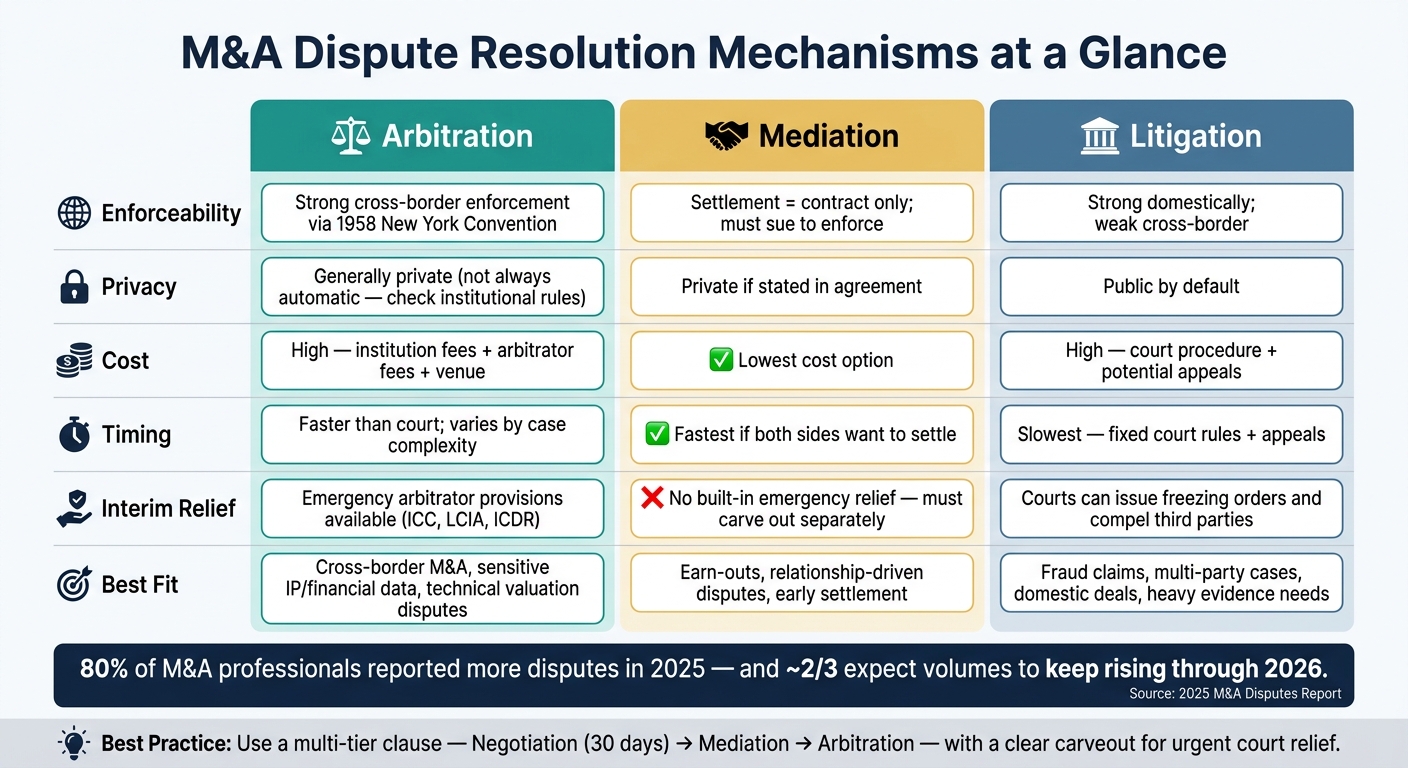
M&A Dispute Resolution: Arbitration vs. Mediation vs. Litigation
| Mechanism | Enforceability | Privacy | Cost | Timing | Interim Relief | Best Fit |
|---|---|---|---|---|---|---|
| Arbitration | Often stronger across borders under the New York Convention | Usually more private, but not automatic | Can be high due to institution and arbitrator fees | Often faster than court, but depends on the case | Emergency arbitrator options and court support may be available | Cross-border M&A, private disputes, technical valuation fights |
| Mediation | Settlement must usually be enforced as a contract | Private if the agreement says so | Usually the lowest-cost option | Often the fastest if both sides want a deal | No built-in emergency relief | Earn-outs, relationship-driven disputes, early settlement |
| Litigation | Often weaker across borders than arbitration | Public by default | Can grow due to procedure and appeals | Often slower | Courts can issue injunctions and compel third parties | Fraud claims, multi-party cases, heavy evidence needs |
Bottom line: I’d use arbitration for enforceability and privacy, mediation to try to settle fast, and litigation when court powers matter most. In many deals, the best answer is a multi-step clause: short negotiation, short mediation, then arbitration, with a clear carveout for urgent court or emergency relief.
Arbitration is often the go-to choice in cross-border M&A. The big reason is simple: arbitral awards are usually easier to enforce in other countries than court judgments.
A major driver is the 1958 New York Convention. It gives parties a standard path to have awards recognized and enforced across signatory states.
Under the New York Convention, the winning party can seek enforcement of an award in other Convention states. For U.S. parties, it’s worth checking that the award falls within the Convention’s commercial-relationship scope. [7]
Arbitration keeps disputes out of the public eye, which matters when a case involves sensitive financial information, price-sensitive data, or reputational risk.
That said, confidentiality does not come built in every time. ICC rules do not impose a default confidentiality duty, so parties need to ask the tribunal for a specific order. LCIA rules take a different path. Article 30 of the LCIA rules provides confidentiality by default. [2]
If privacy matters, don’t leave it to chance. Put it directly in the clause instead of relying on the institution’s standard rules.
Arbitration comes with real expenses. Parties may have to pay administrative fees to the institution, arbitrator fees, and venue costs. In a complex M&A dispute, that bill can climb fast.
There’s an upside, though. Parties can pick arbitrators with M&A and accounting know-how, which can help when the dispute turns on technical matters like purchase price adjustments. Some institutional rules also provide expedited procedures for smaller claims or narrow technical disputes, which can cut both time and cost. [2]
The flip side is finality. Arbitral awards are hard to challenge on the merits, [6] so if the tribunal gets the law or facts wrong, fixing that later is usually very difficult.
Arbitration gives parties a lot of say over the process. They can choose the seat, the language, the governing rules, and the arbitrators.
The seat, or legal place, of arbitration matters a lot. It decides which national courts oversee the process and which procedural law applies. Picking a neutral third-country seat can help avoid a home-court edge for either side. [5][2]
For urgent problems, ICC, LCIA, and ICDR all offer emergency arbitrator provisions. These can provide provisional relief before the full tribunal is in place. [2] And if that still isn’t enough, parties can go to national courts for freezing injunctions or orders to preserve property while the arbitration moves forward. [1]
Arbitration tends to fit parties looking for enforceability, privacy, and finality. Mediation can be more useful when the aim is to narrow the dispute before moving into a binding process.
If arbitration is built to bind the parties, mediation is built to help them settle. It’s a voluntary, non-binding process where a neutral third party helps both sides work toward an agreement, but cannot impose an outcome. Unlike arbitration, the parties stay in control of any settlement. [8]
That makes mediation a strong fit for earn-out disputes. It can help preserve working relationships, which matters when buyer and seller still have to deal with each other after closing. It can also deal with conduct-based fights that don’t fit neatly into a math formula. In many cases, mediation moves faster than arbitration because the focus stays on settlement, not on winning a binding ruling.
A mediated settlement is a contract, not an award. If one side breaks it, the other side will usually need to sue for breach. [4][2] And if the SPA makes mediation mandatory, the parties have to go through that step before moving forward.
That flexibility is a big reason mediation is often the fastest path when a deal is still within reach.
Mediation gives the parties a private setting, which can help keep valuation models, customer data, and financial projections out of the public record. But there’s a catch: confidentiality is not automatic in every jurisdiction. It should be stated clearly in the mediation agreement, not left to assumption. [2][4]
Mediation is usually the fastest and least expensive option - if it works. Complex M&A disputes that might drag on for months in arbitration can sometimes be resolved in a matter of days in mediation. [8]
Still, a mandatory mediation step can backfire if the parties end up in arbitration anyway. In that case, mediation becomes one more stop before the main fight. A short deadline helps. So does a clause that shifts the dispute to arbitration on its own if mediation fails.
Speed helps, but it doesn’t fix urgent risk. The clause should still protect access to emergency relief.
Mediation gives the parties a lot of room to shape the process. They can pick a mediator with corporate law or accounting experience, set the timeline, and decide which issues are on the table. [8][4]
What mediation cannot do is offer urgent interim relief. There’s no built-in emergency process. So if a multi-tier clause requires mediation first, it should plainly preserve the right to seek interim relief from a court or an emergency arbitrator at the same time. That carveout matters because mediation should not delay asset freezes or the preservation of evidence. [2][3]
Litigation means taking a dispute to state or federal court. Parties often go this route when they want a court ruling that can shape later cases, when several parties are involved, or when a forum-selection clause points to a specific court. In those situations, litigation makes sense when court power and precedent matter more than privacy or procedural choice.
A court judgment carries the most force in the jurisdiction of the court that issued it. Collecting on that judgment in another country can be hard. [1][10]
Litigation is public by default. That can be a problem when a dispute involves sensitive valuation models, customer lists, or financial information. [1]
Litigation is often slower and more expensive than mediation because it runs through fixed court rules and may include appeals. One practical upside is discovery. Courts can force third parties to hand over documents and give testimony, which an arbitral tribunal usually cannot do. [9][10]
The big upside is court authority. The tradeoff is less party control. Courts can issue freezing orders and asset-preservation orders, but the parties usually give up control over the judge, the language, and the procedure. [1][9][10]
Once you compare the three options side by side, the main issue becomes pretty simple: which process fits the dispute best? Each one comes with tradeoffs around enforceability, cost, speed, privacy, and control.
| Mechanism | Key Advantages | Key Disadvantages | Most Suitable Cross-Border M&A Scenarios |
|---|---|---|---|
| Arbitration | International enforceability; privacy; expert arbitrators; finality | High upfront fees; limited third-party joinder; no merits-based appeal | Large cross-border deals; transactions involving sensitive IP or trade secrets |
| Mediation | Low cost; helps settle without a binding ruling; flexible and non-adversarial | Non-binding; requires mutual consent; can be used as a delay tactic | Early-stage disputes where parties want to maintain a commercial relationship (e.g., earn-outs) |
| Litigation | Power to compel witnesses and evidence; easier consolidation of related parties and claims | Public proceedings; harder cross-border enforcement; perceived home-court advantage; slower appeals | Domestic deals; simple debt recovery; cases requiring emergency injunctions or alleging fraud |
In many M&A agreements, parties don’t stop at just one mechanism. They stack them. That’s why hybrid, or multi-tier, clauses often make the most sense in cross-border deals. A common setup is mandatory negotiation for a set period, such as 30 days, followed by mediation, and then arbitration. The catch is obvious: if those early steps don’t have firm deadlines, they can turn into stalling tools. Put clear time limits on each stage so the route to arbitration stays open if settlement talks break down. [2][6]
A few drafting choices can have a big effect.
For smaller deals, a sole arbitrator is often the better call because it is faster and costs less. Three arbitrators tend to fit disputes where the amount at stake is high enough to justify the added expense and extra subject-matter depth. [2][5]
When you stack up enforceability, confidentiality, cost, timing, and interim relief, there’s no one-size-fits-all answer. The right path depends on the dispute itself. Each option is built to handle a different kind of problem, so the clause should fit the dispute you’re most likely to face.
For U.S.-based buyers and sellers, the right choice usually comes down to three things: the type of dispute, where the assets are located, and how well the clause was drafted at signing. If the language is vague, parties can end up fighting over forum before anyone even gets to the merits. That’s why careful drafting at signing matters so much.
In cross-border M&A, the best dispute process is the one selected before closing. Pick the forum in the term sheet and the SPA, before a dispute turns the issue into a fight.
It depends on the deal, and on how much risk you're willing to take on. In cross-border M&A, arbitration is often the go-to choice because it offers privacy, stronger cross-border enforceability, and the option to pick arbitrators who know the subject matter.
Litigation can make more sense when you want the authority of a public court, the support of established legal precedent, broader discovery, or urgent interim relief that courts are often better set up to handle.
An M&A dispute clause should require mediation first when the parties want a faster, more cost-effective path than litigation or arbitration. In many cases, mediation can sort out a complex dispute in days instead of dragging on for months or years.
Making mediation mandatory at the start pushes both sides to try to settle before the conflict hardens. That can help protect cash, reduce legal spend, and keep the business relationship from falling apart.
A strong cross-border M&A dispute clause should clearly state the chosen forum, whether that's arbitration or litigation, and spell out the governing law, seat of arbitration, and procedural rules.
It should also use broad wording so it covers the disputes that tend to show up in these deals, including warranty breaches and purchase price adjustments. On top of that, the clause should address how arbitrators will be selected, how any award will be recognized and enforced, and whether mediation or expert determination will apply to technical financial issues.