Published on
May 8, 2026


Static budgets are holding startups back. In today’s fast-moving markets, locking in annual budgets limits flexibility and stifles growth. Dynamic capital allocation offers a better solution by continuously redirecting resources to the most impactful areas.
Here’s the core idea:
Startups that embrace this approach grow faster, improve efficiency, and reduce cash flow risks. The key? Treat capital as a fluid resource, not a fixed commitment.
Dynamic capital allocation is all about flexibility. It’s a strategy that continuously adjusts how resources are deployed based on real-time market conditions, economic trends, and company performance. Instead of sticking to rigid, pre-set commitments, this approach treats capital as a resource that can flow to wherever it will generate the best returns.
At its core, this method prioritizes responsiveness over static goals. It allows businesses to channel more funding into high-performing projects while scaling back or redirecting resources from underperforming ones. This stands in contrast to traditional models that rely on fixed budgets, static debt-to-equity ratios, or "set-it-and-forget-it" investment strategies.
For startups, dynamic capital allocation involves actively managing a mix of equity, debt, and revenue. Funds are reallocated among priorities like market expansion, inventory management, or research and development as the business grows and evolves. The advantages? Greater agility to adapt to market changes, better forecasting through regular reassessment, and less waste from poorly performing initiatives.
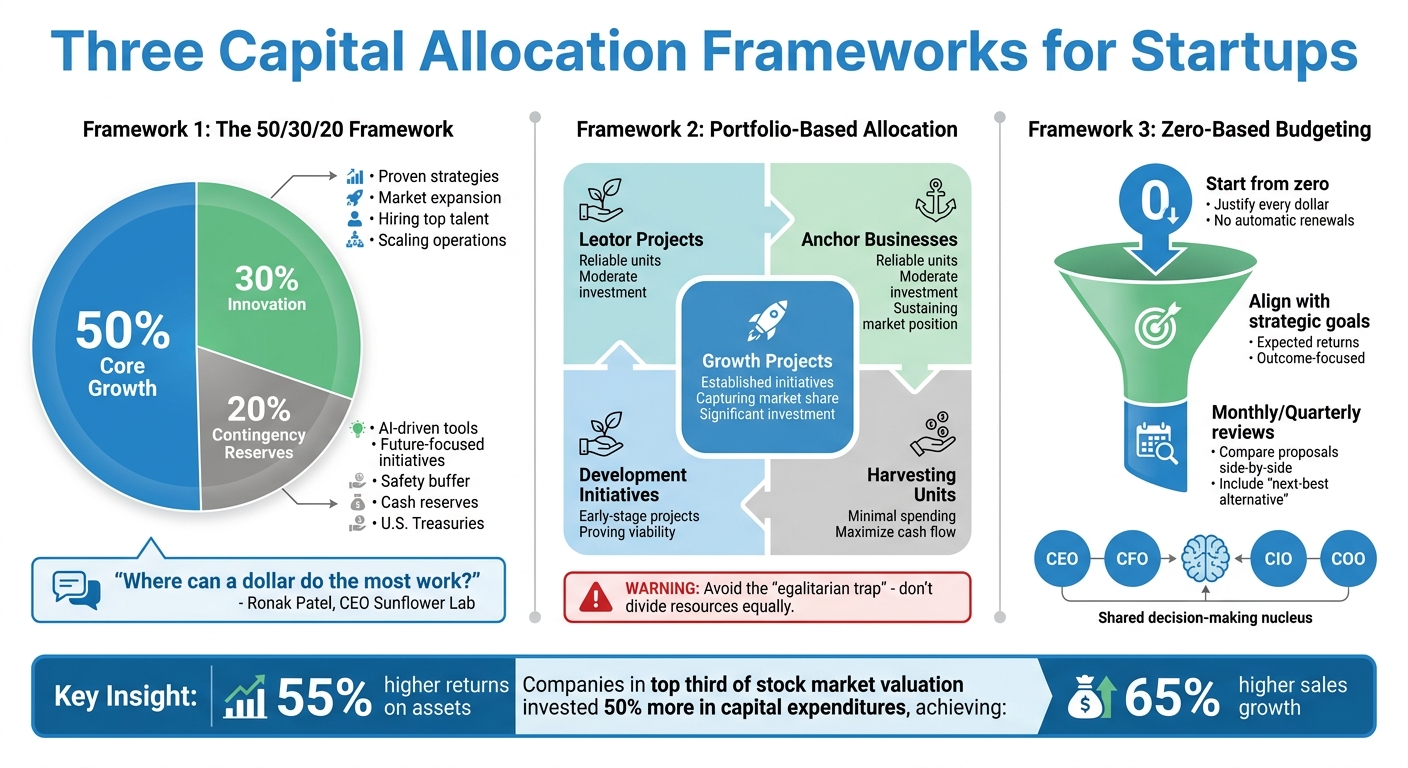
The numbers back this up. Companies in the top third of stock market valuation invested roughly 50% more in capital expenditures than their peers, achieving 55% higher returns on assets and 65% higher sales growth [4]. These figures highlight the power of redirecting capital toward high-value opportunities, especially in rapidly changing markets.
Dynamic allocation becomes a game-changer when markets shift quickly, and priorities evolve. For example, during periods of rapid growth, what worked at the start of the year might be outdated just a few months later. Traditional annual budgets can’t keep up with that pace.
Frequent market changes are a clear signal that it’s time to rethink your approach. Consider this: the startup shutdown rate surged by 58% year-over-year in the first quarter of 2024 [3]. This shows how rigid financial structures can quickly become liabilities. If you find yourself revisiting and revising your budget multiple times a year, adopting a more dynamic strategy might be the answer.
Resource distribution challenges also make the case for dynamic allocation. In 2024, nearly 60% of venture debt financings occurred at the late or venture-growth stage [3], reflecting how companies’ capital needs evolve as they mature. Sticking to outdated allocation strategies can hinder growth during these critical phases.
Changes in the cap table during Series A funding rounds further illustrate the need for flexibility. For instance, the median dilution in Series A rounds during the first quarter of 2024 was 20.1%, with founders’ collective ownership typically dropping from 56.2% to 36.1% [3]. These shifts demand a responsive framework for reallocating resources. As Vikas Garg, Founder and CEO of abillion, pointed out:
When we did our Series A, we needed to professionalize our cap table with fractional CFO services... Any ambiguity creates risk [investors] are unwilling to take on [3].
Dynamic vs Static Capital Allocation: Framework Comparison for Startups
Once you've decided to embrace dynamic allocation, the next step is figuring out how to direct your resources effectively. A solid framework helps you stay disciplined while allowing room to adapt as market conditions shift. With the fast pace of change in today's markets, these frameworks can guide you in reallocating capital quickly toward the most promising opportunities.
This approach splits your capital into three categories: 50% for core growth, 30% for innovation, and 20% for contingency reserves. It strikes a balance between meeting immediate business needs, funding future-focused initiatives, and maintaining a safety buffer.
Ronak Patel, CEO of Sunflower Lab, captures the essence of this approach perfectly:
The best leaders now ask: 'Where can a dollar do the most work?' rather than 'Where do we need to cut or contain?' [1]
While the percentages offer structure, they aren't set in stone. For example, if a game-changing innovation opportunity arises, you might temporarily shift funds from core growth. The flexibility here is key - use the framework as a guide, not a rulebook.
This framework treats your business like an investment portfolio. Instead of spreading resources evenly, you allocate capital based on the strategic role of each unit or project. It helps focus efforts where they'll have the greatest impact.
Your portfolio might include:
This approach prevents what researchers at BCG call the "egalitarian trap", where resources are divided equally regardless of strategic importance [4]. Successful companies evaluate entire business units before diving into individual projects. As one corporate strategist put it:
We made our biggest losses from moves not made. So, we also explicitly review opportunity cost mistakes [4].
By considering not only what you're funding but also what you're neglecting, this method ensures capital flows to the highest-potential opportunities.
Zero-based budgeting rethinks traditional budgeting by requiring you to justify every dollar spent. Instead of tweaking last year’s budget, you start from scratch, funding only what aligns with expected returns and strategic goals.
This method shifts the focus from maintaining fixed departmental budgets to prioritizing outcomes like expanding margins, acquiring customers, or driving innovation [1]. It's particularly effective for startups, as it prevents outdated spending habits from taking hold as the business grows.
A practical way to implement this is by bundling funding decisions into monthly or quarterly reviews. This allows you to compare multiple requests side by side, making tradeoffs clearer. Additionally, requiring each proposal to include a "next-best alternative" ensures decisions are strategic rather than reactive [4].
Zero-based budgeting works best with a collaborative decision-making team. As Patel suggests, this "shared decision-making nucleus" might include the CEO, CFO, CIO, and COO [1]. Together, they can challenge assumptions, conduct risk analyses, and ensure resources are allocated to initiatives that truly drive progress.
With these frameworks in place, the next step is setting up systems to monitor performance and make timely adjustments when needed.
Putting dynamic capital allocation into action requires more than just a framework - it demands consistent performance tracking and timely adjustments. The ability to monitor and reallocate resources effectively often separates startups that scale efficiently from those that struggle with cash flow.
Start by dividing your spending into three main categories: core operations, growth initiatives, and discretionary investments. Use historical financial data to set baseline allocations. For example, you might allocate 50% of your budget to activities that directly generate revenue, based on past performance.
To stay on top of your finances, establish a system of regular reviews:
Set clear triggers for reallocating funds. For instance, if a channel's return on investment (ROI) falls below 1.5x for 30 consecutive days, it might be time to shift resources. A great example of this is Airbnb’s decision in Q1 2023 to reallocate $50 million from underperforming international marketing (ROI of 0.8x) to U.S. product development. This move, led by CFO David Bernstein, resulted in a 35% increase in North American bookings, a $1.2 billion revenue boost, and an extended cash runway by six months [10].
Key metrics to monitor include:
For example, when a fintech startup noticed its lifetime value-to-CAC ratio drop from 3:1 to 1.8:1 in paid search, they reallocated $50,000 monthly to content marketing. Within two quarters, their efficiency improved by 25% [6].
Setting up these metrics is just the start. The next challenge is to ensure decisions are agile and data-driven.
Focus on 5–7 key performance indicators (KPIs) that align with your growth goals. Examples include:
Build a real-time dashboard using tools like Google Data Studio to track these KPIs and evaluate initiatives quarterly. Reallocate funds to top-performing areas without delay.
A case in point: In 2022, Slack redirected $30 million from advertising (which had a CAC of $450 and an 18-month payback) to expand its sales team under CFO Shannon Brayton. The result? MRR growth surged by 45%, reaching $250 million annually, while the burn rate dropped by 28% [11]. Research shows that startups that actively monitor and reallocate capital quarterly grow 2.6 times faster than those with static budgets [8].
The Phoenix Strategy Group has seen similar results with growth-stage clients. Companies using KPI dashboards typically achieve 30% better ROI. In one instance, a client reduced churn from 8% to 3% by reallocating resources based on churn data, extending their cash runway by six months [7]. The takeaway? Make data visible and actionable - when your team knows what’s working, reallocating becomes straightforward.
While KPIs guide strategic decisions, keeping a close eye on burn rate and cash flow ensures operational sustainability.
Your burn rate - the monthly net cash outflow - determines how long your business can operate without additional funding. To calculate it, subtract your ending cash from your starting cash, then divide by the number of months. For instance, if you have $3,000,000 in cash and a $250,000 monthly burn, you’ve got about 12 months of runway.
Keep tabs on both gross burn (total expenses) and net burn (expenses minus revenue). If gross burn spikes unexpectedly - say, due to hiring inefficiencies - consider reallocating to contractors to control costs [5].
Maintain a runway of 18 to 24 months as a safety net. If it falls below 12 months, cut non-essential spending immediately. Forecast cash flows for 12 to 18 months using weekly updates and prepare three scenarios: base case, optimistic, and pessimistic. One B2B SaaS company faced a cash crunch but recovered $400,000 in 45 days by reallocating 10% from R&D to accounts receivable collections during a revenue dip [6].
The stakes are high: 82% of startup failures are linked to cash flow mismanagement. However, effective burn rate tracking can extend a company’s runway by an average of 40% [9]. Tools like Fathom (starting at $39/month) and Baremetrics ($50/month) integrate with accounting systems and send alerts - such as Slack notifications when monthly burn hits $200,000 - giving you the visibility to act before small problems grow into major issues.
Relying on manual spreadsheets and static budgets just doesn’t cut it for startups navigating today’s fast-paced environment. Technology - especially tools like AI-driven forecasting and predictive modeling - gives founders the speed and accuracy they need to allocate capital where it can make the biggest impact. These advanced systems process massive amounts of data and uncover patterns that traditional methods often miss. When combined with agile monitoring practices, they allow for quicker, smarter capital reallocation.
AI forecasting tools analyze millions of data points across countless variables, delivering predictions that are 85% more accurate than traditional manual methods [12]. Unlike static spreadsheets that depend solely on past trends, AI systems update in real time, factoring in transaction data, payment behaviors, and even market sentiment. This lets founders instantly model different scenarios - best-case, base-case, and worst-case - to see how strategic capital shifts might affect their runway or growth trajectory [13][14].
These tools also bring precision to resource allocation. For example, AI can provide SKU-level demand forecasting and track expenses by specific segments, ensuring funds are directed toward high-performing products or departments. Startups focused on AI benefit even more, often reaching $30 million in annualized revenue in just 20 months - far faster than the 60+ months it typically takes for traditional SaaS companies [15]. AI budgeting tools can reduce forecasting errors by 20% to 50%, while also cutting the risk of runway depletion by 40% [12][13].
Lou Abrams, Director of Startup Banking & Founder Success at SVB Startup Banking, puts it perfectly:
AI for startups is a practical tool that helps early-stage founders move faster, automate low-value work and focus limited time and resources on the strategic decisions that drive growth [14].
Beyond improving accuracy, AI systems can also flag potential threats - like supply chain issues or looming cash shortages - before they become serious problems, giving founders time to act [12].
While AI sharpens forecasting, predictive modeling takes things a step further by helping founders identify where their dollars will have the biggest impact.
Predictive models tackle a crucial question: where should you invest to get the best returns? [1] By analyzing risk and return profiles across a portfolio, these systems highlight high-leverage opportunities. Companies that excel at using predictive intelligence for capital allocation typically achieve 55% higher returns on assets and 65% greater sales growth compared to their peers [4].
Take Kensington Asset Management as an example. Their Dynamic Allocation Strategy uses a proprietary trend-following model to adjust exposure between equities and cash based on market volatility. As of March 31, 2026, this strategy delivered a one-year gross return of 34.27%, far outpacing the S&P 500’s 17.80% return. Even during downturns, it performed better, with a maximum drawdown of -15.31% compared to the benchmark’s -23.87% [2].
Phoenix Strategy Group has seen similar success with growth-stage clients using predictive analytics. These companies often improve forecasting accuracy by 25% to 30% and achieve an average ROI of 3.5X on AI investments. In some cases, ROI climbs as high as 8X, thanks to better operational transparency and a disciplined focus on key metrics [13]. The secret lies in creating feedback loops that evaluate not just the outcomes of projects but also the quality of the initial decisions and the data that informed them [4]. By integrating predictive tools into a flexible allocation strategy, startups can quickly redirect capital to seize new opportunities as they arise.
Dynamic capital allocation has become a lifeline for scaling startups, especially when considering that nearly 29% of scale-ups with product-market fit still fail due to financial mismanagement [16]. The ability to pivot resources quickly and intelligently, guided by real-time data, often separates success from failure.
By combining flexible funding frameworks with real-time performance tracking and AI-driven forecasting, companies can create a responsive capital system. Tools like tiered funding models and live dashboards allow for fast reallocation to initiatives that deliver strong results. Meanwhile, AI-powered predictive models provide the accuracy needed to anticipate market trends and adjust accordingly.
"Capital, in this context, must behave like strategy in motion, not static commitment" [1].
Organizations thriving under this model prioritize agility and profitability over adhering to rigid departmental budgets. This shift in focus drives smarter decision-making and positions startups to adapt to changing circumstances more effectively.
The key steps are straightforward: define core KPIs from the outset, monitor capital flow in real time, automate alerts for deviations, and schedule consistent governance reviews. Treating capital as a fluid resource and directing it toward high-impact areas turns financial discipline into a competitive edge.
"The best leaders now ask: 'Where can a dollar do the most work?' rather than 'Where do we need to cut or contain?'" [1].
For personalized guidance on implementing dynamic capital allocation strategies, consider collaborating with Phoenix Strategy Group. They can help your startup embrace these approaches and achieve sustainable growth.
When your business operates in a fast-paced and unpredictable environment, sticking to an annual budget might not be the best choice. Static budgets often fall short when it comes to adjusting to rapid market changes, shifts in revenue, or evolving operational demands. Adopting a more flexible approach, such as dynamic cash flow forecasting, can make a big difference. This method allows for regular updates and scenario planning, helping you stay more responsive and adaptable in managing your finances.
To keep things straightforward, establish clear threshold values for each key performance indicator (KPI). These thresholds should act as triggers for reviewing or adjusting capital allocation when reached. For instance, you could monitor metrics such as cash burn rate, revenue growth, or liquidity ratios. By using real-time monitoring tools, you can track these KPIs continuously and set up alerts for when they exceed or fall below the set limits. This way, you can make timely decisions about reallocating resources.
Startups looking to streamline their operations and make informed decisions should explore AI tools designed to deliver real-time financial insights.
Lucid Financials stands out as a comprehensive solution, offering everything from forecasting to bookkeeping and CFO support in one platform. If sales forecasting is a priority, Oliv AI is an excellent choice, providing tools for deal tracking and pipeline visibility. For startups focused on operational efficiency, Forecast PSA simplifies project planning and resource management.
Meanwhile, Phoenix Strategy Group underscores the critical role of real-time, dynamic cash flow forecasting, especially for companies in their growth stages. These tools can be game-changers for startups aiming to stay agile and competitive.