Published on
May 8, 2026


Securing funding for biotech startups is no small feat. With long R&D cycles, high risks, and no revenue for years, financial planning becomes a survival tool. To succeed, you need to:
Investors are scrutinizing every dollar spent. Your financial model must show how funding reduces risk and moves closer to regulatory and clinical goals. Planning ahead is key.
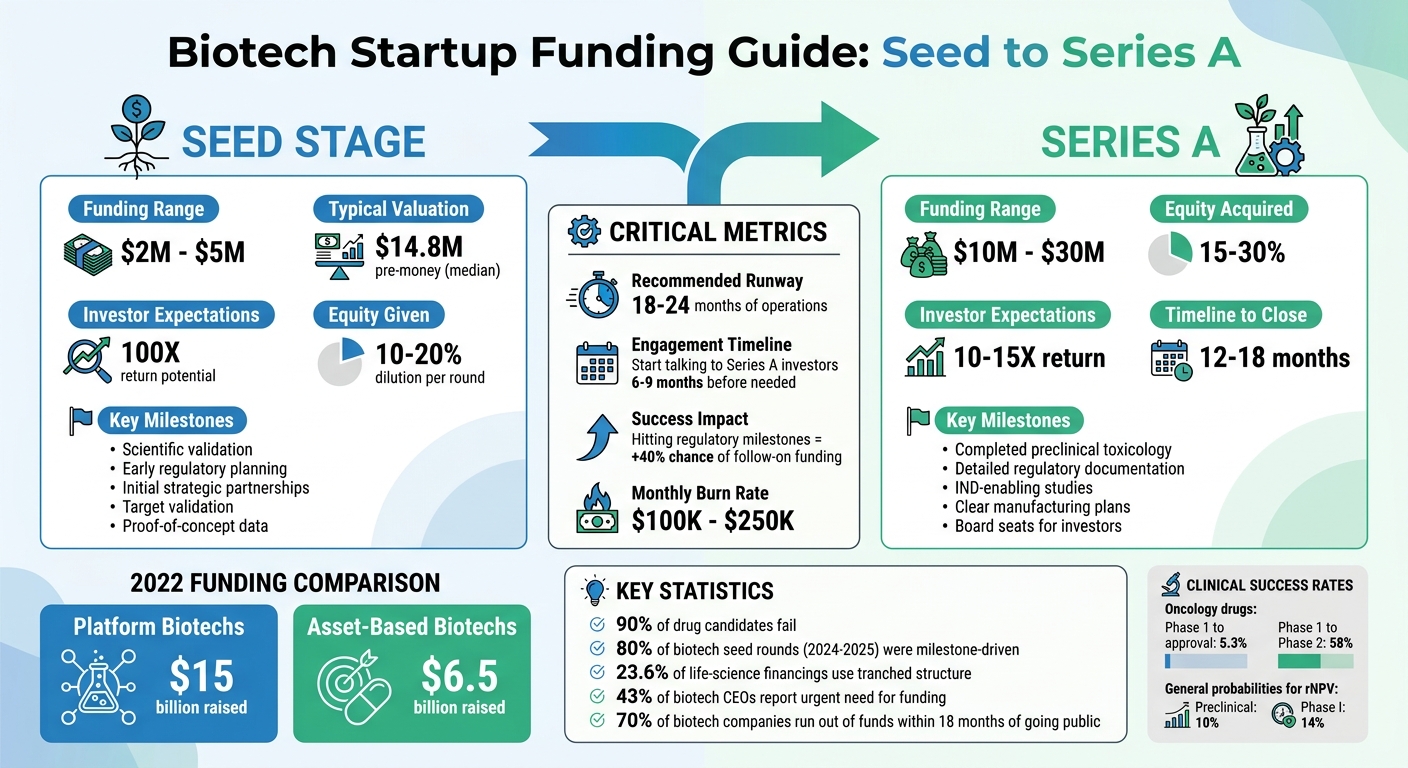
Biotech Funding Journey: Seed to Series A Milestones and Metrics
Investors want to see measurable progress at every stage of funding. Each phase of your journey should demonstrate achievements that signal you're moving closer to commercialization. At the seed stage, the focus is on scientific validation, early regulatory planning, and forming initial strategic partnerships. By the time you reach Series A, the bar is higher. You'll need to have completed preclinical toxicology studies, prepared detailed regulatory documentation, and established clear manufacturing plans. Hitting these regulatory milestones can boost your chances of securing follow-on funding by 40% [5].
The shift from seed to Series A funding is significant. Seed investors are willing to take on higher risks, often in hopes of a 100X return. In contrast, Series A investors aim for more modest returns of 10-15X but expect a lower likelihood of failure. These investors often take board seats and play a role in shaping your company’s strategy. This means they need solid proof that your technology works beyond the lab. Biotech Series A rounds typically range from $10 million to $30 million, with investors acquiring 15-30% equity in return [5]. These rounds often take 12-18 months to close [5].
Your milestones should align with one of two strategic paths. If you're an asset-focused biotech, completing IND-enabling studies is critical. For platform companies, demonstrating multi-model efficacy with clear target indications is key. In 2022, platform biotechs attracted $15 billion in funding, far outpacing the $6.5 billion allocated to asset-based biotechs [5].
Tying your milestones to regulatory stages not only clarifies your development plan but also builds investor trust. Your financial planning should directly reflect these regulatory goals. For preclinical stages, allocate resources to achieve specific objectives like target validation, lead optimization, and proof-of-concept (PoC) data from animal studies. Before pursuing Series A funding, ensure your therapeutic targets are validated and present PoC data that institutional investors can assess.
Typically, the funds you raise should cover 18-24 months of operations, giving you enough runway to hit your next major milestone [5]. Your hiring strategy should also align with these milestones. For example, bring in clinical or commercial experts only when your scientific progress justifies their roles.
Once regulatory milestones are clearly mapped out, the next step is effectively communicating your progress to investors.
A well-organized FP&A framework is essential for presenting your progress to investors. Prepare a detailed clinical data package for due diligence. Your electronic data room should include trial protocols, patient demographics, endpoints, and safety monitoring procedures. This level of preparation not only speeds up the investment process but also highlights your operational discipline - something investors value just as much as your science when larger sums of capital are at stake.
Start engaging Series A investors 6-9 months before you need funding to streamline the due diligence process. As one CEO from DeepLook Medical explained, this process involves "hundreds of investor conversations and detailed due diligence" [5]. When presenting progress, focus on three key areas: scientific and clinical milestones (like toxicology studies and IND submissions), market validation (such as pilot programs or revenue targets for platform companies), and regulatory and IP protection. This structured approach demonstrates that you grasp both the science and the business of bringing new therapies to market.
A solid financial model is the backbone of capital planning, milestone scheduling, and contingency strategies. It sets the stage for accurate cash flow forecasting, where precision is non-negotiable.
When building your model, calculate net proceeds by subtracting all transaction-related fees - such as those for auditors, legal teams, and bankers - from the gross funds raised. As Lou Pizzileo and Brendan McCarthy from Grassi emphasize:
"CFOs must understand cap table dynamics at a granular level and be able to clearly explain how investment scenarios impact product or treatment milestones" [7].
The type of company you’re running - platform or asset-focused - also shapes your financial model. Platform companies need to showcase how their technology can address multiple disease targets, providing sound reasoning for each match. On the other hand, asset-focused biotechs should present a straightforward path from IND-enabling studies to clinical trials [5]. Platform models often involve more intricate scenario planning compared to the relatively linear approach required for asset-focused companies.
Cash flow forecasting is critical to ensure your company has the resources to hit its next milestone. While the general advice is to secure funding for 18-24 months of operations [5], many experts recommend planning for two to three years of cash reserves. This extended timeline accounts for the inherent uncertainties in drug development, where approximately 90% of drug candidates fail [3]. The extra runway provides breathing room to pivot or adjust strategies when necessary.
To forecast expenses effectively, break them down by development stage. Account for costs related to personnel, contract research organizations (CROs), and manufacturing at each regulatory phase. This level of detail helps ensure accurate capital allocation and allows you to quickly identify areas for adjustment if timelines shift. Your model should also pinpoint the "zero cash" date under various scenarios - this metric often determines whether investors view your projections as credible or overly optimistic.
Once your cash flow estimates are in place, test your financial assumptions rigorously to prepare for regulatory risks. Scenario planning is key to creating credible models. Today’s investors expect your financial projections to include built-in regulatory risk assessments [6]. This involves creating multiple scenarios to account for potential clinical trial delays, regulatory hurdles, or market shifts. Include adjustable parameters for each program so you can instantly evaluate how changes - like pausing development or extending a trial phase - affect your runway.
Incorporate industry-standard probability of success (PoS) data to adjust your projections for risk. For example, oncology drugs have an overall likelihood of approval from Phase 1 of 5.3%, and the probability of advancing from Phase 1 to Phase 2 is 58% [8]. These benchmarks aren’t overly cautious - they’re realistic figures that can help you calculate risk-adjusted Net Present Value (rNPV). Acknowledging potential setbacks shows investors that you have a clear-eyed understanding of the science and a plan to navigate challenges. As Allyson Tighe from Amplitude Ventures points out:
"Over the past two or three years, we saw a lot of technology investors coming into drug development and discovery, expecting the speed of a tech venture. In science, of course, revenue might be many years away" [3].
Once you've built a solid FP&A model, the next step is crafting a fundraising strategy that aligns with your scientific milestones. Your financial model serves as the backbone of this strategy, ensuring that every dollar raised is tied to measurable progress.
The key is to balance raising enough capital to hit your next big milestone while keeping founder equity intact. As Sahil Agrawal from Qubit Capital explains:
"Seed investors don't care that you 'need 3M'; they care what happens to the asset, the data, and the valuation if they give you 3M, and what doesn't happen if they don't" [10].
To size your funding round, work backward from a major milestone - like an IND filing or lead candidate selection - and include a 20-30% buffer for unexpected costs [13]. In 2025, biotech seed rounds typically ranged from $2 million to $5 million [10]. Your plan should clearly illustrate how this funding will drive progress and boost your company’s valuation.
Establishing your pre-money valuation requires understanding how biotech investors evaluate companies. Two common methods are:
In 2024, the median U.S. seed valuation was $14.8 million pre-money [12]. However, your valuation will depend on whether you’re building a platform company or an asset-focused company. Platform companies, which generate multiple therapies through repeatable discovery engines, often secure higher valuations and larger funding rounds than companies focused on a single molecule [12]. For context, platform biotechs raised $15 billion in 2022, compared to $6.5 billion for asset-based companies [5].
To calculate your "effective pre-money", multiply the price per share by the total number of shares. Ignacio Sancho-Martinez from Inbistra points out:
"Founders think 'valuation' is a number. It's actually five different numbers, and only one of them is your money" [11].
Keep in mind that the headline pre-money valuation often includes the option pool, which dilutes founders before new investors join. For life sciences startups, Series Seed option pools average 10.8%, lower than the 12-15% standard for other startups [12]. Negotiate whether this pool is created pre-money (diluting founders only) or post-money (diluting all shareholders proportionally).
A well-defined valuation lays the groundwork for managing dilution effectively.
To keep dilution manageable, aim for 10-20% dilution per round by raising milestone-driven funding. This structure was used in over 80% of biotech seed rounds in 2024-2025 [10][13]. The idea is to raise larger amounts only after hitting value-boosting milestones.
In late 2025, about 23.6% of life-science venture financings were structured in tranches. This means capital was released in stages, tied to specific milestones like lead candidate nomination or IND-enabling toxicology studies [12]. Tranches benefit both sides: investors reduce risk by funding incrementally, and founders preserve equity by proving value before raising additional funds. As noted by Causo Hub:
"In a tranched biotech seed, the second tranche is the real round. The first tranche is just the option to run the experiment that justifies it" [12].
You can also explore non-dilutive funding sources like NIH grants, strategic partnerships, or venture debt to extend your runway. With early-stage biotech burn rates typically ranging from $100,000 to $250,000 per month [10], even small grants can delay the need for additional dilutive rounds. Founding CEOs often aim to retain 10% to 20% ownership at exit [13], so saving equity early on has a compounding effect over time.
Biotech founders are often brilliant scientists, but translating clinical timelines into financial narratives that resonate with investors can be a challenge. This disconnect is critical, especially when 43% of biotech CEOs report an urgent need for funding, and over one-third of public biotech companies have less than 12 months of cash runway [14]. Experienced FP&A professionals can bridge this gap by transforming complex R&D milestones into clear, actionable financial models.
Financial leadership is key to meeting investor expectations for operational discipline. As Ravix Group puts it:
"Investors want science that inspires them, but they fund operational discipline" [4].
By 2026, investors are digging deeper into both scientific reproducibility and operational readiness. This means your data room needs to be airtight - featuring audited financials, accurate cap tables, and detailed milestone cost mapping - before due diligence begins. Strategies like hiring a fractional CFO, monitoring key metrics in real time, and leveraging specialized FP&A services can help you turn your R&D progress into a financial strategy that resonates with investors.
A fractional CFO brings high-level financial expertise without the full-time cost, making it an ideal solution for biotech startups with annual revenue under $5 million to $10 million. This model is especially useful during critical phases, such as preparing for IND submissions or Series A fundraising, while allowing flexibility to scale back during quieter periods.
Engaging a fractional CFO six to nine months ahead of a funding round ensures enough time to build financial models and improve operational efficiency [4]. For example, Swiipr Technologies successfully closed a $7.6 million round in February 2026 by leveraging fractional CFO expertise to craft their fundraising narrative [14]. Similarly, Ap Tack secured $500,000 that same month by aligning their financial projections with investor priorities through a fractional finance partner [14].
Biotech-specific CFOs bring expertise in managing unique challenges like R&D expense tracking, intangible asset recognition, and pre-revenue accounting. This ensures your financial story aligns seamlessly with your R&D progress and funding needs.
Real-time tracking of metrics like burn rate, cash runway, and milestone costs is essential for early-stage biotech companies, which often lack historical revenue. Forward-looking pipeline metrics become critical [2].
Key metrics to monitor include:
Vanessa Galarneau from Pluvo highlights the importance of precision:
"A 10-day slip [in validation duration] can shift cash runway by months" [2].
To achieve this level of detail, many companies adopt integrated systems that connect HR, CRM, and accounting tools. Automating data tracking not only reduces manual errors but also provides a clearer financial picture. Reviewing funnel metrics every two weeks allows leadership to identify and address issues early. Breaking progress into 30-, 60-, and 90-day segments ensures teams can act quickly if milestones stall [2].
This operational rigor is especially crucial now, as the median time between funding rounds has increased by 84% [14]. By mastering these metrics, companies can optimize their capital management and build confidence with investors.
Phoenix Strategy Group offers a suite of FP&A services tailored to growth-stage biotech companies. Their approach focuses on aligning financial models with scientific milestones and maintaining operational discipline to attract investors.
Their services include:
Phoenix Strategy Group also provides fractional CFO services, offering biotech-specific expertise to prepare investor-ready data rooms, map milestone costs to key development stages (like IND submissions or Phase 1 trial designs), and create runway models for different scenarios. By combining detailed bookkeeping, advanced FP&A systems, and strategic advisory, they help biotech startups showcase the operational discipline investors demand in today’s high-scrutiny funding environment.
Your pitch deck is your chance to tell the story of how seed capital transforms into reduced scientific risk and tangible progress. As Sahil Agrawal from Qubit Capital explains:
"In biotech, you're not really selling 'a round', you're selling a sequence of de-risking steps." [10]
In fact, over 80% of funded biotech seed rounds in 2024-2025 were structured around clear, achievable milestones. [10] This means every dollar you raise needs to be tied to a specific deliverable.
Your materials should highlight how capital will drive value at key inflection points, showing investors how risks - both scientific and operational - will be reduced at each stage. This is especially critical since roughly 70% of biotech companies run out of funds within 18 months of going public. [10] With investors increasingly focused on capital efficiency, your pitch must clearly outline how you’ll use their funding effectively.
Building on a strong FP&A foundation, your investor materials should emphasize how each investment reduces scientific uncertainties. Unlike other industries, biotech success isn’t measured by immediate revenue but by milestone achievements. Your projections should illustrate how funding will lead to scientific breakthroughs, not just growth metrics.
To make your case, demonstrate how your solution delivers clinical value at a competitive price while maintaining reasonable operational costs. Use bottom-up models that factor in critical drivers like prescriber volume, patient populations, and planned physician training programs. [10] [16]
Key projections to include are:
Always include a contingency buffer - 10-20% - to account for the unpredictable nature of clinical trials and regulatory processes. [10]
Incorporate rNPV modeling into your deck to quantify the risk-adjusted value of your assets. This method accounts for phase-specific success probabilities, aligning with industry standards. To build trust, document every assumption - trial sizes, timelines, headcount, vendor quotes - in an appendix for due diligence. Transparency is key, particularly when U.S. and EU life sciences VCs have an estimated $55 billion in available capital as of 2026. [16]
Real-world success stories illustrate this approach. For instance:
Once your financial drivers are clearly outlined, structure your pitch deck to address investor priorities succinctly. A biotech pitch deck typically includes:
Investors are particularly interested in evidence, roadmaps, and investment highlights. When presenting data, distinguish between proven results and assumptions. [15] With investors paying closer attention to scientific reproducibility and operational readiness, clarity and honesty are essential.
Your "use of funds" section should align strictly with scientific milestones. Most investors expect 18 to 24 months of runway to reach a major value inflection point. Precision in how you allocate capital is non-negotiable.
Keep the main deck concise and avoid excessive jargon. Use visuals or analogies to simplify complex scientific concepts. Save detailed market research, competitor analysis, and technical documentation for the appendix. [16] For example, Astek Diagnostics effectively captured investor attention by quantifying the urgency of their solution - highlighting a $1.6 billion annual cost and 68,000 deaths from UTIs - to position their diagnostic tool as essential. [16]
As Sagar Agrawal from Qubit Capital puts it:
"Biotech investors aren't short on deal flow, they're short on conviction. Your deck either cuts through that noise or quietly joins the pile." [16]
Finally, treat your financial model as a living document. Update it quarterly or whenever significant data readouts occur to ensure your materials reflect your current risk profile and funding needs. [1]
Securing funding as a biotech startup in 2026 takes more than cutting-edge science - it requires sharp financial planning and a clear strategic approach. Investors want to see how every dollar spent reduces risk and moves the company closer to key regulatory milestones. Your financial model is far more than just numbers on a spreadsheet; it’s the bridge between your scientific vision and the commercial reality investors need to trust.
As the Ravix Group aptly states: "Science alone does not close a round. Investors want to know who is running the financial engine." [4] This highlights the importance of creating financial models that address clinical trial uncertainties, regulatory timelines, and burn rates tied to critical milestones like IND submissions or the completion of Phase 1 trials. Engaging a fractional CFO at least 6 to 9 months before fundraising can provide the operational expertise and credibility that often separates companies that secure funding from those that don’t. [4]
Capital efficiency has never been more critical. With investors scrutinizing every expense and due diligence cycles becoming longer, startups must demonstrate disciplined spending, realistic hiring plans, and well-thought-out contingency scenarios. Building investor relationships early is also key - regular updates and maintaining clean, accurate financials, cap tables, and IP documentation can make the diligence process much smoother. As the Ravix Group points out, "Investors reward teams who make diligence smooth." [4]
The biotech funding space is fiercely competitive, but companies that pair scientific excellence with financial transparency have a clear edge. Whether you’re developing rNPV models, strategizing Series A dilution, or crafting pitch decks that emphasize milestone-based capital deployment, having robust financial planning and analysis (FP&A) processes can set you apart. Phoenix Strategy Group’s fractional CFO and FP&A services are designed to help growth-stage biotech companies build the financial infrastructure they need to scale, secure funding, and navigate the complex journey from lab to market.
The scientific breakthroughs of tomorrow hinge on the financial decisions you make today. Equip your biotech startup with the expertise, tools, and strategic vision needed to transform scientific promise into investor confidence - and turn funding into clinical success.
Before diving into Seed or Series A funding, biotech startups need to hit a few critical milestones. First and foremost, it's all about the science - investors want to see solid proof that your concept works, backed by reliable data. Securing intellectual property is another big one; protecting your innovation is essential for long-term growth. Additionally, you'll need to work on de-risking your science. That means addressing potential hurdles early, whether they're experimental, regulatory, or related to market viability.
Investors also pay close attention to your progress. They’re looking for advancements in experiments, regulatory steps achieved, and strong proof-of-concept data. These elements help show that your startup is on the right track.
Another key piece of the puzzle? A clear financial model. You’ll need to link your spending to specific development goals and demonstrate how those goals will create value. This shows investors you’re ready to handle larger funding rounds, which typically fall in the $10 million to $30 million range.
To build a reliable runway model for your biotech startup, focus on creating a clear, modular financial framework that accurately represents your cash flow and timelines. Use practical assumptions when outlining milestones, funding requirements, and potential risks. Including scenario analysis is key - it demonstrates how different variables could affect your financial runway. This level of transparency not only boosts investor confidence but also aligns with financial planning and analysis (FP&A) practices tailored for biotech startups.
When you're starting a biotech company, bringing in a fractional CFO early - ideally before or during your Series A funding - can make a big difference. They provide support with financial planning, investor relations, and handling the complexities of funding structures. Having this expertise on board at the right time helps your company showcase strong financial discipline, effective milestone management, and smart strategic planning. These qualities are essential to stand out and attract institutional investors in a highly competitive market.