Published on
April 2, 2026


In 2026, ESG compliance is no longer optional for tech companies - it’s a requirement for growth, investor trust, and avoiding hefty fines. With regulations like California’s SB 253 and the EU AI Act tightening oversight, companies must act now to align with environmental, social, and governance standards. Here’s what you need to know:
Upcoming deadlines, such as the EU’s CSRD and California’s Climate Accountability Package, make it critical to integrate these practices into your operations. By focusing on these steps, companies can ensure compliance, reduce risks, and meet stakeholder expectations.
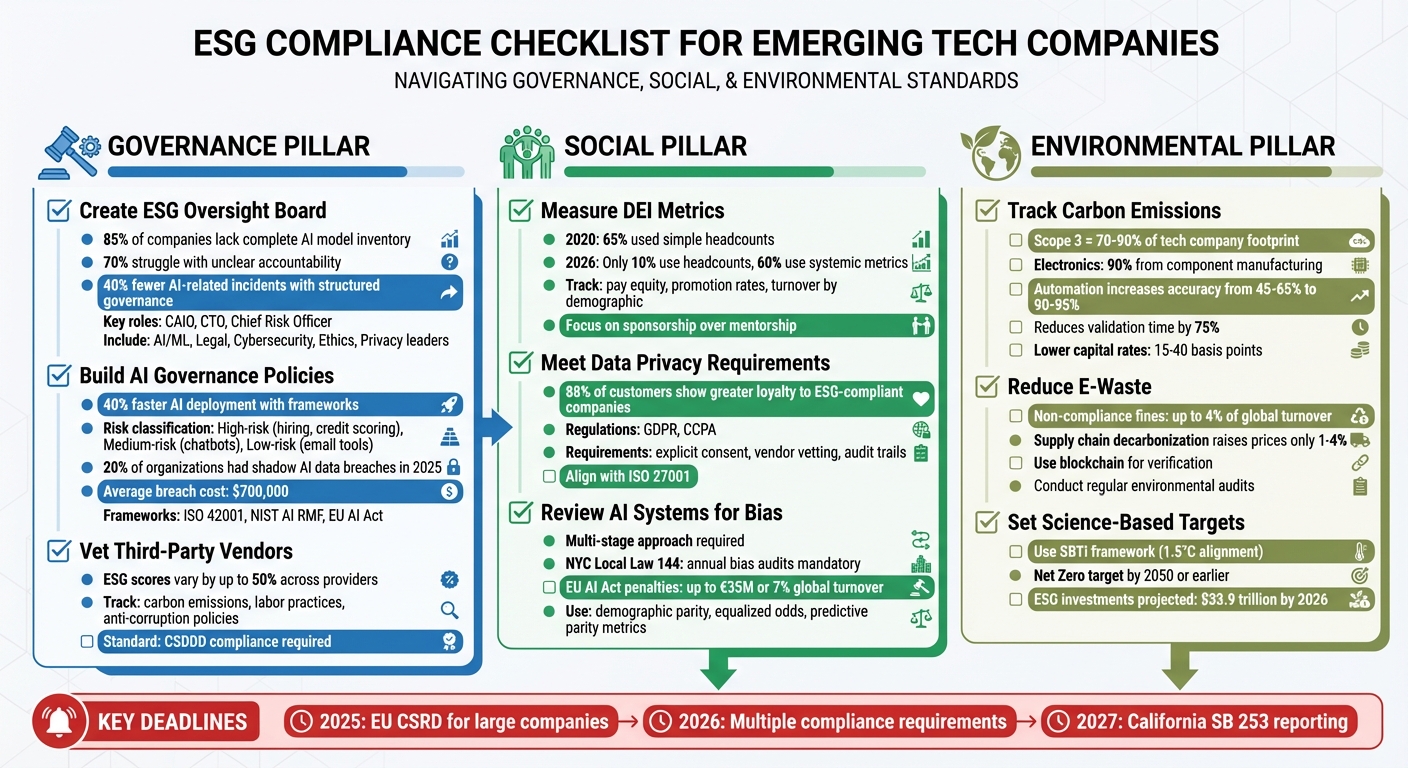
ESG Compliance Checklist for Tech Companies: Governance, Social, and Environmental Requirements
A staggering 85% of companies lack a complete inventory of their AI models, and 70% struggle with unclear accountability. To address this, appoint a senior executive - such as a Chief AI Officer (CAIO), Chief Technology Officer (CTO), or Chief Risk Officer - to lead your ESG oversight board [5]. This board should include leaders from AI/ML, Legal/Compliance, Cybersecurity, Ethics, and Privacy departments to ensure comprehensive oversight. Companies with well-structured governance committees report 40% fewer AI-related incidents [3].
"The question for boards is no longer 'Are we using AI?' but 'Do we know what our AI is doing, and can we prove it?'"
– Larry Fink, Chairman & CEO, BlackRock [5]
Start by drafting a charter that outlines the board's authority to approve or reject technology use cases, allocate necessary resources, and escalate critical risks to the Board of Directors. Integrate this governance structure into your Enterprise Risk Management (ERM) framework to avoid fragmented oversight. While implementation costs can be steep - enterprise frameworks often run into the high hundreds of thousands, and software platforms can cost tens of thousands - this investment is essential for effective governance [5].
Once accountability is in place, the next step is to establish strong AI governance policies.
Adopt recognized frameworks such as ISO 42001, the NIST AI Risk Management Framework, or the EU AI Act to guide your governance efforts. Companies that implement structured AI governance frameworks deploy AI systems 40% faster than those without [6].
Classify AI systems based on their risk levels and apply appropriate oversight:
Maintain a centralized inventory of all AI systems, including unsanctioned "shadow AI" tools. Implement a "Register or Retire" policy to ensure these systems are either formally integrated or decommissioned [5]. This step is vital, considering that 20% of organizations experienced data breaches involving shadow AI in 2025, with such breaches increasing costs by an average of $700,000 [7].
"AI governance is a business enabler, not a blocker - companies with frameworks deploy AI 40% faster."
– ECOSIRE Research and Development Team [6]
To meet regulatory expectations, enable runtime monitoring of AI systems with tools like drift detection, anomaly alerts, and performance dashboards. Regulatory bodies are increasingly requiring live telemetry and audit trails, so include a "kill switch" in every AI system to allow for immediate shutdown in case of malfunction or harm [4]. Align these policies with evolving regulations to ensure long-term growth and compliance.
Your governance framework shouldn't stop at internal processes - it must also extend to third-party vendors. Evaluate vendors on their environmental, social, and governance (ESG) practices. For example:
Avoid relying solely on one-off ESG scores, as these can vary by up to 50% across different rating providers [2]. Instead, use persistent IDs to track vendors over time, consolidating due diligence records, periodic updates, and corrective actions. This approach is critical for meeting standards like the Corporate Sustainability Due Diligence Directive (CSDDD), which requires proof that your due diligence effectively prevents harm [2].
"Under CSDDD, a score cannot prove your due diligence is 'effective at preventing harm' - only longitudinal evidence connected to the same entities across time can satisfy that standard."
– Sopact [2]
Use AI-powered thematic analysis to process open-ended responses from vendors or their employees. This can help uncover hidden risks - like retaliation or leadership gaps - that traditional metrics might miss. When risks are identified, link them to clear corrective action plans and use follow-up surveys to measure progress over time [2]. Strong external due diligence is just as important as internal controls for maintaining a solid compliance framework.
Strengthening governance measures with social compliance helps organizations address workplace equity, uphold data integrity, and ensure fairness in algorithmic systems.
The way organizations track diversity, equity, and inclusion (DEI) has evolved significantly. Back in 2020, 65% of companies relied on simple headcounts. By 2026, only 10% continued this approach, as the focus shifted to systemic accountability. Metrics like pay equity, promotion rates, and turnover by demographic became the standard, with adoption rising from 5% to 60% [9].
It's essential to track intersectional data, including factors like neurodivergence, caregiving responsibilities, and multi-ethnic identities. For tech companies using AI in HR processes, conducting regular bias audits on tools like automated resume screening and performance reviews is critical to maintaining equity [9]. Additionally, emphasize sponsorship rates over mentorship programs. Unlike mentorship, sponsorship involves leaders actively advocating for underrepresented talent, which has proven to be more effective [9].
"The leadership blueprint has shifted: flexibility is no longer a perk, but a prerequisite. Today's market leaders win by weaving autonomy and equity into the very fabric of their high-performance cultures."
– Aparna Vinod, Founder, Build to Sustain [9]
Leverage specialized tools for continuous pay audits instead of relying on annual reviews. Use software that identifies and interrupts bias in real time during tasks like creating job postings or providing performance feedback [9]. Centralize your ESG data with governance, risk, and compliance (GRC) software to streamline social metrics collection and ensure a reliable source of truth for audits [8][10].
Data privacy is central to social compliance. Regulations like GDPR and CCPA require organizations to establish a lawful basis for processing personal data, minimize data collection, and uphold individual rights, including the ability to contest automated decisions [13][14]. Start by performing a gap analysis to review current data flows and pinpoint compliance gaps [8].
Document your data policies, covering collection, analysis, and ownership, in formal ESG frameworks [10]. Make sure you obtain explicit consent for customer data collection and thoroughly vet third-party vendors to ensure they meet standards like GDPR compliance or ISO 27001 certification [8]. Automated tools and vendor portals can help suppliers complete regular privacy evaluations, promoting transparency across the supply chain [8].
Maintain a transparent audit trail using centralized databases or blockchain technology. This creates immutable records of data handling, which not only supports public claims but also fosters trust - especially when 88% of customers show greater loyalty to ESG-compliant companies [15]. Align existing security frameworks like ISO 27001 with ESG reporting requirements to avoid duplication of effort and save resources [10][11].
These steps create a solid foundation for addressing and mitigating bias in AI systems.
Ensuring fairness in AI is a key part of social compliance, safeguarding both employees and consumers. Bias in AI often stems from historical discrimination in training data, biased annotations, underrepresentation, or the use of misleading proxies [12][13]. A multi-stage approach is necessary to address these issues throughout the model's lifecycle.
Use mathematical fairness metrics tailored to your specific context. For general equality, demographic parity (equal positive decision rates across groups) works well. In high-stakes areas like hiring or lending, consider metrics like equalized odds (similar true/false positive rates) or predictive parity [12]. Implement automated fairness monitoring to flag deviations in outcome distributions in real time [13].
"Bias in AI is not a bug - it is a feature of training on historical data that contains human bias."
– Bartosz Ciepierski, CEO, ARDURA Consulting [13]
Incorporate a human-in-the-loop system for critical decisions, ensuring human oversight and the ability to override automated processes [13][14]. Tools like Model Cards can document intended use and limitations, while explainability tools like SHAP or LIME help clarify high-impact decisions [12][13]. For compliance, NYC Local Law 144 mandates annual bias audits of automated employment decision tools by independent auditors [14]. Similarly, the EU AI Act imposes penalties of up to €35 million or 7% of global annual turnover for non-compliance, whichever is higher [14].
When it comes to reducing your company's environmental impact, the focus needs to be on actionable strategies. For tech companies, this is especially critical since Scope 3 emissions often account for 70% to 90% of their total carbon footprint [16]. In the electronics sector, a significant portion of these emissions - up to 90% - comes from component manufacturing alone [17].
The first step is to define your organizational boundaries, using either an equity share or control approach. Then, map your entire value chain, covering suppliers, transportation routes, and other key contributors [17]. Zero in on 3–5 material categories that make up over 80% of your Scope 3 emissions [16].
For accurate and efficient emissions tracking, adopt a hybrid calculation approach:
To get started, focus on Tier 1 suppliers who represent 70–80% of your spending or emissions [17]. Walmart’s "Project Gigaton" is a great example of success in this area. By working with over 5,900 suppliers, they reduced 1 billion metric tons of CO₂e emissions - six years ahead of schedule [17].
Automating data collection is another game-changer. ESG-specific software that integrates with ERP systems can cut validation time by 75% and boost data accuracy from 45–65% to 90–95% [16]. Companies with high-quality, audit-ready Scope 3 data also enjoy financial perks, such as lower capital rates - 15 to 40 basis points lower than competitors [16].
Keep in mind that regulations are tightening. The EU’s CSRD will require large companies to disclose all material Scope 3 categories starting in 2025, and California’s SB 253 mandates similar reporting by 2027 [16]. Once your emissions data is solid, shift your focus to sustainable sourcing and waste reduction.
Integrate ESG principles into your supply chain by setting strict standards for hardware vendors. Blockchain technology can help verify sustainability claims and track compliance across complex supply chains [15]. Blockchain’s immutable records ensure transparency and accountability.
Regular environmental audits can identify risks related to waste management and resource use [18]. Automating e-waste tracking with ESG compliance software reduces manual errors and improves reporting accuracy [15]. To ensure accountability, include sustainability clauses in procurement contracts across your vendor network.
"Focusing on sustainable and ethical processes enables businesses to reduce waste, optimize resources, save money, and build stakeholder trust, which leads to improved long-term financial and operational performance."
– KEY ESG [15]
Non-compliance with ESG regulations can be costly, with fines reaching up to 4% of global turnover [15]. However, fully decarbonizing the supply chain would only raise end-consumer prices by 1% to 4% [17], making it both achievable and financially sound.
With accurate emissions data and responsible sourcing in place, the next step is to set climate targets aligned with scientific benchmarks. Use the Science Based Targets initiative (SBTi) framework to ensure your goals are consistent with limiting global warming to 1.5°C [19]. This approach not only keeps your targets credible but also reassures investors - ESG-focused investments are projected to hit $33.9 trillion by 2026 [15].
Commit to a Net Zero target by 2050 or earlier [19]. Your goals should cover direct emissions, purchased energy, and emissions across your value chain. Include carbon performance as a key factor in selecting and renewing supplier contracts, holding your ecosystem accountable [17].
Set interim milestones with clear reduction percentages and timelines. Leverage AI and machine learning to catch data inconsistencies and estimate missing values, cutting validation time [16]. Blockchain technology can also provide traceable, regulator-grade records for your climate commitments [16].
ESG compliance offers more than just regulatory alignment - it’s a growth driver and a resilience booster for emerging tech companies [20]. Tess Dury from Extantia highlights this dual-edged nature:
"Poorly-executed ESG represents a real risk to the company, while ESG done well can set companies on the right track to become best-in-class."
Think of ESG as a living framework. Start with solid policies, weave them into your daily operations, and continuously refine them to lead with openness and forward-thinking practices. This checklist has outlined the essential governance, social, and environmental steps to turn ESG compliance into a competitive edge.
Focus on the 3–5 ESG areas that align most closely with your company’s goals. For AI-driven companies, this might mean prioritizing data privacy and bias audits. For hardware manufacturers, the focus could be on responsible sourcing and e-waste management. As Dury points out:
"Taking a close look at your company under an ESG lens can reveal business opportunities that you have otherwise missed, and ways to distinguish yourself from the competition" [20].
By implementing these strategies, you can turn compliance hurdles into opportunities for growth and differentiation. These steps offer a clear path to progress.
With key 2026 regulatory deadlines approaching, such as California's Climate Accountability Package and the EU's CSRD, embedding ESG into your strategic decisions is more urgent than ever [1]. Treating ESG as a simple checklist risks missing its broader strategic and legal implications. Shailesh Sahay, Partner at Bracewell LLP, underscores this point:
"Integrating sustainability into strategy, risk and capital decisions is no longer optional when subject to these reporting obligations; it is a fundamental component of the governance required by these programs" [1].
To get started, assess your current ESG practices and establish systems for audit-ready data collection ahead of upcoming reporting cycles. For growth-stage companies juggling compliance demands and scaling operations, Phoenix Strategy Group (https://phoenixstrategy.group) can provide fractional CFO services and strategic advisory support. They can help integrate ESG into your financial planning, prepare for investor evaluations, and develop robust reporting systems to ensure long-term success.
To get started, it's crucial to implement a thorough ESG due diligence process, particularly if your business is navigating mergers, acquisitions, or expansion. This means evaluating risks tied to environmental, social, and governance factors while staying compliant with changing regulations such as CSRD, SFDR, and CSDDD. Developing a solid ESG framework not only helps validate claims and minimize the risk of greenwashing but also lowers potential liabilities and promotes sustainable growth in the long run.
To get a handle on all AI in your organization, including the elusive shadow AI, automated tools are your best bet. These tools can scan network traffic, endpoints, and cloud environments to pinpoint any unapproved AI. Keeping an eye on employee activity - like data uploads and API usage - can also help uncover shadow AI that might otherwise go unnoticed.
To maintain control, set up a governance framework that aligns with recognized standards such as ISO and NIST. Regular audits are essential to ensure everything stays on track. By combining these steps, you can streamline the process and take inventory much faster.
To estimate Scope 3 emissions when supplier data is scarce, organizations can turn to technology-driven tools such as AI-powered automation, blockchain for verification, and scalable data platforms. These tools can help improve both the accuracy and reliability of emissions tracking.
A good starting point is the 15 categories outlined in the GHG Protocol, with a particular emphasis on upstream activities like purchased goods and services. If supplier-specific data isn't available, alternative approaches like using proxy data, industry averages, or modeling techniques can help bridge the gaps effectively.