Published on
March 2, 2026


Finance and operations teams often struggle to align, leading to inaccurate forecasts, wasted resources, and missed opportunities. But when they work together, businesses can achieve:
To succeed, teams need clear KPIs, defined task ownership, and structured communication. Tools like cloud dashboards, integrated financial models, and collaboration platforms can simplify processes. Regular reviews and cross-training also strengthen teamwork, ensuring continuous improvement.
The key takeaway: Align finance and operations through shared goals, consistent communication, and the right tools. This creates a more agile and accountable organization.
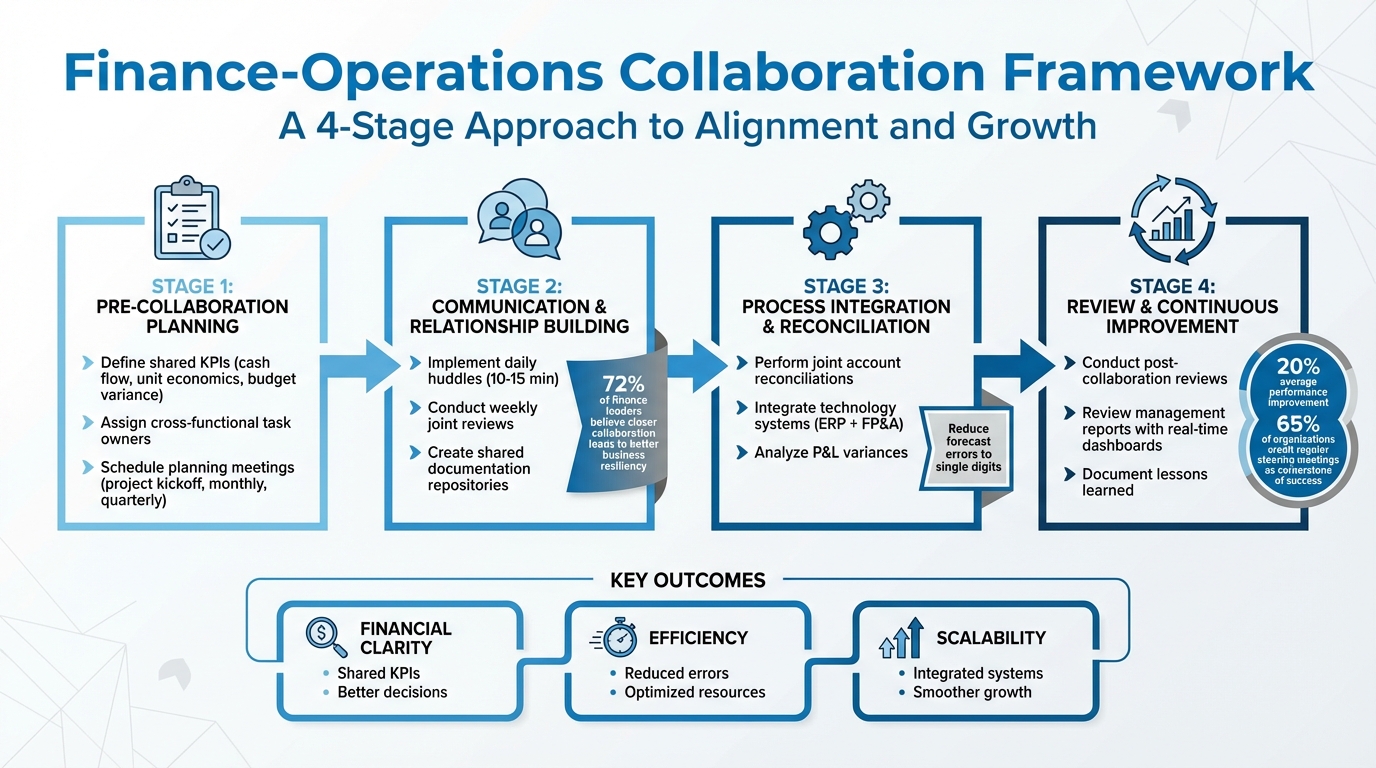
4-Stage Framework for Finance-Operations Collaboration
For finance and operations teams to work seamlessly, it’s essential to start with a shared management foundation. This means defining success metrics, assigning clear task ownership, and setting up a structured meeting cadence. These steps ensure everyone is aligned from the outset, reducing confusion and eliminating the silos that can derail collaboration.
The first step is identifying metrics that matter to both teams. For instance:
These shared KPIs create a common language, allowing finance and operations to make decisions together rather than working at cross-purposes. Once the metrics are defined, ensure clear ownership of tasks tied to these KPIs.
Accountability is key to avoiding missed responsibilities. Assign specific individuals to handle critical tasks like:
By involving team members from both departments, you create natural touchpoints that keep communication flowing, even during busy periods.
A well-structured meeting schedule keeps everyone on the same page without wasting time. Use a three-tiered approach:
To keep these meetings efficient, include clear agendas and pre-read materials. For routine updates, self-service cloud dashboards can reduce the need for constant inquiries. As David Eckstein, CFO at Vanta, shared:
"Ramp gives us one structured intake, one set of guardrails, and clean data end‑to‑end - that's how we save 20 hours/month and buy back days at close" [2].
Laying this groundwork is the first step toward achieving both financial clarity and operational efficiency.
Once you’ve established a solid planning framework, the next step is fostering the relationships and communication habits that keep collaboration thriving. Regular touchpoints are key to ensuring plans don’t just sit on paper but come to life. In fact, 72% of finance leaders believe that closer collaboration leads to better business resiliency and agility [3]. This highlights how critical effective communication is to success. By setting up consistent communication rituals, you can reinforce alignment and keep everyone on track.
Short, focused huddles - about 10 to 15 minutes - are a great way to keep both teams aligned without taking up too much time. In these quick sessions, team members can:
While these daily check-ins are great for immediate updates, pairing them with more in-depth weekly meetings can provide a clearer picture of trends and strategic adjustments.
Weekly meetings give teams a chance to dig into performance trends and address any unexpected issues. To make these sessions productive, start by focusing on business impact before diving into financial details. For example, connect profit figures to their planned outcomes.
To keep discussions efficient and decision-focused:
During periods of significant disruption, some executive teams even increase the frequency of these meetings to two or three times a week - or daily, if needed [3].
Cloud-based tools can make collaboration seamless by eliminating version control issues and ensuring everyone works with the latest data. Visual dashboards, for instance, can quickly compare budgets to actuals, making it easier to grasp key insights than combing through spreadsheets [2].
Real-time dashboards not only cut down on endless email threads but also build trust by directly linking decisions to performance. As one finance expert put it:
"When teams help build the budget, they're more likely to follow it" – Ramp [2].
Once you've set shared KPIs and communication routines, the next step is aligning financial records with operational realities. This is where process integration becomes key - it ensures that your financial data reflects actual business activity. By tightening the link between finance and operations, you can catch errors early, stay audit-ready, and make decisions based on accurate numbers.
Reconciliations are most effective when finance and operations collaborate. Start by verifying that the opening balance matches the previous period's approved closing balance - this avoids carrying over errors. From there, align account movements with real-world activities like sales, procurement, and payroll. Check that sub-ledger totals (e.g., accounts receivable, accounts payable, inventory, and assets) match the general ledger. Cross-check these figures against bank, vendor, or customer statements for added accuracy.
Any discrepancies should be documented with clear descriptions, assigned ownership, and specific resolution deadlines. Categorize unresolved items by age (e.g., 30, 60, or 90+ days) and ensure accountability. Arpita Pandey highlights the importance of this process:
"A review checklist forces teams to validate not just the numbers, but also the logic, evidence, and control structure behind them."
She also warns:
"Items without ownership rarely get resolved."
Finally, compare the reconciled balances against budgets and historical trends to identify any anomalies. [5]
Manual data entry is prone to mistakes and slows everything down. By integrating your ERP and FP&A tools, you can automate key processes like cash tracking, accruals, and variance analysis. This ensures both finance and operations have access to real-time data, which is especially important for companies experiencing rapid growth, where fractional CFO services can provide the necessary strategic oversight. Such integration builds on earlier communication efforts, providing a clear view of how operational decisions impact financial outcomes.
Dive into cost center data to uncover deviations from expected performance. The aim is not just to spot variances but to understand their root causes. As Arpita Pandey explains:
"Addressing symptoms without root causes results in recurring reconciliation issues. Root-cause analysis reduces long-term workload and improves control maturity."
When finance and operations teams work together seamlessly, the right tools and resources can make all the difference. By using efficient technology and providing targeted training, businesses can break through data silos and enable faster, more accurate decision-making.
Integrated financial models bring forecasts, budgets, and real-time metrics together on a single platform. This approach provides a unified view of performance, risks, and opportunities, helping to reduce forecast errors to single digits by incorporating operational insights into financial planning[1].
Cloud-based FP&A platforms like Talentia Software and Workday allow finance and operations teams to collaborate on forecasts, test what-if scenarios, and validate data together. This creates a shared "single source of truth" and demonstrates how operational choices - such as adjusting inventory levels - can directly affect working capital[1].
Collaboration platforms like Asana or Monday.com, combined with real-time messaging tools like Slack, make task tracking and communication more efficient. These tools help teams establish a centralized system for managing budgets, forecasts, and approval workflows. Clear processes, such as requiring dual sign-offs for purchases over $10,000 and maintaining version control, reduce friction and build trust between departments[2][6].
This kind of alignment sets the stage for effective cross-training initiatives.
Training programs help bridge the gap between finance and operations. For instance, finance professionals gain insight into operational challenges like production delays, while operations teams learn essential financial concepts such as EBITDA, working capital, and cash flow. Workshops, shared glossaries of key terms, and appointing operational "champions" to act as liaisons are all effective strategies for cross-training.
According to Robert Half, job shadowing or mentoring programs where finance team members experience operational roles firsthand can deepen understanding and strengthen collaboration[4].
Businesses that create dedicated finance-operations business partner roles often see measurable improvements in accountability and performance tracking[1]. For growth-stage companies, Phoenix Strategy Group offers customized FP&A and strategic advisory services to support scalable, data-driven decision-making.
Collaboration doesn’t stop when a project wraps up - it’s an ongoing effort. Regular checkpoints are key to evaluating performance and making adjustments. In fact, organizations that prioritize collaborative planning see a 20% improvement in performance on average. For those with more established processes, holding at least five review sessions annually helps maintain progress and momentum [7]. These reviews ensure that insights from past efforts directly inform operational updates.
Schedule post-collaboration reviews at critical intervals, bringing together finance and operations teams. Use these sessions to pinpoint obstacles that may have slowed progress, like incomplete data, unclear responsibilities, or technology issues. Gather detailed feedback on any friction points and document actionable improvements.
These discussions should also address major performance differences to ensure both teams are aligned. Open communication during these reviews reduces blame-shifting and fosters trust. Interestingly, 65% of organizations that hold regular steering committee meetings - including finance, operations, and general management - credit these sessions (typically held monthly) as a cornerstone of their planning success [7].
Static monthly variance reports can only go so far. Instead, leverage real-time dashboards to monitor trends and moving averages. Track budget-to-actual figures, maintain rolling forecasts (12–18 months ahead), and dive into variances between forecasts and actual results. Any mistrust in forecasts or errors from manual processes should be treated as warning signs requiring immediate attention.
To streamline decision-making, adopt self-service reporting tools that allow operational managers to create formatted reports independently. This reduces bottlenecks and ensures timely insights. Capture and analyze these findings systematically to refine future collaborative efforts.
Keep a record of what works well and share those outcomes organization-wide. Highlight the specific strategies, tools, and communication practices that contributed to success. Additionally, conduct quarterly audits of system access and financial controls to ensure your collaborative framework remains secure and efficient as teams expand and roles evolve [7].
Phoenix Strategy Group specializes in helping growth-stage companies build scalable FP&A processes and implement frameworks for continuous improvement, fostering strong, long-term collaboration between finance and operations teams.
Strong collaboration between finance and operations leads to quicker decisions, more precise forecasts, and smarter resource allocation - key ingredients for success in growth-stage companies. The process itself is simple: set shared KPIs, maintain regular communication, align processes and technology, and refine your strategy based on results. These aren't just theoretical benefits; they're supported by real data.
As highlighted earlier, many organizations identify this collaboration as a critical factor for success[1]. Combining financial models with operational insights through cross-functional forecasting can reduce error rates to single digits[2].
But it takes discipline to make this work. Start by aligning financial goals with operational outcomes, and hold teams accountable through finance-operations partnerships or steering committees. Ditch conflicting spreadsheets in favor of a unified, cloud-based system, and make collaboration a habit by standardizing workflows and documenting successful practices. When executed well, this approach goes beyond numbers, turning collaboration into a lasting competitive edge.
Teams gain a deeper understanding of each other's challenges, adapt faster to market shifts, and stay engaged by co-creating plans instead of following top-down mandates[1]. This level of teamwork signals operational maturity, which is highly regarded by investors.
Phoenix Strategy Group exemplifies this methodology by offering fractional CFO services, FP&A systems, and strategic advisory to help companies blend financial rigor with operational insight. Their frameworks give businesses the structure they need to scale effectively and gear up for the next stage of growth.
Finance and operations teams should focus on sharing key metrics such as revenue growth rate, gross margin, EBITDA, operating expenses, and cash flow forecasting. These figures play a crucial role in aligning financial and operational objectives, promoting steady growth, and fostering transparency across all departments.
Regular meetings play a key role in encouraging collaboration between finance and operations. While there’s no strict rule for how often these should happen, it’s crucial to focus on consistent communication, real-time data sharing, and routine check-ins. These practices help maintain alignment and support smarter decision-making, especially in growth-stage businesses.
Tools designed to establish a single source of truth are all about integrating and automating financial data. These systems link up accounting software, CRMs, banking platforms, and other essential tools to enable real-time data sharing. The result? Fewer errors, no more tedious manual data entry, and consistent, always-current information.
By using integrated platforms with features like APIs, robotic process automation (RPA), and AI/ML technologies, businesses can simplify reporting, improve forecasting, and make better decisions. For growth-stage companies, this unified and accurate data becomes a game-changer, fostering smoother collaboration and supporting scalability.