Published on
June 1, 2026


Managing legal compliance in alliances is critical to avoid financial penalties and reputational risks. Key metrics provide the tools to monitor obligations, identify risks, and ensure regulatory adherence. Here are the eight essential metrics you need to track:
In 2024, the SEC imposed $8.2 billion in penalties, highlighting the costs of non-compliance. Metrics like these help organizations proactively identify risks, maintain accountability, and ensure regulatory adherence in complex partnerships. Tracking both leading indicators (predictive) and lagging indicators (historical) creates a balanced compliance strategy.
For organizations, automating data collection, assigning ownership, and conducting regular reviews are key to staying ahead of compliance challenges. These metrics transform compliance from a reactive task into an organized, measurable process.
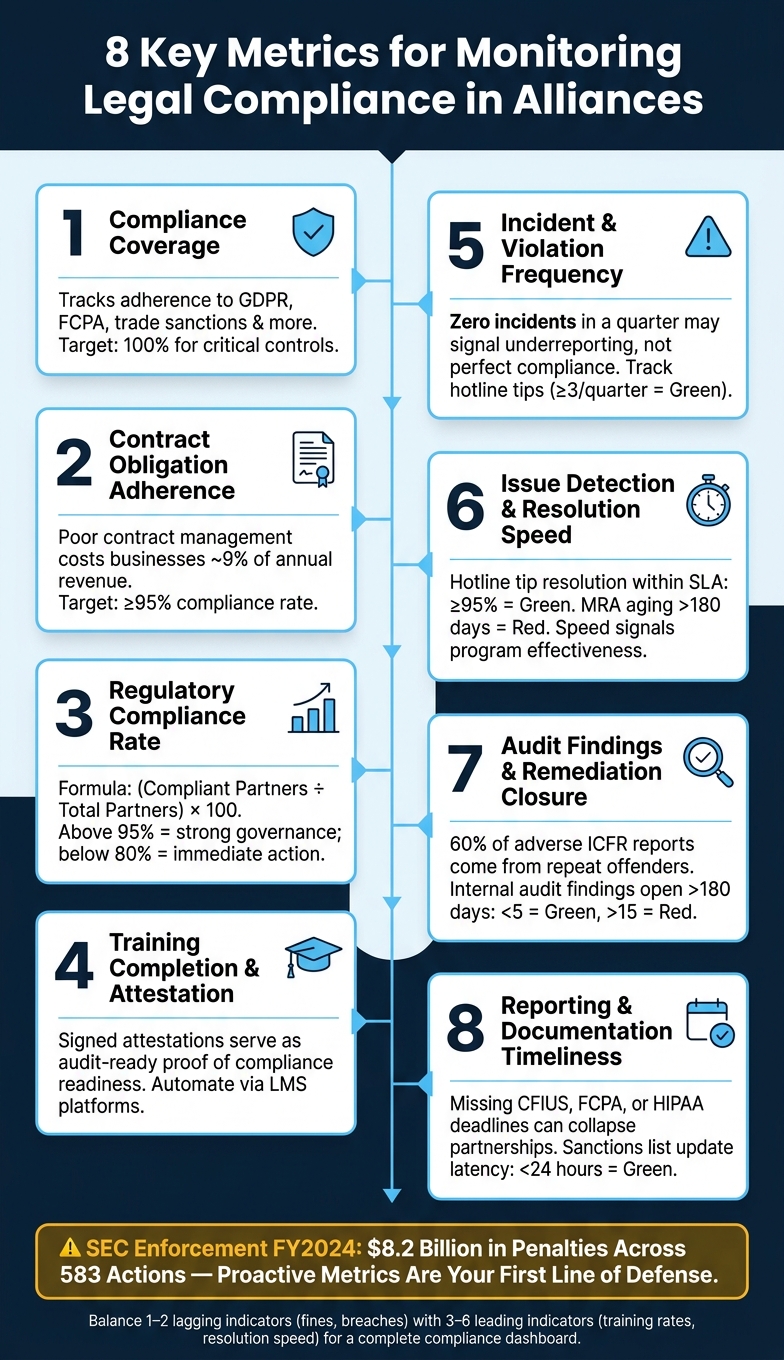
8 Key Legal Compliance Metrics for Strategic Alliances
Compliance coverage evaluates whether a partnership adheres to all necessary legal and regulatory requirements. Think of it as a detailed map - any gaps could signal potential risks. This metric focuses on ensuring that the alliance addresses all relevant obligations, including antitrust laws, data privacy regulations like GDPR and CCPA, anti-bribery laws such as the FCPA, and trade sanctions, across all applicable jurisdictions [6]. Creating a Regulatory Matrix can help quickly pinpoint any overlooked areas. This comprehensive approach is essential for understanding how each requirement affects overall legal compliance.
When two organizations collaborate, their legal responsibilities often grow exponentially. Umbrex highlights this dynamic:
"Strategic partnerships amplify opportunity - and risk. Two organizations bring not only complementary assets but also their vulnerabilities, regulatory obligations, and reputational baggage." [6]
This metric ensures that all legal obligations are managed proactively, reducing the chances of regulatory missteps.
Tracking compliance coverage doesn't have to be complicated. A Compliance Register - a dynamic log that tracks filings, approvals, and renewal dates with assigned ownership - can simplify the process and ensure no deadlines or obligations are missed [6]. By 2026, many organizations have adopted real-time dashboards instead of static monthly reports. These dashboards automatically flag compliance gaps, making monitoring more efficient [3].
Here’s a quick look at thresholds for key compliance metrics:
| Compliance Coverage Metric | Green (Target) | Red (Critical) |
|---|---|---|
| FCPA Third-Party Due Diligence (High-Risk) | 100% | <85% |
| NDA / DPA Coverage on Regulated Data | 100% | <90% |
| Compliance Control-Testing Coverage | ≥95% | <80% |
| Conflict-of-Interest Disclosures | 100% | <95% |
Proper compliance monitoring can significantly lower risks. For example, in October 2024, TD Bank faced a $3.09 billion penalty - the largest AML fine in U.S. history - after regulators discovered that 92% of its $18.3 trillion in transactions between 2018 and 2024 went unmonitored [8]. This case highlights the financial consequences of ignoring compliance gaps.
Interestingly, a quarter with no whistleblower tips might not indicate perfect compliance. Instead, it could point to a lack of awareness, making hotline coverage another vital area to monitor [1].
Identifying gaps with a compliance register is important, but keeping track of contractual obligations ensures that every commitment is fulfilled. This monitoring ensures that all parties in a partnership stick to their agreed responsibilities - whether it's meeting deadlines, maintaining service levels, or following specific terms laid out in the contract. Signing the contract is just the starting point; the real challenge lies in delivering on those promises. Poor contract management can cost businesses an average of 9% of their annual revenue [5], which directly affects the stability of partnerships when obligations are overlooked, a risk often mitigated by fractional CFO services that oversee financial compliance. Keeping a close eye on these commitments is essential for reducing risks in collaborations.
Contracts in alliances carry binding legal requirements. Missing even one critical provision - especially in sectors like healthcare or finance - can not only nullify the agreement but also result in regulatory penalties [5].
Take this example: In July 2021, Amazon faced a €746 million fine from Luxembourg's data protection authority for GDPR violations linked to its advertising agreements [5]. This case highlights how non-compliance with both contractual and regulatory obligations can quickly lead to severe consequences.
One of the biggest challenges in tracking contract obligations is dealing with scattered data. In fact, 63% of executives say fragmented data significantly complicates compliance monitoring [11]. The solution? Centralize all partnership agreements in a Contract Lifecycle Management (CLM) system. AI tools can then extract critical information - such as key duties, deadlines, and service level agreements (SLAs) - into manageable data fields [5][11].
Real-time dashboards with traffic-light indicators make it easy to spot compliance issues before they escalate [10][4]. To maintain accountability, assign each obligation to a specific person using a RACI matrix, ensuring continuity even when staff changes occur [5][12].
| KPI | Definition | Target Threshold |
|---|---|---|
| Contract Compliance Rate | % of obligations and SLAs met on time | ≥95% [9] |
| Obligation Fulfillment Rate | % of specific duties fulfilled vs. total commitments | 100% [11] |
| On-Time Delivery Rate | % of milestones met by deadlines | ≥98% [10] |
| Missed Renewal Rate | % of contracts expiring without a documented decision | 0% [5] |
| Value Leakage | Estimated lost revenue from non-compliance events | <5% of total contract value [10][11] |
Tracking contract obligations doesn’t just prevent breaches - it fosters trust and strengthens partnerships. Real-time dashboards are particularly valuable here, letting teams respond quickly to potential compliance issues before they escalate. Companies that implement formal measurement systems report 34% higher ROI from partnerships compared to those without such frameworks [3]. On the flip side, failing to monitor obligations often leads to disputes and weakens relationships. To prepare for any issues, it’s smart to pre-define actions for when a metric goes off track - whether that’s escalating the issue, activating contractual remedies, or initiating a two-hour triage review [4][3].
The regulatory compliance rate is calculated using the formula: (Number of Compliant Partners ÷ Total Number of Partners) × 100 [13]. While tracking contract obligations focuses on specific commitments, this metric takes a broader look at whether partners are adhering to legal standards. It complements the detailed monitoring of contractual compliance by providing a wider lens on regulatory adherence.
A compliance rate above 95% indicates strong governance, while anything below 80% signals the need for immediate corrective action. As KPI Depot explains:
"High compliance rates indicate robust risk management and effective partner oversight. Low values may signal potential governance issues or operational inefficiencies." - KPI Depot [13]
This highlights the importance of regular reviews across all regulatory areas.
In highly regulated industries, this metric is a cornerstone for managing risk. Every partner in an alliance - not just the lead organization - must meet the relevant regulatory standards [8]. Failure to do so can lead to hefty financial penalties, making it critical to sustain high compliance rates across the board.
A major shift in compliance monitoring is the move from annual audits to continuous, real-time tracking [13]. Continuous monitoring, often facilitated by real-time dashboards, provides a current and detailed view of regulatory adherence across all partners [8]. A centralized dashboard, integrating data from case management systems, GRC tools, and HR platforms, allows for live updates on each partner's compliance status [8]. Instead of applying uniform oversight, consider risk-tiered reviews: high-risk partners can be monitored monthly, while lower-risk partners may only require semi-annual checks [7].
| Monitoring Activity | High Risk (Tier 1) | Medium Risk (Tier 2) | Lower Risk (Tier 3) |
|---|---|---|---|
| Transaction testing (BSA/AML) | Monthly | Quarterly | Semi-annually |
| Consumer compliance testing | Quarterly | Semi-annually | Annually |
| Complaint analysis | Monthly | Quarterly | Quarterly |
| Comprehensive partner review | Semi-annually | Annually | Annually |
Using Green/Amber/Red thresholds and benchmarking them quarterly against peer standards ensures consistent oversight aligned with your board-approved risk appetite [8]. Automating data collection also minimizes human error and eliminates the need for manual spreadsheets, keeping compliance data accurate and up-to-date [13].
Maintaining a high compliance rate helps prevent program drift - the gradual weakening of compliance standards that can occur due to staff turnover or inconsistent monitoring [8]. Standardizing the onboarding process with compliance checkpoints, such as risk assessments, due diligence, and contract milestones, ensures that every new partner meets regulatory requirements before they begin operations [7]. These proactive measures strengthen legal compliance within strategic partnerships.
"A Key Risk Indicator is a leading metric that flags a compliance failure before the regulator does." - Chris Ekai, Content Manager, Risk Publishing [8]
Beyond monitoring compliance coverage and ensuring contractual obligations are met, completing training and obtaining attestations play a critical role in securing legal compliance within partnerships. A compliance policy alone isn't enough - partners must read, understand, and formally acknowledge it. High rates of training completion and signed attestations provide not only proof of compliance but also audit-ready evidence that the program is active and effective.
In strategic partnerships, training is essential for maintaining legal compliance because the actions of every partner in your network can impact your organization. If a reseller, contractor, or supplier mishandles sensitive information or breaches trade regulations, your company may face shared consequences. Training ensures that partners understand the necessary regulatory and operational standards. A signed attestation takes this further by serving as a timestamped record that confirms an individual has acknowledged a specific policy version and understands the consequences of violations, including potential termination [14].
Regulatory bodies view this as critical. As KSK Competition Law points out:
"A programme that produces a policy but fails to train employees on its application provides the appearance of compliance without its substance - and will not be credited as a mitigating factor in penalty proceedings." [14]
This isn't just about best practices - it's about financial risk. For instance, in the EU, competition law fines can reach up to 10% of global annual turnover, and in the U.S., the Department of Justice considers documented training efforts when determining penalties [14].
Using a centralized learning platform, like Partner Academy or an Extended Enterprise LMS, makes tracking training completion straightforward. These tools eliminate the need for manual spreadsheets by automatically logging details such as completion timestamps, exam scores, and certification expiration dates [16][17].
Auditors often require detailed, per-individual records - not just a broad "92% completion rate." They want proof that specific individuals completed specific training before they performed regulated tasks [19]. A robust LMS should allow you to filter records by partner, region, or certificate type in mere minutes.
| Capability | Ad Hoc (Manual) | Operationalized (Automated) |
|---|---|---|
| Certification tracking | One-time training; manual logs [15] | Role-based curricula with renewal schedules [15] |
| Content access control | Untracked PDFs [15] | Access gated by certification/attestation [15] |
| Audit evidence | Aggregate completion % | Per-employee timestamps and scores [19] |
| Expiration management | Reactive follow-up | Automated alerts 30–90 days before expiry [17][18] |
Automated tracking not only simplifies compliance management but also strengthens your ability to mitigate risks effectively.
A practical way to reduce risk is through access gating - restricting partner access to sensitive systems, pricing data, or proprietary assets until mandatory training is completed and attestations are signed [15]. Systems can also be configured to revoke access automatically when certifications expire.
Training programs should be tiered by role and risk level, ensuring requirements are relevant while avoiding unnecessary burdens on lower-risk partners [14]. Additionally, trigger-based refresher training - initiated by regulatory changes or incidents - keeps the program up-to-date between annual cycles [14].
Incident frequency provides a real-time snapshot of a compliance program's effectiveness, complementing metrics like contract adherence and regulatory compliance. By focusing on actual incidents and violations, this approach moves beyond theoretical evaluations, offering a more grounded, evidence-based view of program health [1].
In alliances involving multiple partners, a single partner's violation can create legal risks for the entire group. Tracking incident frequency helps identify patterns of concentration risk. For instance, if a shared middleware provider or a key reseller is responsible for a significant portion of violations, it may point to a systemic issue rather than isolated errors [1].
An interesting concept in compliance monitoring is the "zero-incident" fallacy. Chris Ekai of Risk Publishing explains:
"Whistleblower hotline volume reads inversely. Zero tips in a quarter is a red flag, not a green one. ACFE research shows tips drive over 40% of fraud detection. A hotline that records nothing usually has an awareness or retaliation problem, not a perfect-control profile." [1]
This perspective aligns with data from the SEC, which received 45,130 whistleblower tips in fiscal year 2024 and issued $255 million in awards. These figures highlight the importance of active and legitimate reporting in a healthy compliance system [1].
Modern GRC tools and dashboards make it easier to automate the collection and analysis of incident data across alliance partners. Standardizing incident categories - such as disclosure errors, billing disputes, or data handling failures - helps compare performance and spot trends consistently [1].
To ensure incident data leads to actionable steps, it's critical to establish clear escalation thresholds. Below is a Green/Amber/Red framework for tracking key risk indicators (KRIs):
| Incident/Violation KRI | Green | Amber | Red |
|---|---|---|---|
| Substantiated hotline cases (per quarter) | <3 | 3–7 | >7 |
| Whistleblower hotline tips (quarterly) | ≥3 | 1–2 | 0 |
| Open SEC/DOJ/regulator inquiries | 0–1 | 2–3 | >3 |
| Senior-leader conduct events | 0 | 1 | >1 |
| Sanctions list match events (per quarter) | 0 | 1–2 | >2 |
This framework provides clear triggers for action when compliance issues arise, ensuring problems are addressed promptly.
The Boeing case serves as a stark reminder of the costs tied to poor incident monitoring. In July 2024, Boeing faced a proposed plea agreement with the U.S. Department of Justice over conspiracy to defraud the FAA regarding the 737 MAX. This agreement included a fine exceeding $240 million and required a court-supervised independent monitor. However, in December 2024, U.S. District Judge Reed O'Connor rejected the agreement due to concerns over the monitor selection process. The case underscores the importance of tracking key risk indicators proactively to avoid regulatory intervention [1].
For partners who cross the Red threshold, it’s essential to mandate a root cause analysis and enforce a strict timeline for corrective actions. Require alliance partners to report major breaches or regulatory inquiries within 24–48 hours to enable a swift response. Additionally, keep an eye on voluntary turnover in compliance roles - if it exceeds 20%, it could signal upcoming challenges as institutional knowledge is lost [1].
Issue Detection and Resolution Speed goes beyond incident frequency by examining how quickly compliance issues are addressed. The speed of resolving these issues is a strong indicator of whether a compliance program is genuinely effective or just for show. Swift action is especially crucial in alliances, where interconnected compliance failures can quickly spiral out of control. Regulators, like the DOJ through its ECCP, view quick resolutions as proof of an effective compliance program that works in practice [1][21].
In partnerships involving multiple entities, unresolved issues rarely stay contained. As Umbrex explains:
"Escalation clarifies who decides and how quickly issues must be resolved when customer impact is likely. It also creates a shared language for distinguishing normal operating friction from material breach." [20]
Even seemingly minor issues - such as delays in disclosures or unanswered requests for regulatory data - can escalate into serious compliance risks. These lapses can lead to material breaches if not addressed promptly.
To monitor resolution speed effectively, use aging-based KRIs (Key Risk Indicators). These metrics help identify whether issues are being resolved within acceptable time frames:
| Resolution Speed KRI | Green | Amber | Red |
|---|---|---|---|
| Hotline tip resolution within SLA | ≥95% | 85–94% | <85% |
| MRA (Matters Requiring Attention) aging | 0 days | 1–179 days | >180 days |
| Regulator data requests open >30 days | <3 | 3–7 | >7 |
| Internal audit findings open >180 days | <5 | 5–15 | >15 |
(Source: Risk Publishing [1])
Manual tracking can miss critical details, so automating data collection is key. Integrate GRC tools, matter management systems, and hotline platforms to ensure weekly updates. This approach provides real-time oversight and minimizes the chance of regulatory surprises [1].
Monitoring resolution speed works hand-in-hand with other metrics to identify risks before they grow. For instance, leaving regulator data requests unresolved for over 30 days or allowing MRAs to age beyond 180 days signals potential high-risk compliance gaps [1]. Chris Ekai of Risk Publishing underscores the importance of such metrics:
"A legal-and-compliance Key Risk Indicator is a leading metric that flags a litigation event, a regulator inquiry, or a program weakness before the audit committee, the regulator, or the press finds out first." [1]
In alliances, proactive transparency is critical. Hassan Chaudry, Chief Compliance Officer at Ultium CAM, highlights this point:
"In a joint venture, transparency isn't just best practice – it's a cornerstone of success. Minimise surprises, especially the kind that come from hearing something first from the other partner." [21]
Tracking how quickly audit findings are addressed is a critical indicator of how well a compliance program is functioning. When findings remain unresolved for months, it often signals inefficiencies or breakdowns in the remediation process. Understanding these metrics is essential for evaluating their impact on legal risks within strategic alliances.
Unresolved compliance issues can significantly increase risks in alliances. For example, in partnerships like healthcare collaborations governed by HIPAA or cross-border ventures subject to FCPA rules, shared obligations mean that one partner’s unresolved findings can create exposure for both. Repeat findings are particularly concerning, as they point to systemic control failures and attract regulatory attention. Statistics back this up - 60% of adverse Internal Control over Financial Reporting (ICFR) reports come from repeat offenders [8]. This kind of pattern often leads to enhanced scrutiny, with regulators increasingly issuing personal accountability orders and requiring external monitors as of 2026 [8].
One of the advantages of audit findings is that they are straightforward to track and measure. Governance, Risk, and Compliance (GRC) tools can automatically flag findings and categorize them using green/amber/red thresholds based on how many are open and how long they’ve been unresolved [1].
It’s essential to differentiate between two key metrics:
Both metrics are necessary to get a full picture of compliance health.
| Audit/Remediation Metric | Green | Amber | Red |
|---|---|---|---|
| Internal audit findings open >180 days | <5 | 5–15 | >15 |
| MRA aging >180 days | 0 | 1 | >1 |
| Regulator-finding repeats year-over-year | 0 | 1 | >1 |
| DPA/NPA covenant findings open | 0 | 1–2 | >2 |
| Complaint root-cause closure (days) | <30 | 30–60 | >60 |
(Source: Risk Publishing [1][8])
For accurate measurement, a finding should only be classified as "closed" when it has undergone review, received approval, and includes supporting evidence - not just when a closure email is sent [22]. Assigning a specific owner to each finding, rather than leaving it to a vague "compliance team", ensures accountability [1].
The Department of Justice (DOJ) uses remediation closure as a concrete way to evaluate the effectiveness of corporate compliance programs [1]. Chris Ekai from Risk Publishing notes:
"A bank with an MRA still open at the next safety-and-soundness review has either a remediation problem or a documentation problem, and the supervisor will treat both the same." [8]
This was evident in December 2024, when U.S. District Judge Reed O'Connor rejected a plea deal between Boeing and the DOJ. One of the reasons? Boeing’s failure to meet court-supervised compliance expectations, which included unresolved audit findings [1]. The stakes are high - fiscal year 2024 saw the SEC impose $8.2 billion in financial penalties across 583 enforcement actions [1]. The message is clear: unresolved findings can lead to serious financial and reputational consequences. Up next, we’ll explore how the timeliness of reporting plays a key role in compliance metrics.
Timely reporting plays a key role in maintaining legal compliance within strategic alliances. Missing a regulatory deadline - whether it's a CFIUS disclosure, an FCPA third-party due diligence update, or a HIPAA data-sharing report - can result in penalties, increased scrutiny, or even the collapse of the partnership [23][24]. The urgency of meeting these deadlines underscores the importance of managing the documentation requirements unique to each alliance.
Legal compliance hinges on proactive measures and accurate reporting. Each alliance has its own set of documentation obligations. For example:
Failing to meet these requirements can lead to serious consequences, such as blocked investments, intellectual property disputes, or violations of sanctions. As Chris Ekai from Risk Publishing points out, "OFAC violations are strict-liability" [1], emphasizing the critical nature of timely sanctions list updates.
To stay on top of reporting deadlines, it's essential to assign clear ownership and establish fixed due dates, often supported by automated workflows. For instance, Novo Nordisk streamlined its alliance management by using a dedicated partnering platform, while a global biotech firm standardized its information flow to manage over 600 financial obligations across more than 20 partnerships [25].
Here is a table outlining key metrics for monitoring documentation timeliness:
| Reporting/Documentation Metric | Green | Amber | Red |
|---|---|---|---|
| Regulator data requests open >30 days | <3 | 3–7 | >7 |
| Sanctions list update latency (hours) | <24 | 24–72 | >72 |
| Conflict-of-interest disclosures complete | 100% | 95–99% | <95% |
| Right-to-audit clauses missing (critical) | 0 | 1–3 | >3 |
| FCPA third-party DD refresh aging | <24 mo | 24–36 mo | >36 mo |
(Source: Risk Publishing [1])
Delays or gaps in documentation can create vulnerabilities in compliance efforts. For example, when regulators' data requests remain unresolved for over 30 days, it signals potential program drift and can lead to heightened regulatory scrutiny [1]. Similarly, incomplete contracts, missing right-to-audit clauses, or outdated IP assignments leave legal teams exposed to financial risks that might only surface publicly during critical filings.
As Meegle explains, "By providing a clear framework for monitoring, it reduces the risk of non-compliance, financial penalties, and reputational damage" [2]. Proactively tracking documentation not only strengthens compliance efforts but also helps alliances address issues early, rather than reacting to problems during high-stakes reporting periods like a 10-Q filing.
Understanding the difference between leading and lagging indicators is key to improving compliance oversight. These metrics serve distinct purposes: some help predict potential issues, while others confirm past outcomes. In the context of alliance management, identifying problems early can mean the difference between a quick resolution and a full-blown regulatory investigation. These indicators complement the metrics discussed earlier, offering both forward-looking and retrospective insights.
Leading indicators are predictive tools. They assess activities, behaviors, and process quality - think of metrics like training completion rates, the speed of escalating red flags, or the status of sanctions screening automation. On the other hand, lagging indicators look backward, capturing results such as regulatory fines, unresolved audit findings, or contract terminations. As SpotDraft emphasizes:
"The full value of a contract lies in the robustness of its compliance controls." [5]
Relying solely on lagging indicators can be dangerous. By the time a fine or breach is reported, the actual failure may have occurred months earlier, leaving little room for timely corrective action.
The regulatory landscape is shifting. By 2026, authorities like the U.S. Department of Justice and EU regulators will increasingly demand data-driven evidence that compliance controls are effective, rather than relying on narrative summaries of past events [26]. This makes leading indicators more crucial than ever.
A well-balanced compliance strategy should combine 1–2 outcome-based metrics with 3–6 process-based metrics [3]. The table below illustrates how common compliance metrics align with these categories:
| Metric Category | Leading Indicators (Predictive) | Lagging Indicators (Historical) |
|---|---|---|
| Legal & Regulatory | Training completion rates; regulatory matrix update frequency; sanctions screening automation status | Total regulatory fines paid; license revocations; number of legal disputes |
| Cybersecurity | Unpatched critical vulnerabilities; frequency of red-team exercises; failed login spikes | Number of data breaches; total records compromised; recovery costs |
| Governance | Decision cycle time; issue resolution speed; meeting attendance rates | Contract terminations; material audit findings; governance deadlocks |
| Operational | Audit remediation closure speed; documentation timeliness; health check frequency | Revenue leakage; safety incidents; missed renewal deadlines |
This balanced approach highlights the importance of using both types of indicators to create an agile compliance strategy. A simple way to differentiate: lagging indicators tell you what went wrong, while leading indicators signal where things are heading. Both are essential for a comprehensive compliance dashboard, but leading indicators enable teams to take proactive steps before issues escalate.
Using the right metrics transforms alliance compliance from a reactive task into a well-structured process. The eight key metrics - compliance coverage, contract obligation adherence, regulatory compliance rate, training completion, incident frequency, resolution speed, audit findings closure, and reporting timeliness - create a shared framework for evaluating critical compliance areas.
The SEC’s record $8.2 billion in remedies during fiscal 2024 highlights the steep costs of compliance failures, especially within intricate alliance structures where accountability often becomes blurred [1].
As the Umbrex Joint Venture Playbook aptly states:
"A KPI without a trigger is a scoreboard; a KPI with a trigger is a control system." [4]
Metrics only deliver results when paired with clear thresholds, designated responsibility, and defined escalation processes. This approach ensures compliance efforts stay proactive and effective. These metrics not only provide a snapshot of past performance but also serve as tools for addressing future risks in partnerships.
For growth-stage companies, automating data collection, assigning ownership for metrics, and conducting regular reviews - weekly for litigation warnings, monthly for disclosures, and quarterly for audit committees - are essential steps [1]. Partnering with Phoenix Strategy Group can help these companies strengthen their data systems and governance frameworks.
To build a solid framework for monitoring legal compliance in partnerships, pay attention to these three key metrics:
By focusing on these metrics, you can protect your business interests while cultivating trustworthy and dependable alliances.
To establish Green, Amber, and Red thresholds, start by defining clear, time-specific triggers linked to actionable steps, such as initiating escalations or implementing corrective plans. It's essential to ensure that KPIs are both quantifiable and measurable, with a designated owner responsible for tracking them.
For instance, in litigation tracking, thresholds might look like this: fewer than five open cases fall under Green, five to ten cases indicate Amber, and anything over ten signals Red. This method enables early risk identification and allows for timely preventive actions.
Automating compliance tracking means leveraging platforms that simplify and centralize the process. For instance, tools like Sharaka 360 and Titan pull key metrics from contracts and display them on live dashboards. These platforms also include features like configurable reviews and renewal alerts to keep everything on track.
Other tools, such as Inpart and WorkSpan, focus on sending automated reminders for obligations, ensuring no commitments are overlooked. Meanwhile, Meegle offers ready-to-use templates that help streamline workflows, cutting down on regulatory risks and reducing the likelihood of manual errors.