Published on
April 16, 2026


When expanding internationally, currency fluctuations can wreak havoc on revenues, profits, and cash flow. A 7% tracking error alone can derail budgets and shorten financial runways. For FP&A teams and fractional CFOs, the challenge is separating actual business performance from currency noise. Without effective strategies, results may look worse than they are - like hitting sales targets but missing them due to exchange rate impacts.
Key takeaways to manage this risk include:
These steps help stabilize earnings, improve forecasting, and protect financial performance during international growth.
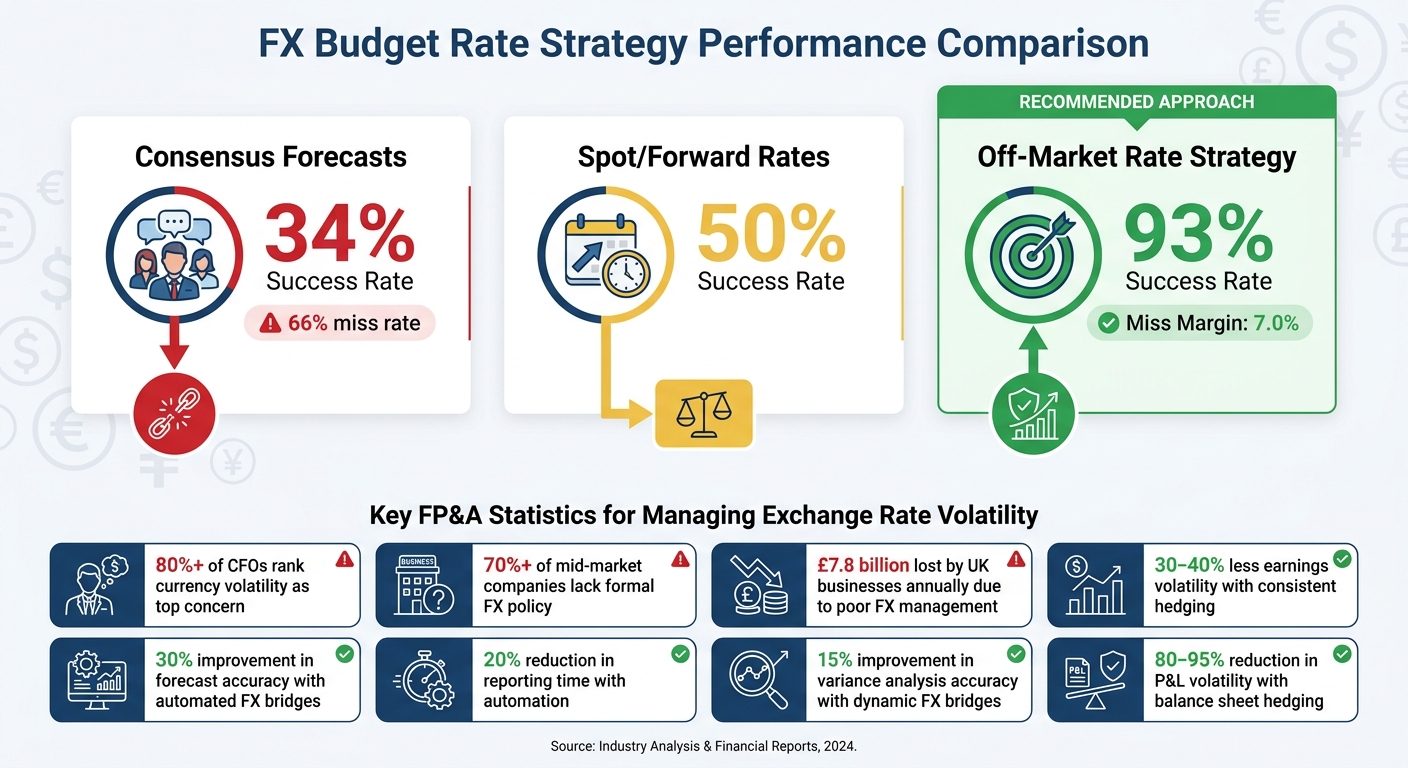
FX Budget Rate Strategy Success Rates and Key FP&A Statistics
Establishing an FX budget rate at the beginning of your planning cycle helps separate your operational performance from the unpredictable impact of currency fluctuations. This fixed rate serves as a reference point for converting foreign currency revenues, expenses, and cash flows into U.S. dollars.
The method you choose for setting this rate matters. Research shows that consensus forecasts miss targets 66% of the time, while spot or forward rates hit the mark only 50% of the time. However, using an off-market rate strategy - where the spot rate is adjusted with a one standard deviation cushion - achieves an impressive 93% success rate, with just a 7.0% miss margin [1]. This approach not only improves budget accuracy but also guides decisions on hedging and managing FX risks.
As Ivan Asensio, Ph.D., points out:
"FX budget rates can play a key role in annual financial planning, budgeting and contract negotiation" [1].
Setting this benchmark is a critical step in reducing FX-related risks. It supports pricing strategies and helps evaluate performance effectively. For growing companies, these rates are essential for providing constant currency reporting to investors, ensuring that operational results remain clear despite currency fluctuations.
To strengthen your financial plan against volatility, align your FX budget rate with your hedging strategy. Use tools like forward contracts or options to protect against unpredictable market changes. Focus on monitoring the currencies that significantly affect your business, and use the budget rate as a performance metric for both treasury operations and overseas sales teams.
After setting your FX budget rate, the next step is to map out your foreign currency cash flows over a 1–3 year timeframe. This means identifying all significant inflows, like sales revenue or dividends, and outflows, such as raw material purchases, debt payments, or repatriations [2].
This process establishes a baseline of FX cash flows, which is essential for managing currency risks. It pinpoints where your exposure lies and helps you decide whether to use financial tools like forward contracts or make operational changes - such as renegotiating supplier contracts to use a different currency [2]. Without this clarity, currency fluctuations could leave you vulnerable to unexpected financial impacts.
Mapping cash flows also highlights how currency shifts affect critical metrics like cash burn, margins, and operating expenses [1]. For growth-stage companies, this visibility is especially useful. It can uncover potential liquidity risks, such as delayed customer payments or supply chain disruptions that are worsened by currency fluctuations [3]. Once you’ve identified these exposures, you can move on to systematically quantifying and analyzing them.
Start by extracting data from contracts and debt schedules. Document transactions by currency, amount, and timing, and run sensitivity analyses using exchange rate scenarios ranging from 5% to 20% [2]. This preparation helps your FP&A team separate operational performance from currency translation effects, giving you a clearer picture of what’s driving your business [4].
Once you've mapped your foreign currency cash flows, the next step is to create an Excel FX bridge. This tool helps you separate your operational performance from the effects of fluctuating exchange rates, providing a clear picture of what's driving changes. Essentially, it acts as a framework to measure the impact of currency movements versus actual operational shifts [4].
Here’s how it works: the bridge compares numbers calculated at constant currency rates with those at actual rates. For example, if revenue declines by 5% but 3% of that is due to currency headwinds, the operational decline is only 2% [4]. This distinction is vital for growth-stage companies where investors and executives need to understand whether changes are tied to core business performance or external market factors.
Take GlobalTech as an example. In 2025, they incorporated FX budget rates into their Excel models to separate currency translation effects from operational changes. This adjustment brought their forecast error rate down from 15% to less than 3%, resulting in more reliable financial planning [7]. Similarly, FoodieCo implemented automated tools to pull real-time exchange rate data into their FP&A spreadsheets. By doing so, they saved about 200 hours per year in manual data entry, improved forecast accuracy by 10%, and boosted net profit margins by 5% [7].
To replicate these results, design your Excel FX bridge with clear and organized layers. A strong model typically includes four key components:
For clarity, structure your spreadsheet with columns that display values in local currency, reporting currency at budget rates, and reporting currency at actual rates. This layout makes it easier for stakeholders to instantly spot FX variances [4].
To enhance accuracy, consider using Excel add-ins or APIs to pull real-time exchange rates. Automating this process not only eliminates manual entry errors but also ensures your models stay aligned with current market conditions. Companies that have adopted automated FX bridges report a 30% boost in forecast accuracy and a 20% cut in reporting time [7]. With this solid foundation, you'll also be better equipped to run scenario analyses for various exchange rate forecasts.
Once you've built your FX bridge, it's time to stress-test your financial plans against various currency scenarios. Scenario analysis allows you to model how fluctuations in exchange rates could impact your bottom line, working capital, and ability to meet financial covenants, helping you prepare for unpredictable market shifts [3][8].
Start by creating multiple scenarios that reflect realistic market conditions. Many FP&A teams typically develop three cases: a base case with current exchange rates, an upside scenario with favorable currency movements, and a downside scenario with unfavorable shifts. For companies in growth stages, it’s smart to include extreme stress tests involving 10%-20% currency swings. These tests help account for volatility caused by major monetary policy changes, like the European Central Bank's six rate cuts since June 2024 or the Reserve Bank of Australia's first rate reduction since 2020 [8].
It’s worth noting that consensus forecasts often miss the mark, leading to significant FX miscalculations [1]. However, organizations that use dynamic FX bridges with integrated scenario analysis have reported an average 15% improvement in the accuracy of their variance analyses [4].
To bring this to life, tools like Excel's Scenario Manager or Data Tables can simulate different FX rate environments [4][2]. For example, you might model a 5% swing in the dollar's value and assess its impact on revenue, margins, and cash flow. Then, push further by testing extreme scenarios, such as a major currency moving by up to 20%, to identify potential liquidity risks [3].
When presenting your findings, use visual tools like waterfall charts and heat maps to illustrate risks by currency pair and business segment [2]. These visuals make it easier for executives and board members to grasp which exposures are most critical and where hedging strategies could provide the greatest benefit.
Real-time FX variance tracking is a game-changer for navigating volatile markets, especially when paired with scenario analyses. It’s not just about crunching numbers - it’s about making smarter decisions.
FX variance analysis helps you compare actual financial results to budgeted figures or forecasts, highlighting discrepancies caused by exchange rate shifts. For growth-stage companies utilizing fractional CFO services, this isn't just a reporting exercise - it’s a way to separate genuine operational performance from the noise created by currency fluctuations. The formula is simple: Variance = Actual – Plan. From there, it splits into two components: rate variance (pure FX impact) and efficiency variance (operational changes) [6].
"The gap between what a number shows and what it means is exactly what variance analysis exists." - Pigment [6]
To make this process efficient, consider a management-by-exception approach. By setting materiality thresholds upfront, you can zero in on deviations that genuinely matter to your business. In highly volatile markets, real-time or weekly monitoring offers more actionable insights than waiting for monthly updates. Automated planning tools can cut data aggregation time by up to 80%, and AI-driven analyst tools can save finance teams as much as 12 hours per month on executive reporting [6].
However, don’t immediately celebrate favorable variances - they might mask deferred investments or hidden risks. The real value lies in embedding these insights into rolling forecasts. Instead of treating variance analysis as a historical report, use it to shape forward-looking decisions. This approach ensures that currency impacts actively inform your next steps, keeping your financial planning aligned with real-time market conditions [6].
Foreign exchange (FX) risks come in different forms, and understanding them is key to managing their impact. Transaction exposure is the most immediate and directly affects your cash flow. This type of risk arises from the time lag between agreeing on a price in a foreign currency and the actual payment or receipt of funds [2][9]. For instance, if you invoice a European customer €100,000 with a 60-day payment cycle, a 5% drop in the euro's value could mean losing approximately $5,000 in cash. For companies in growth stages, where burn rates are closely monitored, this kind of loss can be hard-hitting.
On the other hand, translation exposure doesn’t impact cash flow right away but can still cause complications. This occurs when the financial statements of foreign subsidiaries are consolidated into the parent company’s reporting currency [9]. While it doesn’t result in immediate cash losses, it can create volatility in your balance sheet and reported net assets. Investors often pay close attention to these fluctuations during due diligence. For example, in 2022, the GBP/EUR exchange rate shifted by 12%, enough to wipe out the profit margins of many small to medium-sized enterprises (SMEs) [9].
Then there’s economic exposure, which presents a more long-term challenge. This risk stems from sustained currency shifts that can affect your global competitiveness. For example, if your exports become more expensive due to currency changes, competitors with lower-priced imports might gain an advantage [9]. Over time, these shifts can alter your market position and reduce your pricing power.
Shockingly, more than 70% of mid-market companies lack a formal FX policy, leaving them exposed to unmanaged risks [9]. Meanwhile, over 80% of CFOs rank currency volatility as a top concern, yet many fail to address it effectively, leading to significant financial losses [4]. In fact, UK businesses alone lost an estimated £7.8 billion in a single year due to poor FX management [9].
Shield your company from the impact of currency fluctuations by incorporating hedging strategies. One effective tool is a forward contract, which doesn’t require an upfront premium and provides clear protection against currency volatility [9].
A forward contract is a binding agreement to exchange a set amount of currency at a predetermined rate on a future date - ranging from as soon as one week to as far as 24 months ahead. When you’ve already mapped your currency exposures, forward contracts offer a direct way to manage those risks.
By locking in an exchange rate today, you can eliminate much of the uncertainty that might otherwise disrupt cash flow or shrink profit margins. For instance, if your company has a $3 million exposure and faces a 5% unfavorable currency movement, the resulting $88,000 variance can be reduced to just $22,000 by hedging 75% of the exposure [9]. While this approach does mean forfeiting potential gains if exchange rates move favorably, many FP&A teams prioritize the predictability it brings to budgeting. In fact, companies that hedge consistently report 30–40% less earnings volatility from foreign exchange movements [9]. This stability also demonstrates financial discipline, which can be a key factor during investor evaluations.
Taking a layered approach to hedging can further enhance your strategy. For example, hedge one-third of your exposure monthly over three months to average out entry rates [9]. Adjust your hedge ratios based on time horizons: cover 75–100% of exposures within 0–3 months, and 25–50% for exposures 6–12 months out [9]. Before entering into any forward contract, calculate your net exposure by balancing foreign currency income against costs - this natural hedging reduces the amount of active coverage required [9]. Additionally, compare forward rates to mid-market rates to ensure you’re getting fair pricing [9].
Balance sheet hedging focuses on reducing the impact of foreign exchange (FX) fluctuations already reflected in your financial statements. This method addresses exposures like receivables, payables, intercompany loans, and foreign currency cash balances. While cashflow hedging protects future transactions, balance sheet hedging offsets unrealized gains and losses that arise when foreign-currency items are remeasured at the end of a reporting period. Under accounting standards such as IAS 21 and FRS 102, items are remeasured using the closing exchange rate. By hedging these positions, you can ensure that gains or losses on hedging instruments offset the FX-related fluctuations in your profit and loss (P&L) statement.
To implement this, use short-dated FX forward contracts (typically 1–3 months) that align with your reporting cycle. Start by calculating the net position for each currency - subtract total liabilities from total assets - to pinpoint the exact exposures. Before executing trades, look for natural offsets within your balance sheet. Many companies aim for a 100% hedge ratio for these quantifiable exposures, with rolling hedges helping to reduce P&L volatility by 80–95% [10].
Intercompany loans and balances often represent the largest source of balance sheet FX risk but are sometimes overlooked. Make sure to include accrued income, deposits, and prepayments in your analysis, not just trade receivables. It's also critical to ensure that FX forward contracts mature on your reporting date (e.g., the last day of the month or quarter) to avoid timing mismatches that could lead to residual gains or losses.
Keep an eye on your positions throughout the reporting period and adjust hedges if balance sheet positions change by more than 10–15%. While balance sheet hedges generally don't require formal hedge accounting documentation, auditors typically expect a clear policy outlining how exposures are identified and who approves trades. The key difference between this and cashflow hedging lies in the accounting treatment: balance sheet hedging uses fair value through the P&L to create a natural offset, whereas cashflow hedging often involves formal hedge accounting under IFRS 9. By focusing on exposures already on your books, balance sheet hedging can help stabilize earnings.
The FP&A team at Phoenix Strategy Group incorporates these principles into a comprehensive FX risk management framework, ensuring a well-rounded approach to managing currency risks.
Handling FX tracking manually not only eats up time but also increases the likelihood of errors. Automating your FX processes with real-time data feeds can solve these issues by ensuring you’re working with up-to-date market data, which helps reduce forecasting mistakes. Tools like Excel add-ins and external APIs can pull live exchange rates directly into your spreadsheets, keeping your models aligned with current market conditions. Companies that have adopted automated FX bridges in Excel have reported a 30% boost in forecast accuracy and a 20% cut in reporting time[7].
Taking automation a step further, integrating these tools with your ERP systems can make financial workflows even smoother. By doing so, you can significantly cut down on manual data entry errors and improve the overall accuracy of your financial data[7]. Additionally, setting up automated alerts and dashboards allows you to monitor currency trends in real time. If exchange rates cross your pre-set thresholds, the system can notify your FP&A team immediately. This enables quick adjustments to forecasts or hedging strategies, helping you stay ahead of market volatility before it impacts your bottom line. Automating these processes not only improves FX forecasting but also strengthens your broader FP&A framework.
In fact, automation can save up to 30% of the time spent on monthly close activities[4].
When evaluating automation tools, focus on security and integration features. It's critical to ensure that your data is encrypted - both at rest and in transit - and that role-based access controls are in place to protect sensitive financial information. While there may be an upfront cost to implementing automated FX solutions, the investment often pays off by reducing errors, speeding up financial closes, and delivering more accurate forecasts[7]. These tools are essential for helping FP&A teams manage FX volatility more effectively.
For growing businesses, incorporating automated FX processes into your FP&A strategy can significantly improve financial flexibility. At Phoenix Strategy Group, we specialize in FP&A systems and real-time data integration, helping you implement solutions that keep you ahead of exchange rate fluctuations.
Keeping your exchange rate strategies up to date is essential. Market conditions, business forecasts, and strategic goals can shift quickly, and quarterly reviews help ensure your foreign exchange (FX) strategy stays on track.
Each quarter, take a fresh look at your foreign currency exposure map. Factor in new contracts, renewals, and updated cash flow projections. Use this opportunity to rebalance your hedge portfolio - adjusting forwards, options, and other derivatives to match current risk levels. This step helps avoid over-hedging, which can lead to unnecessary margin and collateral costs. These adjustments work hand-in-hand with earlier FX management practices, keeping your approach aligned with the latest market dynamics.
Beyond exposure mapping and hedging updates, revisiting your FX assumptions is equally important. Quarterly updates to FX budget assumptions ensure they reflect significant market shifts. While annual budgets are common, quarterly adjustments provide a more accurate picture of changing conditions [5]. Companies that regularly update FX budget rates report a 15% improvement in reporting accuracy [4]. Tools like FX bridges are also helpful for isolating currency impacts from operational performance.
It's equally important to share these updated FX assumptions with senior management and investors. Sharing insights like scenario sensitivities, variance analyses, and risk concentrations fosters transparency and builds trust [4]. This approach ensures all teams are working from the same playbook when addressing currency volatility.
Quarterly reviews also play a key role in investor reporting and maintaining constant currency results [1]. This process strengthens the proactive FX management framework you've established. Phoenix Strategy Group specializes in helping businesses set up systematic quarterly FX review processes, ensuring your strategies stay effective as the market evolves.
Managing currency volatility effectively requires a structured approach. A systematic FX framework is essential to navigate fluctuations and protect growth. With over 80% of CFOs identifying currency volatility as a major risk factor for their organizations [4], tools like FX budgeting, exposure mapping, and scenario analysis become crucial for maintaining stability. These methods lay the groundwork for implementing precise, technology-driven controls.
Automation plays a transformative role in FX management, turning it into a strategic advantage. Companies that have adopted automated FX processes report spending 30% less time on monthly close activities [4]. This extra time allows teams to focus on in-depth analysis rather than repetitive data entry. Tools like Excel FX bridges and real-time dashboards offer clarity by isolating currency impacts from operational performance, presenting investors and stakeholders with a transparent view of business fundamentals.
"Proactive mastery of FX modeling clarifies risks, stabilizes earnings, and supports international growth." - Macabacus [2]
Currency swings can occur rapidly, driven by factors like macroeconomic shifts, interest rate changes, and geopolitical events [2]. Incorporating tools such as dynamic FX bridges into your review process has been shown to enhance the accuracy of variance analyses by about 15% [4]. Together, these strategies create a robust FX management framework.
Phoenix Strategy Group specializes in building scalable FX management systems tailored for growth-stage companies. By setting budget rates, designing FX bridges, and establishing regular review processes, they help transform currency volatility from a challenge into a controllable aspect of international expansion.
When managing financial planning and analysis (FP&A), it's crucial to pay close attention to the currencies of your major trading partners and those known for high volatility. By prioritizing these, you can better protect your business from exchange rate risks and enhance the precision of your forecasts.
To determine an FX budget rate that aligns with your plan, focus on using practical methods that account for expected currency shifts. Consider incorporating tools like hedging to mitigate volatility. The key is to ensure the rate supports both your financial and operational objectives, helping you stay steady despite potential exchange rate changes.
Hedging is an effective tool for managing exchange rate volatility, helping to minimize its impact on financial performance. On the other hand, reporting in constant currency is ideal for showcasing performance metrics that remain unaffected by currency fluctuations. This approach provides a clearer picture of the core operational results. Combine hedging to mitigate risks with constant currency reporting to emphasize the fundamental aspects of your business.