Published on
December 23, 2025

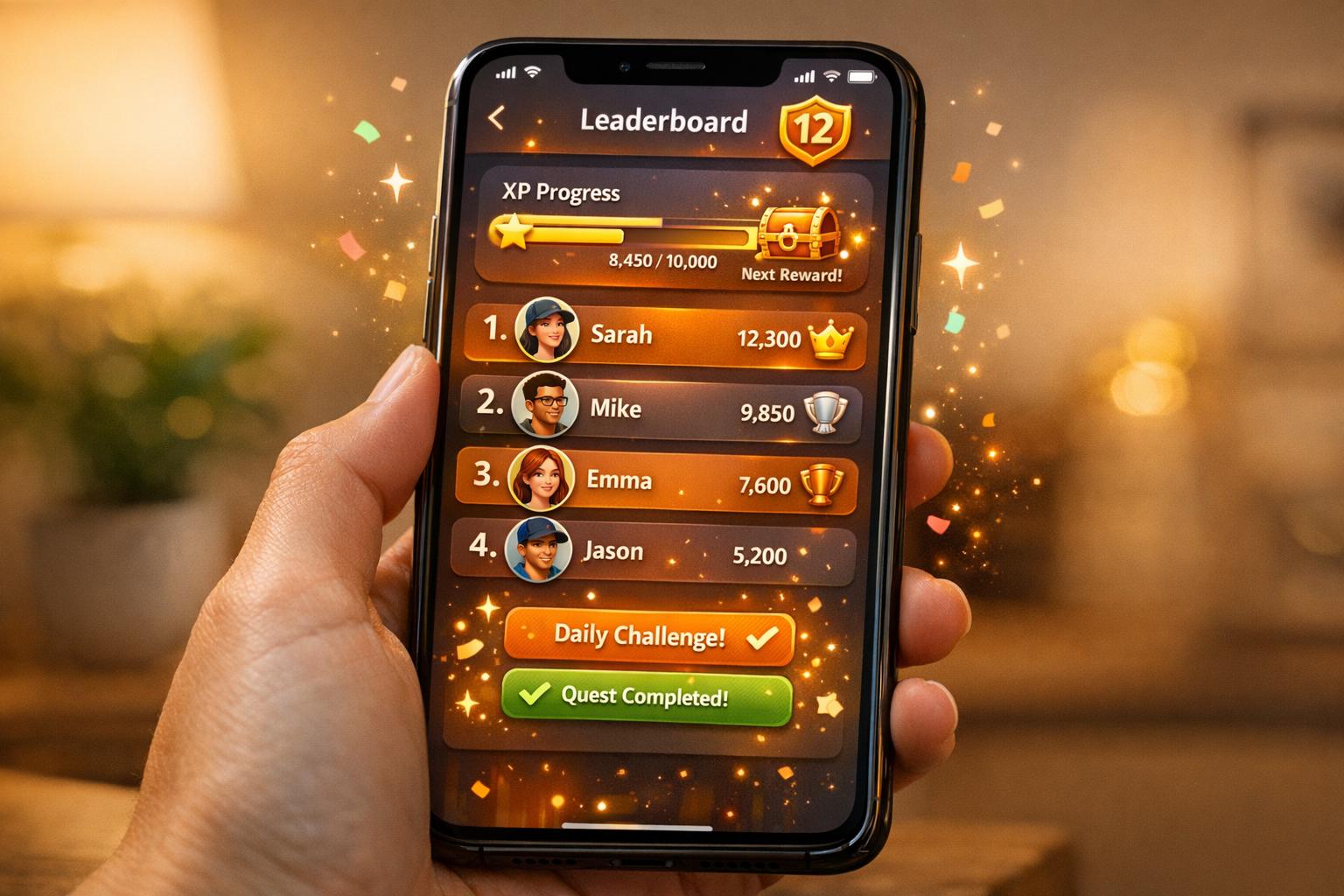
Gamification can help subscription businesses keep users engaged and lower churn rates. By incorporating game-like elements such as points, badges, leaderboards, and challenges, companies make their services more interactive and rewarding. This approach addresses two major reasons users cancel: low engagement and unclear value.
Gamification not only keeps users engaged but also boosts profitability by increasing customer lifetime value (LTV) and lowering acquisition costs (CAC). Companies that adopt these strategies often see higher retention, better engagement, and improved revenue.
To make gamification successful, businesses should:
The bottom line: Gamification isn’t just about fun - it’s a practical tool to reduce churn and grow subscription-based businesses.
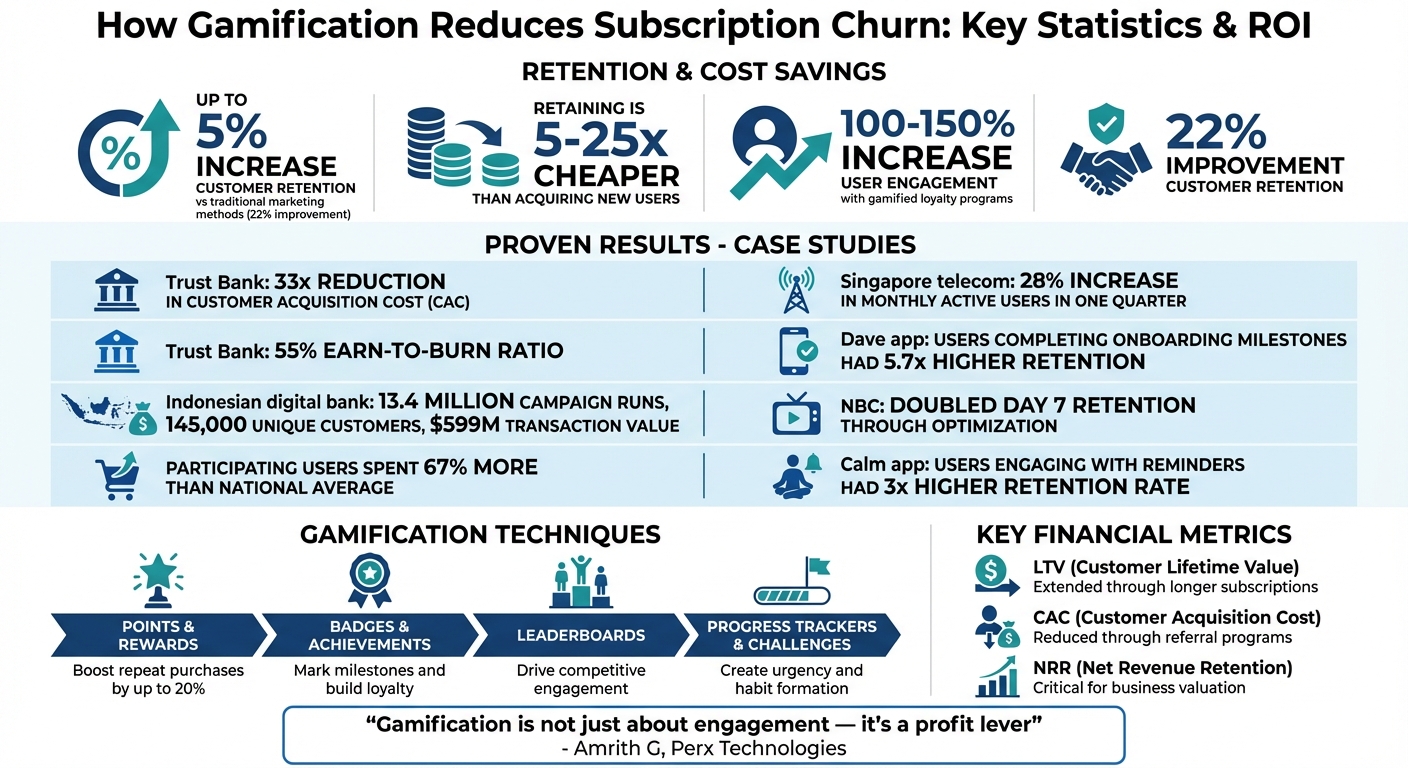
Gamification Impact on Subscription Retention: Key Statistics and ROI Metrics
Using gamification effectively can reshape how users interact with your subscription service. Here are four techniques that have been shown to increase engagement and lower churn rates.
Points and rewards systems are a powerful way to keep users coming back. These systems go beyond rewarding purchases - they can incentivize actions like referrals, social shares, leaving reviews, or exploring platform features [8]. This kind of instant feedback keeps users engaged and invested in your service. In fact, points systems have been shown to boost repeat purchases by up to 20% [8].
To make these systems even more effective, consider adding a tiered structure. This approach creates "emotional switching costs", making users less likely to cancel their subscriptions [6][4]. Introducing points early in the onboarding process can also help new users feel accomplished and less overwhelmed [6].
Badges and achievements are another way to deepen user engagement. By marking milestones like "First 100 Tasks", badges reward users for their progress and reinforce their commitment to your platform. These achievements tap into intrinsic motivation, providing clear proof of progress and mastery [6][3]. When thoughtfully integrated into the user journey, badges can serve as visible reminders of the value users are getting from your service.
Leaderboards bring out users' competitive side, encouraging them to engage more frequently [9]. For example, a telecom company in Singapore saw a 28% increase in Monthly Active Users over one quarter by implementing gamified engagement strategies [4].
"Gamification applies game mechanics such as points, streaks, and challenges to loyalty programs, turning passive point collection into active, rewarding engagement that motivates customers to return and spend more."
- Amrith G, SVP, Marketing & Customer Analytics, Perx Technologies [4]
To make leaderboards more relevant, rank users against their own social circles rather than a global pool [6]. Pairing leaderboards with specific missions or quests gives users clear goals to work toward, further encouraging participation.
Progress trackers and daily challenges are excellent tools for keeping users engaged. Visual indicators show users how far they've come, while time-sensitive challenges create a sense of urgency [8].
When combined with rewards and competitions, progress trackers help create a unified experience that motivates users to stay active. Time-limited rewards, in particular, encourage regular interaction, turning casual use into a habit that reduces the likelihood of churn [7].
Gamification can be a powerful tool to reduce subscription churn when implemented strategically. To make it work, focus on identifying what drives retention, aligning gamification features with your product's value, and refining the process over time.
Start by pinpointing the key action that reflects user value - this could be something like completing a recurring payment or another critical behavior. For instance, a personal finance app saw a 5.7% retention boost by emphasizing recurring expenses during onboarding [10][11].
Next, determine your product-usage interval - how often users are naturally expected to engage. A meditation app might aim for daily usage, while tax software may see monthly engagement as the norm [10]. It's also important to distinguish between the initial activation phase and ongoing engagement [2].
Dive into cohort analysis to uncover behaviors that correlate with long-term retention. Take Calm as an example: they discovered that users who interacted with their reminders feature had a retention rate three times higher than others. As a result, they made this feature more prominent in their app's interface [10][11]. To further refine your approach, map out your features on an engagement matrix to identify behaviors worth encouraging through gamification [11].
"Retention is the new growth. Without it, your product is a leaky bucket. Pouring new users in will never fill it up." - Amplitude [10]
With these insights, you can start designing gamification features that align with your retention goals.
Tailor gamification mechanics to match your subscription cycle and the value you offer. For frequent, short-term interactions (like daily app use), consider a points system. For services with longer cycles or higher stakes, such as SaaS platforms, achievement tiers may be more effective [5]. A continuous engagement loop - built on the Hook Model - can help: a trigger sparks an action, which delivers a variable reward, followed by an investment that enhances the next interaction [15].
Onboarding deserves special attention. The steepest drop in user engagement often happens within the first three days, so focus on helping users quickly discover your product's value. For subscriptions with lots of content, features like badge stacks or guided learning paths can combat choice paralysis and guide users to their "aha" moment faster [14]. NBC, for example, doubled their Day 7 retention by using funnel analysis and A/B testing to optimize their homepage layout [11].
Gamification should also extend beyond transactions. Reward users for actions like referring friends, leaving reviews, or completing surveys. These non-purchase activities help build emotional loyalty and foster a deeper connection with your product [5].
Once your gamification features are live, testing and personalization are key to keeping users engaged.
Segment your users based on their engagement patterns and tailor challenges and rewards to suit their needs [2]. Participation data can serve as an early warning sign for potential churn, so keep a close eye on it [17].
Use onboarding surveys to gather details like fitness goals or personal interests, then create customized challenges and recommendations based on this information [2]. For example, if a user gives a low score (0–6) on an NPS survey, trigger immediate outreach from customer support to address their concerns and reduce churn risk [2].
Monitor your "earn-to-burn" ratio - how often users redeem rewards - to ensure your gamification system is compelling enough to drive repeat engagement [4]. Leverage push notifications, emails, and in-app messages to nudge users toward premium features they haven’t explored yet [2][18]. Collect user feedback and track session frequency to continuously fine-tune your gamification mechanics [12][13].
To turn gamification efforts into measurable revenue, it's essential to track the right metrics. Start by distinguishing between process KPIs (like behavioral shifts such as feature adoption) and performance KPIs (business outcomes like reduced churn or increased sales) [19]. Performance metrics help determine if gamification efforts are paying off.
From there, focus on metrics that directly reflect retention and engagement.
To measure the effects of gamified features, establish a baseline first [19]. Pay close attention to activation metrics, which track how many users complete initial actions that unlock your product's value - like creating a profile or finishing their first challenge [2]. Next, monitor retention metrics that indicate habit formation, such as completing daily streaks or exporting finished projects [2].
Participation data is another key indicator. Metrics like session duration, app opens, and feature adoption rates provide insight into how often and consistently users engage. Research highlights that the time users invest - both in length and regularity - is a strong predictor of churn risk [17].
For example, the personal finance app Dave revamped its onboarding process in 2020 by introducing gamified milestones that encouraged users to add recurring expenses. The result? Users who completed these steps had 5.7x higher retention than those who didn't [10].
It's also critical to identify and address early signs of disengagement. As Alice Muir from Phiture explains:
"The key difference between disengaged users and churned users is that disengaged users still have a need for your product, otherwise they would have churned and unsubscribed" [2].
Detecting disengagement early allows you to deploy strategies like streaks or personalized reminders to re-engage users.
The financial impact of gamification becomes evident in two major metrics: Customer Lifetime Value (LTV) and Customer Acquisition Cost (CAC). Gamification can extend subscriptions, increasing LTV, which is calculated by multiplying ARPU (average revenue per user) by the average customer lifespan [21]. It can also encourage users to upgrade to premium tiers through challenges tied to engagement [20][21].
On the acquisition side, gamified referral programs can significantly reduce CAC by turning users into advocates. In 2024, a Southeast Asian neo bank collaborated with Perx Technologies to implement gamified campaigns, including spend challenges and referral streaks. This strategy led to a 33x reduction in CAC and a 55% earn-to-burn ratio, proving the rewards effectively drove repeat activity [4].
Keep an eye on earn-to-burn ratios to confirm rewards are influencing behavior [4]. Additionally, monitor the LTV:CAC ratio - a healthy subscription business aims for LTV to far exceed CAC [21][10]. A shorter payback period signals faster recovery of acquisition costs [21].
For instance, an Indonesian digital bank ran gamified campaigns in 2023 that included minimum spend rules. These campaigns ran 13.4 million times, engaging 145,000 unique customers and generating $599 million in transaction value. Participating users spent 67% more than the national average [4].
"Gamification is not just about engagement - it's a profit lever. Gamification directly drives profitability by lowering customer acquisition costs, increasing transaction values, and elevating customer engagement." - Amrith G, SVP Marketing & Customer Analytics, Perx Technologies [4]
Beyond immediate financial results, long-term analysis can provide deeper insights into user behavior.
Cohort analysis helps uncover trends that aren't visible in aggregated data. By grouping users based on when they joined or specific actions they took, you can identify patterns. Acquisition cohorts reveal when users churn, while behavioral cohorts can show why they churn [10]. For gamification, behavioral cohorts are especially useful for pinpointing which features - such as completing streaks or reaching milestones - drive long-term retention.
Tracking N-Day retention (how many users return on days like Day 1, Day 7, or Day 30) can highlight how engagement changes over time [10]. This is particularly valuable for subscription apps with regular usage patterns. A/B testing different gamification strategies, such as "surprise and delight" rewards versus standard incentives, can also reveal what resonates most with users [10][4].
The streaming service iflix leveraged behavioral cohorting to create personalized onboarding journeys based on user interactions rather than demographics. This approach boosted daily engagement and retention across Southeast Asia [10]. Similarly, the app Play&Go, which gamifies sustainable mobility, used participation data and machine learning models to predict churn. They discovered that consistent time investment was the strongest indicator of long-term user retention [17].
"Retention is the new growth... Without it, your product is a leaky bucket. Pouring new users in will never fill it up." - Amplitude [10]
To make the most of cohort analysis, track every gamification trigger - points earned, badges unlocked, levels reached - as discrete events. This granular data helps identify which behaviors are truly driving retention and which are just noise [10].
Gamification can drive impressive engagement, but turning that engagement into profit requires a sharp focus on ROI. For growth-stage companies, the key lies in linking user behavior - like completing streaks or participating in challenges - to core financial metrics. Without a clear plan to measure ROI, gamification risks becoming an expense rather than a revenue generator.
Let’s dive into how financial advisory services can turn these insights into actionable ROI models.
Phoenix Strategy Group’s FP&A (Financial Planning & Analysis) services help businesses assess the financial impact of gamification by digging deep into unit economics. They analyze how factors like participation rates and time spent on activities influence Customer Acquisition Cost (CAC) and Customer Lifetime Value (LTV). Here’s the kicker: even a modest 5% boost in customer retention can significantly increase LTV, and higher Net Revenue Retention (NRR) often leads to stronger valuation multiples [1][22].
Using behavioral data, financial advisors develop predictive models to flag potential churn risks before they materialize [17]. They also segment users based on engagement levels to fine-tune tiered pricing strategies [2]. A critical metric they monitor is the "earn-to-burn" ratio, ensuring that the cost of rewards stays balanced with the revenue they generate, with a benchmark of 55% as a guiding standard [4].
This method creates a more precise pricing model that supports long-term growth.
Retention insights are just the beginning. Aligning pricing with user behavior can further strengthen unit economics. By integrating gamified features into pricing strategies, companies can boost both retention and profitability. Phoenix Strategy Group identifies which behaviors - like completing daily challenges or hitting key milestones - are tied to higher Average Revenue Per Account (ARPA) and lower churn rates [22].
Their cash flow forecasting tools also reveal how gamified referral programs can lower CAC while extending customer lifespans. By connecting these engagement metrics to NRR, their Integrated Financial Model highlights NRR’s critical role in driving business valuation.
As gamification efforts grow, scaling them effectively requires careful planning and execution. Phoenix Strategy Group’s M&A advisory services help businesses showcase how gamification-driven retention enhances enterprise value, especially during exit planning. Their data engineering ensures every gamification trigger is tracked, providing clear insights for potential investors.
To keep gamification tied to business goals, their fractional CFO services align variable compensation for Customer Success and Product teams with NRR milestones [22]. They also run scenario analyses to demonstrate how even small improvements in Gross Revenue Retention (GRR) can lead to long-term profitability.
Gamification has proven to be a game-changer for subscription-based businesses. It significantly lowers customer acquisition costs and increases revenue. In fact, retaining customers through gamified strategies costs 5 to 25 times less than bringing in new ones [1]. Plus, companies using gamified loyalty programs often see user engagement jump by 100% to 150% and customer retention improve by 22% compared to traditional marketing methods [16].
But it’s not just about keeping customers around - it’s about creating an emotional connection. Gamification builds what’s called emotional switching costs. When users invest time and effort into achieving streaks, milestones, or rewards, canceling their subscription feels like losing something valuable. This emotional tie makes them more likely to stick around.
To harness these benefits, growth-stage companies can take several steps to maximize the return on gamification. Start by defining clear metrics for activation and retention [2]. Identify which user behaviors are linked to long-term subscription value and design gamified elements - like daily streaks, tiered rewards, or personalized surveys - to encourage those actions. For instance, targeted Net Promoter Score (NPS) surveys can help quickly identify and re-engage subscribers at risk of churning (those scoring between 0–6) [2].
Modern no-code gamification tools make it easier than ever for marketing teams to roll out campaigns in just a few hours [4]. Additionally, introducing grace periods for failed payments can help reduce involuntary churn while keeping users engaged [23].
Financial planning is another critical piece of the puzzle. Services like Phoenix Strategy Group’s FP&A offerings help tie gamification metrics to unit economics, ensuring that these initiatives deliver measurable ROI. Their fractional CFO services can guide businesses in aligning gamification efforts with broader goals, while their data engineering expertise tracks every user action to provide detailed, investor-ready reports. This approach not only strengthens user engagement but also sharpens your overall financial strategy - essential for any company aiming to scale effectively.
Gamification can play a big role in cutting down subscription churn by turning everyday product interactions into fun, reward-based experiences. By incorporating features like points, badges, leaderboards, and challenges, users are motivated to stay engaged, build consistent habits, and enjoy a sense of accomplishment.
These tools don’t just make the onboarding process more enjoyable - they also boost how much value users feel they’re getting from your service. Plus, gamification can help create a sense of community and connection among subscribers, which strengthens loyalty and lowers the chances of cancellations. When done right, it transforms passive users into excited, long-term customers.
Gamification is a powerful tool for boosting user engagement and keeping subscription churn in check - when done right. Some of the most effective strategies include point systems that reward users for specific actions, leaderboards that spark friendly competition, and badges or achievements that recognize milestones. These features tap into natural motivations, encouraging users to stay active and engaged.
Incorporating challenges or quests, like daily tasks, streaks, or goals to level up, can add a sense of purpose and accomplishment. Pairing these with tangible rewards - think discounts, exclusive content, or virtual currency - makes participation even more enticing. Tiered rewards, in particular, give users something to strive for and promote ongoing interaction. Social elements, like sharing achievements or joining team challenges, can further strengthen the sense of community and drive engagement.
When gamification is seamlessly woven into a subscription model - through onboarding perks, progress tracking, or surprise rewards - it not only boosts retention but also builds lasting loyalty. Companies like Phoenix Strategy Group specialize in helping growth-stage businesses integrate these strategies in ways that align with their revenue and retention goals, setting the stage for long-term success.
To measure how well your gamification strategy is working, keep an eye on a few important metrics that show how engaged and loyal your users are. Start by tracking engagement rates - this includes things like how much time users spend on your platform, how many challenges they complete, and how often they participate in leaderboards. Next, dive into retention metrics by looking at churn rates, subscription renewals, and customer lifetime value. These numbers give you a clear picture of whether your users are sticking around.
Don’t forget to gather user feedback as well. Tools like Net Promoter Scores (NPS) and customer satisfaction surveys can help you understand how happy and loyal your users are.
By regularly reviewing these metrics, you’ll be able to pinpoint what’s working, make improvements, and provide a more engaging experience for your audience.