Published on
June 24, 2026

If I’m buying a company that relies on vendors, I’m not just buying software and contracts - I’m buying old privacy risk too. Under GDPR, fines can hit €20 million or 4% of global annual revenue. Under CCPA, penalties can reach $7,500 per intentional violation. That can change price, indemnities, escrow terms, and closing conditions fast.
Here’s the short version:
The biggest split is simple: GDPR focuses on legal basis, controller/processor roles, and cross-border transfer rules. CCPA focuses on notice, opt-out rights, and whether a vendor is a service provider, contractor, or third party.
That means my diligence usually comes down to a few high-impact checks:
One bad role label can throw off notices, contracts, and risk analysis under both laws. And if old EU-to-U.S. transfers lacked valid SCCs, I can fix future flows, but I can’t erase past exposure.
| Point | GDPR | CCPA / CPRA |
|---|---|---|
| Main roles | Controller, Processor | Business, Service Provider, Contractor, Third Party |
| What drives review | Legal basis, contracts, transfers | Notice, opt-out, vendor status |
| Cross-border rules | Yes - adequacy, SCCs, TIA | No GDPR-style transfer rule |
| Vendor contract focus | Article 28 DPA terms | No sale/sharing; no extra use outside service scope |
| Main user rights | Access, Erasure, Portability, Objection | Know, Delete, Correct, Opt-out |
| Big deal risk | Missing SCCs, missing DPAs, bad role mapping | Weak service provider terms, hidden sale/sharing, bad notices |
If I had to boil the article down to one point, it’s this: GDPR problems usually sit in transfer rules and processing rules, while CCPA problems often sit in vendor classification and opt-out failures. That’s the lens I’d use before I touch price, reps, or closing steps.
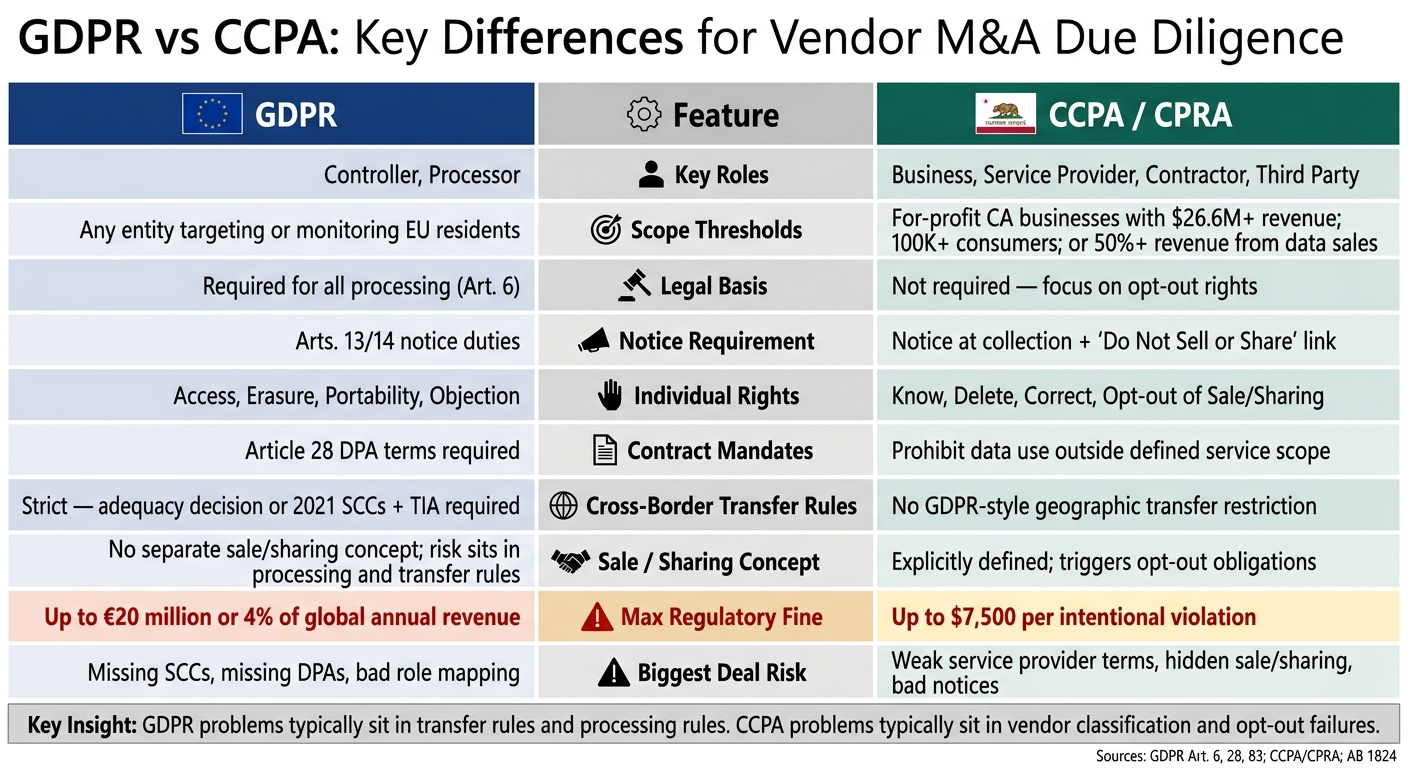
GDPR vs CCPA: Key Differences for Vendor M&A Due Diligence
In vendor M&A review, the gap between GDPR and CCPA shapes diligence requests, contract red flags, and the cost to fix problems.
| Feature | GDPR | CCPA / CPRA |
|---|---|---|
| Key roles | Controller, Processor | Business, Service Provider, Contractor, Third Party |
| Scope Thresholds | Any entity targeting or monitoring EU residents | For-profit businesses in California with more than $26,625,000 in annual gross revenue; 100,000+ consumers or households; or 50%+ of revenue from selling or sharing data [4] |
| Legal basis | Required for all processing (Art. 6) | Not required; focus on opt-out rights |
| Notice Requirement | Arts. 13/14 notice duties | Notice at collection; "Do Not Sell/Share" link |
| Individual Rights | Access, Erasure, Portability, Objection | Know, Delete, Correct, Opt-out of Sale/Sharing |
| Contract Mandates | Article 28 DPA terms | Prohibitions on data use outside the defined service |
| Cross-Border Rules | Strict - adequacy decision or SCCs/TIAs required | No GDPR-style transfer restriction |
| Sale / Sharing Concept | No separate sale/sharing concept; transfer risk sits in processing and transfer rules | Explicitly defined; triggers opt-out obligations |
| Max Regulatory Fine | Up to €20 million or 4% of global annual revenue [2] | Up to $7,500 per intentional violation [2] |
Those differences tell you which vendor records deserve the closest look: role maps, notices, DPAs, and transfer terms.
Under GDPR, the two roles that matter most are controller and processor. The controller decides what personal data gets collected and why. The processor handles that data only on the controller's instructions.
CCPA uses a similar setup, but with different labels. You look at business as the rough controller equivalent, service provider or contractor as the rough processor equivalent, and third party for any entity that falls outside those two buckets.
That third party label is where deals can get messy fast. If a vendor receives personal information without a compliant service provider contract, the transfer may be treated as a sale under CCPA. Once that happens, opt-out duties kick in right away. And in many deals, the target never built those mechanics in the first place.
As M&A attorney Alex Lubyansky put it:
"Controller and processor misclassification is the foundational error in data privacy diligence. If a target has categorized itself as a processor when it functions as a controller, its privacy notice, consent records, and contractual flow-downs are structurally defective." [1]
This kind of mix-up isn't just bad labeling. It's more like building a house on the wrong blueprint. The contracts are off, the notices are off, and the consent records are off too.
GDPR requires a documented legal basis for every processing activity, whether that's consent, contract, legitimate interest, or something else under Art. 6. CCPA does not. Instead, it centers on notice at collection and the consumer's right to opt out of sale or sharing.
That changes what diligence looks like in practice. A GDPR-compliant target should be able to map a legal basis to each data flow. A CCPA-compliant target should be able to show clear disclosures and working opt-out tools. Same broad privacy theme, very different homework.
Cross-border transfers create another review path under GDPR that CCPA simply does not impose. Any EU-to-US data flow needs an adequacy decision or approved safeguards such as Standard Contractual Clauses (SCCs). And those SCCs must be the 2021 version. Older 2010-era SCCs are not valid.
That point matters more than it may seem. If SCCs are missing or defective for data already transferred, the problem can't be fixed after the fact. The buyer takes on that past exposure at closing [1]. CCPA has no matching geographic transfer rule, though cross-border vendor arrangements can still create sale or sharing issues based on how data moves between parties.
There's also one CCPA-specific item buyers need on the checklist. Under AB 1824, effective January 1, 2025, a buyer must honor any opt-out requests that consumers gave to the seller before the deal closed [4].
Use these differences to guide the vendor-by-vendor review that comes next.
With roles and transfer rules mapped, the next step is to review the vendor records that back them up.
Start with the RoPA or data map. That shows which personal data each vendor touches, why it touches that data, and in what role. Without that foundation, role mapping turns into guesswork. [1]
The role classification issue matters a lot here. A B2B SaaS vendor may say it's a processor under GDPR or a service provider under CCPA. But if that same vendor uses customer data for its own product analytics, it's acting as a controller. A bad label doesn't just sit on paper. It throws off notices, contracts, and transfer analysis.
Under CCPA, this mistake can be just as expensive. If a vendor gets personal information without the needed service provider or contractor terms in place, that transfer can be treated as a sale even if no money changes hands. The ad-tech stack needs extra scrutiny. Website pixels, scripts, and cookies can trigger CCPA sharing duties and opt-out rules. [1]
After roles are mapped, compare the target's public privacy policy with its actual data flows. If the policy says "we do not sell data" but the site uses third-party tracking pixels, that's a plain compliance mismatch. When the policy and the data map don't line up, treat that gap as a diligence defect.
For GDPR, check that each processing activity has a documented lawful basis. For CCPA, confirm that the notice at collection is present and accurate, and that a working "Do Not Sell or Share My Personal Information" link appears where needed. It also helps to review older privacy policies. If the target told users one thing while its data flows did another, that's a red flag.
The two biggest misses here are absent Article 28 DPA terms and missing CCPA sale or sharing limits. The contract review uses a different checklist under each law. This table shows the main provisions to confirm:
| Requirement | GDPR | CCPA/CPRA |
|---|---|---|
| Use restrictions (documented instructions) | Yes | Yes |
| Explicit prohibition on selling/sharing | No | Yes |
| Delete or return data at end of term | Yes | Yes |
| Sub-processor flow-down obligations | Yes | Yes (CPRA) |
| Audit or inspection rights | Mandatory right to audit | Right to take "reasonable steps" |
For GDPR, the main task is to confirm that Article 28 Data Processing Agreements (DPAs) are in place and include the required terms: subject matter, duration, nature and purpose of processing, data types, categories of data subjects, documented instructions, confidentiality duties, security requirements, and subprocessor approval rights. For CCPA, the focus shifts. You want contracts that clearly prohibit the vendor from selling or sharing personal information and stop the vendor from combining data from the target with data from other clients. [3]
Two contract gaps carry the most deal risk:
Also review any contract rights that let the vendor use customer data for AI training. If the contract is silent or gives broad permission, flag it.
These contract gaps feed straight into the cross-border risk analysis next.
Once you’ve mapped the contract gaps, the next step is simple: check whether personal data moves across borders, and whether that transfer has legal cover.
Under GDPR, EEA-to-U.S. transfers need adequacy or valid 2021 SCCs plus a TIA. If the SCCs are broken, they do not clean up earlier transfers. That matters in deals. Past transfers made without valid SCCs stay on the books as inherited exposure at closing.
The SCC review is only part of the job. You also need to confirm whether the target has a Transfer Impact Assessment, or TIA, on file. A TIA explains why the destination country’s surveillance laws, including U.S. FISA 702, do not undercut the protection the SCCs are meant to provide. Without a TIA, the transfer setup is unfinished even if the 2021 SCCs were signed.
CCPA works differently. The risk does not depend on geography. It depends on classification. In plain English, the key question is whether the vendor terms keep the vendor in service provider status. Ad-tech pixels and analytics tools often create CCPA sharing unless the target has a working opt-out link.
Each privacy issue needs to turn into a deal term, not just a note in diligence.
Here’s how the most common findings usually map to deal terms:
| Finding | Deal Impact | When |
|---|---|---|
| Missing or defective SCCs for EU data flows | Special indemnity / price adjustment | Pre-close (future flows); indemnity (past transfers) |
| Missing DPAs with core vendors | Closing condition | Pre-close |
| Unauthorized sub-processing | Reps & warranties / integration plan | Post-close |
| Weak or absent service provider terms | Special indemnity / escrow holdback | Pre-close (risk allocation) |
Missing SCCs are often the toughest item to absorb. Since they can’t be repaired for past transfers, buyers usually push for a special indemnity carved out from standard R&W insurance. An escrow holdback is common when the exposure is material but hard to price before close.
Missing or defective service provider terms under CCPA create a different, but still serious, problem. If a vendor was legally a third party receiving a sale of data, the target may have owed consumers an opt-out tool and never gave them one. That creates a backward-looking gap, and it’s one reason buyers often want cleanup or deal protection before signing.
A practical way to sort the issues is to place them into three buckets:
That split helps keep the deal moving without leaving the buyer stuck with open-ended liability.
Turn the diligence findings above into a short memo that drives pricing, reps, indemnities, and closing steps.
The memo should convert diligence findings into clear deal actions. Split it into two separate sections - one for GDPR and one for CCPA - so issues under each law stay separate and ownership is easy to assign.
Use two separate tracks so GDPR and CCPA issues don't blur together.
| Memo Section | GDPR Focus | CCPA Focus |
|---|---|---|
| Roles | Processor vs. Joint Controller | Service Provider, Contractor, or Third Party |
| Data flows | RoPA entries; EEA-to-U.S. transfer map | Inventory of sale or sharing |
| Contract gaps | Article 28 mandatory terms; 2021 SCCs; sub-processor flow-downs | Service provider language prohibiting use outside the business relationship |
| Transfer issues | TIA status; DPF certification; historical SCC gaps | Not applicable |
| Notice and rights gaps | Right to erasure; data portability; breach-notice deadlines | Do Not Sell or Share link; breach-notice deadlines |
| Remediation steps | Fix going forward; negotiate indemnity for historical gaps | Update vendor contracts; implement opt-out tools pre-close |
| Deal terms | Specific indemnity, escrow, or price adjustment | Reps & warranties; closing condition or post-close remediation covenant |
This format pushes the deal team to decide, fast, what has to be fixed before close and what can wait for post-close remediation.
The top priority is role misclassification and missing or defective 2021 SCCs for EU-to-U.S. transfers. Those are structural issues, and the SCC gap can't be cured for data already transferred [1].
Keep the memo short and specific: state the risk, name the governing law, and spell out the required action.
It depends on the target company’s jurisdiction and how it handles data. GDPR can apply if the target has an establishment in the EU or UK, offers goods or services there, or monitors behavior. CCPA can apply if the target processes California residents’ personal information, including B2B and HR data.
In many deals, both can apply at the same time. That’s often what happens when data moves across borders and one company ends up facing rules from more than one regime at once.
Before closing, companies should clean up key privacy issues to cut regulatory and financial risk. That usually means checking a handful of items that can cause trouble fast if they're wrong or missing:
These points may sound dry, but they matter. A bad classification can throw off roles and duties. Missing transfer terms can create problems for cross-border data flows. And if opt-out records or vendor terms aren't in order, the buyer may inherit a mess instead of a clean handoff.
No. Past GDPR or CCPA violations usually can't be fixed after the fact for data that has already been processed or transferred.
Once the deal closes, the buyer takes on the target’s compliance history, including past violations and any exposure that still exists. For example, if data was moved without a valid transfer mechanism, that issue doesn't disappear later. You can't go back and repair that past transfer. That's why diligence matters so much.