Published on
February 13, 2026


Upskilling employees can deliver an average ROI of 353% - or $4.53 for every $1 invested. Yet, only 8% of organizations measure the business impact of training programs. This guide breaks down how to calculate ROI for upskilling initiatives, helping you tie training investments to measurable outcomes like revenue growth, retention, and strategic growth through cost savings.
By following these steps, you can ensure upskilling is seen as a critical investment, not an expense, and align training efforts with your company’s goals.
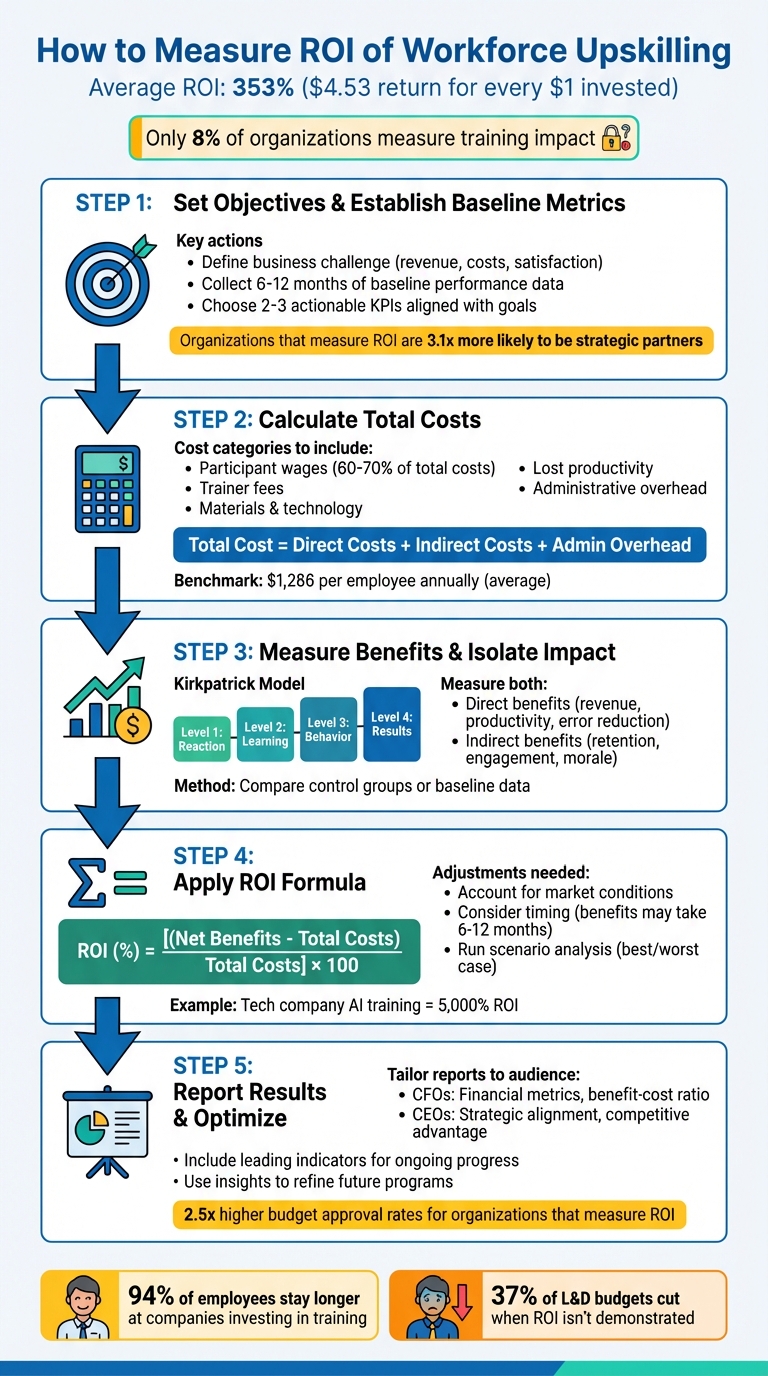
5-Step Process to Calculate ROI of Workforce Upskilling Programs
For companies in the growth stage, every dollar counts. When budgets get tight, training programs often find themselves on the chopping block - 37% of learning and development (L&D) budgets are slashed when ROI isn't clearly demonstrated [3]. Without solid data to back up the value of workforce development, it risks being dismissed as a "nice to have" rather than a critical investment, jeopardizing the broader talent strategy. Understanding the measurable and intangible outcomes of upskilling is essential to counter this perception.
Tracking ROI turns upskilling into a strategic tool rather than a simple expense. It provides the hard evidence executives need to justify training costs and helps identify which initiatives deliver meaningful results. For example, showing that a $200,000 compliance training program saved $1.2 million in fines [9] or that leadership training generated nearly $1 million in additional revenue with a 950% ROI [8] gives decision-makers the proof they need.
But it’s not just about justifying budgets - measuring ROI ensures that training programs align with the company’s larger goals. Whether the focus is on digital transformation, entering new markets, or improving efficiency, tracking ROI means setting clear success metrics that tie training outcomes to business objectives. This is particularly important since 67% of L&D leaders admit they struggle to demonstrate the impact of training to executives [9].
For mid-sized companies in regulated industries, measuring ROI can also act as a safeguard against risks. One financial services firm, for instance, saw a 40% drop in compliance violations after investing in advanced compliance training, which translated to $1.2 million in avoided fines over 12 months [9]. These kinds of results highlight the strategic importance of training investments for growing companies.
To truly understand the value of upskilling, it’s important to look at both measurable and intangible benefits. While not all outcomes immediately show up in financial reports, they still contribute significantly to an organization’s success. Differentiating between these two types of benefits helps paint a complete picture of a training program’s impact.
Measurable benefits are the tangible results that can be quantified in numbers or financial terms. These include things like increased revenue from better sales performance, lower turnover costs (which can range from 150% to 250% of an employee’s annual salary [7]), quicker onboarding for new hires, and fewer operational mistakes. One example is Booz Allen Hamilton’s "Data Science 5K Challenge", which reskilled 25,000 employees, leading to a 4% increase in billables and an 11% boost in talent retention [6].
Qualitative benefits, while harder to quantify, are equally important. These include things like improved employee morale, greater innovation, stronger team collaboration, and a better employer brand. While it’s tough to assign a dollar value to improved collaboration or higher morale, these factors often lead to measurable outcomes over time, such as better retention rates or enhanced productivity.
| Benefit Category | Definition | Examples |
|---|---|---|
| Measurable (Quantitative) | Tangible results expressed in numbers or financial terms | Revenue growth, reduced turnover costs, quicker onboarding, fewer errors, lower compliance violations |
| Qualitative (Intangible) | Hard-to-quantify benefits that improve workplace culture | Higher morale, increased innovation, better teamwork, stronger brand reputation, greater employee loyalty |
The best ROI measurement strategies capture both types of benefits. Measurable data justifies the investment, while qualitative insights provide a fuller picture of how upskilling strengthens an organization’s position. Balancing these two perspectives shows how upskilling drives growth while fostering long-term success.
Before kicking off an upskilling program, it's essential to set clear goals and evaluate current performance. Defining the program’s purpose upfront ensures every dollar spent ties directly to a measurable outcome [1][11]. Without this groundwork, you risk wasting resources without knowing what success looks like.
Start by pinpointing the business challenge you're addressing. Are you aiming to shorten onboarding time? Minimize compliance issues? Boost sales revenue? Set specific goals like increasing revenue, cutting costs, enhancing customer satisfaction, or streamlining financial operations before designing the program [1][11]. For example, a global energy company used this approach during a retail transformation. They trained frontline leaders and ran an A/B test to compare a pilot group to a baseline group. The results? A 3% profitability increase in the pilot group, which justified the program's expansion across the organization [1]. Connecting training efforts to clear business outcomes like this lays the groundwork for measurable ROI.
Establish baseline performance metrics before starting the training. Bruce C. Rudy, Associate Professor at the University of Texas at San Antonio, emphasizes:
"The first step is to quantify baseline performance before training - but it's not enough to assess what the learner already knows. To help you target training to the individuals and teams most in need, you also want to understand how they contribute to team and organizational outcomes" [8].
One legal services firm applied this principle by benchmarking attorney performance. They analyzed inputs like salaries and non-billable hours against outputs like fees and client referrals. This data helped identify underperformers, who then received targeted leadership coaching. The result? A 15% annual increase in billed hours and nearly $1 million in additional revenue [8].
To build a reliable baseline, collect performance data across areas like productivity, quality, customer satisfaction, and retention over 6–12 months. This data becomes your benchmark for measuring improvement down the line [3][15][16].
Once you've set your objectives and gathered baseline metrics, focus on 2–3 actionable KPIs that align closely with your goals [3]. Trying to track too many metrics can dilute your efforts and make it harder to prove impact. Choose KPIs that your team directly influences. For instance, a marketing team should be measured on controllable factors like discretionary spending, not total operational costs [8].
The right KPIs depend on your specific goals. If you're targeting efficiency, track metrics like time to proficiency or units produced per hour. For revenue growth, focus on sales indicators like win rates, average deal size, or sales cycle length. If customer loyalty is your priority, measure Net Promoter Score or first-call resolution rates [3][11]. A company addressing compliance risks might monitor violation rates and fines, while one prioritizing talent retention could track voluntary turnover and internal promotions [1][12].
Interestingly, only 8% of organizations measure the impact of their training programs [3]. Yet, those that do are 3.1 times more likely to be recognized as strategic partners by leadership [3]. Setting clear objectives and baseline metrics isn't just about proving ROI - it’s also key to earning long-term support and investment.
Once you’ve set clear goals and established baseline metrics, it’s time to dive into the numbers. Calculating the total costs of your upskilling program involves looking beyond the obvious expenses - like course fees and materials - to include hidden costs, such as lost productivity and administrative overhead.
Many organizations overlook the full scope of their investment, often underestimating the largest expense: participant time. In fact, participant time typically makes up 60% to 70% of total training costs [3]. Here's how to calculate it:
Participant Cost Formula:
(Training Hours + Pre-work) × Number of Participants × Fully Loaded Hourly Rate
The "fully loaded hourly rate" isn’t just base salary - it includes benefits, payroll taxes, and other compensation. For example, training 200 employees at $65 per hour for 18 hours would result in a participant cost of $234,000 [3].
Don’t Forget Opportunity Costs
Opportunity costs are especially relevant for revenue-generating roles. For instance, when salespeople spend hours in training instead of closing deals, the potential revenue lost can be substantial. For high-impact roles, calculate this lost revenue to get a clearer picture of the true cost [3][14]. Timing matters too - training during peak business periods could amplify these costs.
A real-world example highlights this: Between 2020 and 2021, the European Society of Intensive Care Medicine rolled out the C19_SPACE program across 24 countries, training 17,494 healthcare workers. While development costs (IT, VR content, video) totaled €2.48 million and trainer fees added €1.84 million, the opportunity costs for doctors and nurses - who were pulled away from patient care - amounted to over €15.5 million. This made up 77% of the total €20.1 million investment [18].
Breaking down expenses into clear categories ensures you don’t miss anything. Here’s a sample breakdown:
| Cost Category | Description | Calculation Method | Sample Amount (USD) |
|---|---|---|---|
| Participant Wages | Compensation for training hours | (Training Hours + Pre-work) × # of Participants × Hourly Rate | $234,000 |
| Trainer Fees | Costs for internal or external instructors | Flat fee per session or Hourly Rate × Hours | $16,000 |
| Learning Materials | Books, digital tools, or hardware | Cost per Unit × Number of Participants | $5,000 |
| Technology & Platform | LMS licenses, IT setup, or maintenance | Annual Subscription or One-time Setup Fee | $2,880 |
| Lost Productivity | Revenue lost during training hours | (Average Hourly Wage × Training Hours) × # of Participants | $12,000 |
| Administrative Costs | Time spent on coordination and management | Staff Hourly Rate × Hours Spent on Admin | $12,000 |
| Development Costs | Course design and building | Instructional Design Hours × Hourly Rate | $20,000 |
Administrative labor is another area that can add up quickly. Tasks like program design, promotion, registration, and evaluation often require significant hours from HR, L&D, and management teams. For a mid-sized program, administrative costs alone can reach $5,000 [19].
The formula for total cost looks like this:
Total Cost = Direct Costs (Fees + Materials + Tech) + Indirect Costs (Number of Employees × Training Duration × Hourly Wage) + Administrative Overhead [18][5].
Large companies typically spend around $1,286 per employee annually on training [4]. However, your costs will vary based on factors like program complexity, participant seniority, and the delivery method. Getting these numbers right is critical for evaluating ROI down the line.
Once you've evaluated costs, the next step is to measure the benefits of your program to determine its actual ROI. Surprisingly, only a few organizations take the time to quantify the impact of training. Yet, those that do report an average return of $4.53 for every $1 invested [3]. The tricky part? Proving that the improvements are due to your upskilling program and not external factors like market trends or new technologies.
The Kirkpatrick Model offers a four-level approach for assessing the effectiveness of training programs:
To take it further, the Phillips ROI Model adds a financial layer, helping you calculate the monetary value of training outcomes while accounting for external influences [33,34]. As Disha Gupta from Whatfix puts it:
"If you can add a number – a monetary value – to your L&D program benefits, you will build trust with all teams much faster than you would without a number."
Jack Phillips suggests that only 5–10% of training programs - usually the most costly or strategically important - require a detailed Level 5 ROI evaluation [20].
Direct Benefits
These are tangible outcomes you can measure, such as increased revenue, reduced defect rates, faster production times, or shorter customer service handle times [3,25].
Indirect Benefits
These are less obvious but still valuable. For example, reducing employee turnover saves on recruiting and onboarding costs, while improved customer satisfaction can be tracked through metrics like Net Promoter Scores (NPS) or CSAT ratings [3,35].
| Benefit Category | Direct Metrics (Tangible) | Indirect Metrics (Intangible) |
|---|---|---|
| Sales | Revenue growth, win rates, deal size | Brand reputation, customer loyalty |
| Operations | Error rates, cycle time, units/hour | Team collaboration, stress reduction |
| HR/People | Turnover rate, time-to-proficiency | Employee engagement, culture alignment |
| Customer Service | First-call resolution, handle time | CSAT, NPS, customer complaints |
To prove your program directly caused the improvements, you need to separate its impact from other variables. One way to do this is by comparing a control group or baseline data (collected 6–12 months before training) with post-training results. You can also adjust your estimates based on feedback from participants and managers, applying a confidence factor to refine your analysis [3,33].
For example, in January 2024, a global energy company used A/B testing to assess the impact of training on frontline leaders. The results? A 3% increase in profitability directly linked to the training program [1].
As Jack Phillips wisely advises:
"When in doubt, leave it out: Be conservative in benefit estimation" [3].
Accurate measurement depends on collecting data throughout the program lifecycle:
Organizations that consistently track ROI are 3.1 times more likely to be recognized as strategic partners by their leadership teams [3]. With benefits measured and isolated, you’re ready to apply the ROI formula under different scenarios.
To measure the return on investment (ROI) for upskilling programs, use this formula:
ROI (%) = [(Net Benefits – Total Costs) / Total Costs] × 100 [4].
Here, Net Benefits represent the total financial gains, such as increased productivity, revenue growth, and recruitment savings, minus the program's overall costs. Include all expenses - both direct (like trainer fees, materials, and travel) and indirect (such as wages during training and administrative time). The accuracy of your ROI calculation hinges on using precise financial data rather than rough estimates. For employee time costs, calculate the "fully loaded" cost, which combines salary and benefits divided by annual working hours [21]. Once the core formula is established, tailor your calculations to reflect current market trends and timing differences.
Once you've calculated net benefits and costs, adjust the ROI formula to suit different contexts. For instance, if market conditions improved during the training period, employ trend line analysis to gauge baseline performance without the training program. For initiatives with long-term benefits - like leadership development - track early indicators such as skill assessments or behavioral shifts that eventually lead to measurable financial outcomes [1].
Timing also matters, as the full impact of training may take months or even years to manifest [4]. For companies in growth phases or volatile markets, scenario analysis becomes essential. Take this example from Udemy Business: in 2024, a tech company trained 200 software engineers on AI-assisted coding. Post-training, the engineers saved 3 hours weekly on routine tasks, resulting in annual savings of approximately $2,550,000, based on a fully loaded hourly rate of $85 over 50 weeks. With training costs of $50,000, the ROI reached an impressive 5,000% [21].
Another example is the European Society of Intensive Care Medicine's C19_SPACE initiative (2020–2021). This program trained 17,494 professionals across 24 countries with an investment of €20.1 million. The ROI was calculated at 478%, with a break-even point of just 5.1 days. Scenario analysis showed a best-case ROI of 2,020% (break-even in 1.4 days) and a worst-case ROI of -9.2% (break-even in 33 days) [18].
"Calculating training ROI isn't just about showing value - it's about maximizing your investment in your people and processes" [14].
After determining your ROI, compare it to industry benchmarks, like the average ROI of 353% (or $4.53 in return for every $1 spent). This comparison helps you decide whether to scale, refine, or redesign your training program [3].
When preparing an ROI report, it's essential to tailor it to different audiences. For instance, Chief Financial Officers (CFOs) need to see hard financial data, like the benefit-cost ratio and ROI percentage. On the other hand, CEOs are more interested in how upskilling aligns with strategic goals, such as boosting competitive advantage or supporting long-term business objectives [3]. To meet these needs, your report should include a detailed cost breakdown - covering both direct costs (like vendor fees) and indirect expenses (such as participant time). Use frameworks like Kirkpatrick and Phillips to present multi-level metrics, and explain how you isolated the training's impact from external factors [3].
Since business results often take 6–12 months to fully emerge, include leading indicators to show progress. Metrics like skill assessment scores, behavioral changes noted by managers, or tool adoption rates can provide valuable insights [1][3]. For example, in October 2023, a law firm used balanced benchmarking to identify underperforming attorneys and offered leadership coaching to its partners. By tracking client satisfaction and billed hours, they documented a 15% increase in billed hours, generating nearly $1 million in additional revenue. This effort delivered an ROI exceeding 950% [8].
Currently, only 8% of organizations measure the business impact of training, but those that do are 3.1 times more likely to be seen as strategic partners [3]. Alongside quantitative data, consider adding employee testimonials or success stories to highlight the broader cultural effects of your programs [10]. These insights not only validate the training's success but also provide a roadmap for improving future initiatives.
Armed with clear and actionable reports, you can identify areas that need immediate adjustments to enhance program outcomes.
ROI reports aren't just about showcasing results - they're a tool for continuous improvement. Use the data to pinpoint what’s working and what isn’t. For deeper insights, apply the Success Case Method by interviewing both top and underperforming participants to determine which aspects of the program are effective and which need refining [17].
Monitor interim metrics like enrollment rates, reenrollment trends, and periodic skill assessments. This allows you to make mid-cycle adjustments rather than waiting for the final results [1]. If a program consistently fails to deliver meaningful benefits compared to its costs, it may be time to discontinue it. Maintaining a positive ROI often requires cutting low-value initiatives [13].
Organizations that actively measure and refine their training programs tend to achieve 2.5 times higher budget approval rates for learning and development. Conversely, those that lack ROI data face a 37% likelihood of budget cuts during economic downturns [3]. By focusing on results and a commitment to improvement, you can ensure your training programs remain impactful and cost-effective.
Measuring the ROI of workforce upskilling goes beyond just analyzing numbers - it's about demonstrating value and making informed decisions that benefit your business. By following the five steps outlined in this guide, you can define clear goals, calculate total costs, measure the training's impact, apply the ROI formula, and present results in a way that resonates with stakeholders. This approach shifts upskilling from being seen as an optional expense to a strategic investment that delivers measurable growth.
The numbers tell a compelling story: companies that measure ROI systematically see an average return of $4.53 for every $1 invested, equating to a 353% ROI [3]. Even more, these organizations are 3.1 times more likely to be recognized as strategic partners by their leadership teams [3]. On the flip side, 67% of L&D leaders still struggle to prove the impact of their training programs [9].
"The successful companies of the future will not only invest in human capital but also track and report progress with the same attention they devote to other assets." - Boston Consulting Group [1]
ROI measurement isn’t a one-and-done exercise; it’s an ongoing process. Use the insights from your analysis to refine programs, eliminate initiatives with low impact, and scale those that deliver results. Whether it's cutting employee turnover by 30% to 50% [2] or increasing productivity by 14% through focused reskilling efforts [4], these insights ensure workforce development aligns with your company’s broader goals.
For businesses navigating complex financial decisions, having the right expertise is critical. Phoenix Strategy Group offers fractional CFO services and FP&A support to help companies measure key metrics, optimize investments, and scale effectively.
The fastest way to gauge the return on investment (ROI) for upskilling, even with limited data, is by concentrating on leading indicators. These include factors like improved employee productivity, efficiency improvements, and sustained business growth. Focus on metrics that clearly demonstrate impact, such as time savings, cost reductions, or increases in revenue. Use data that is easy to access and directly supports your company’s objectives.
To understand the real impact of training - separate from market shifts or team dynamics - focus on tracking performance changes directly linked to the program. Start by setting clear objectives and measurable KPIs that align with the training’s goals, like productivity gains or reduced time-to-competency. Then, compare data from before and after the training, making sure to account for external factors. Using control groups or benchmarks can also help provide a clearer picture. By monitoring these metrics over time, you can pinpoint improvements that stem specifically from the training, while filtering out unrelated influences.
When it comes to proving the value of upskilling to a CFO, focusing on measurable outcomes is key. Metrics like performance improvements, productivity gains, and quality of work can clearly highlight the impact of these initiatives.
Other critical indicators include time-to-competency - how quickly employees master new skills - and the achievement of specific business goals tied to the upskilling efforts. These KPIs not only provide a clear financial perspective but also demonstrate how upskilling aligns with the company’s broader strategic objectives.