Published on
April 25, 2026


Media companies face unique financial challenges: they invest heavily in content upfront, but revenue often takes years to materialize. Add unpredictable income streams dependent on hits, and the stakes are high. Aligning capital with growth requires clear financial goals, strategic funding methods, and a balanced mix of debt and equity. Key steps include:
Before aligning your capital with growth, you need a solid understanding of your current financial situation and your future ambitions. Media companies often have intricate capital structures that have evolved over time. Grasping this foundation is a crucial step in making smarter financing decisions.
Start by diving into the numbers that reflect your company's financial health. One essential metric is the debt-to-equity ratio. While high debt can indicate risk, it might also show a strategic use of intellectual property (IP) to leverage growth.
Pay close attention to cash flow, especially since media businesses often face irregular revenue cycles tied to production schedules. Instead of relying on a single quarterly snapshot, monitor working capital averages to get a clearer picture of liquidity over time[4].
Revenue diversification is another critical factor. Breaking down your income into categories - like production-for-hire, IP licensing, advertising partnerships, distribution fees, and merchandising or event revenue - offers a clearer view of how sustainable your growth might be[4]. Total revenue alone doesn’t tell the full story.
A formal IP library valuation can also provide insight into the assets supporting your capital structure[3]. Your library could include global formats or digital distribution opportunities capable of generating efficient cash flow. This valuation helps you understand the true potential of your IP assets.
Finally, review both your IP valuation and external funding costs to uncover hidden expenses that might hinder growth. For instance, some partnerships may seem appealing but carry hidden costs like profit-sharing or creative control limitations. Identifying these factors ensures your financing decisions align with your growth goals[3].
These steps lay the groundwork for defining clear and actionable growth targets.
To make informed capital decisions, you need measurable goals. For example, Vice Media, after restructuring, aimed to shift from 65% service-based revenue to 60% IP-owned revenue within five years. This plan also included boosting their EBITDA margin from 8% to 18%[4]. Such specific targets allow for a well-structured capital strategy over a multi-year timeframe.
Set concrete goals around areas like content production, market expansion, or distribution. If scaling digital distribution is on your radar, calculate the required investment and estimate the timeline for returns. Similarly, if entering new geographic markets, outline revenue goals and the capital needed for partnerships or licensing agreements.
Another key consideration is your windowing strategy - the timing and sequence of content releases across platforms[3]. Optimizing this process can improve cash inflow timing, making it easier to manage debt and reinvest in future projects. A well-executed windowing plan transforms growth objectives into actionable financial milestones.
If you’re transitioning from a production-for-hire model to IP ownership, track this shift carefully. For instance, moving even a single percentage point in your revenue mix requires thoughtful capital allocation decisions over three to five years[4]. This roadmap will guide your choices between debt, equity, or alternative financing options.
With these goals clearly defined, you’ll be ready to fine-tune your financing strategy to support your ambitions effectively.
After evaluating your financial position and growth goals, the next step is finding the financing model that aligns with your needs. Media companies today have options beyond the traditional equity-vs-debt choice, each offering different benefits and trade-offs in terms of ownership, risk, and repayment.
Equity financing involves selling ownership stakes to investors, such as venture capital or private equity firms. This method provides significant capital without requiring repayment, making it appealing for high-risk projects or rapid growth. A key advantage is risk sharing - if the project doesn’t perform well, investors share in the losses.
However, equity financing has its downsides. Investors usually take ownership stakes ranging from 20% to over 50% and often expect a role in strategic decision-making, which could limit your creative control. Additionally, they typically require a return of 110% to 125% of their investment before profit sharing begins [6].
On the other hand, debt financing offers an alternative that allows you to maintain full ownership.
Debt financing provides access to capital through loans, lines of credit, or mezzanine financing while allowing you to retain complete ownership. This option works well for companies with strong collateral, such as pre-sale contracts or an established intellectual property library. For example, senior debt might carry interest rates of Prime plus 2% to 5%, while higher-risk gap financing - used to cover the final 10% to 15% of a budget - can range from 8% to 15% [6].
While debt financing preserves ownership and creative independence, it comes with fixed repayment terms, which can pose challenges during revenue shortfalls. To secure this type of financing, you may need a completion bond (costing 3% to 6% of your budget) to ensure your project is finished on time and within budget [6]. However, declining pre-sale volumes for smaller projects - like the 23% drop for independent films under $10 million between 2019 and 2023 - have made traditional debt financing harder to access for some [6].
Revenue-based financing (RBF) offers a flexible option that doesn’t require giving up ownership or committing to fixed payments [5]. Instead, you receive upfront capital in exchange for a percentage of future revenues until a set return multiple is reached - typically 1.5× to 3× the original investment [5]. This model shifts risk from your balance sheet to your project’s performance. If revenues dip, payments adjust proportionally, rather than staying fixed.
RBF is particularly well-suited for media companies with steady revenue streams from subscriptions, licensing, or digital distribution. Revenue-sharing terms generally range from 5% to 15% of monthly net receipts, with repayment periods lasting three to five years [5].
A notable example of this model in action is Hipgnosis’ $1.47 billion asset-backed securities deal in 2024, which was collateralized by royalty streams from around 45,000 songs [1]. Similarly, Apollo Global Management invested $700 million into Sony Music Group, giving clients access to high-grade securities backed by music royalty revenues [1].
Providers like Lighter Capital offer RBF deals ranging from $50,000 to $4 million. Conservative arrangements typically aim for return multiples between 1.35× and 2.5×, while higher-risk projects may require multiples from 2.5× to 4× [5]. Many RBF agreements also integrate direct API connections with streaming platforms like Netflix and YouTube, allowing for real-time revenue tracking and transparent reporting [5].
The right mix of financing options can set the stage for growth and success. For expert advice, consider working with Phoenix Strategy Group (https://phoenixstrategy.group), which offers tailored financial and strategic guidance to help media companies secure funding, scale effectively, and prepare for future opportunities.
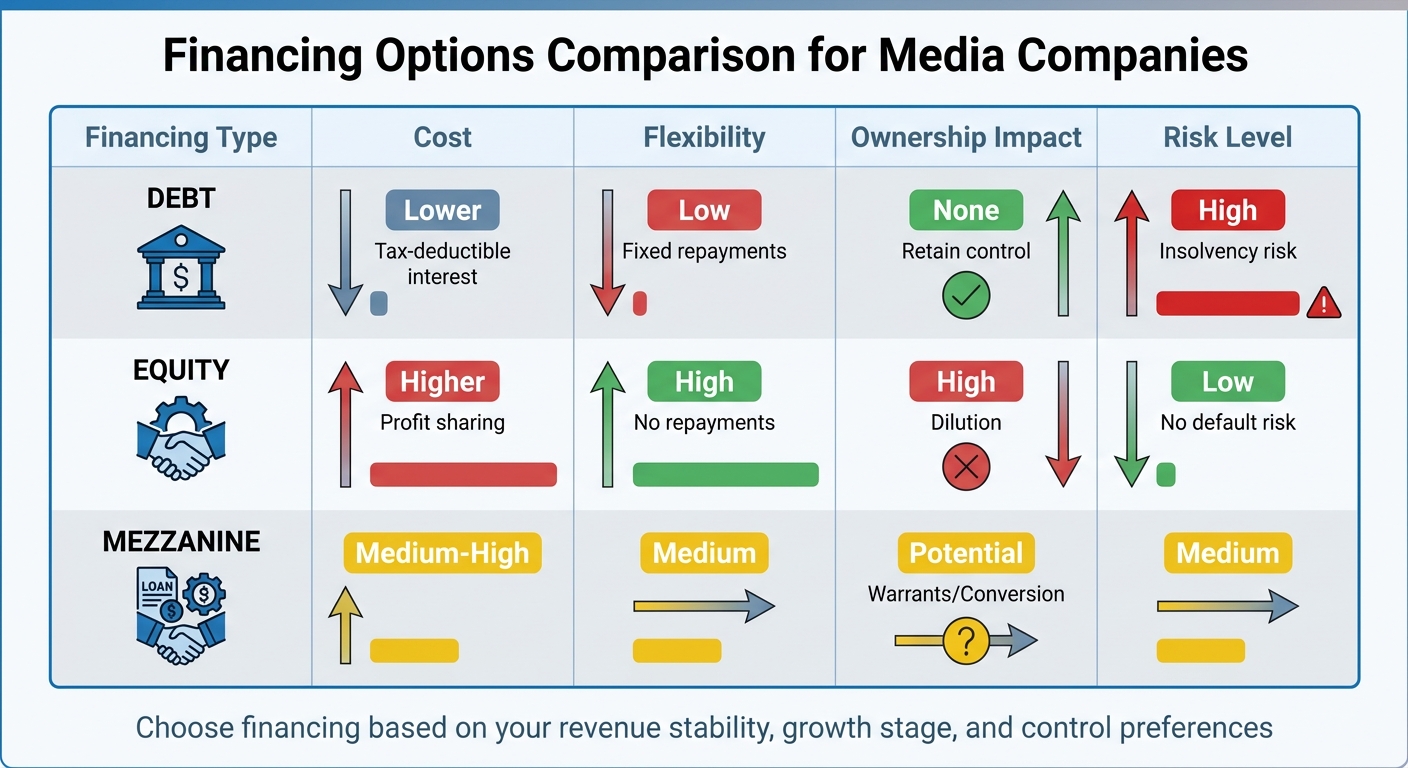
Media Company Financing Options Comparison: Debt vs Equity vs Mezzanine
Getting the balance right between debt and equity is a key part of fueling growth after evaluating your financial health and setting clear objectives. Striking this balance helps lower your overall cost of capital while keeping you nimble enough to adapt to market changes.
To find the optimal mix, calculate your Weighted Average Cost of Capital (WACC). This will help you determine whether taking on more debt (which offers tax-deductible interest) or raising equity (which provides more flexibility) aligns better with your current needs.
It's also important to forecast cash flows by examining patterns like revenue decay and spending trends. This ensures you have the capacity to meet fixed debt obligations. If your revenue is prone to significant fluctuations, equity financing might be a safer choice, as it avoids the risk of insolvency during slow periods. These models give you a structured way to weigh the costs, flexibility, and risks of different financing options.
Each financing option comes with its own set of trade-offs. Knowing these differences allows you to align your capital strategy with your business stage and cash flow dynamics.
| Financing Type | Cost | Flexibility | Ownership Impact | Risk Level |
|---|---|---|---|---|
| Debt | Lower (Tax-deductible interest) [7] | Low (Fixed repayments) [7] | None (Retain control) [7] | High (Insolvency risk) [7] |
| Equity | Higher (Profit sharing) [7] | High (No repayments) [7] | High (Dilution) [7] | Low (No default risk) [7] |
| Mezzanine | Medium-High [7] | Medium [7] | Potential (Warrants/Conversion) [7] | Medium [7] |
Mezzanine financing, a blend of debt and equity, offers a middle-ground solution. While it tends to be pricier than standard debt, it’s generally cheaper than equity. It often includes features like warrants or conversion rights, which allow lenders to gain ownership if specific goals are achieved. This option is especially useful for businesses, like media companies, that need growth capital but want to avoid immediate dilution and maintain financial flexibility.
Once you've fine-tuned your capital mix, the next step is weaving financial strategies into your daily operations. This means setting up systems that transform financial data into actionable steps and collaborating with advisors who understand the unique challenges of scaling media businesses.
Media companies often need top-tier financial oversight but may not have the budget for a full-time executive team. This is where fractional CFOs and advisors come in. They can turn raw financial data into growth opportunities by implementing automated finance tools and real-time dashboards[8].
Phoenix Strategy Group, for instance, specializes in fractional CFO services and FP&A systems tailored to growth-stage companies. Their services include creating integrated financial models, setting up weekly cash controls, and mapping out milestone-based roadmaps. These tools help communicate operational progress clearly to investors.
With professional financial oversight, you could extend your cash runway from 6 months to 18 months and improve EBITDA margins from 8% to 19% - a major boost for growth-stage consumer media companies[8]. When seeking growth capital, structure your pitch using the "Thesis-Evidence-Upside" framework. Start with the market opportunity, back it up with performance data, and then outline the potential for future growth[9].
Having the right advisory support ensures that your key metrics consistently align with sustainable growth goals.
To keep your capital and growth strategies aligned, it's crucial to monitor key financial metrics regularly. For instance, use "runway math" to evaluate both your content runway (how long you can maintain quality production) and your revenue runway (how long your operations can sustain themselves with current cash flow)[9].
Instead of focusing solely on market valuation expectations, prioritize metrics that highlight your business's core value[11]. Key performance indicators like reach, retention, and conversion rates provide a clearer picture of audience engagement than follower counts alone. Additionally, track how effectively your capital drives growth at critical turning points[12].
Don't overlook the importance of analyzing the impact of media investments across different channels - whether it's TV, streaming platforms, out-of-home advertising, or digital campaigns. Understanding these metrics can guide smarter decisions as you scale your business[10].
Aligning your capital structure with your business goals is not a one-time task - it’s a continuous effort that demands thoughtful evaluation, strategic planning, and expert input. Begin by analyzing your financial metrics, setting clear growth objectives, and identifying the ideal blend of equity, debt, and alternative financing that fits your revenue model.
Getting this balance right is essential. For instance, 94% of media fund managers are expected to either increase or maintain their media capital allocations by 2025 [2]. On top of that, media companies that fine-tune their financing strategies can reach mass-market penetration up to five years earlier than those relying on older growth models [2].
Expert guidance can turn raw financial data into actionable strategies. Phoenix Strategy Group offers fractional CFO services and FP&A systems to help media companies create integrated financial plans, enforce disciplined cash management, and design milestone-driven roadmaps. These measures can extend cash runways and improve EBITDA margins.
Keep a close eye on the metrics that truly matter - such as content runway, revenue runway, audience reach, retention, and conversion rates. These indicators provide a clearer view of sustainable growth than vanity metrics, ensuring your capital allocation stays aligned with your evolving goals.
When your capital structure and growth strategy are in sync, your media company can scale more quickly, operate more efficiently, and build lasting competitive advantages.
To figure out whether your company can handle more debt without jeopardizing its financial health, you need to evaluate its risk and flexibility within its capital structure. Pay attention to factors like the Weighted Average Cost of Capital (WACC), how stable your cash flow is, and how much your revenue fluctuates over time.
It's also wise to keep an eye on market trends, adjust your capital structure when necessary, and consider a variety of funding options. Bringing in financial advisors can provide valuable guidance, helping you make choices that align with your company's operational goals and growth plans.
A media company might want to explore revenue-based financing (RBF) if it’s looking for a funding option that adapts to its revenue performance. Unlike traditional loans, RBF doesn’t involve fixed payments or giving up ownership. Instead, repayments are tied directly to the company’s income, making it easier to manage during periods of revenue ups and downs.
This approach works especially well for companies with steady or growing revenue streams. It provides upfront capital while aligning repayment risks with how well the company’s content performs. For media businesses, this flexibility can be a game-changer when navigating unpredictable market conditions.
Key metrics to watch are revenue growth (frequently surpassing 100%), gross margins (typically around 80% or more), and customer retention rates. These numbers highlight how efficiently the business operates and its ability to scale over time. They also provide insight into whether content investments are likely to yield strong returns.