Published on
April 25, 2026


SaaS costs are growing fast, and many companies are overspending by 20–30%. CFOs can save significant money by negotiating smarter with SaaS vendors. Here’s how:
Fractional CFOs often find themselves at a disadvantage when negotiating with vendors. Why? Because vendors have a wealth of data about your company's usage patterns, while you might have little to none unless you specifically ask for it. Sales teams are armed with dashboards that track everything from login frequency to feature adoption and peak usage trends - details you need to level the playing field.
Before signing any contract, insist that vendors provide detailed usage reports in these four areas:
This data is more than just numbers - it’s leverage.
"Vendors know exactly what you're paying, your usage patterns, your renewal date, and what similar customers pay. You typically know none of these things." - Kost Kompass [6]
Once you have granular data, you can calculate the true cost per active user. Here’s an example: if you’re paying $50,000 annually for 100 seats, the apparent cost is $500 per seat. But if only 60 employees are actively using the tool, the real cost jumps to $833 per active user [6]. That’s a major difference - and a clear signal that adjustments are needed.
To optimize your SaaS spending, align this usage data with your contract terms. Identify licenses that have been unused for 90 days (or 30 days for high-cost tools) and flag them for removal [7]. Better yet, negotiate API access or admin dashboard exports into your contract so you can monitor activity continuously instead of relying on vendor reports once a year [1]. Start gathering this intelligence 90 to 120 days before your renewal date to avoid being caught in auto-renewal traps [6][2]. This proactive approach has uncovered significant waste for many businesses, turning what was once lost money into powerful negotiation ammunition.
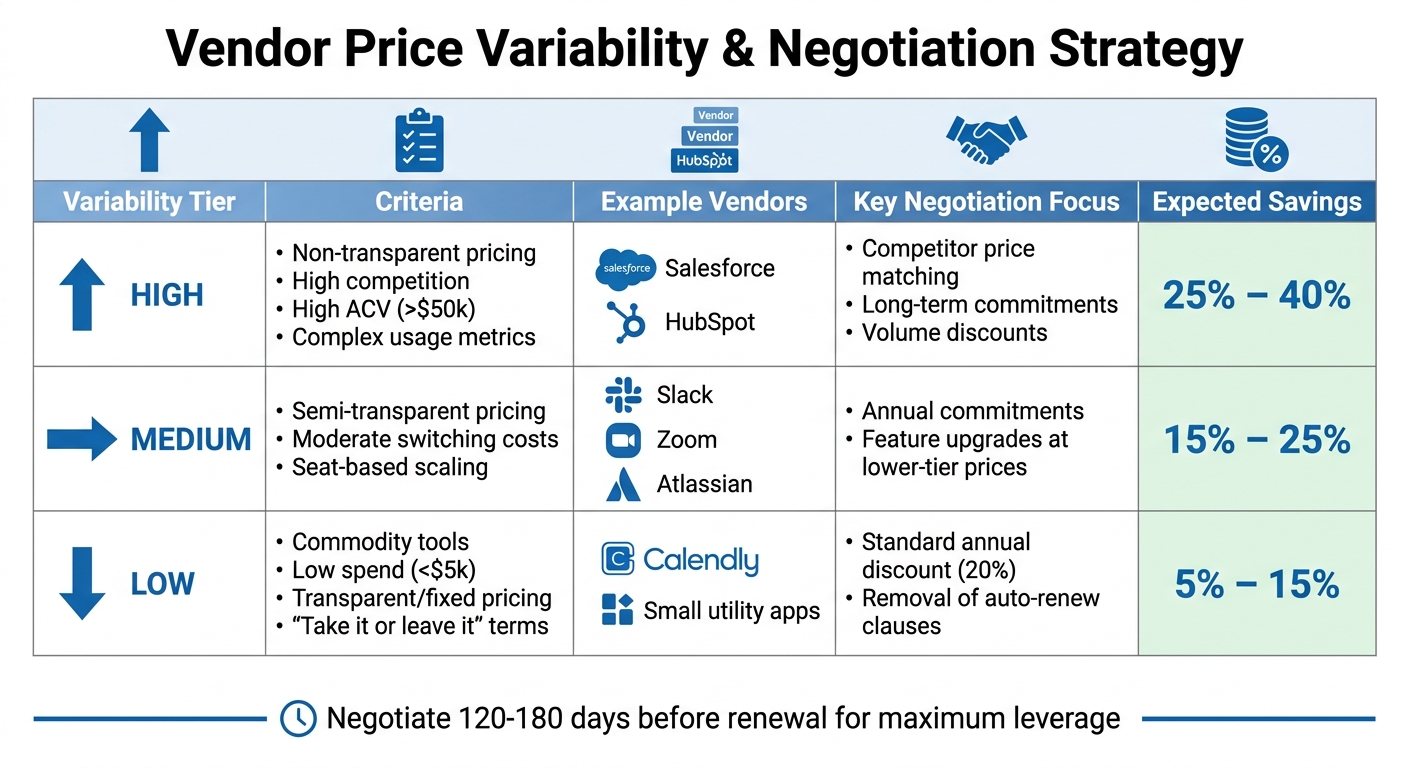
SaaS Vendor Price Variability Tiers and Negotiation Strategy Guide
Once you've analyzed your usage data, the next step is to refine your strategy by grouping vendors based on how flexible they are with pricing. Not all SaaS vendors approach pricing the same way - some are open to negotiation, while others stick firmly to fixed rates. The trick is knowing where to spend your time and energy to get the best deal.
Start by dividing vendors into three tiers based on their pricing variability: high, medium, and low. This categorization depends on factors like contract value, pricing transparency, switching costs, and competitive market pressure. Here's how these tiers typically break down:
"Almost every price is negotiable. That sticker price on their website is a starting point, not a ceiling." - Arthur Jacquemin, Founder & Lead Analyst, CompareTiers [9]
Timing can significantly impact your negotiation leverage. Vendors are often more willing to negotiate at the end of their fiscal year or quarter when sales teams are under pressure to meet revenue targets. For example, Salesforce’s fiscal year ends on January 31, Microsoft’s on June 30, and Adobe’s on November 30 [6][9].
For high-variability vendors, presenting a competitor’s quote during negotiations can often secure discounts of 10% to 30% [9]. With low-variability vendors, instead of pushing for steep discounts, focus on locking in price caps for annual increases, ideally keeping them between 3% to 5% [6][9].
Here’s a quick reference table to help you categorize vendors and focus your negotiation strategy:
| Variability Tier | Criteria | Example Vendors | Key Negotiation Focus | Expected Savings |
|---|---|---|---|---|
| High | Non-transparent pricing, high competition, high ACV (>$50k), complex usage metrics | Salesforce, HubSpot | Competitor price matching, long-term commitments, volume discounts | 25% – 40% |
| Medium | Semi-transparent pricing, moderate switching costs, seat-based scaling | Slack, Zoom, Atlassian | Annual commitments, feature upgrades at lower-tier prices | 15% – 25% |
| Low | Commodity tools, low spend (<$5k), transparent/fixed pricing, "take it or leave it" terms | Calendly, small utility apps | Standard annual discount (20%), removal of auto-renew clauses | 5% – 15% |
To make the most of your vendor negotiations, prepare well in advance of renewal dates [6]. Use your usage data to identify underutilized licenses - if, for instance, 40% of your licenses are sitting idle, that vendor should move to the top of your negotiation list [6]. For high-variability vendors, establish a BATNA (Best Alternative to a Negotiated Agreement) by securing quotes from competitors [6][8]. This gives you the leverage to walk away if the vendor refuses to meet market standards. Most vendors won’t risk losing a customer over a 20% to 30% discount [9].
After analyzing pricing variability, CFOs should turn to industry benchmarks to sharpen their negotiation tactics and manage SaaS expenses more effectively. Without these benchmarks, you're essentially negotiating in the dark. Consider this: the average enterprise overpays by 31%, with some paying as much as 60% more than necessary [13]. This gap exists because vendors typically have a much deeper understanding of market pricing than CFOs.
To level the playing field, gather real pricing data before entering renewal discussions. Tools like VendorBenchmark, which analyzes over 4 billion contract data points from Fortune 1000 companies [11], and CompareTiers, which tracks 521 tools across 15 categories [14], can be especially helpful. These platforms reveal patterns in negotiated discounts - like Salesforce deals, which can vary from 15% to 62% depending on the negotiation [11]. Similarly, platforms such as Spendflo and SpendHound offer insights into anonymized spend data from over 1,000 companies [12][15].
"The median enterprise is overpaying by 31% compared to comparable accounts. Some are overpaying by 60%." - Fredrik Filipsson, Co-Founder, VendorBenchmark [13]
This data isn't just for reference - it’s a powerful tool in negotiations. For instance, if your Oracle Database Enterprise Edition renewal is priced 28% above market rates [11], use that benchmark to push back with your account manager. For cloud services, secure competitive quotes - like comparing an Azure MACC against an AWS EDP. Even if switching providers isn’t your plan, having a viable alternative strengthens your bargaining position. Benchmarks can also highlight hidden costs, such as Enterprise Support, which is often listed at 15% but can be negotiated down to 3–6% for larger accounts [13].
Timing matters just as much as data. Before signing, model potential usage scenarios - calculate costs at 2x to 5x your expected volume to avoid unpleasant surprises [14]. Additionally, benchmarks show that for every 10% of compute spend covered by Reserved Instances or Savings Plans, companies save around 2.5–3% of their total cloud expenses [13]. These insights come from comparing your contracts to those of peers who’ve already optimized their spending.
Once you’ve gathered benchmark data, the next step is to lock in predictable costs through usage buffers and price caps. This ensures spending remains steady and avoids surprises like automatic renewal price hikes (typically 5%–15% [9]) or unexpected overage fees. By focusing on these protections, you can build on earlier strategies to maintain cost stability.
Start by addressing renewal price caps. In 2025, SaaS pricing increased by 8.7% year-over-year - almost five times the G7 inflation rate [18]. Vendors like Salesforce and Microsoft often include annual price increases of 6% to 9% [18]. To counter this, negotiate a cap of 3% to 5% on annual price hikes [7, 24]. Avoid contracts with vague terms like "then-current market rates", as they eliminate predictability and give vendors control over future pricing [5].
For usage-based pricing models, it’s important to negotiate flexible buffers. A usage buffer acts as a soft limit, allowing you to exceed your allocated threshold without immediately incurring overage fees [17]. Additionally, request quarterly "True-Up" billing to defer charges for occasional spikes in usage, rather than paying for peak capacity year-round. For tools like storage or API calls, include rollover clauses so unused credits carry over instead of expiring [18].
To further control costs, ensure your contract includes provisions to adjust capacity based on actual usage. For example, secure downsizing rights upfront. If your company scales down or a department reduces headcount, you should have the option to reduce seat counts or downgrade feature tiers mid-contract [11, 12]. Before signing, review actual usage data - such as active users, feature adoption, and storage consumption - to avoid over-provisioning. Studies show that organizations typically use only 47% of their purchased SaaS licenses, leading to an estimated $21 million in annual waste for large enterprises [18].
"The 'Renewal Price Cap' is the single most valuable clause for long-term cost control." - Lejay Ghost [18]
For mission-critical tools with high switching costs, consider negotiating 1- to 3-year price locks. This avoids the hassle of annual negotiations and protects against inflation [10]. Start these discussions at least 90 days before your opt-out date. Missing this window can weaken your leverage and result in automatic renewals at higher rates [6, 7].
Once you've tightened up vendor contracts, the next step is to take a closer look at your software stack. An internal audit can reveal surprising savings by cutting out redundant tools and unused features. In fact, finance teams often uncover 20% to 30% of recoverable spend from unused licenses and duplicate tools [7]. For companies with 50 to 500 employees, software expenses can add up fast - ranging from $4,800 to $5,600 per employee annually [7].
To get started, gather 12 to 24 months of transaction data from your accounting software and corporate card statements. Focus on recurring charges, then cross-check this data with SSO logs from platforms like Okta or Google Workspace. These logs help identify all active applications and, importantly, show when they were last used [7]. Dormant tools can be flagged using inactivity thresholds - 90 days for standard tools and 30 days for high-cost licenses [7].
Next, organize the tools by department and function. This step makes it easier to spot overlapping solutions, like having multiple project management or e-signature platforms. Consolidating these tools can lead to significant savings [2]. Pay attention to license tiers as well. Studies reveal that 40% of users only need basic features, yet many are tied to higher-cost enterprise plans - like paying $45/month when a $15/month plan would suffice [7].
Another common issue is "orphaned licenses" left behind by former employees. Cross-reference active licenses with your HR roster to identify these "zombie" accounts. When employees have access to 20 to 30 tools each, these inefficiencies can quickly spiral out of control if not addressed [7]. Cleaning up these accounts not only reduces waste but also strengthens your negotiating power with vendors by providing clear usage data.
"If only 60% of your licenses see regular use, that's a factual case for right-sizing the contract." - Brian, Cash Flow Desk [7]
To maximize your leverage, start this audit 90 to 120 days before contract renewals. Use the data to build a case for reducing seat counts or downgrading licenses, potentially saving 15%–30% on annual contracts [1]. Armed with these insights, you'll be in a stronger position to negotiate better terms during renewal discussions.
Once you've identified redundant tools, the next step is to streamline procurement by clearly defining roles using the RACI framework. Why is this so important? A lack of clear ownership in SaaS procurement often leads to inefficiency. In fact, 70% of IT leaders report that business units purchase more cloud and SaaS offerings than IT is even aware of [17]. This "shadow SaaS" phenomenon not only results in duplicate spending but also weakens your bargaining power when multiple departments negotiate with vendors independently.
The RACI framework helps tackle these challenges by assigning four distinct roles for every software purchase:
Assigning these roles brings order to what can otherwise be a chaotic process. It also ensures that earlier efforts to consolidate tools and eliminate redundancies are supported by unified negotiation and contract management.
As Sara Yamase, Partner at Simon-Kucher Partners, puts it:
"Someone needs to own the decision, and the rest of the team needs to know their role" [17].
The framework also helps align priorities before vendor discussions. For example, if your engineering team requests specific features, finance pushes for quarterly payment terms, and legal demands tight data clauses, these requirements should be synchronized in advance to strengthen your negotiating position [5].
Beyond negotiations, the RACI framework helps reduce "orphaned tools" - applications without clear ownership that quietly inflate costs. For each SaaS tool, assign:
To avoid surprises, set automated reminders 120, 90, and 60 days before renewal dates. This allows enough time for thorough reviews and renegotiations.
Finally, standardize your procurement intake process. Require every department head to provide business justification, confirm budget alignment, and complete security checks before engaging with a vendor. This prevents late-stage finance involvement, which often leads to auto-renewals and weakens your ability to negotiate [2]. It’s worth noting that nearly 40% of organizations spend over $1 million annually on SaaS, yet 16% have no regular process to review these expenses [19]. A centralized RACI framework ensures every dollar spent is accounted for, with clear ownership and accountability at every step.
Working closely with department heads before starting negotiations can turn a routine renewal into a well-planned, strategic discussion. Ideally, this collaboration should begin 60 to 90 days before the renewal or cancellation deadline [6][10]. By preparing early, companies can often achieve price reductions of 15–25% compared to auto-renewal rates, avoiding the 20–30% in savings typically missed when taking a reactive approach [6].
Start by collecting data on actual software usage versus licensed capacity. Document service performance, including any downtime or support issues, and gather future growth plans from each department. Ask department heads for details on active users, feature adoption rates, and usage patterns. This information helps identify which features are truly essential and which are optional extras. With this insight, you can evaluate whether teams could operate effectively on lower pricing tiers, allowing for better negotiation of usage buffers and discounts [6][1].
Work together with department heads to pinpoint credible competitors and calculate the total cost of switching, including retraining staff, transferring data, and any potential productivity losses. For enterprise SaaS applications, these switching costs can often be two to three times the annual contract value [6]. This analysis helps establish a clear walk-away point if negotiations don’t go as planned [6].
"Renewal outcomes improve dramatically when Finance, IT, Procurement, and business unit owners share accountability rather than treating renewals as a procurement-only function." - Ty Sutherland, Chief Editor at Kost Kompass [6]
Using a chargeback model, where software costs are assigned to individual department budgets, can also be highly effective [1]. This method encourages department heads to take ownership of their software spending, making them more critical of unnecessary requests and motivated to cut waste. Additionally, unified feedback from all departments strengthens your negotiating position. It prevents vendors from using a "divide and conquer" strategy by obtaining conflicting information from different teams, ensuring your approach remains consistent and data-driven [8].
Strong internal alignment is just the beginning - long-term vendor relationships take your cost-control efforts to the next level. By forming strategic partnerships, you can lock in better pricing and improve efficiency. Multi-year agreements, for example, eliminate the need for yearly renegotiations and often come with economies of scale. As the overall contract value grows, the cost per unit usually drops. This is especially useful for tools that require significant setup time, where frequent migrations can disrupt workflows and waste your investment in training and implementation [20].
Transitioning from a one-off transactional approach to a collaborative partnership starts with setting clear expectations, agreeing on shared goals, and establishing realistic timelines. This creates a better foundation for negotiations. In fact, multi-year contracts can often lead to an additional 10–20% discount compared to annual agreements [6]. To ensure budget stability, it’s also smart to negotiate hard caps on future price increases, typically in the range of 3–5% [6][5].
You can also leverage non-monetary benefits to get more value out of your partnerships. For example, offering to act as a reference customer or participate in case studies can help you negotiate waived fees or deeper discounts [5]. If you’re planning to scale, committing to a certain number of new users over the next year can give you leverage to secure better volume-based pricing now [5]. This “give-get” strategy shifts negotiations from being purely about price to a collaborative effort where both parties win.
"Rather than focusing on a quick sale, starting from a healthy playing field in terms of deadlines, goals, and expectations can change the tone of a software negotiation and long-term relationship." - Vendr [20]
Here’s another critical point: 80% of SaaS vendors are likely to change their pricing model within a year to test its impact on revenue [20]. That’s why it’s crucial to include price protection clauses in your contracts. Additionally, always negotiate to remove auto-renewal clauses, which can lock you into unexpected price hikes. For software requiring extensive implementation timelines, committing to a two-year term or longer ensures you maximize your return on setup costs while maintaining leverage for future negotiations [20].
When paired with accurate usage data and a collaborative procurement process, long-term vendor partnerships become a cornerstone of effective cost management. This approach not only reduces expenses but also sets the stage for smarter strategies around renewals and contract alignment.
When it comes to SaaS renewals, timing can make or break your negotiation success. Starting negotiations at least six months before your contract expires can lead to savings of 15–25% [6]. On the other hand, waiting until the last minute signals to vendors that you're short on time, which weakens your ability to negotiate effectively.
"The biggest single factor in negotiation success is starting early enough that the vendor knows you have time to switch." - Ty Sutherland, Chief Editor, Kost Kompass [6]
Kicking off the renewal process 120–180 days before a contract ends gives you the breathing room to gather usage data, pinpoint unused licenses, and avoid missing cancellation deadlines. Many contracts require 30–90 days' notice to prevent auto-renewals, which often come with price hikes of 7% or more [6][10]. For larger contracts - those exceeding $100,000 annually - starting negotiations at least 150 days in advance is recommended [6]. This early preparation also sets the stage for co-terming, a strategy that can dramatically improve your bargaining position.
What is co-terming? It’s the practice of aligning renewal dates for multiple products from the same vendor (e.g., Microsoft, Adobe, or Atlassian). This allows you to negotiate a single, unified agreement. By bundling renewals, you not only streamline vendor relationships but also increase your importance to the vendor. This often translates to better pricing [5][6]. Additionally, timing co-termed negotiations to match the vendor's fiscal year-end - such as January 31 for Salesforce, June 30 for Microsoft, or November 30 for Adobe - can help you take advantage of sales teams pushing to meet their quotas [6].
When early renewal planning and co-terming are combined, you maximize your leverage. Multi-year agreements negotiated under these conditions can secure discounts of 10–20% and lock in annual price increase caps, usually in the range of 3–5% [6]. Beyond the financial perks, this approach also simplifies contract management by reducing the number of renewal cycles your team needs to monitor throughout the year.
After implementing negotiation tactics, the next step is to carefully examine your contracts for hidden costs. Just like analyzing usage data or aligning with vendors, digging into your contract terms can help you avoid unexpected expenses.
SaaS contracts often include auto-renewal clauses that can trap you into paying for another year of services unless you cancel within a specific timeframe - usually 30 to 90 days before the renewal date [4][5].
"The easiest contract to lose money on is the one you forgot renews itself."
- Prashant Yadav, SaaS Specialist [4]
Another sneaky cost to look out for? Price escalation clauses. These allow vendors to increase prices annually, often without a cap. Some contracts vaguely state renewals will be at "then-current rates", which can lead to jumps of 5–10% or more [5][23]. To avoid this, negotiate a fixed cap on price increases. For usage-based contracts, consider requesting "soft limits" or usage buffers to prevent surprise overage fees [17].
Unused licenses, often called "shelfware", are another hidden expense. Without regular audits, these unused or "zombie" licenses can quietly drain your budget [16][21]. Before renewing, analyze your actual usage data and adjust license counts accordingly. Be sure to also check for termination fees, data export charges, and any mandatory premium support tiers that might inflate your overall costs [5][22].
Modern tools can make this process easier. AI-powered solutions can quickly scan contracts, flagging problematic clauses like one-sided liability terms or vague uptime guarantees [16][22]. These tools can even benchmark your pricing against anonymized industry data to see if you're overpaying [3][16].
"We saved over $300K on 3 vendors just by using CloudEagle's negotiation team."
- Procurement Head, Series D Fintech [16]
To stay ahead, set up automated alerts at 90, 60, and 30 days before your contracts renew [10][22]. Push for renewal terms that require explicit written approval rather than automatic rollovers [23]. These small adjustments can save you thousands of dollars annually by eliminating unplanned expenses.
Negotiating SaaS contracts requires a focused, data-driven approach that safeguards margins and improves financial forecasting. By applying the strategies discussed - such as requesting usage data, timing renewals strategically, and auditing for hidden costs - CFOs can address the 20–30% overspend many companies face with SaaS expenses [2]. Starting negotiations early and steering clear of missteps like disclosing your budget upfront can lead to cost reductions of 15–25% compared to auto-renewals [6].
The foundation of successful negotiations lies in leveraging usage data to align licenses with actual needs. Beyond pricing, it’s important to negotiate terms like capping annual price increases at 3–5% and securing service level agreements (SLAs) with strong uptime guarantees [6][16]. Keeping a credible walk-away option and resisting initial offers can further strengthen your position. Over time, these adjustments can shift SaaS from being a cost burden to a strategic advantage.
To make sure you're getting the most out of your SaaS investments, gather key data points like actual usage metrics, consumption patterns, and utilization rates. This information can help you pinpoint underutilized licenses, cut down on wasted expenses, and keep your SaaS spending efficient and aligned with your needs.
To secure a fair renewal price cap, start negotiations at least 90 days before the renewal date. This timing works in your favor, as vendors often feel the pressure to close deals before deadlines. Aim to keep any price increases within the industry standard range of 8-12%, or push for added perks like discounts, upgraded features, or volume-based pricing.
Remember, most SaaS contracts costing over $1,000 per year are open to negotiation. Use industry benchmarks and your budget as a guide to set a cap that fits your financial objectives.
Starting SaaS renewal negotiations around 90 days before the renewal date can give you a strong advantage. Vendors tend to be more willing to discuss discounts or adjust terms when there’s ample time to negotiate. On the other hand, if you wait until the final 30 days, your ability to negotiate effectively decreases significantly. By initiating discussions early, you open the door to potential savings and more favorable contract terms.