Published on
June 20, 2026


SaaS loyalty should reward product use, renewals, and account growth - not just payments. If I run a SaaS company between $500,000 and $10 million in annual revenue, the play is simple: use product behavior, billing data, and customer health signals to trigger offers that help cut churn and grow expansion revenue.
A few numbers make the case fast. A 5% lift in retention can grow profits by 25% to 95%. And keeping a current customer can cost 5x to 25x less than winning a new one. So instead of generic perks, I’d focus on rewards tied to actions like finishing onboarding, using a core feature, hitting seat limits, or nearing renewal.
Here’s the short version of what matters:
| Focus Area | What to Personalize | Common Trigger | Example Offer | Main Goal |
|---|---|---|---|---|
| Data setup | Customer signals | Product events, billing updates, support activity | N/A | Make rewards timely |
| Segments | Behavior + revenue | Low use, high use, expansion signs, churn signs | Different rewards by segment | Better targeting |
| Product usage | Adoption and habits | Onboarding done, workflow streak, feature milestone | Training, feature pass, beta access | More product use |
| Subscription offers | Renewals and upgrades | 60 days to renewal, 90% seat use, cancel intent | Credits, annual plan offer, pause option | Retention and expansion |
| Governance | Budget and control | Before launch and each review cycle | Caps, approval rules, liability tracking | Protect margin |
| Measurement | Program ROI | Pilot and post-launch reviews | Holdout test, cohort review | Prove incrementality |
This article shows how I’d connect customer behavior, contract timing, and reward cost into one loyalty program that supports retention, expansion, and margin at the same time.
Personalization only works when your data is clean, connected, and tied to action. That's the layer that makes usage-based rewards and renewal triggers work.
SaaS loyalty personalization depends on three main pillars: product analytics like logins, time in product, feature adoption, and key workflow completion; subscription data like plan type, billing frequency, MRR/ARR, and renewal dates; and support and health signals like support tickets and NPS/CSAT [6][5].
Give each object one clear system of record. Use your CRM for account data, billing for revenue data, and support for health signals. If you rely on batch syncs, you're often looking at stale behavior. API-first or event-driven data keeps triggers current and usable in the moment [5].
Build 4 to 6 behavior-based segments your team can actually use. A good way to do that is to borrow the retail RFM model and reshape it for SaaS. In this setup, Recency means time since the last login or key feature interaction. Frequency means the volume of high-value actions, such as exports, reports generated, or API calls. Monetary means MRR, ARR, or LTV [7].
This matters because behavioral segments can drive up to 91% better ROI than static demographic groupings [7].
| Segment | Data Inputs | Strategic Goal | Example Reward |
|---|---|---|---|
| Newly Activated | Onboarding completion, first key action | Habit formation | 7-day premium feature pass |
| Power Users | High login frequency, high active days | Advocacy & Lock-in | Early access to Beta features |
| At-Risk | Low logins, low NPS score | Retention | 1-on-1 optimization workshop |
| Expansion-Ready | High usage, multi-product adoption | Increase ARPU | Discounted upgrade to annual plan |
Once the data model is in place, connect each segment to the usage milestones and renewal signals that should trigger rewards.
Before launch, model reward cost against gross margin, churn, CAC, LTV, CAC payback, and breakage liability. Run last year's accounts through your proposed reward structure and see what happens. If the discount or credit rate cuts too far into gross margin, the program may look good on paper and still hurt the business [6].
One guardrail matters a lot here: keep LTV:CAC above 3:1 [2].
Once you’ve defined your segments, connect product behavior to rewards that help with adoption, renewals, and expansion. The point isn’t to reward how long someone has been around. It’s to reward what they actually do. That’s why these signals should trigger rewards only after the customer has already shown value.
Milestones focus on the moments that matter most in a customer’s product journey: finishing onboarding, activating a core workflow, integrating a third-party tool, or generating a first custom report [8][1]. Each of these actions shows deeper product buy-in, and an immediate reward helps reinforce that behavior.
Engagement streaks do something a little different. Instead of one trigger, they reward consistency, like using a key workflow five days in a row or logging in every week for a month. Streaks are especially useful in the first 30 to 90 days, when churn risk is often highest for SaaS companies [1]. Good product-led rewards here include extra seats, beta access, training, or priority support. Those perks push users back into the product instead of teaching them to wait for a discount.
Keep milestone rewards simple to redeem and fast to deliver. Automated triggers tied to real-time event data, not manual handoffs, make sure the reward shows up while the action is still fresh [8][1].
Power-user tracks should be reserved for accounts that use several features often and with steady frequency. The best perks at this level usually cost little to deliver but still feel like a big win: early beta access, roadmap advisory sessions, or office hours with the product team.
Usage-based tiers tend to work best at the account level in B2B SaaS. Entry rules should be based on volume metrics like API calls, active seats, or data processed, not just tenure. One B2B tier framework uses these thresholds and perks [1]:
| Tier | Entry Criteria | Perks |
|---|---|---|
| Silver | Up to 25 active seats | Standard SLA, 1% renewal credit |
| Gold | 26–100 active seats | Premium SLA, 3% renewal credit, optimization workshops |
| Platinum | 100+ active seats | Executive sponsor, roadmap council, 5% renewal credit |
Use this table to line up the right tactic with the job you need it to do:
| Tactic | Primary Goal | Required Data | Typical Rewards |
|---|---|---|---|
| Milestones | Feature activation | Feature-specific event triggers | Service credits, advanced training |
| Streaks | Habit formation | Daily/weekly active usage (DAU/WAU) | Limited premium access, badges |
| Power-User Tracks | Advocacy & feedback | Frequent use across multiple features | Beta access, roadmap advisory |
| Usage-Based Tiers | Account growth | Volume metrics (seats, data, API calls) | Priority support, admin tools |
Tie rewards to renewal or expansion invoices so credits support revenue instead of only cutting price [6].
Next, map the same triggers to plan type, billing cadence, and renewal risk.
Usage signals tell you what customers are doing. Subscription signals tell you when to step in. Put the two together, and you can pick the right offer, send it at the right time, and tie it to the right contract motion.
The best offer depends on the type of account in front of you.
Self-serve and SMB customers tend to respond well to automated incentives tied to usage milestones. That could mean an onboarding upgrade to a higher-tier feature set or referral credits. The idea is simple: show the value first, then ask for the upgrade.
Mid-market accounts are usually a better fit for tiered programs with renewal discounts in the 5% to 15% range and priority support [9][6]. Enterprise accounts need a different approach. Start with high-utility, low-marginal-cost rewards like roadmap sessions, executive sponsorship, premium SLAs, or sandbox environments [6].
Billing frequency matters too. Monthly plans usually come with more churn risk and less predictable revenue. One-time credits can help move monthly customers to annual billing. For multi-year contracts, growth rebates make more sense [10][6].
An offer only lands when it fits both the customer's contract type and the behavior that triggered it.
Once the offer fits the account, trigger it from contract events instead of fixed calendar dates.
Timing can make or break the offer. A renewal credit applied 60 days before the contract ends gives customers something concrete to weigh in their decision [10]. A seat expansion offer sent when an account hits 90% seat utilization lands at the moment expansion is already starting to happen [10].
For churn-risk accounts, the first instinct is often to offer a discount. In many cases, that's the wrong first move. Start by showing what they'll lose - data, workflows, integrations - before you talk price [10]. Loss-aversion messaging, pause options, and downgrade paths can work better than jumping straight to a discount.
And one more thing: reward the account champion who drives day-to-day adoption, not just the economic buyer.
This view helps teams match offer size to financial impact.
| Tactic | Trigger | Target Segment | Short-Term Cost | Expected LTV Gain | Complexity |
|---|---|---|---|---|---|
| Annual Conversion | After 3 paid months | Monthly self-serve | Moderate (discount) | High (lock-in) | Low |
| Renewal Credit | 60 days pre-renewal | Mid-market / enterprise | Low (credit) | Medium | Medium |
| Seat Expansion Offer | 90% seat utilization | Growth accounts | Medium (credit) | Very high (expansion) | Medium |
| Pause / Skip Offer | Cancellation intent | Churn-risk accounts | Zero | Medium (delayed revenue) | Low |
| Roadmap Access | Tenure / high NPS | Enterprise / power users | Zero | High (advocacy) | High |
When possible, use service or product credits instead of discounts. Credits help protect margin and push more product use. If they go unused, they remain a liability until they’re redeemed [6].
Personalization works best when the trigger, the offer, and the contract type line up.
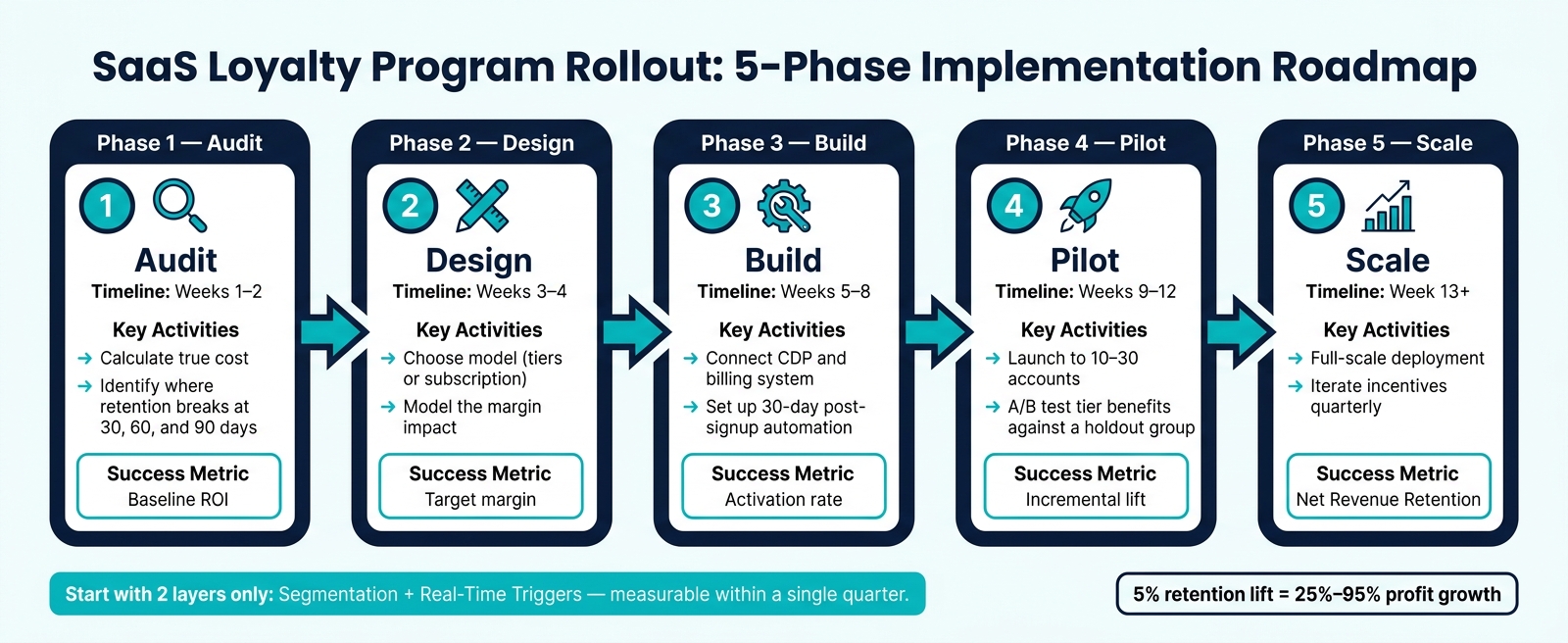
SaaS Loyalty Program Rollout: 5-Phase Implementation Roadmap
Use the segments, triggers, and reward types you already mapped out, then roll the program out in phases instead of trying to do everything at once.
| Phase | Timeline | Key Activities | Success Metric |
|---|---|---|---|
| Audit | Weeks 1–2 | Calculate true cost; identify where retention breaks at 30, 60, and 90 days | Baseline ROI [11] |
| Design | Weeks 3–4 | Choose your model (tiers or subscription); model the margin impact | Target margin [6][11] |
| Build | Weeks 5–8 | Connect your CDP and billing system; set up a 30-day post-signup automation | Activation rate [11] |
| Pilot | Weeks 9–12 | Launch to 10–30 accounts; A/B test tier benefits against a holdout group | Incremental lift [6][11] |
| Scale | Week 13+ | Full-scale deployment; iterate incentives quarterly | Net Revenue Retention [6] |
Start with two layers only. Segmentation and real-time triggers are a smart place to begin. That keeps the first rule set small enough to measure cleanly within a single quarter [5].
Each phase should tie back to the inputs already in your system: segments, usage triggers, subscription signals, and reward costs. That way, you're not building a program in the dark.
If the pilot hits both margin and lift targets, set ownership rules before you scale. This is one of those details that feels small at first, then turns into a mess if you skip it.
A loyalty program without guardrails turns into a discount machine fast. Before launch, lock down three areas.
Start with financial limits. Forecast the average discount or rebate rate by tier before launch, and check that projected expansion lift is greater than the margin hit. If the time needed for a customer to earn a reward is more than 18 months based on average annual spend, the program probably won't change behavior [11]. Put a cap on discount-equivalent value and track reward liability before launch [6][11].
Next comes data handling. Personalization runs on first-party behavioral data, and customers tend to share more of that data when consent and privacy terms are clear. Keep customer data in one CDP so product, billing, and CRM signals stay aligned [4][12]. Want better preference data? Offer a small point reward for completing a preference quiz [13][5].
Then set ownership. Finance should own margin limits, reward liability, and tax compliance. Product should own usage triggers and feature-based rewards. Customer Success should own renewal and churn signals. Without that split, offers go out without approval and reporting starts to drift.
Once the pilot is live, measure incrementality before adding more rewards.
Track NRR as the main outcome metric [2]. Watch it alongside expansion MRR, churn rate, usage scores, assisted revenue, and cohort LTV.
Always compare results against a holdout group. Without a control, you can't tell if a renewal credit changed the outcome or if it just rewarded someone who already planned to renew [3][11]. Incrementality is the only honest way to judge program ROI.
Review behavioral signals on a short cycle. A weekly metrics review can catch problems before they snowball [5][4]. Quarterly cohort reviews still help when you're looking at tier design and offer mix, but real-time monitoring is what keeps the program tied to cash flow.
Phoenix Strategy Group helps growth-stage SaaS teams model reward costs, stress-test margins, and align loyalty spend with growth plans.
Start by collecting basic signup details like company name, industry, and employee count. Then use that data in your CRM to build simple customer segments.
As your company grows, layer in behavioral data by tracking user actions and feature adoption. You can also ask new users about their main goals during onboarding. That gives you a more personal experience from day one.
In SaaS, protect margins by staying away from cash back or deep discounts. Those moves can chip away at the perceived value of a premium product.
A better play is to offer non-monetary, status-based rewards. Think tiered access, early beta access, roadmap advisory sessions, exclusive training, or premium support.
These perks can feel high-value to customers while costing far less than direct price cuts. Just as important, they build loyalty around what the product does for people, not around rebates or lower prices.
That timeline depends on what you’re trying to do.
In most cases, teams add behavioral triggers after 3 to 6 months. A breakage model for financial accounting usually needs at least 12 months of data before it makes sense to use.
No matter which path you take, keep a close eye on your key performance indicators during the pilot. Then review results every quarter so you can adjust your approach based on what the data is showing.