Published on
December 24, 2025


Private equity (PE) firms are reshaping how manufacturers manage inventory growth. They don't just provide funding; they also offer expertise to streamline operations, optimize supply chains, and implement advanced technologies. This approach helps manufacturers overcome common challenges like cash flow constraints, excess inventory, and supply chain disruptions. Between 2020 and 2024, PE firms invested $262 billion into manufacturing, addressing inventory inefficiencies and supporting growth. Key takeaways:
PE-backed manufacturers benefit from better cash flow, reduced debt, and improved profitability. The key is aligning inventory plans with financial goals and operational upgrades, ensuring long-term success.
Manufacturers often consider private equity when financial or operational challenges start to surface. For instance, delayed payments to suppliers or an over-reliance on short-term loans can indicate that working capital is stretched too thin. Excess or outdated inventory is another red flag, as it ties up cash and hampers liquidity. Recent shifts in supply chain strategies - from just-in-time to stockpiling - have further complicated cash flow, inflating balance sheets and reducing flexibility.
Succession planning is another major factor. A startling 40% of the 125,000 manufacturers owned by baby boomers lack a clear plan for leadership transition. This creates a pressing need for solutions, especially when most of the ownership is over 55 years old. Private equity can step in to address these gaps, offering a way to avoid forced closures and ensure a smooth transition.
By identifying these triggers, manufacturers can better understand the gap between their current working capital and future growth needs.
To figure out how much funding your inventory growth requires, it’s essential to analyze your working capital cycle - specifically, Days Sales Outstanding (DSO), Days Inventory Outstanding (DIO), and Days Payable Outstanding (DPO). For example, DSO should typically fall between 40 and 50 days. If it stretches much beyond that, cash flow becomes restricted as funds are tied up in receivables, leaving less available for inventory purchases.
Inventory obsolescence is another key metric. Ideally, outdated inventory should account for no more than 20%–30% of total inventory. Additionally, ensure your credit facilities can support up to 90% of the appraised value of your inventory. If your projected growth demands inventory levels that exceed these credit limits, you’ve identified a funding gap.
It’s also wise to test your financial resilience against potential disruptions, like commodity price spikes or longer lead times, to ensure you can manage volatility without breaching loan covenants.
| Metric | Manufacturing Benchmark | Indicator for Seeking Capital |
|---|---|---|
| Days Sales Outstanding (DSO) | 40–50 Days | Significant increase beyond 50 days[3] |
| Inventory Obsolescence | 20%–30% | Excessive buildup and storage costs[3] |
| Inventory Advance Rate | 90% of appraised value | Difficulty securing 90% LTV from banks[7] |
Once you’ve quantified the funding gap, private equity investors will evaluate your operational strategies to determine your readiness for inventory-driven growth.
Private equity investors focus on whether inventory challenges stem from operational inefficiencies rather than fundamental flaws in the business model. According to the 2025 EY-Parthenon PE Working Capital report, 73% of private equity firms include working capital improvements in their initial deal assessments, as unexpected risks emerge in nearly a quarter of all transactions[4].
One of the first things investors examine is your margin profile. Companies with higher margins are generally less reliant on external funding to manage their cash conversion cycles. They also assess supply chain resilience by reviewing vendor agreements, flexibility in commodity pricing, and the stability of lead times for raw materials.
Technological readiness plays a significant role as well. Investors look for the adoption of advanced tools like AI-driven demand forecasting, centralized data systems, and predictive analytics to manage supply chain fluctuations[2][5]. A company with well-organized inventory systems signals strong operational discipline, which reduces investment risk.
While private equity funds collectively hold an estimated $2.5 trillion in unspent capital[5], they deploy it carefully. Manufacturers that demonstrate both growth potential and operational efficiency are far more likely to secure funding.
When it comes to financing inventory, asset-based lending (ABL) tied to eligible inventory is a popular choice. Another option is private credit structures, which offer more flexible terms, typically with an average loan-to-value (LTV) ratio of less than 50%. These approaches help manage short-term cash flow challenges [6][8]. By late 2025, the global private credit market is projected to hit roughly $2 trillion [6], giving manufacturers more alternatives to traditional bank loans. For inventory-heavy businesses that need extended timelines to realize their full potential, private equity (PE) firms might turn to continuation funds, which provide longer investment periods beyond the usual 10-year fund lifecycle [9].
Improvements in net operating working capital (NOWC) can create structural advantages. For example, cutting NOWC by $2 million not only reduces net debt by the same amount but also lowers interest expenses [8]. This creates a ripple effect: the freed-up cash can be used to pay down debt, further reducing interest costs and boosting profitability - all without needing additional capital investment or a full-time CFO. These flexible financing strategies set the stage for operational improvements that make inventory management more efficient.
PE-backed manufacturers see the best results when they combine new capital with operational upgrades. A primary focus is improving demand forecasting. By integrating data from ERP, logistics, and HR systems, companies can leverage AI-driven predictive analytics to align production schedules with real-time demand. This reduces excess work-in-progress inventory and enhances overall efficiency [2].
Rationalizing SKUs (stock-keeping units) is another effective strategy. Take the example of a $40 million revenue distributor that cut its SKUs by 40%. By automating collections and streamlining inventory, the company unlocked $3.2 million in cash and boosted EBITDA by 200 basis points. This also helped achieve a 6.5x exit multiple, a significant improvement over the 4.0x baseline for distressed assets [8]. The key lies in identifying and eliminating products that consume resources without delivering adequate returns.
Supply chain optimization plays a crucial role too. Renegotiate supplier agreements to reduce or eliminate minimum order quantities (MOQs), which often lead to bloated inventory. Standardizing payment terms to Net 45–60 on strategic purchases can also increase "supplier float", essentially providing interest-free financing [8]. Unlike one-off adjustments to working capital, these process improvements create long-lasting value that buyers recognize during exit evaluations [8].
Operational improvements don't just enhance efficiency - they also strengthen financial metrics, making it easier to meet covenant requirements in credit agreements. Many PE credit deals include covenants for minimum fixed charge coverage ratios (FCCR) and caps on net leverage [8]. Some agreements also feature "springing" tests, which only activate when ABL availability drops below a certain threshold [8]. By improving the cash conversion cycle (CCC), companies gain a "double cushion" for these covenants: lower net debt and higher EBITDA, thanks to reduced carrying costs [8].
"Every $1 reduction in net operating working capital (NOWC) generates $1 of immediate free cash flow without touching EBITDA." - Uplevered [8]
Key metrics to monitor include days inventory outstanding (DIO), inventory turnover, and NOWC as a percentage of sales. For example, a $75 million revenue manufacturer reduced its NOWC from 18% to 7.3% of sales. This was achieved by cutting days sales outstanding (DSO) by 10 days, improving inventory turns from 6x to 8x, and extending days payable outstanding (DPO) by 10 days. These changes freed up $5.5 million in cash for debt repayment and added covenant flexibility, while also saving around $440,000 annually in interest costs at an 8% borrowing rate [8].
Operational performance metrics are equally important. While optimizing working capital, companies should never compromise on on-time, in-full (OTIF) delivery. Regularly track stockout rates and customer complaints to maintain service levels [8]. Implementing ABC cycle counts can help: review high-value items monthly, medium-value items quarterly, and low-value items annually [8]. This ensures that excess capital isn’t tied up in slow-moving inventory while maintaining the accuracy required for ABL eligibility. Overall, optimizing working capital can unlock an additional 10–25% of cash flow for middle-market portfolio companies - without needing extra capital investment [8].
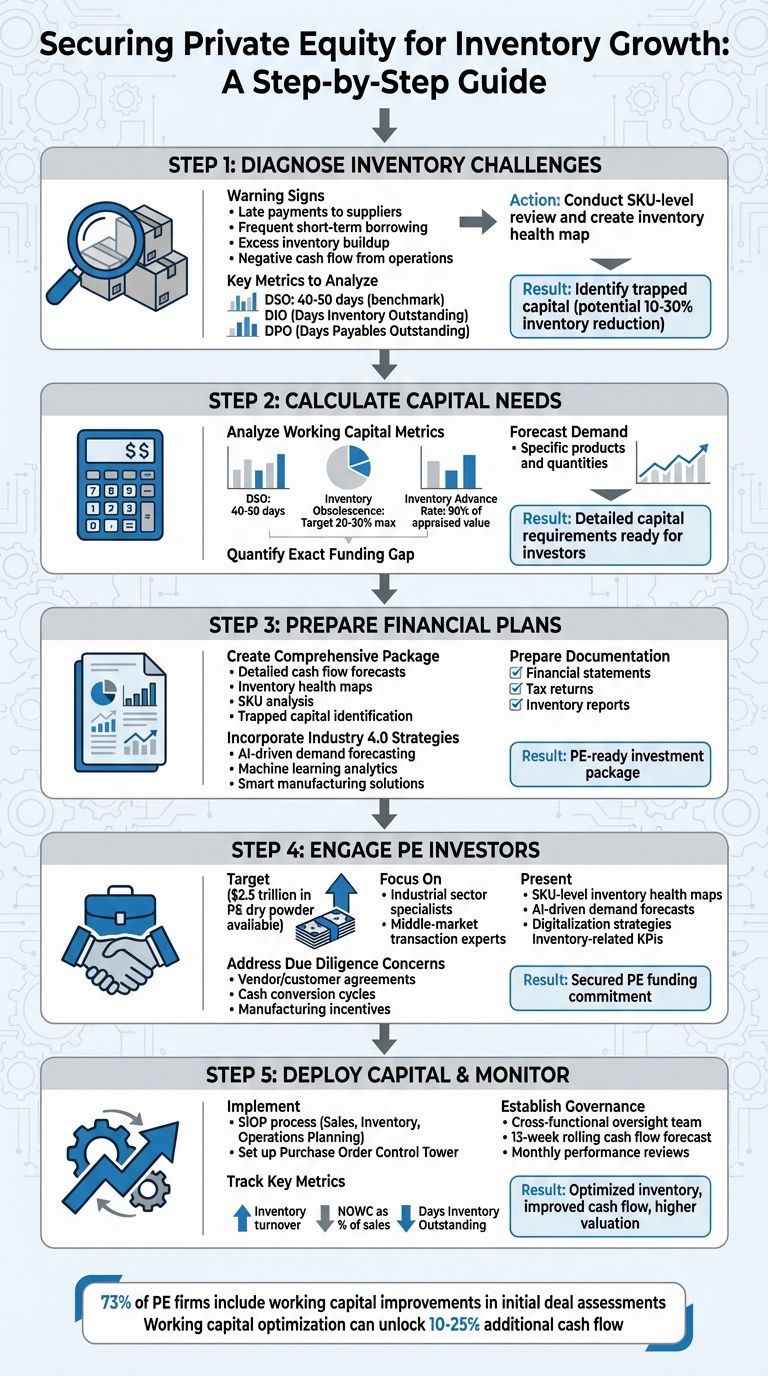
5-Step Process to Secure Private Equity for Manufacturing Inventory Growth
Spotting inventory issues early is key to staying ahead of potential financial trouble. Look for warning signs like late payments to suppliers, frequent short-term borrowing, excess inventory piling up, or ongoing negative cash flow from operations [3]. These red flags signal it’s time to dig deeper.
Start by analyzing your core working capital metrics: Days Sales Outstanding (DSO), Days Inventory Outstanding (DIO), and Days Payables Outstanding (DPO) [3]. For manufacturing companies, DSO typically falls between 40 and 50 days [3]. If your numbers stray too far from these norms, you’ve likely pinpointed a problem.
To go beyond surface-level analysis, conduct a SKU-level review. Broad forecasting methods often miss the specific missteps causing inventory buildup, whether in raw materials or finished goods [13]. Use tools like an "inventory health map" to visualize where you have excess or shortages across warehouses and distribution centers [13]. Additionally, applying ABC Analysis can help you prioritize inventory management efforts by grouping items based on their value and importance [12].
Another critical step is identifying trapped capital. Private equity investors are particularly interested in uncovering this hidden value on your balance sheet. Check whether issues like poor data quality in your ERP or planning systems are leading to inaccurate forecasts and inefficient use of resources [13].
Finally, calculate your exact capital needs. Instead of requesting a general sum, forecast demand for specific products and quantities [11]. Streamlined inventory practices can typically cut inventory levels by 10% to 30%, freeing up significant cash for other priorities [13]. This detailed analysis lays the groundwork for a financial and inventory plan that will appeal to potential private equity investors.
Once you’ve identified the underlying issues, the next step is creating a package that meets private equity investors' expectations. These investors often focus on targeted working capital improvements when evaluating opportunities [4].
Prepare detailed cash flow forecasts that account for factors like seasonal demand, production cycles, and lead times [3]. Use your inventory health map and SKU analysis to justify your funding needs and highlight operational improvements. Highlight trapped capital by identifying dead or obsolete inventory and inefficient collection processes. For example, automating invoicing and collections can reduce DSO by 25% to 30%, which is highly appealing to investors [3].
Align your inventory strategy with modern trends like Industry 4.0. Incorporate AI, machine learning, and data analytics to refine cash flow patterns and improve demand forecasting [3]. Investors are increasingly drawn to “Smart Manufacturing” solutions that enhance inventory accuracy and efficiency, as these innovations can protect valuations and boost returns [12][5].
Make sure all key documents are in order, including financial statements, tax returns, and inventory reports, to facilitate a smooth due diligence process [11]. Regular cycle counting can help maintain inventory accuracy and uncover discrepancies early, ensuring a clean balance sheet that inspires investor confidence [3]. You might also consider adopting Just-in-Time (JIT) systems to cut holding costs and reduce the risk of obsolescence [3].
Take a team-based approach by forming a cross-functional group to review surplus and slow-moving inventory [3]. This demonstrates to investors that your organization is fully committed to optimizing inventory. Be ready to address specific questions about cash conversion cycles, vendor agreements, and customer payment terms [4].
With a clear diagnosis and a well-prepared plan, you’re ready to approach private equity investors. Focus on firms that specialize in the industrial sector and middle-market transactions. These investors currently manage $2.5 trillion in unspent capital (dry powder) and have allocated over $800 billion to buyouts as of September 30, 2022 [5]. They are actively seeking opportunities to enhance portfolio performance in today’s economic climate [5].
Present your findings using a SKU-level inventory health map to highlight trapped capital and forecasting errors [13]. Show operational sophistication by incorporating AI-driven demand forecasts [1]. Research private equity firms with expertise in your sector and available capital to ensure a good match [5].
Investors are particularly drawn to plans that include digitalization and automation strategies. These capabilities not only improve efficiency but also help sustain valuations during economic downturns [5]. Define inventory-related KPIs that link your funding needs to measurable operational improvements [1] - this demonstrates you have a clear plan for deploying their capital effectively.
During due diligence, investors will scrutinize vendor and customer agreements to optimize cash conversion cycles [4]. They’ll also evaluate whether your manufacturing teams are incentivized to produce the right product mix, as surplus low-demand SKUs can pose significant risks [13]. Address these concerns in your presentations to show you’ve anticipated their questions.
Private equity funding provides flexible capital options that go beyond traditional bank loans [11]. Frame your funding request within this broader context to showcase your understanding of why private equity is the ideal fit for your business.
For specialized advice on aligning your inventory strategy with private equity goals, consider consulting Phoenix Strategy Group. Their expertise can help you refine your approach and maximize investor interest.
Once you've secured private equity (PE) funding, the next step is to ensure that capital is allocated wisely. A refined inventory strategy is crucial, but the real game-changer lies in precise capital deployment. This means basing your decisions on detailed, short-term cash flow forecasts, which help identify the true cash drivers in your business. By doing so, you avoid sinking funds into inventory categories that don't deliver value [16].
To align inventory management with demand, implement a Sales, Inventory, and Operations Planning (SIOP) process. This system brings together procurement, production, sales, and logistics teams to ensure everyone is on the same page. Additionally, consider setting up a Purchase Order Control Tower staffed with experienced material planners. These planners review every new order against set targets, requiring written justification for any deviations.
Move away from intuition-based ordering and adopt clear, data-driven business rules. These rules should be informed by historical supplier performance and accurate demand forecasts. For example, one manufacturer managed to cut inventory levels by 17% in just nine months while maintaining steady customer service levels [16].
"The key is to reduce inflow by reviewing the company's open purchase order book and ensuring that planners only place orders that the business needs." – Sebastian Janssen, Cornelius Herzog, Wolfgang Krenz, and Fabian Jost, Oliver Wyman [16]
Integrate data from various systems - like ERP, logistics, and HR - into a single source to enable SKU-level performance tracking. With limited access to cheap debt, PE sponsors are now focusing on improving margins through advancements in manufacturing processes, such as robotics and AI, rather than relying solely on financial restructuring [15].
Once capital is deployed effectively, the next critical step is establishing strong governance to maintain and monitor performance.
Governance plays a central role in private equity-backed operations. According to research, unforeseen risks emerge in 24% of all deals, and 73% of PE funds incorporate working capital improvements into their base case underwriting [4]. To meet these expectations, form a cross-functional oversight team. This team should include representatives from finance, manufacturing, supply chain, procurement, and commercial operations, and it should meet monthly to review projections and set actionable targets.
A disciplined approach is essential. Implement a 13-week rolling cash flow forecast, coupled with weekly variance analyses. This fosters a cash-focused culture and allows teams to identify and address issues early. Increasingly, PE firms are giving operations teams a stronger voice throughout the entire investment lifecycle, from acquisition to exit [15].
Standardize the criteria for business case evaluations, such as when deciding to buy ahead of anticipated price hikes or responding to supplier "last call" offers. Update these guidelines regularly to reflect current market dynamics.
"We see operational expertise as the dominant driver of private equity returns today and in the coming years, overtaking traditional financial engineering strategies that relied on low-cost debt." – Brookfield [15]
For more detailed oversight, track performance at the SKU level. This helps identify excess working capital before it becomes a problem. Additionally, incentivize manufacturing teams to optimize their product mix, rather than focusing solely on increasing overall production volume. This approach prevents imbalances in inventory levels.
Even with disciplined governance, inventory management comes with inherent risks. In fast-moving industries like electronics and automotive, 20% to 30% of inventory can become obsolete or unsellable [3]. Rising interest rates further complicate matters by increasing the cost of holding excess inventory, while geopolitical tensions and trade tariffs can disrupt supply chains.
To address these challenges, adopt a risk management framework built around four key pillars: Prevention, Preparedness, Response, and Recovery (PPRR). Leverage AI and machine learning to go beyond traditional forecasting methods. These tools enable dynamic reorder points that adjust in real time based on demand and supply conditions.
Regularly stress test your supply chain to uncover hidden vulnerabilities. With only 21% of companies describing their supply networks as "highly resilient" [17], it's crucial to ensure your systems can withstand disruptions. Diversify your supplier base and explore nearshoring options to reduce cycle times and mitigate geopolitical and logistical risks.
Scenario planning is another valuable tool. Use it to evaluate liquidity under both baseline and worst-case scenarios. When market pressures intensify, review your open orders to identify opportunities to delay, split, or cancel purchases that no longer align with current demand.
"Private equity leaders surveyed indicate unforeseen risk shows up in 24% of all deals, which brings home why 73% of PE funds surveyed include working capital improvements in their base case underwriting." – 2025 EY-Parthenon PE Working Capital report [4]
Cybersecurity is another critical area, especially with the rise of IoT and digital supply chains. Enforce strict compliance standards and user access controls to mitigate risks. Companies that successfully optimize working capital while managing risks can unlock 5% to 7% of their annual revenue [14].
For manufacturers seeking specialized guidance, Phoenix Strategy Group offers financial and strategic advisory services to help implement these strategies and optimize inventory financing effectively.
For manufacturers planning an exit, aligning inventory management with their goals is a must. Efficient inventory systems don’t just keep operations running smoothly - they directly impact the value of the business. Buyers care about how effectively inventory is turned into cash, and poor management can raise red flags, contributing to risks in nearly a quarter of all deals [4].
Key metrics like inventory turnover ratios and Return on Net Assets (RONA) play a big role in how buyers evaluate a business. For example, inventory turnover ratios that fall outside the 5:1 to 10:1 benchmark can signal inefficiencies [23]. On the other hand, a RONA between 5% and over 20% reflects smart use of inventory and assets to drive profits [23]. These numbers directly influence the multiple buyers apply to EBITDA, with operational excellence potentially boosting multiples by 5%–10% [19].
"Data accuracy will equate to higher multiples: Buyers want to know how capital intensive a manufacturing business is, so it's in sellers' best interest to have this information readily available." – First Page Sage [23]
During due diligence, buyers dig deep into inventory processes, supply chain documentation, and working capital adjustments. Companies handling their M&A process without professional representation often leave money on the table, earning an average of 31% less than those with expert guidance [23]. By streamlining inventory management, manufacturers can not only enhance valuation but also approach the exit process with greater confidence.
Private equity-backed manufacturers generally follow one of four main strategies when it’s time to exit. The most popular route is selling to a strategic buyer, such as a larger competitor or a company in a related industry that’s looking for synergies or market expansion [20].
Another option is a secondary buyout, where the business is sold to another private equity firm for a new growth phase. This approach has gained traction as holding periods grow longer; in fact, PE exit values increased by 50% in Q3 2024, even though total exit volumes declined [1]. Some firms choose recapitalization, allowing them to realize some gains while retaining ownership to benefit from future growth [21]. Occasionally, companies go public through an IPO, though this path requires significant scale and market readiness [20].
One strategy that stands out is the buy-and-build or roll-up approach. Here, platform companies acquire smaller manufacturers at lower multiples, creating immediate value through consolidation [21]. Strengthening inventory and operational systems can secure funding and increase exit multiples, making this strategy particularly effective.
Beyond financial metrics, buyers look for operational systems that guarantee consistent performance. They’re not just buying assets - they’re buying processes and systems. That’s why it’s critical for manufacturers to establish strong ERP systems and standardized metrics well before an exit. Integrated financial models that bring together data from logistics, HR, and finance give buyers a reliable, unified view during due diligence [22].
"If too much of a company's strategy exists in an owner's mind, the business is worth less to a potential buyer." – Scott Sutton, Managing Director, CBIZ Somerset [18]
A centralized management system that tracks KPIs like safety, quality, delivery, and cost demonstrates operational discipline [19]. This approach has tangible benefits: manufacturing valuation multiples increased from 10.2x in H1 2024 to 11.1x in H1 2025 [23]. Companies with well-documented processes and transparent governance consistently command higher valuations.
Technology is also reshaping the manufacturing landscape. With 83% of manufacturers expecting smart factories to transform the sector within five years [24], buyers now expect companies to move beyond basic tools like Excel. Platforms such as Anaplan or OneStream are becoming the norm, offering faster planning cycles, better forecasting, and scalability [22].
For manufacturers preparing to exit, having the right systems in place can make all the difference. Firms like Phoenix Strategy Group offer M&A advisory services, financial modeling, and data engineering to help businesses build the processes and documentation needed to maximize transaction value.
To align private equity funding with inventory growth, focus on optimizing people, processes, and technology. Within the first 100 days, integrate your finance function into the Value Creation Plan, ensuring it becomes the single, reliable source for tracking growth and liquidity [10]. Consolidating data from various systems into one central hub can refine demand planning. From there, implementing Just-in-Time practices and demand forecasting can significantly reduce holding costs.
Dead inventory is a common challenge, with many manufacturers struggling with rates of 20%–30% [3]. Improving working capital is a critical performance metric. Automating back-office operations can cut Days Sales Outstanding by 25%–30% [3], which, in turn, can boost free cash flow by 3% to 8% of revenue [10]. This additional liquidity provides manufacturers with the flexibility to focus on strategic growth initiatives.
"Working capital management is not just a financial concept - it is the lifeblood of survival and growth." – Cherry Bekaert [3]
Unforeseen risks impact nearly a quarter of all deals [4], making meticulous planning and transparent reporting essential. Move beyond Excel-based forecasting tools by adopting integrated planning solutions. Establish clear governance for inventory management and conduct regular cycle counting to ensure accuracy. By maintaining disciplined operations and robust inventory systems, manufacturers can enhance free cash flow and improve valuation multiples. These practices lay the groundwork for long-term, growth-driven success.
Private equity has the potential to transform inventory from a cost-heavy burden into a strategic advantage. With PE funds sitting on an estimated $2.5 trillion in unallocated capital [5], manufacturers who demonstrate operational excellence and growth readiness stand to benefit significantly.
Effective inventory management requires clear planning, measurable KPIs, and collaboration across functions. For manufacturing leaders who lack the internal resources to meet private equity standards, financial experts can bridge the gap. Phoenix Strategy Group offers fractional CFO services, FP&A, M&A advisory, and data engineering to help manufacturers fine-tune systems, build essential documentation, and create financial models that maximize transaction value. Whether you're preparing for a capital raise or planning an exit, having the right financial infrastructure in place can be a game-changer for sustainable growth.
Private equity firms see outdated or excess inventory as a chance to free up capital and boost efficiency. They rely on detailed, data-driven methods like ABC classification and demand forecasting to pinpoint inventory that’s slow-moving, obsolete, or surplus. This analysis not only highlights the financial impact of the inventory but also informs strategies for managing or liquidating it effectively.
To release cash tied up in inventory, these firms often use custom financing options, such as revolving credit lines or vendor-backed loans. They also collaborate with CFOs to create write-down schedules or develop resale strategies aimed at recovering as much value as possible. On top of that, they fine-tune supply chain operations by adjusting reorder points, adopting just-in-time inventory practices, and renegotiating supplier agreements to avoid future overstock issues.
For manufacturers looking for expert support, Phoenix Strategy Group provides services like fractional CFO assistance, financial planning and analysis (FP&A), and strategic advisory. These services are designed to help businesses improve inventory management, optimize working capital, and prepare for growth or a successful exit.
Private equity firms rely on a handful of critical financial metrics to gauge the performance and growth prospects of manufacturing companies. Among the most important are EBITDA (Earnings Before Interest, Taxes, Depreciation, and Amortization) and its valuation multiples. These figures provide insight into profitability and how the company is valued in relation to its earnings.
They also pay close attention to revenue growth and its associated multiples, which reflect the company's ability to expand and generate higher sales. Another key metric is the debt-to-equity ratio, which helps assess the company's financial leverage and risk profile.
Beyond these, cash flow trends are analyzed to evaluate liquidity and operational efficiency - essential for maintaining smooth business operations. Lastly, working capital requirements are examined to ensure the company has enough resources to handle day-to-day expenses. Together, these metrics paint a clear picture of the company's financial health and potential for growth.
Manufacturers aiming for a successful exit should see inventory not merely as a cost but as a strategic tool. By improving inventory turnover and syncing stock levels with accurate demand forecasts, they can enhance cash flow and working capital - two areas that private equity buyers closely scrutinize. Cutting down on surplus inventory, whether it’s raw materials or finished goods, unlocks cash for growth initiatives and reduces the chance of write-downs that might negatively impact valuation.
Implementing approaches like just-in-time purchasing, vendor-managed inventory, or asset-based lending can transform inventory into liquidity without disrupting production. Monitoring key metrics such as days inventory outstanding (DIO) and inventory-to-sales ratios supports data-driven decisions and highlights operational efficiency to potential buyers. These efforts not only improve financial performance but also demonstrate lower risk, which can lead to higher valuation multiples. For personalized strategies, experts like Phoenix Strategy Group can assist manufacturers in building strong frameworks and preparing for a smooth ownership transition.