Published on
July 2, 2026

A small EBITDA adjustment can change your sale price by a lot. If a buyer applies a 5x to 10x multiple, even a $100,000 error can shift value by $500,000 to $1,000,000.
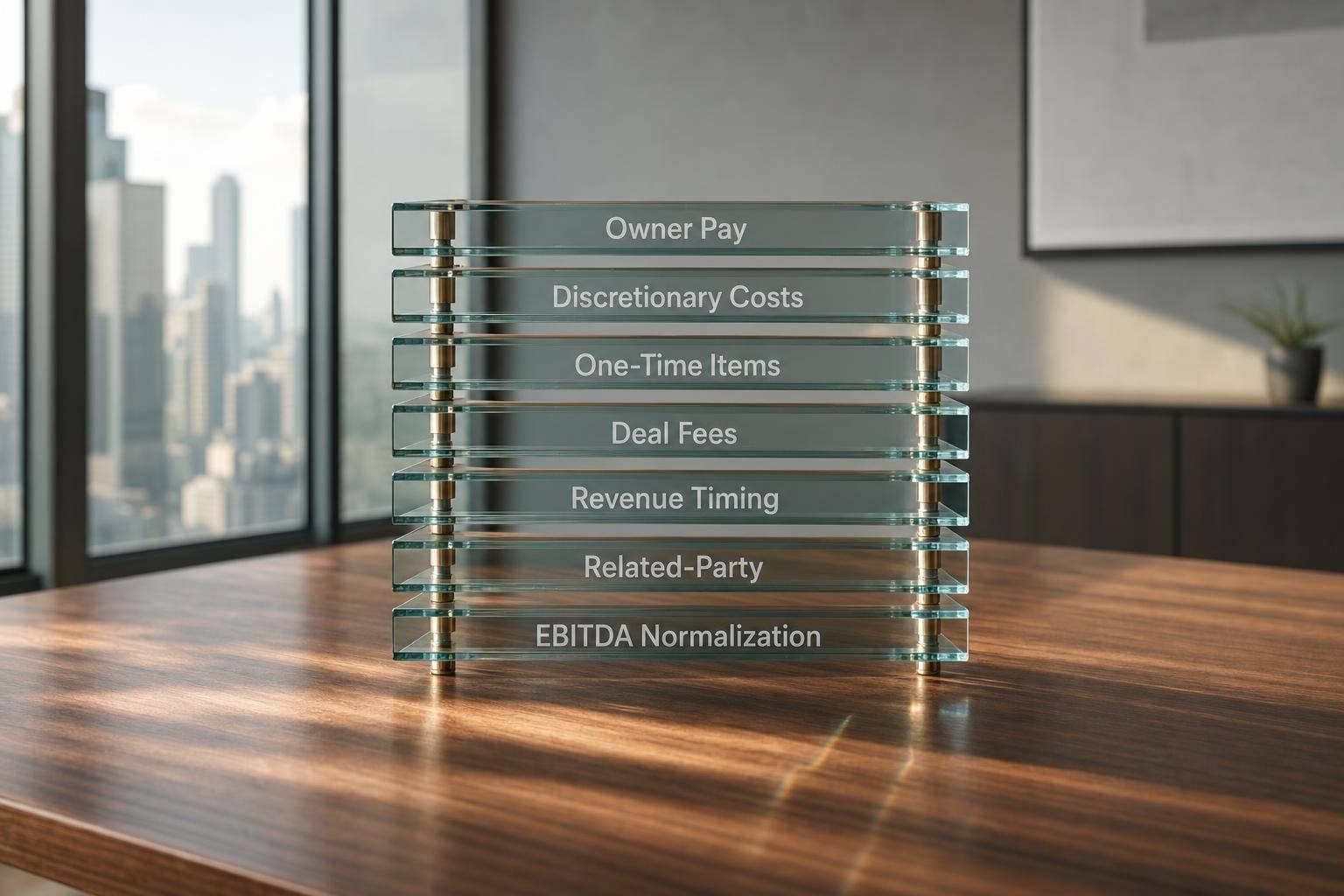
If I had to sum up the article in plain English, it’s this: buyers do not price your company off the number in your books. They price it off adjusted EBITDA after they clean up pay, personal spending, one-time costs, deal fees, revenue timing, related-party items, and run-rate issues.
Here are the 7 adjustments buyers review most often:
What matters most is simple: every add-back needs support. If I can’t tie an adjustment to payroll records, invoices, contracts, GL detail, or market-rate data, a buyer may cut it. And when that happens, the hit to value can be large.

7 QoE EBITDA Adjustments in Exit Deals: What Buyers Review
| Adjustment | What buyers are fixing | EBITDA can move | What they usually ask for |
|---|---|---|---|
| Owner comp | Pay above or below market | Up or down | Payroll, W-2s/K-1s, comp benchmarks |
| Personal expenses | Costs that won’t stay after close | Usually up | Receipts, card statements, payroll detail |
| One-time costs | Costs or gains that won’t repeat | Up or down | Invoices, agreements, proof of payment |
| Deal expenses | Fees caused by the sale process | Usually up | Engagement letters, legal invoices, bonus support |
| Revenue timing | Cash timing vs. earned revenue | Up or down | Contracts, GL detail, deferred revenue rollforward |
| Related-party items | Rent, payroll, fees not set at market | Up or down | Leases, appraisals, salary data, service agreements |
| Run-rate / timing | Partial-year or wrong-period items | Up or down | Payroll dates, accruals, billing history, TB/GL support |
Bottom line: the article is about turning reported EBITDA into a buyer-ready number that a diligence team can test fast. The cleaner the bridge and backup, the lower the chance of a price cut late in the deal.
Once the bridge is built, this is where things get serious. Adjusted EBITDA is the earnings number buyers use to price the business. So even a small miss can hit value hard.
The math is simple: every $100,000 misstatement in EBITDA can move the final purchase price by $500,000 to $1,000,000 when a 5x–10x multiple is used [10]. That’s a big swing from one line item.
Buyers use an EBITDA bridge to show each adjustment and what it does to earnings. In plain English, they want to see exactly why EBITDA changed and whether each addback holds up. That’s why they dig into every adjustment before moving ahead.
Fast-growing companies often run into accounting issues that blur recurring earnings. A few common causes show up again and again:
A pre-deal EBITDA bridge helps cut retrade risk too. It brings these issues into the open before a buyer finds them first.
The next seven items are the adjustments buyers see most often.
Owner pay is often the first QoE adjustment because it can throw off the bridge from reported EBITDA to adjusted EBITDA.
Here’s the issue: owners don’t always pay themselves at market rate. Some pay themselves too much. Others pay themselves too little. Either way, reported EBITDA gets skewed. QoE fixes that by resetting owner compensation to a market benchmark.
Buyers usually swap the owner’s pay for a market-rate salary based on the job the owner actually does, like CEO or GM. Only the amount above market gets added back. Adding back the full salary is a common mistake [12].
This adjustment can move EBITDA in either direction. If the owner is overpaid, EBITDA goes up after the adjustment. If the owner is underpaid, EBITDA can go down [7][12].
The dollar impact can be big. A $200,000 gap in owner pay can shift enterprise value by $1.2 million at a 6x multiple [11].
Support usually includes W-2s or K-1s, payroll records, job descriptions, and compensation benchmarks [13][3]. Buyers also want backup for salary, benefits, family payroll, and personal perks. That often means payroll records, benefit statements, job duty details, and expense support.
Owner compensation is often the largest single add-back in a QoE report [6].
Next, buyers look for personal expenses run through the business.
Personal expenses run through the company are one of the first things buyers flag. Why? Because they push reported EBITDA down even though they don't reflect the day-to-day earning power of the business.
Common examples include personal vehicle costs, family health or life insurance premiums, travel, and entertainment charged to the business [8][5][7]. Under new ownership, those costs usually go away. So a buyer won't view them as part of normal operations.
Buyers add these costs back because they don't expect them to continue after the sale. Once those expenses are removed, adjusted EBITDA gives a cleaner picture of what the company earns on its own.
This can change value fast. At a 6x multiple, every $100,000 of accepted add-backs adds $600,000 to enterprise value [6]. That's why this area gets a lot of attention. If an add-back isn't supported, buyers often cut it back or reject it during diligence.
Buyers want proof, not just a note in a spreadsheet. Support should include receipts, invoices, card statements, payroll records, and a written explanation of business purpose [12][8].
A few areas usually get extra scrutiny:
From there, buyers test whether the cost was temporary, one-time, or tied to the deal itself.
One-time costs can push reported EBITDA down even when normalized earnings haven't changed. Common examples include legal settlements, severance, restructuring, facility moves, and ERP implementation or conversion costs [9][5].
On the flip side, some one-time gains can make EBITDA look better than it should. Those need to come out. That includes PPP forgiveness, insurance recoveries, and asset-sale gains [8][14].
The goal is to get to run-rate adjusted EBITDA. So, valid nonrecurring costs are added back, and one-time gains are removed.
That said, buyers don't just take management's word for it. If a company labels marketing spend as "one-time", but the general ledger shows the same kind of expense showing up again and again in prior periods, that cost usually stays in EBITDA. In plain English: if it walks and talks like a recurring expense, buyers will treat it that way.
Every add-back needs support that was created when the expense happened, not pieced together later during diligence.
Buyers usually accept these add-backs only when they tie back to source documents. That's the paper trail they want to see:
| Nonrecurring Item | Required Documentation |
|---|---|
| Legal settlements | Settlement agreements, legal invoices, proof of payment |
| Severance/restructuring | Severance agreements, payroll records, organizational charts before and after |
| ERP conversions | Implementation contracts, one-time licensing fees, payroll records for temporary staff |
| One-time consulting | Project-specific contracts, invoices, evidence of project completion |
| PPP/government grants | Grant award letters, bank statements, forgiveness documentation |
Each item should also be mapped to a specific GL account and period.
Next are expenses created by the sale process itself.
Transaction-related expenses are often added back because the deal caused the cost, not the business itself.
That usually includes banker fees, legal fees, QoE fees, retention bonuses, and one-time consulting. These items tend to be nonrecurring, so they can pull down reported EBITDA even though they relate to the sale process rather than day-to-day operations. As a result, reported EBITDA can give a skewed picture unless buyers remove those costs and look at what the company actually earns.
After spotting these expenses, buyers usually check one thing: does the cost stop at close?
That matters because the math adds up fast. At a 6x multiple, every $100,000 of accepted add-backs changes enterprise value by $600,000 [6].
There’s also a common red flag here. If so-called "one-time" fees keep showing up in the general ledger, buyers often view them as normal operating costs instead of true add-backs. When that happens, they’ll likely reject the adjustment.
Each transaction-related expense needs contemporaneous documentation. Buyers usually want engagement letters, invoices, and proof of payment to show that the cost was non-recurring and tied to the transaction.
| Transaction-Related Item | Required Support |
|---|---|
| M&A Advisory / Success Fees | Engagement letter, success fee invoice |
| Deal-Specific Legal Fees | Invoices detailing transaction-related work |
| Sell-Side QoE Fee | Engagement letter, proof of payment |
| Retention / Transaction Bonuses | Signed bonus agreements, payroll records |
| One-Time Consulting | Project-specific invoices, scope of work |
Unlike deal costs, this adjustment hits core operating revenue.
Many growth-stage companies still record revenue when cash comes in. In a QoE, that often gets restated to accrual accounting under GAAP/ASC 606 [5][2].
Buyers make that change when cash timing and delivery timing don't line up.
A simple SaaS example shows why. If a company collects a $120,000 annual contract on January 1, only $10,000 should count as January revenue under accrual accounting. The other $110,000 gets recognized over the next 11 months [5][4].
Cut-off errors cause the same kind of mess from another angle. December work might get billed in January. Or revenue might get booked before the service is delivered. Either way, the trailing-twelve-month period can be off [1][3].
This matters because unrecognized performance obligations can lower what a buyer is willing to pay today. Deferred revenue is cash collected for work the company still owes, so buyers may treat it as a drag on value or use it in a purchase price adjustment [5][7].
And the math adds up fast. A $60,000 downward adjustment at a 10x multiple cuts the exit price by $600,000 [4]. Revenue recognition errors can also materially change reported revenue [9].
Buyers don't accept this adjustment on gut feel. They want the contracts and rollforwards to tie cleanly to the general ledger.
That usually means:
For subscription businesses, buyers check that revenue was recognized ratably over the contract term, not all at once when the invoice went out. For project-based businesses, they look at WIP schedules to test underbillings and overbillings [3].
So one prepaid SaaS contract might push current-month EBITDA down, while unbilled work that's already complete might push it up.
Once buyers normalize revenue timing, they often move on to test whether affiliated parties affected other operating results.
After buyers sort out revenue timing, they look at affiliated-party costs. The reason is simple: these costs can make EBITDA look better or worse than it would under normal market terms. If a related-party expense isn't set at arm's length, buyers adjust it to what an outside party would likely pay. That matters because it changes the cost base a buyer would step into after closing.
Common examples include rent paid for a building owned by the seller, family members on payroll at pay rates that don't match the market, management fees paid to a holding company, and vendor pricing routed through related entities [7][1].
These items can push EBITDA up or down.
If the company pays above-market rent to an owner-owned LLC, the excess is usually treated as an add-back. If it pays below-market rent, buyers bring EBITDA down to reflect what a market lease would cost [6]. The same logic applies to compensation. If pay or rent is above market, buyers add back the excess. If it is below market, they reset EBITDA to market terms. Family payroll gets the same treatment, so any pay that doesn't match a market replacement cost is normalized.
Buyers want to know what the business will cost to run once ownership changes hands. That's why management fees paid to a holding company usually don't get a free pass. If the cost is recurring, it has to be marked to market rather than lumped in as a one-time deal expense. The focus is on a cost structure the buyer can live with after the transaction closes [7][1].
The math gets painful fast. A $200,000 add-back dispute at a 6x multiple cuts $1.2 million from enterprise value [11].
Buyers don't just take management's word for it. They want proof that the adjusted number lines up with actual market rates.
| Related-Party Item | Support | Adjustment |
|---|---|---|
| Owner-Owned Rent | Real estate appraisal, broker market comparables, draft market-rate lease | Excess rent add-back or market-rate reset |
| Family Payroll | Salary benchmarks, payroll records, role descriptions | Market-rate reset |
| Management Fees | Service agreements, invoices, GL detail | Usually full add-back |
| Intercompany Charges | Vendor contracts, service level agreements, arm's-length pricing analysis | Normalized to market delta |
Next, buyers check whether timing and run-rate changes belong in adjusted EBITDA.
Once related-party items are dealt with, buyers usually turn to timing adjustments.
Timing issues can shift EBITDA even when the business itself hasn't changed. A company may bill upfront, miss a cutoff, or record an item in the wrong period. On paper, EBITDA moves. In practice, the core performance may look the same.
Mid-year changes are a common source of noise. Say a company hires someone in month 7, renegotiates a vendor contract in month 9, or gets hit with a rent increase halfway through the year. The trailing period only shows part of that cost, not the full-year run rate. That can make EBITDA look better than the business would produce over a full 12 months.
Out-of-period items create the same kind of problem. Catch-up billings or expenses that belong in another fiscal period can land in the trailing twelve months (TTM) window and skew normalized EBITDA.
QoE removes those timing effects so buyers can underwrite recurring earnings.
Buyers apply a purchase multiple to sustainable EBITDA, not reported EBITDA. That's where price can shift.
If reported EBITDA includes timing noise, the valuation base is off. So buyers separate short-term distortion from earnings they can actually support. Put simply: they don't want to pay for a number that only looked good because of timing.
Each adjustment needs source documents from the period in question. Buyers usually want clear backup, not guesswork. The table below shows what they often expect:
| Adjustment Type | Required Support | Impact |
|---|---|---|
| ASC 606 Revenue Correction | Customer contracts, revenue recognition schedules, GL detail | Negative - spreads upfront billings over the service period |
| Annualized New Hires | Offer letters, payroll records with start dates, org chart | Negative - reflects the full-year cost of mid-period hires |
| Out-of-Period Expenses | Invoices, accrual schedules, trial balance exports | Positive or negative - moves costs to the correct period |
| Catch-Up Billings | AR aging, billing history, customer statements | Negative - removes revenue tied to prior-year services |
Run-rate adjustments annualize known changes. Pro forma adjustments reflect expected changes, and buyers usually discount those unless they are backed by contract.
The bridge should show each timing adjustment clearly before the final EBITDA presentation.
Once you've identified the adjustments, the next job is simple: lay them out so a buyer can check them in minutes, not hours.
An EBITDA bridge should show how reported EBITDA turns into normalized EBITDA. And each adjustment needs to answer three plain-English questions:
The clearest setup uses three core columns for every adjustment:
That format makes life easier for a buyer’s diligence team because they can trace each line back to source documents without digging through a mess.
For timing and revenue items, show the shift month by month:
| Date (MM/DD/YYYY) | As-Reported Monthly EBITDA | Normalized Monthly EBITDA | EBITDA Impact (USD) | Rationale |
|---|---|---|---|---|
| 01/31/2026 | $150,000 | $40,000 | ($110,000) | ASC 606 - annual subscription recognized ratably |
This matters because buyers value the business on normalized EBITDA, not the reported figure. So the bridge becomes the buyer-facing proof that each adjustment stands up under review.
Every line should also link to source support. If a buyer clicks into an adjustment, the backup should be right there and easy to follow. For example:
In short, each line in the bridge should connect to support a buyer can open fast.
Before diligence begins, clean up the records that feed the bridge.
Once the bridge is built, attention turns to the records behind it. An EBITDA bridge is only as good as the books supporting it.
One of the smartest moves a seller can make is to start getting ready 12 to 24 months before going to market [10]. That window gives you time to fix problems before diligence begins, not while buyers are already poking holes in the numbers.
Before diligence, shift to accrual accounting. Book payroll accruals, bonus accruals, unbilled revenue, and prepaid expenses on a consistent basis. That sounds simple, but it matters a lot. If the books are messy or uneven from month to month, buyers will spot it fast.
Then make sure every adjustment has support that was put together before diligence starts. For each add-back, have the backup ready:
This kind of prep can pay off in a big way. Sellers who commission a sell-side QoE 6 to 12 months before going to market can close at 10–25% higher valuations than those who do not [15].
With the books cleaned up and the support in place, the next piece is showing the bridge in a format buyers can check fast.
The seven adjustments covered here are the main items used to normalize EBITDA in exit-deal QoE work. They all point to the same issue: does this EBITDA show the earnings power the business is expected to have after closing?
When each adjustment is documented, categorized, and linked to a clean EBITDA bridge, diligence tends to move faster. Buyers can also underwrite with more confidence.
The numbers make the point. Add-backs average 29% of adjusted EBITDA in middle-market exits, and sellers with a sell-side QoE transact at a median 7.4x EBITDA versus 7.0x without one. For a business with $3 million in EBITDA, that 0.4x gap equals $1.2 million.
That lift in valuation depends on clean support and a clear EBITDA bridge. When those pieces are in place, diligence shifts from debate to confirmation.
Buyers pay the most attention to adjustments that change normalized, steady earnings.
That usually means looking closely at:
Why does this matter so much? Because these areas often create the biggest EBITDA gap.
Put simply, buyers usually price a business based on adjusted EBITDA, not reported EBITDA.
Buyers usually want primary-source documents and a clear explanation for each add-back that they can check and defend.
That often means:
For example, owner compensation adjustments usually need W-2s and salary benchmarks. Related-party rent or family salaries usually need leases or role descriptions matched against market data.
If you can't back up an add-back, buyers may apply a 30% to 50% haircut.
Prepare a Quality of Earnings (QoE) report well before you start the sale process. That puts you in control of the financial story and helps you avoid valuation surprises when buyers dig into the numbers during due diligence.
A common window is 30 to 90 days before listing the business. Starting early gives you time to check your financials, back up add-backs, and deal with issues before they turn into problems.