Published on
April 4, 2026

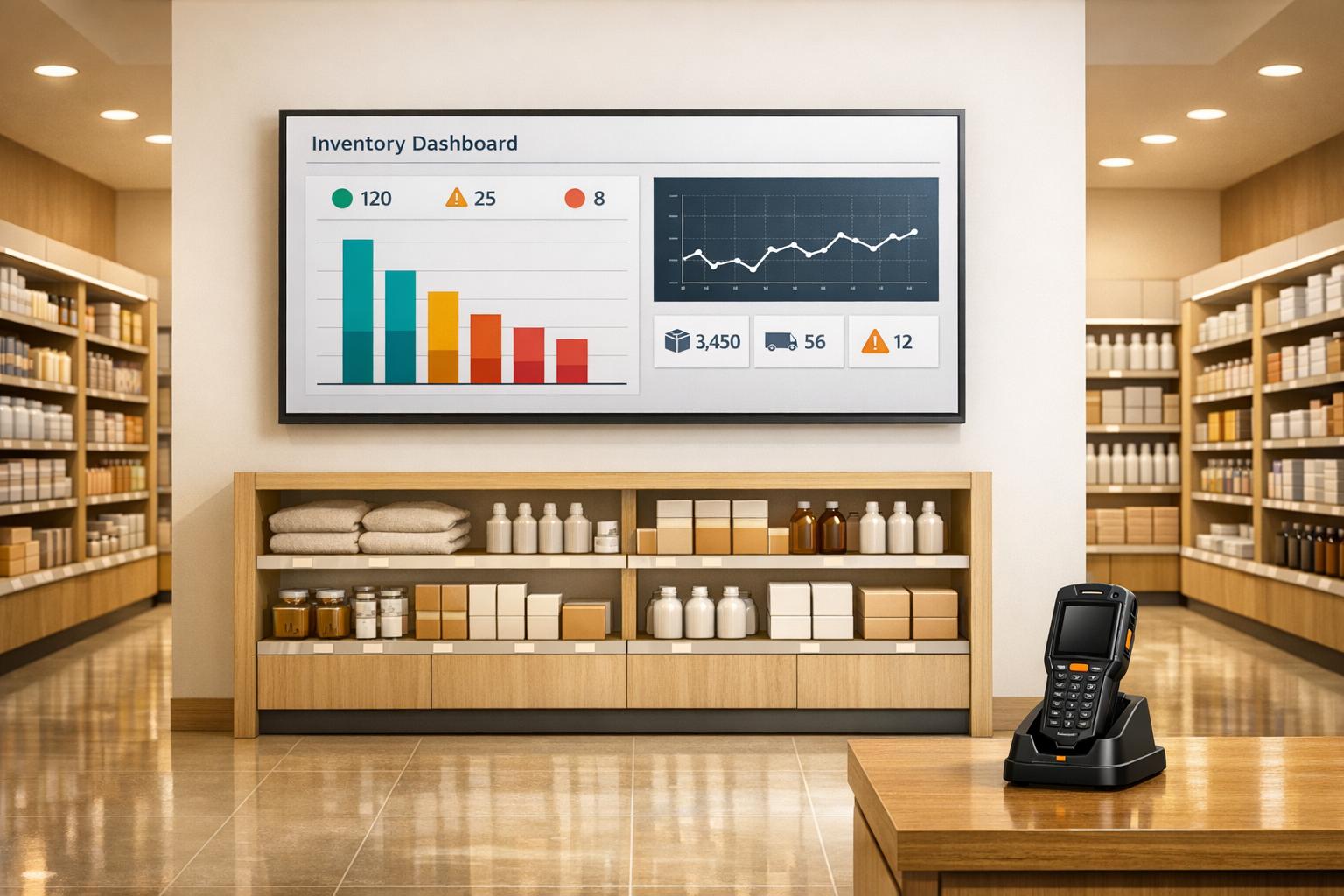
Real-time inventory dashboards give retailers a live view of their stock across all locations, eliminating delays and errors tied to outdated systems. These dashboards update instantly, tracking inventory movements with 100% scan-based accuracy, ensuring that data is always current and reliable.
Here’s why they matter:

Real-Time Inventory Dashboard Benefits: Key Statistics for Retail Success
Real-time dashboards eliminate the tedious process of manually reconciling spreadsheets and cross-checking multiple admin panels. Instead of exporting CSV files and searching for inconsistencies, retailers gain a live, unified view of stock movement across all locations. This centralized system removes the risk of errors caused by manual data entry or updating inventory counts by hand.
With scan-based execution, every scanned item updates the system automatically, significantly reducing human errors. As Connor Perkins, Director of Fulfillment at G10 Fulfillment, explains:
You want everything to be scanned in the warehouse, nothing done on paper. Paper creates invisible work. Invisible work creates missing transactions [1]
By ensuring every item is scanned at each touchpoint - from receiving to packing - the dashboard updates seamlessly, removing errors like missing or double-counted stock.
Dashboards also categorize stock statuses - such as available, reserved, incoming, and committed - automatically. This prevents overselling the same inventory across multiple sales channels. Retailers can access critical stock comparisons instantly, without needing separate reports for each metric [4]. This automation speeds up decision-making and reduces operational friction.
Real-time updates from automated scanning allow managers to detect and resolve problems quickly. When inventory data is updated instantly, issues like low stock levels can be addressed before they escalate. For instance, dashboards make it possible to pause sales channels as soon as stock reaches a critical threshold, avoiding unfulfilled orders. They also highlight opportunities to redirect idle stock from one location to another where demand is higher, enabling immediate transfers.
Live data also improves labor allocation. Managers can identify receiving backlogs or spikes in "short picks" (items unavailable during order fulfillment) and reassign staff to address these issues. This proactive approach prevents bottlenecks and keeps operations running smoothly. For example, G10 Fulfillment maintains a shipping accuracy rate of over 99.9% by connecting real-time order progression with inventory data [1].
Babymaxi, a Shopify-based retailer, faced challenges when moving from a single warehouse to multiple 3PL providers. Using Sumtracker for real-time inventory synchronization, they tracked stock transfers across multiple warehouses and maintained visibility over hundreds of SKUs. This ensured no sales channels competed for the same physical inventory, solving the common issue of "invisible" stock [2].
Inventory discrepancies cost U.S. retailers over $1.7 trillion annually due to out-of-stocks and overstocks [6]. Real-time dashboards address this by recording every transaction from receipt to shipment. This creates a detailed audit trail, making it easier to pinpoint where discrepancies begin.
Differentiating between "on-hand" and "sellable" stock is crucial. Dashboards with status-based visibility track items in different stages, such as receiving, staging, quarantine, or already allocated to orders. This prevents "phantom inventory", where system stock exceeds physical inventory, and "shadow inventory", where physical stock exists but is unrecorded [6].
Fulfillment providers that enforce 100% scan-based workflows achieve inventory accuracy rates of about 99.7% [5]. As Maureen Milligan, Director of Operations and Projects at G10 Fulfillment, notes:
An inventory accuracy dashboard gives teams a clear, shared view of whether the warehouse is keeping its promises [5]
Inventory turnover is calculated by dividing the cost of goods sold (COGS) by the average inventory. This metric helps retailers understand how often they replace their stock within a specific period [7]. A low turnover rate may indicate that a business is holding too much inventory compared to its sales. For context, retailers with more than 25% to 30% of their inventory classified as "dead stock" - items that remain unsold - are often seen as lagging behind competitors [7].
Another critical measure is Days on Hand (DOH), which reflects the average length of time items stay in stock [7]. A high DOH suggests sluggish inventory movement and tied-up capital, while a lower DOH indicates efficient stock turnover, freeing up cash for other investments. Real-time dashboards automatically update these figures with each sale, eliminating the delay of waiting for end-of-month reports.
The sell-through rate compares the number of units sold to the number received from manufacturers [7]. This metric is essential for merchandise planning, as it highlights which products are selling quickly and which are stagnating. Dashboards can even activate pricing adjustments when sell-through rates decline, allowing retailers to discount aging stock before it becomes unsellable [12]. In fact, retailers who closely monitor markdown percentages have reported up to a 7% improvement in margin retention [8].
These metrics are the foundation for better stock management and help retailers anticipate shortages while meeting demand effectively.
Building on inventory turnover insights, tracking stockout rates and forecast accuracy is essential for maintaining profitability. The stockout rate measures the percentage of items that are unavailable when customers attempt to purchase them [7]. Stockouts are costly - 37% of customers will turn to competitors, and 21% may never return [13]. Real-time dashboards mitigate these risks by monitoring inventory levels and sending alerts when stock falls below preset thresholds [11][13].
Forecast demand accuracy measures the gap between actual inventory and predicted demand [7]. Retailers using AI-powered forecasting tools within real-time dashboards can achieve a 20% to 50% reduction in errors compared to older methods [13]. These systems incorporate historical sales data alongside external factors like weather, local events, and social media activity to predict potential stockouts days in advance [10][13].
Additionally, modern dashboards dynamically adjust safety stock levels based on changes in lead times and demand variability, moving beyond static calculations [13]. For example, grocery retailers using these systems have reduced stockouts by 25% [8]. Similarly, one apparel retailer increased their conversion rate by 12% in just one quarter by optimizing staffing levels using real-time data on customer behavior [8].
To complement inventory management, tracking supplier performance ensures the entire supply chain supports retail success. The Supplier Quality Index (SQI) evaluates vendor performance based on material quality, delivery timeliness, and responsiveness [7]. Real-time dashboards simplify this process, flagging suppliers who frequently miss deadlines or deliver subpar products, empowering retailers to make informed decisions about their vendor relationships.
The Perfect Order Rate tracks the percentage of orders that meet all requirements - being delivered on time, complete, damage-free, and with accurate documentation [7]. For example, G10 Fulfillment achieves a shipping accuracy rate exceeding 99.9% by integrating real-time inventory data with order tracking systems [1].
Finally, Gross Margin Return on Investment (GMROI) measures how much revenue is generated for every dollar invested in inventory [9]. By dividing gross margin by average inventory cost, dashboards can quickly identify which products or categories are underperforming and draining profitability [7]. This insight enables retailers to focus on stocking items that deliver the best return on investment.
Nobody likes the frustration of thinking an item is in stock, only to find out it’s not. Real-time inventory systems solve this by offering a clear distinction between total inventory and sellable inventory - excluding items that are still in transit, undergoing quality checks, or already reserved for other orders [1]. This ensures customers see accurate stock levels, reducing the chance of disappointment.
Here’s a hard truth: 69% of online shoppers will jump to a competitor if their desired item is out of stock [14]. And with U.S. retailers averaging just 65% inventory accuracy, it’s no wonder customers often face stock issues [14]. Real-time systems tackle this by connecting platforms like Shopify, Amazon, in-store point-of-sale systems, and logistics providers through APIs. This ensures that what’s displayed online matches what’s actually available in the warehouse [14].
For in-store shoppers, the benefits are just as crucial. 82% of customers encountered an out-of-stock item in the last year [15]. Real-time dashboards enable an "endless aisle" approach, where store associates can locate inventory at other locations or warehouses and arrange for direct shipping to the customer. This not only saves the sale but also enhances the overall shopping experience [15].
Order cancellations are a quick way to lose customer trust. Real-time dashboards help avoid this by instantly reserving stock as soon as an order is placed, ensuring the same item isn’t sold on multiple platforms [14]. This level of precision ensures orders are fulfilled without hiccups.
The financial impact of stockouts is staggering: U.S. grocery retailers lose between $15 billion and $20 billion annually, or roughly 3% of their total sales [14]. Broader inventory inaccuracies can cost retailers up to 4% of their annual sales [14]. Retailers using real-time Order Management Systems have seen overselling drop by 40% and fulfillment speed improve by 30% [16].
By reserving stock immediately and using smart routing to minimize shipping distances, these systems streamline fulfillment. Retailers leveraging scan-based tracking - where every warehouse movement is digitally logged - can achieve over 99.9% shipping accuracy, ensuring customers get exactly what they ordered [1].
Real-time dashboards don’t just prevent cancellations - they also unify the shopping experience across platforms. Whether customers shop in-store, online, or via a mobile app, they expect seamless transitions. Real-time systems make this possible by synchronizing inventory data across all channels instantly [15]. For example, if the last unit of a product is sold on Amazon, that update is immediately reflected on your Shopify store and in physical locations.
This synchronization is critical for services like Buy Online, Pick Up In-Store (BOPIS) and curbside pickup. These systems provide assurance that an item is ready and waiting when the customer arrives [15]. Retailers using real-time inventory tools have reported up to a 30% boost in fulfillment rates and a 20% rise in customer satisfaction [15].
The stakes are high: Out-of-stock situations cost retailers nearly $1 trillion annually in lost sales, and 61% of shoppers are unlikely to return after encountering a stockout [17]. By offering real-time visibility into stock levels and order progress, retailers not only reduce support tickets but also build trust and loyalty with their customers [1].
Real-time dashboards thrive on the smooth integration of essential systems. Point of Sale (POS) systems handle in-store transactions and returns, instantly updating digital stock levels as customers check out [19]. Meanwhile, Warehouse Management Systems (WMS) monitor inventory movement at every stage - receiving, staging, and picking - so you always know the exact location of each item [1]. Enterprise Resource Planning (ERP) platforms tie it all together, managing finances and coordinating the supply chain [14][8]. At the center of it all is the Order Management System (OMS), which consolidates stock, orders, and reservations across all channels, eliminating data silos [14][18].
The magic lies in Application Programming Interfaces (APIs), which allow platforms like Shopify, Amazon, and back-end ERPs to exchange data in real time [14]. Retailers are increasingly adopting event-driven architecture, where inventory updates are pushed instantly to all systems using APIs and webhooks [18]. Webhooks ensure data reaches dashboards the moment changes occur, avoiding the lag of traditional polling methods (5–15 minutes) [18]. To streamline updates, delta sync focuses only on modified SKUs instead of refreshing the entire catalog [18]. During high-traffic periods, atomic operations (like Redis DECR) prevent overselling by rejecting simultaneous transactions for the last available unit at sub-millisecond speeds [18].
With this robust integration in place, advanced tracking technologies take inventory management to the next level.
Barcodes have been a staple in inventory tracking but come with limitations, achieving just 85–95% accuracy due to manual scanning and line-of-sight requirements [20]. On the other hand, Radio Frequency Identification (RFID) technology offers a significant leap, reading through materials without line-of-sight and capturing over 1,000 tags per second with 99.0–99.8% accuracy [20]. By early 2025, 93% of North American retailers are expected to incorporate RFID into their operations [20].
Consider this: In March 2026, a Charlotte warehouse uncovered a 2,594-unit variance worth $311,000. Barcode errors contributed to a 4.2% cancellation rate, leading to nearly $1.84 million in losses over six months [20]. RFID minimizes such issues by using fixed portal readers at dock doors or aisle entrances to automatically capture data - no manual input required [20]. While passive RFID tags cost between $0.04 and $0.15 each, fixed readers range from $3,000 to $8,000 [20].
Many retailers now combine technologies for maximum efficiency: barcodes for pallets and cartons, passive RFID for high-velocity case picks, and active GPS/IoT sensors for high-value or long-haul shipments [21]. Middleware plays a key role in filtering duplicates, validating data, and syncing clean events with WMS or ERP systems within seconds [21]. Running systems in "shadow mode" for 1–2 weeks before full deployment allows teams to compare automated logic against manual counts, ironing out discrepancies [18]. These measures dramatically reduce inventory errors, keeping operations and customer satisfaction on track.
Integration and tracking are just the beginning - automated alerts keep operations running smoothly. Real-time dashboards flag critical issues like low stock on popular items, receiving delays, recurring location mismatches, or spikes in short picks [1]. Advanced systems also monitor dwell time (e.g., items sitting for over 24 hours), cold-chain breaches, and even negative stock levels [21].
Drift detection tools compare real-time updates against full audits to identify mismatches between master inventory records and channel listings [18]. Sync health dashboards track performance metrics like latency (time from sale to update), API errors, and buffer usage. High-performing systems achieve alert latency under 10 seconds and sync latency below 30 seconds [21][18].
Maureen Milligan, Director of Operations and Projects at G10 Fulfillment, highlights the value of these tools:
What these real-time portals provide our customers is 100% visibility. They can actually watch those progressions going on [1]
Joel Malmquist, VP of Customer Experience at the same company, adds:
We have over 99.9% ship accuracy of these orders [1]
This level of transparency empowers both internal teams and customers to monitor orders and inventory in real time, cutting down on service inquiries and improving overall satisfaction. Mobile-accessible heat maps offer supervisors a bird’s-eye view of warehouse activity, helping them identify congestion or empty pick faces and adjust labor allocation accordingly [21].
For businesses looking to maximize the potential of real-time inventory dashboards, expert support can make all the difference. Phoenix Strategy Group (https://phoenixstrategy.group) provides strategic advisory and data engineering services to integrate POS, ERP, WMS, and OMS systems seamlessly, ensuring precise inventory management and operational efficiency.
Real-time inventory dashboards are proving to be a game-changer for retail operations, with adopters seeing revenue boosts of 13–20% [22]. Acting as a single source of truth, these dashboards cut down on internal confusion and reduce support tickets. When marketing, sales, and operations teams rely on the same live data, they can focus on execution rather than wasting time chasing outdated information.
Accurate product availability not only smooths out operations but also elevates the customer experience. In fact, 45.9% of businesses now prioritize product availability over pricing [3]. When paired with integrated systems like POS, ERP, and WMS, retailers gain real-time visibility into both stationary and moving inventory. This clarity can slash delivery times by up to 35% [3]. Armed with these insights, retailers can take calculated steps to use real-time dashboards as a tool for strategic growth.
To fully leverage these advantages, retailers should take a few critical steps. Start by assessing your technical infrastructure. Bryan Wright, CTO and COO at G10 Fulfillment, highlights the importance of robust systems:
A good WMS tracks inventory through the warehouse at every point that you touch it [1]
Make sure your systems support full scan-based execution before implementing a dashboard.
Next, set clear, measurable goals tied to key performance indicators (KPIs). Are you trying to reduce order split rates, improve first-time fill rates, or cut transportation costs? Defining specific objectives will help shape your technology choices and integration plans. Additionally, set up alerts for stock-related issues - like low inventory on top-performing SKUs, backlogs in receiving, or mismatched locations - to address problems before they impact customers [1].
Proper training is another essential step. A staggering 52% of companies fail to capitalize on their technical setups because staff aren’t trained to make decisions based on live data [3]. Connor Perkins, Director of Fulfillment at G10 Fulfillment, emphasizes this point:
Having a 3PL and WMS that is 100% scan-based is crucial [1]
The accuracy of your dashboard depends entirely on the quality of the data feeding into it, so ensure every inventory movement is digitally recorded.
For retailers seeking expert advice on system integration and data engineering, Phoenix Strategy Group (https://phoenixstrategy.group) provides strategic services to help seamlessly align your systems. This ensures your dashboard becomes a reliable cornerstone for growth and operational efficiency.
The fastest way to maintain accurate inventory in real-time is by updating inventory data immediately as tasks are completed on the warehouse floor. Technologies like RFID, barcode scanners, IoT sensors, and cloud-based platforms make this possible by enabling instant data capture and synchronization, reducing delays and minimizing errors.
To create a functional real-time inventory dashboard, it's crucial to connect several systems seamlessly. The most important integrations include:
By linking these systems, you can maintain accurate and synchronized inventory data across all platforms, making monitoring and decision-making much more efficient.
Real-time dashboards are a game-changer for avoiding overselling. They deliver instant, accurate updates on stock levels, allowing businesses to keep a close eye on their inventory. With this real-time visibility, companies can quickly address stock shortages and ensure that sales across different platforms stay in sync with what’s actually available.