Published on
April 4, 2026

Want to keep your subscribers from leaving? Start listening to their feedback.
Customer churn is a major issue for subscription-based businesses. In 2025, one-third of users canceled at least one video service, often citing high prices or lack of value. But here’s the good news: understanding why customers leave - and acting on their feedback - can significantly reduce churn and boost profits.
Here are five practical ways to use feedback to retain more subscribers:
Even small improvements in retention have a big impact. Increasing retention by just 5% can boost profits by 25% to 95%. Let’s dive into how these strategies can help you keep your subscribers engaged and loyal.
How Feedback Reduces Subscription Churn: Key Statistics and Impact
Reducing churn starts with understanding why customers decide to leave. Without clear feedback, any effort to address the issue becomes a guessing game. But capturing meaningful insights doesn’t have to be complicated. Here’s how you can gather and use this feedback effectively.
One of the easiest ways to collect feedback is to automate the process during cancellations. For example, when a customer clicks "cancel", you can prompt them with an in-app survey. Include options like pricing concerns, missing features, switching to a competitor, or dissatisfaction with onboarding [7]. This method ensures you're gathering input from a broad group, rather than relying on a few voluntary responses.
Your support team also plays a key role here. Train them to ask simple, direct questions during cancellations. As ProductPlan points out, these "exit interviews from churned customers yield unvarnished truths that current customers are too polite or afraid to offer up" [7]. Customers who are leaving often feel freer to share honest feedback.
Once you’ve collected this data, organize it into categories to identify trends. For instance, if you notice a pattern of complaints about pricing or missing features, it’s a clear signal to revisit your pricing model or prioritize new features in your product roadmap.
Armed with this feedback, you can implement retention strategies that address specific issues. For example, during the cancellation process, offer personalized solutions based on customer responses. If pricing is the problem, consider presenting a discount. If a customer feels the product lacks certain features, you might showcase upcoming updates or offer a temporary pause option for infrequent users [8]. These tailored offers can reduce cancellations by 10% to 39% [8].
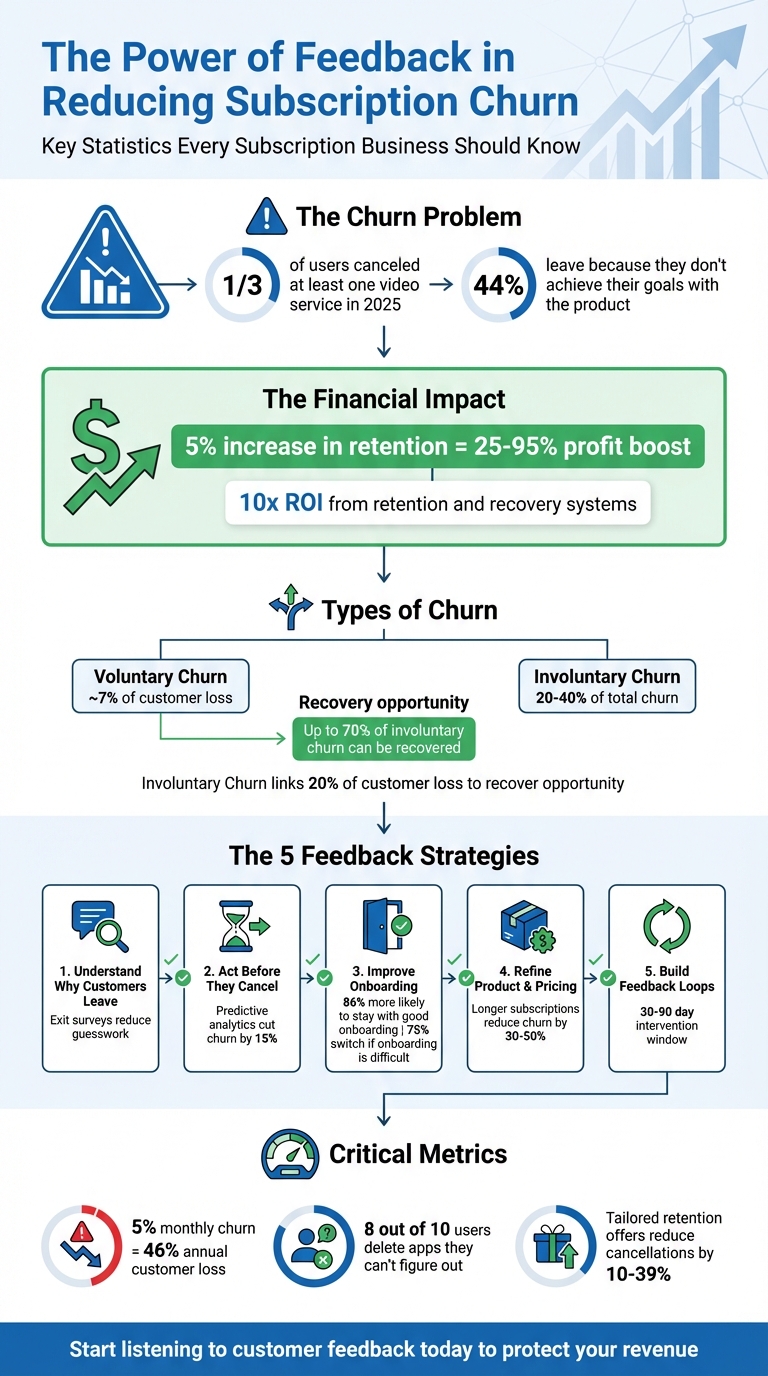
The financial impact of even small improvements in retention is enormous. Research shows that increasing retention by just 5% can lead to a profit boost of 25% to 95% [6]. Additionally, 44% of customers leave because they don’t feel they’re achieving their goals with the product [6]. This highlights the importance of improving onboarding, customer success initiatives, and product education. By addressing these gaps and tracking their impact, you can create a stronger, more effective retention strategy.
Early behavioral changes often provide the most useful feedback - long before a customer officially cancels. Unfortunately, many subscription businesses wait until a cancellation happens to ask why, but by then, the damage is already done.
Instead, focus on tracking early warning signs like fewer logins, declining usage, or negative feedback from support interactions [4]. For instance, if a customer hasn’t logged in for three weeks, that’s a red flag. Set up automated alerts to identify accounts with a 50% drop in usage, and then reach out with tailored messages [5]. This kind of proactive engagement can make a big difference in reducing churn.
Catching problems early doesn’t just improve customer satisfaction - it also boosts your bottom line. Tools like predictive analytics and automated workflows can help you address declining health scores, potentially cutting churn by as much as 15% [4]. This kind of early intervention delivers clear financial rewards, proving the value of acting on customer feedback.
It’s also important to understand the two main types of churn: voluntary and involuntary. Voluntary churn - caused by dissatisfaction or pricing concerns - typically accounts for around 7% of customer loss in subscription businesses. Involuntary churn, often due to payment failures, is much higher, making up 20% to 40% of total churn [4]. Here’s the upside: with effective dunning systems and better communication, up to 70% of involuntary churn can be recovered [4]. Many businesses overlook this opportunity, even though it’s one of the easiest ways to retain customers.
The good news? You don’t need complicated tools to get started. Most billing platforms, like Stripe, Recurly, and Chargebee, already offer payment recovery features, including retry logic based on specific decline codes [8][1].
For voluntary churn, simple actions can go a long way. If a customer’s health score drops, send a friendly “we miss you” email or give them a quick call. These small, straightforward efforts ensure that early warning signs lead to immediate action, helping to prevent churn before it spirals out of control. And the best part? You’ll usually start seeing results within 1–3 months [5].
Customer onboarding is a critical moment that shapes long-term engagement. As UX Designer Bart Krawczyk explains: "The truth is that what happens on day one of the user experience (even before they become subscribers) profoundly influences long-term product engagement" [9]. Unfortunately, many businesses miss key opportunities by overlooking gaps in their onboarding process.
Feedback plays a vital role in identifying where users struggle. For example, in 2024, a B2C edtech startup catering to African university students uncovered specific onboarding challenges through targeted interviews. They found that users were ignoring valuable non-exam features because of a heavy focus on seasonal exam prep. By updating their copy and visuals to emphasize year-round benefits, they increased feature discovery and engagement by 30% [9]. This example shows how early feedback can refine onboarding strategies and directly impact user retention.
A complicated onboarding process can drive customers away - nearly 75% of users will switch to a competitor if onboarding feels too difficult [10]. Even more striking, 8 out of 10 users have deleted an app simply because they couldn’t figure out how to use it [10]. If customers don’t quickly see the value of your product, they’re likely to leave before you’ve even had the chance to prove its worth.
On the other hand, effective onboarding can dramatically improve retention. 86% of consumers are more likely to stay loyal to a brand that invests in welcoming and educating them during the onboarding process [10]. Often, churn in the first 60 days stems from unmet expectations [1]. Addressing onboarding issues based on user feedback can help align expectations and reduce one of the biggest risks to retention.
The good news? Improving onboarding doesn’t have to be complicated. Small changes - like updating welcome screens, simplifying steps, or highlighting key features - can deliver big results. The edtech example above proves how even basic updates to copy and visuals can lead to a 30% boost in engagement [9].
To start, consider interviewing users at key milestones: day one, after one month, and after two months. Ask them what they expected when they signed up and whether those expectations have been met. Use in-app polls to identify points of confusion in real time, such as asking, "Was this step clear?" immediately after a key action. These simple tweaks require minimal effort but can lead to noticeable improvements within just a few billing cycles.
Direct feedback is a goldmine for refining both your product and pricing strategies. When customers leave because of pricing or feature issues, it’s a clear sign that something isn’t aligning with their expectations. For example, if exit surveys consistently show that users find your service "too expensive", you can respond with options like a lower-cost plan or limited-time discounts before they finalize their cancellation [1][2].
Customer interviews and discussions in community forums often highlight missing features or areas where the product falls short [2]. On the flip side, if users feel the product offers more than they need, consider solutions like pausing their subscription or reducing delivery frequency to maintain the relationship [1][2].
Addressing these pain points can make a noticeable difference in your churn rate. Data shows that 44% of cancellations occur because customers feel the product isn’t helping them achieve their goals [4]. By tackling these issues head-on, you not only fix immediate problems but also strengthen your overall retention strategy. Adjusting pricing and plans based on feedback can lower voluntary churn, which averages around 7% for subscription businesses [4]. Companies offering longer-term subscriptions often see churn rates drop by 30% to 50% [4][5]. Even a slight reduction in monthly churn - say, from 6% to 4% - can significantly boost customer lifetime value over time [5].
The tools to implement these changes are readily available and simple to use. Platforms like Recurly, Recharge, and Churn Buster include features like exit surveys and automated retention offers, allowing you to make adjustments without heavy technical work [1][2][3]. Start by creating cancellation flows that ask users why they’re leaving and offer tailored alternatives - such as a budget-friendly plan or a "skip shipment" option for those feeling overwhelmed [1][5]. Regularly review your pricing tiers for simplicity and transparency, and ensure you act on feedback from NPS or CSAT surveys. When customers see their input leads to real improvements, it builds trust and loyalty [1][4].
Building on earlier strategies for gathering actionable feedback, implementing a continuous feedback system takes retention efforts to the next level.
A continuous feedback loop typically follows five stages: Input (collecting data), Processing (analyzing patterns), Output (implementing changes), Feedback (closing the loop), and Adjustment (measuring results) [11]. To make this system effective, collect insights from multiple sources such as in-app surveys (using tools like Hotjar or Pendo), NPS scores, support ticket transcripts, usage analytics, and exit surveys [11][12]. Combining these sources helps detect silent churn early on.
Segmenting feedback by user group is key. For instance, ask power users about the features they find most valuable, while identifying frustrations among less engaged customers. Use tools like an Impact vs. Effort Matrix to prioritize changes that will have the greatest effect on reducing churn [11].
Churn can have a snowball effect: a 5% monthly churn rate leads to a 46% annual customer loss. However, increasing retention by just 5% can result in profit gains between 25% and 95% [4][13]. Companies leveraging predictive analytics to identify at-risk behaviors have successfully reduced churn by up to 15% [4]. Real-time dashboards that monitor indicators like declining login frequency or feature abandonment offer a critical 30- to 90-day window for intervention before cancellations occur [14].
"Treat churn like a smoke detector: the earlier you catch signals, the easier it is to prevent damage."
By integrating continuous feedback, subscription businesses can enhance their retention strategies with real-time responsiveness. These metrics highlight the importance of acting on insights promptly to drive better outcomes.
Modern tools make creating a continuous feedback system more straightforward than ever. For example, AI-powered sentiment detection can automatically flag negative support tickets, while automated alerts can notify teams when customer health scores drop [4][12][14]. Tracking critical metrics like time-to-first-value during onboarding is also essential, as delays in delivering value often lead to early churn [16]. These tools streamline decision-making and allow businesses to focus on what matters most - keeping customers engaged.
One of the biggest advantages of continuous feedback systems is their scalability. Automated in-app surveys can gather real-time input without increasing staff workload, while AI tools can process sentiment across thousands of support tickets [11][14][15]. However, closing the feedback loop is the final, crucial step. When customers see their feedback driving tangible product improvements, trust and engagement grow [11][12].
"Feedback without follow-up breeds cynicism. Always close the loop to show that customer voices matter."
- Gainsight [12]
Sharing these improvements publicly reinforces the message that customer feedback is valued and acted upon. This approach not only strengthens trust but also encourages further engagement.
Customer feedback plays a crucial role in protecting revenue. The five approaches outlined - understanding why customers leave, taking proactive measures, improving onboarding processes, aligning products with pricing, and maintaining continuous feedback - work together to create a retention strategy that grows stronger over time. These strategies not only help keep customers but also lead to measurable financial gains.
The financial impact is hard to ignore: boosting customer retention by just 5% can result in profit increases ranging from 25% to 95% [4]. Additionally, fine-tuned retention and recovery systems can deliver returns that exceed 10 times the initial investment [1]. Companies leveraging predictive analytics and behavioral feedback to address at-risk customers have managed to cut churn by as much as 15% [4].
Retention should be viewed as an ongoing revenue strategy. As Ewan Watt, Founder & CEO of ROI Growth Agency, explains:
"Implementing a simple system to track feedback, assign ownership for action, and measure the results will deliver significant returns in reduced churn and increased customer lifetime value" [17].
Focus on the 20% of customers who typically generate 80% of future revenue [4]. Use tools like Net Promoter Score (NPS) and Customer Satisfaction (CSAT) scores to identify and address churn risks early [4]. Don’t forget to capture feedback from the silent majority - those who leave without voicing concerns. Close the loop by demonstrating to customers that their feedback drives real improvements. This creates a positive cycle where happy customers turn into loyal advocates, enhancing your brand’s reputation and encouraging referrals.
The fastest way to spot churn risk is by keeping an eye on early warning signs like reduced usage, missed payments, or falling engagement levels. Once you notice these red flags, take action quickly. Use retention strategies that match these specific issues - like sending personalized messages or offering targeted deals to win back customer interest.
To stay in tune with your customers, leverage tools like in-app surveys, NPS (Net Promoter Score), and AI chatbots. These methods give you consistent, actionable insights into what your customers need and where they’re facing challenges.
Using these tools ensures you can identify and address issues quickly, keeping your customers happy and engaged.
To tackle churn effectively, start by gathering insights from tools like surveys or Net Promoter Score (NPS) assessments. These can help you pinpoint recurring issues that may be driving customers away. Once you’ve identified the key problems, take swift action to address them.
For customers who seem at risk, consider offering personalized support. This could mean tailoring solutions to their specific needs or reaching out with a more hands-on approach. Additionally, show customers that their feedback matters by sharing updates on the changes you’ve made based on their input - this helps build trust and loyalty.
Keep an eye out for early warning signs, such as a drop in product usage or engagement. By spotting these red flags early, you can intervene before customers decide to leave. Finally, track your progress by measuring retention rates or churn metrics. Use this data to refine your strategies and create a stronger customer experience over time.