Published on
February 15, 2026


Revenue forecasting for SaaS companies and legal firms requires completely different approaches because of how they generate income. SaaS businesses rely on predictable subscription-based revenue, while legal firms depend on variable and labor-intensive billing methods. Here's a quick breakdown:
Both industries face challenges like data silos, timing delays, and market volatility but require tailored strategies and metrics to forecast accurately. SaaS companies focus on churn management and cohort analysis, while legal firms prioritize resource allocation and backlog forecasting.
Quick Comparison:
| Aspect | SaaS | Legal Services |
|---|---|---|
| Revenue Model | Recurring subscriptions (MRR/ARR) | Billable hours, retainers, contingency |
| Key Metrics | Churn, NRR, CAC Payback | Utilization rate, realization rate |
| Forecasting Focus | Customer retention, deferred revenue | Staff capacity, matter cycles |
| Main Challenge | Churn and data accuracy | Variability in billable hours |
Accurate forecasting in these industries demands industry-specific methods and tools to manage complexities and improve financial planning.
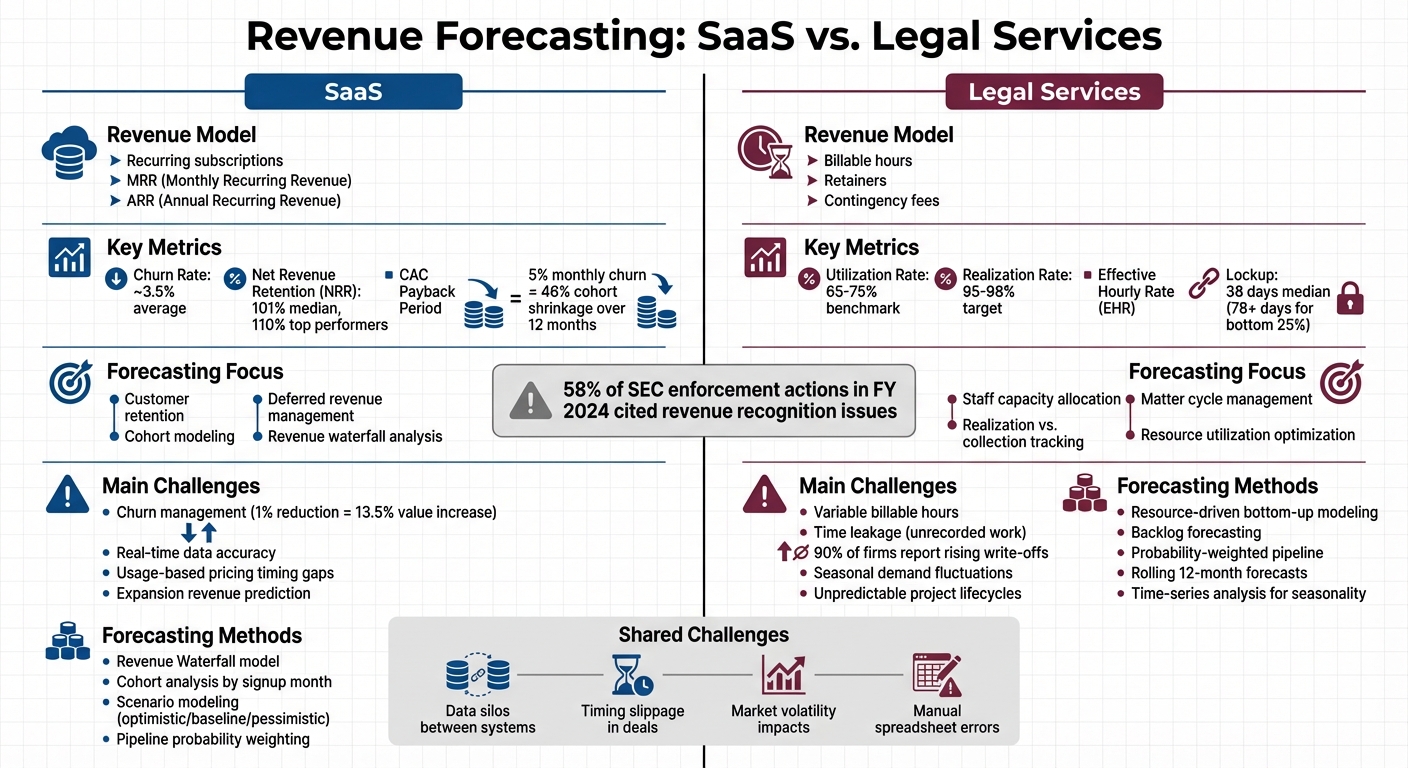
SaaS vs Legal Services Revenue Forecasting: Key Metrics and Models Comparison
For SaaS companies, keeping existing customers is often more challenging - and impactful - than acquiring new ones. Even small changes in churn rates can dramatically alter revenue projections. For instance, a customer cohort experiencing a 5% monthly gross revenue churn will shrink by 46% over a year unless expansion revenue offsets the loss[4]. Lowering that churn by just 1% (from 5% to 4%) boosts the cohort's 12-month value by 13.5%[4].
Not all churn is the same, though. Involuntary churn, like failed payments or expired cards, affects revenue differently than customers actively canceling their subscriptions[4][8]. Combining these two types of churn in a single model can hide important differences. Gene Godick from G-Squared Partners highlights this issue:
"Most SaaS forecasts fail by Q2, and it's almost always because churn and expansion aren't modeled with the same rigor as new bookings." [4]
Expansion revenue adds even more complexity. Predicting upsells depends on hard-to-model factors like feature usage, account growth, and customer behavior patterns[2]. What worked for expansion in one quarter might not hold in the next[2]. Additionally, treating all customers the same when calculating retention rates is misleading. Enterprise customers behave very differently from SMBs, and this distinction matters. For example, in 2025, the median Net Revenue Retention (NRR) for SaaS companies was 101%, while top performers reached 110%[4]. That difference can translate into millions of dollars in compounded revenue.
This level of churn variability highlights the importance of managing data in real time - a topic we’ll dive into next.
In the fast-moving SaaS world, outdated data can render revenue forecasts useless. David Appel from Sage explains it best:
"Outdated forecasts are like an old map; so much has changed over the years that you just can't be confident, and you're likely to end up at a dead-end." [5]
Disconnected systems, like billing, CRM, and usage platforms, often lead to duplicated revenue records, faulty assumptions, and cash flow projections that lag behind actual performance by months[4]. Usage-based pricing compounds these issues. For example, a customer might increase usage in March, but the invoice may not go out until April, with payment collected in May[4]. Failing to account for these timing gaps can throw off cash flow projections significantly.
Real-time tracking of key indicators can help. Metrics like declining logins, increased support tickets, or payment failures can flag churn risks 30 to 60 days before they become actual losses[4]. However, this requires clean, well-maintained data. In FY 2024, revenue recognition and internal accounting controls were cited in 58% of SEC accounting and auditing enforcement actions[9], showing that poor data management isn’t just a forecasting issue - it’s also a compliance risk.
Synchronizing data is only part of the challenge. Deferred revenue and long sales cycles add even more layers of complexity to SaaS forecasting.
Deferred revenue and lengthy sales cycles make accurate forecasting even harder for SaaS businesses. Deferred revenue, which appears as a liability on the balance sheet until services are delivered, creates a disconnect between cash collected and revenue recognized. This is especially true for companies that bill annually upfront. Mona Sharma from Drivetrain explains:
"Deferred revenue forms a basis for the financial planning and performance of any SaaS business. If done right, deferred revenue forecasting allows you to better manage growth expectations and make more informed financial decisions." [10]
For example, if a customer downgrades from a $5,000-per-month plan to a $2,000-per-month plan, deferred revenue balances must be recalculated, which can skew quarterly results[10]. Usage-based pricing introduces even more volatility, as the rate at which deferred revenue is recognized depends on actual usage[4].
Extended sales cycles, particularly for Enterprise deals, add another layer of unpredictability. These deals often take much longer to close than those with SMBs, and lumping them into a single pipeline can distort performance metrics[7]. A 12-month payback period combined with a 5% monthly churn rate means a company might barely break even on nearly half its customers before they churn[4]. Without segmenting pipelines into categories like New Business, Renewals, and Expansions, it’s nearly impossible to accurately assess the likelihood of closing deals[7].
Legal service firms often face unpredictable revenue due to the nature of their work, which relies heavily on bespoke expertise and custom projects [3][6]. One major hurdle is time leakage, where hours worked go unrecorded or unbilled [12]. On top of that, different billing models introduce their own set of challenges. For example:
Another issue is the difficulty in separating steady, repeatable work from episodic, unpredictable cases. Take a firm generating $1 million annually as an example: $700,000 (70%) might come from consistent matters like patent applications, while $300,000 (30%) stems from irregular litigation [11]. Combining these two types of revenue in one forecast can obscure the firm's true financial stability.
Even with accurate billable hour tracking, the unpredictability of project lifecycles adds another layer of complexity to revenue forecasting.
Accurate tracking of billable hours is only part of the equation. The irregular nature of legal project cycles further complicates forecasting.
Unlike SaaS companies, where customer retention often guarantees recurring revenue, legal firms must navigate matter cycle variability - the unpredictable time between starting a project and completing it (and getting paid) [3]. This variability often results in "lockup", a term used to describe revenue stuck in two stages:
The numbers are striking: 90% of firms report year-over-year increases in lockup, with the median firm holding 38 days' worth of annual revenue in an unbilled state. For the bottom 25% of firms, this number exceeds 78 days [16][17].
Karen L. Smith, Executive Director at Baird Holm, underscores the issue:
"Relying solely on billable hours and rate increases is no longer enough to ensure sustainable growth." [16]
For firms operating on contingency fees, the challenges are even greater. Revenue often hinges on milestones like settlements or trials, making it nearly impossible to predict when - or even if - income will materialize [13].
Seasonal demand and billing practices add yet another layer of difficulty to revenue forecasting.
Legal firms frequently deal with cyclical demand patterns, making resource planning and revenue projections tricky [3]. Compounding this is the gap between reported revenue (billable hours) and actual cash collected. Many firms are grappling with increasing write-offs, discounts, and write-downs. Over the past year, 90% of firms reported rising write-offs, with 88% expecting the trend to continue [16].
This issue, often referred to as "write-off rot", diminishes the benefits of rate increases. For example, while firms may raise their rates, the impact is often negated by discounts and billing adjustments. Additionally, aged work in progress (WIP) is a major source of cash-flow pressure for half of surveyed firms, with 26% citing cash-flow predictability as their top financial concern [16].
Marina Raykin, Chief Financial Officer at Mintz, highlights the underlying problem:
"Attorneys are advancing to partnership without the commercial acumen or operational discipline required to effectively drive profitability." [16]
Billing cycles also play a significant role. Firms that issue invoices sporadically throughout the month face more unpredictable revenue patterns compared to those that bill consistently and early [14]. Without closely monitoring both billing realization (work performed vs. work billed) and cash realization (work billed vs. cash collected), firms risk missing early signs of revenue shortfalls.
These challenges demand forecasting strategies tailored specifically to the unique project and billing cycles of legal firms - approaches that differ sharply from the data-driven methods used in industries like SaaS.
Let’s dive into how SaaS companies and legal service providers approach revenue metrics and forecasting models. These metrics are the backbone of industry-specific forecasting strategies.
SaaS businesses rely heavily on recurring revenue metrics like MRR (Monthly Recurring Revenue) and ARR (Annual Recurring Revenue) to track their subscription income flow [1]. A common tool here is the Revenue Waterfall model, which starts with Beginning ARR and factors in new revenue, expansions, contractions, and churn. This approach provides clear visibility into growth dynamics [8].
Another critical metric is Net Revenue Retention (NRR), which combines churn, expansion, and contraction. NRR rates above 100% are considered strong, with top-performing SaaS companies hitting around 110% [2]. On average, B2B SaaS companies experience a churn rate of about 3.5%, making churn modeling a key focus for accurate forecasting [8][4].
CAC Payback - the time it takes to recover customer acquisition costs - is another vital efficiency measure. SaaS companies often use cohort modeling, grouping customers by their sign-up month, to identify long-term revenue trends and predict customer lifetime value [8][2].
As Stripe explains:
SaaS revenue forecasting clarifies how your business earns and loses revenue... it includes enough detail to inform real decisions across the company [2].
Legal firms operate on a different model, emphasizing human capital efficiency rather than subscription growth. Their cornerstone metric is the Utilization Rate, which measures the percentage of billable hours worked compared to total available hours. Industry benchmarks typically fall between 65% and 75% [18].
Utilization Rate is the main gauge for staff efficiency in a legal practice. Hitting the target means you're maximizing your billable capacity without burning people out. [18]
Another key metric is the Realization Rate, which tracks how much of the billed work is actually collected as revenue. Top firms aim for realization rates between 95% and 98% [18]. The Effective Hourly Rate (EHR), calculated as total revenue divided by total billable hours, highlights pricing power after discounts. For instance, in June 2026, Apex Legal Solutions achieved an EHR of $250, supported by a 72% gross margin target [18].
Legal firms also calculate Customer Acquisition Costs (CAC), such as Apex Legal Solutions’ $333.33 CAC in January 2026, which was below their $350 target [18]. Instead of cohort analysis, legal practices often rely on Overhead Coverage models to determine the minimum revenue needed to cover fixed costs. They also use probability-weighted pipeline forecasting, categorizing potential cases into Locked-in, Committed, High-probability, or Aspirational [19].
These metrics emphasize the stark differences in how SaaS and legal firms generate and measure revenue.
| Metric/Model | SaaS Approach | Legal Services Approach | Key Differences |
|---|---|---|---|
| Core Metric | ARR/MRR: Tracks recurring revenue run rates [1] | Utilization Rate: Measures billable hours [18] | SaaS focuses on contract value over time; legal focuses on labor efficiency. |
| Efficiency Indicator | CAC Payback: Time to recover acquisition costs [8] | Realization Rate: Work billed vs. cash collected [18] | SaaS evaluates marketing efficiency; legal measures billing discipline. |
| Growth Indicator | NRR: Tracks churn, expansion, and contraction [2] | EHR: Revenue per billable hour [18] | SaaS monitors account growth; legal tracks pricing power and profitability. |
| Forecasting Model | Cohort Modeling: Tracks customer retention [2] | Overhead Coverage: Calculates break-even revenue [18] | SaaS focuses on lifecycle analysis; legal focuses on cost coverage. |
| Revenue Leakage | Churn Rate: Lost subscriptions [8][4] | Realization Rate: Uncollected billings [18] | SaaS tracks subscription loss; legal tracks billing inefficiencies. |
SaaS companies face unique challenges like churn, data accuracy, and deferred revenue. To tackle these, they rely on specialized forecasting techniques.
One popular approach is the Revenue Waterfall model, which starts with Beginning ARR or MRR and factors in new revenue, expansion, contraction, and churn [8]. This method highlights both growth trends and areas where revenue is leaking.
Another key technique is cohort modeling. By grouping customers based on factors like signup month or plan type, SaaS teams can monitor retention and expansion trends over time. This helps predict long-term Net Revenue Retention (NRR). For instance, in 2023, a mid-market DevOps platform reduced forecast errors by 20% by shifting from a flat MRR model to one based on usage, incorporating historical consumption data [2][4][22].
Pipeline management also plays a critical role in projecting future bookings. SaaS companies weigh opportunities by probability and sales stage to estimate when deals might close [2]. Additionally, scenario modeling tests assumptions like churn spikes or economic downturns by creating optimistic, baseline, and pessimistic projections. This method ensures forecasts are stress-tested for various conditions. Cross-departmental collaboration further refines these predictions [2][4][8].
Legal firms, dealing with variable billable hours and complex matter cycles, use tailored strategies to manage their forecasts, focusing heavily on resource allocation.
A common approach is a resource-driven, bottom-up model. This method aligns pipelines with staff capacity, ensuring resources like attorneys and support staff are matched to active matters and unearned backlog. Given that revenue depends directly on billable hours, capacity planning is essential [20][21].
Backlog forecasting is another critical tool. Legal firms distribute contracted work over time to project revenue [20][23]. They also use probability-weighted pipeline forecasting, which estimates the likelihood of specific matters closing [3].
To handle volatility, legal firms often use rolling 12-month forecasts, updating them monthly to reflect new conditions. Time-series analysis helps identify cyclical trends and seasonal peaks, such as heightened demand during tax season. As Lou Gerstner, former Chairman and CEO of IBM, aptly said:
In business, what you can anticipate, you can manage. [3]
These strategies directly address earlier challenges, enabling legal firms to fine-tune their forecasts and adapt to dynamic revenue patterns.
The table below highlights how forecasting strategies are tailored to meet the unique needs of SaaS companies and legal firms.
| Strategy Type | SaaS Application | Legal Services Application |
|---|---|---|
| Pipeline Management | Weighs opportunities by probability and stage to predict subscription bookings [2]. | Evaluates the likelihood and value of potential matters to estimate future revenue [3]. |
| Capacity Planning | Focuses on hiring limits that could impact onboarding or sales capacity [2]. | Matches staff schedules with available billable hours to optimize utilization [20]. |
| Scenario Modeling | Tests churn and expansion scenarios (e.g., "What if churn rises 1%?") [2][4]. | Models outcomes based on client budget fluctuations, from optimistic to pessimistic [3]. |
| Backlog Forecasting | Tracks new deals signed but not yet paid or implemented [21]. | Tracks contracted commitments from clients that are yet to be fulfilled [23]. |
| Historical Analysis | Uses MRR buildup and past growth rates (e.g., ~5%) to set future revenue baselines [5]. | Employs time-series analysis to find cyclical trends and seasonal demand peaks [3]. |
Revenue forecasting isn’t easy, and both SaaS companies and legal firms face similar challenges, even if the specifics differ. Take data silos, for example. SaaS teams often struggle when billing, CRM, and product usage systems don’t talk to each other. Meanwhile, legal firms face issues with unrecorded billable hours slipping through the cracks before they even make it to invoices. Paul Carlson, CPA and Managing Partner at Law Firm Velocity, sums it up perfectly:
Lawyers are extremely busy, and time slips through the cracks a lot... It gets harder to forecast things you never captured. [19]
Timing slippage is another common headache. Relying on “likely” deals as if they’re guaranteed can lead to major forecasting misses. Just look at OSP Labs in 2025: two delayed contracts - representing 70% of their projected quarterly revenue - left their actual revenue 40% below forecast due to client restructuring. To fix this, they introduced a four-tier forecasting system (Locked-in, Committed, High-probability, and Aspirational), which slashed forecast variance by over 30% in just two quarters [19].
Both industries also grapple with market volatility. SaaS revenue can take a hit from algorithm changes or competitor price wars, while legal firms face shifting interest rates and regional economic downturns. Add in the heavy use of manual spreadsheets, and you’ve got a recipe for human error [5].
The solution? Move beyond single-number forecasts. Instead, build best-case, worst-case, and most-likely scenarios to stress-test your assumptions. Automating data integration can also reduce errors and improve accuracy. For businesses with concentrated client bases, maintaining a “minus-one” stress case - where you exclude your largest client - can help prepare for unexpected revenue gaps [5][19]. Tackling these challenges often requires expert financial advisory support.
Expert financial advisory services can make a world of difference for growth-stage companies struggling with forecasting issues. Phoenix Strategy Group specializes in FP&A and cash flow forecasting, replacing error-prone manual processes with automated, real-time solutions. Their approach brings together insights from sales, customer success, and product teams into unified financial models, eliminating the silos that lead to missed assumptions or double-counted revenue [2][5].
For SaaS companies, Phoenix Strategy Group digs into Customer Acquisition Cost (CAC) by channel and cohort, helping businesses avoid the pitfalls of blended metrics that can obscure unprofitable trends. Their scenario modeling highlights key risks, such as how a small churn rate increase (e.g., from 3% to 6%) could significantly impact the company’s runway [8]. Legal firms benefit too, with tools that connect practice management systems to general ledgers, offering real-time insights into utilization and accounts receivable.
Here’s a snapshot of common pitfalls and how expert advisory services can help address them:
| Pitfall | SaaS Risk | Legal Services Risk | Unified Solution via Expert Advisory |
|---|---|---|---|
| Data Silos | CRM and usage-based billing systems don’t sync [2]. | Billable hours lost before invoicing [19]. | Integrated FP&A platforms that align time-tracking with billing. |
| Timing Slippage | Delays in software implementation or procurement [19]. | Clients going silent, then needing urgent action [19]. | Probability-weighted pipeline modeling and qualitative reviews. |
| Market Volatility | Algorithm updates or pricing wars hit lead flow [19]. | Interest rate or regional economic shifts impact budgets [19]. | Rolling forecasts that factor in external market signals. |
| Manual Errors | Double-counted revenue in multi-year deals [2]. | Compliance mistakes in trust accounting [19]. | Automated revenue recognition and cash flow forecasting. |
Revenue forecasting for SaaS businesses and legal service firms requires tailored approaches because the way these industries generate income is fundamentally different. SaaS companies see a significant impact from even small improvements in churn rates, while legal firms depend heavily on optimizing billable hours and realization rates. These processes combine statistical analysis with qualitative insights into market trends [4][15].
Accurate forecasting is critical for navigating these complexities. Poorly designed models can lead SaaS companies to overestimate growth, resulting in hiring plans that exceed actual needs and cash flow issues. Similarly, inaccurate forecasts can prevent legal firms from allocating resources effectively, undermining their profitability and long-term stability [4][15]. As Gene Godick from G-Squared Partners highlights:
The real value isn't prediction: it's strategic clarity. Your model reveals which initiatives deliver the highest ROI [4].
Both industries benefit from shifting away from static annual plans in favor of dynamic, living forecasts that adjust monthly based on actual results. For SaaS teams, this means segmenting data by customer size and acquisition channel instead of applying uniform retention rates. Legal firms, on the other hand, should explore additional revenue streams to identify and focus on the most profitable opportunities [4][15].
Specialized financial advisory services, like those offered by Phoenix Strategy Group, play a key role in supporting these strategies. By integrating real-time financial modeling and automating manual processes, they help businesses interpret their data and uncover the story behind their numbers, guiding them toward smarter decisions and sustainable growth.
For SaaS companies, it’s all about scenario analysis. Dive into metrics like Monthly Recurring Revenue (MRR), churn rates, and customer behavior to predict future performance. On the other hand, law firms should focus on past financial data, client retention rates, and market trends to forecast revenue effectively. Adjusting your methods to fit the unique factors of each industry is key to producing reliable projections.
The fastest way to sharpen your forecast accuracy is by tailoring your approach to your industry. For SaaS companies, this means focusing on metrics like Monthly Recurring Revenue (MRR), churn rates, and Customer Acquisition Cost (CAC). These numbers should be updated frequently, ideally using real-time data, to keep your models precise and actionable.
For legal services firms, the key lies in using accurate data, analyzing historical trends, and employing scenario planning - like mapping out best-case and worst-case outcomes. This approach helps prepare for a range of possibilities and ensures better decision-making.
No matter the industry, incorporating technology, relying on verified data, and conducting regular reviews are essential steps to achieving more reliable forecasts.
For SaaS companies, it's crucial to tie revenue forecasts directly to cash flow by keeping a close eye on metrics like Monthly Recurring Revenue (MRR), churn rates, Customer Acquisition Cost (CAC), and Lifetime Value (LTV). Incorporating scenario analysis can help align your projections with the timing of cash inflows and outflows, offering a clearer financial picture.
In contrast, legal firms should prioritize understanding billing schedules, payment patterns, and the impact of economic factors. This ensures their forecasts accurately represent actual cash movements rather than just expected revenue.
For both industries, maintaining continuous data validation and leveraging real-time updates is critical for keeping forecasts accurate and actionable.