Published on
July 5, 2026


If you treat every compliance task like a crisis, you waste time and money. I’d focus on six controls that tell me where the biggest risks sit, who owns them, what proof exists, and when issues must move up the chain.
For a U.S. company doing $500,000 to $10 million in yearly revenue, the goal is simple: keep records clean, test what matters most, and fix issues before an audit, funding round, or expansion puts pressure on the business. The article’s main point is that a risk-based program helps you spend effort where the downside is highest, not everywhere at once.
Here’s the short version:
A few numbers stand out:
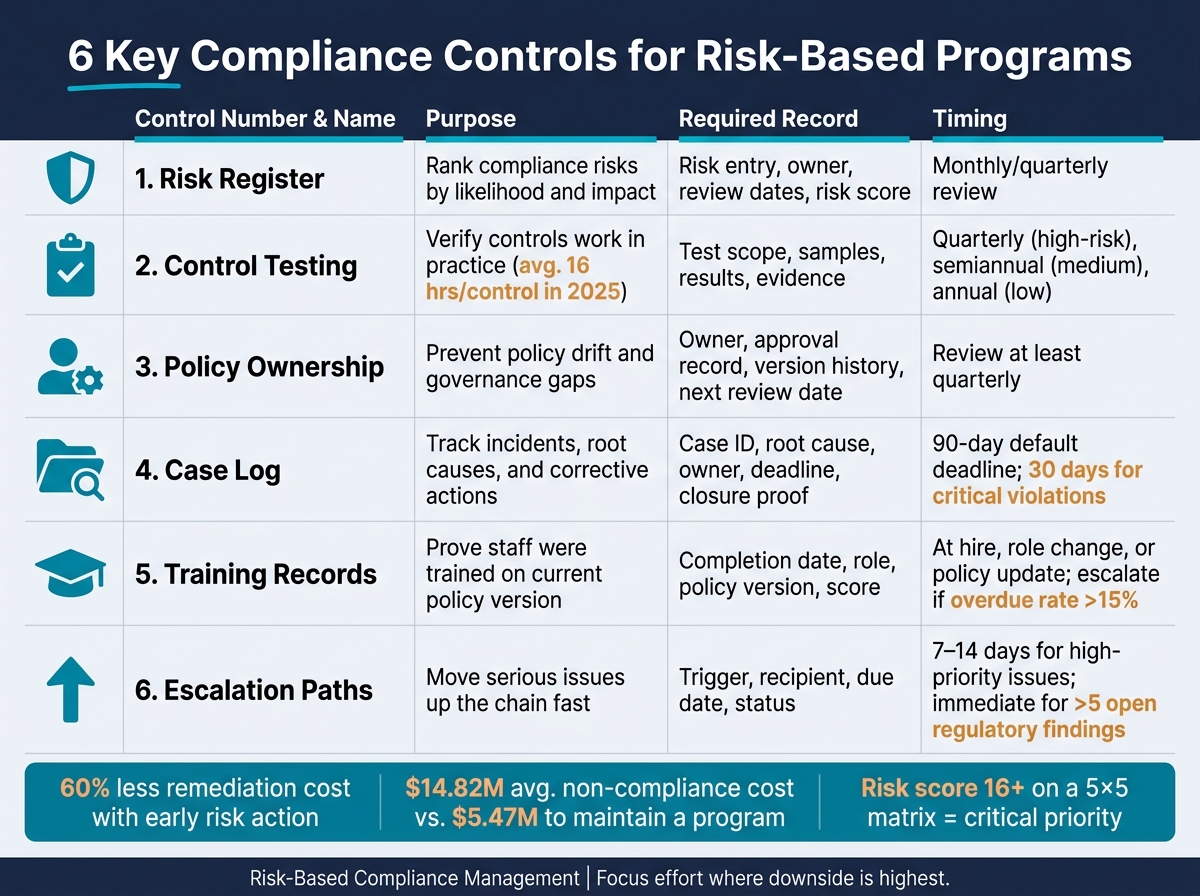
6 Key Compliance Controls: What to Track, Prove & When
| Control | What I’d use it for | What record should exist | Typical timing |
|---|---|---|---|
| Risk register | Rank compliance risks | Risk entry, owner, review dates, risk score | Monthly/quarterly review |
| Control testing | Check if controls work | Test scope, samples, results, evidence | Quarterly, semiannual, or annual |
| Policy ownership | Prevent policy drift | Owner, approval, version history | Review at least quarterly |
| Case log | Track incidents and fixes | Case ID, root cause, owner, deadline, closure proof | Update as issues happen |
| Training records | Prove staff were trained | Completion date, role, policy version, score | At hire, role change, policy change |
| Escalation paths | Move serious issues fast | Trigger, recipient, due date, status | As soon as thresholds are hit |
Bottom line: I’d use these six controls to keep compliance work focused, documented, and easier to review.
The first three controls do most of the work. They spell out what the business is exposed to, show whether safeguards work in practice, and make it clear who is on the hook when something changes.
Start with the register. It drives testing, ownership, and escalation.
Each entry should list the exact regulation or obligation it maps to, plus the business process, system, or data type affected. That keeps the assessment tied to day-to-day operations instead of made-up scenarios.
Track both inherent risk - your exposure before controls - and residual risk - what is left after controls are in place. The gap between those two tells you a lot. Are the controls reducing exposure, or are they just adding paperwork? That score should also set how often the control gets tested.
Every row should include:
If residual risk falls outside tolerance, that is the point to escalate.
Testing is not the same thing as saying a control exists. It is a separate check backed by evidence, and it needs to hold up in an audit. Use the residual-risk rating to decide how often testing happens.
High-risk controls should be tested quarterly, medium-risk controls semi-annually, and low-risk controls annually [5]. Run out-of-cycle testing after a regulatory change, an acquisition, a new product launch, or a compliance incident [5]. Use an independent tester, because that gives the result audit weight [5].
Document the scope, method, sample period, exceptions found, remediation status, and the evidence kept on file. According to the KPMG 2025 SOX Survey, average testing time per control has increased to 16 hours in 2025, up from 12 hours in 2022 [2]. So this can't be treated like a last-minute scramble. It needs a place on the operating calendar.
Policies without owners tend to drift. They get old, get ignored, or turn into a mess because no one knows who can update them.
Old policies create governance gaps. Written policies that people do not follow lead to operational failures.
Each policy should have a named owner, an approval record, version history, and a next review date. The owner should sit in the business unit that runs the process. Compliance gives oversight; the business unit owns execution [5]. Map each policy back to the exact risks and regulatory obligations it covers, so when a rule changes, you can see right away which policies need updates and who needs to act.
Use a control matrix that links each policy to its rule, owner, evidence, and testing frequency during audit or diligence.
With risks, tests, and ownership in place, the program can move into issue tracking and training.
Once risks are mapped, controls are tested, and owners are in place, the next job is simple to describe and hard to fake: catch problems, prove people were trained, and move issues up the chain fast. That’s the paper trail auditors, buyers, and lenders want to see. It also turns compliance from a one-off project into something the business can run again and again.
Use one centralized log for every incident, exception, complaint, and corrective action. If cases are scattered across inboxes, spreadsheets, and chat threads, patterns slip by and ownership gets blurry. A central log makes repeat failures easier to spot and helps teams adjust controls when something keeps going wrong.
Each case entry should include:
A finding with no owner, no root cause, and no deadline is a liability.
Don’t close a case just because someone says it’s fixed. Close it only after retesting or other validation shows the fix worked. Capture evidence at the time the issue is found or the action is taken. Screenshots, system logs, and timestamps are stronger than after-the-fact summaries. Use 90 days as the default deadline, and 30 days or less for critical regulatory violations [7]. Quarterly trend reviews can surface repeat failures across teams, which may point to a training problem or the need for a policy rewrite. When the same case keeps showing up, that should feed back into policy updates and retraining.
Training needs to match both the current policy version and the employee’s role. Records should show the role, policy version, completion date, acknowledgment, and assessment score [5][8].
Version control matters for audit defensibility. You need a clear record of which policy version was in effect so you can show the training matched the rule at that time [8]. Set clear retraining triggers too. A policy update, a control failure, or a role change should automatically create a new training requirement. And don’t let overdue completions sit there. Track them closely. If overdue completion rates go above 15%, notify the CCO [2].
A compliance program without clear escalation rules leaves people guessing when to act and who needs to know. That’s how serious issues get stuck. Escalation should happen when an issue goes past tolerance, not only when it turns into a fire drill.
Escalation paths should spell out the trigger, who must escalate, who receives the notice, and the deadline. Issues should move up on policy breaches, overdue remediation, unresolved exceptions, high-severity incidents, and material regulatory changes. Missed policy attestations or overdue training should go to the first-line manager. High-priority risks, major control failures, and whistleblower reports should go to the Chief Compliance Officer. High-severity incidents or risks above appetite should be briefed to the Board Risk or Audit Committee.
Set remediation deadlines of 7 to 14 days for high-priority issues. If there are more than five open regulatory findings, that should also go to the Board Risk Committee [2].
Test these escalation paths with periodic drills so staff know exactly when to stop the process, report the issue, and escalate it.
Once the six controls are in place, put them on a fixed operating calendar.
A lean operating model treats compliance like a set of repeatable routines, not a one-off project. That means monthly refreshes for evidence and testing, quarterly updates to scope and risk, and an annual review of the program charter and full risk assessment [9][3]. Each item on that calendar should have one named owner and a hard deadline [4][1]. If ownership sits with “the compliance team,” then no one is on the hook.
| Cadence | Focus Areas | Primary Output |
|---|---|---|
| Monthly | Key control testing and evidence refresh | Testing results, evidence packages |
| Quarterly | Risk register and policy reviews | Updated risk scores, approved policy versions, access reviews |
| Annually | Program charter and full risk assessment | CEO-signed charter, refreshed risk register |
When a control runs, capture the logs, approvals, and timestamps right then and there [1][3]. That small habit saves a lot of scrambling later.
Use current business data to update the risk register between scheduled reviews.
New products, new vendors, new jurisdictions, and customer shifts should all trigger a risk register update [1][7]. If that sounds easy to put off, the numbers say otherwise: U.S. businesses spend an average of $14.82 million per year on non-compliance consequences, compared with $5.47 million for the average cost of maintaining a compliance program [2].
Score each risk on likelihood and impact with a 5×5 matrix, and treat scores of 16 or higher as critical. Those issues should move to the front of the line for remediation [6].
A compliance program is only as strong as the evidence you can produce on demand. When these controls run on a set schedule, compliance stops being just a policy exercise and becomes proof. These six controls build an audit trail that shows the program is active and working.
What ties all six controls together is simple: named owners, a defined schedule, and evidence created when the work happens. In February 2025, OKX paid over $504 million after pleading guilty to operating without an effective AML program, a sharp reminder that weak controls can get expensive fast. [2]
For growing companies, these six controls cut blind spots, make ownership clear, and turn audit prep into a routine task instead of a last-minute scramble. The goal is a defensible program that gets better with each review cycle.
Start by defining your compliance universe. List every federal and state law, regulation, and contract requirement that applies to your business. Then map each one to the business processes it touches so you can spot where things might break down.
From there, score each risk based on likelihood and impact. Use that scoring to rank your risks, note the controls you already have in place, assign a clear owner, and keep it all in one central register.
That register should track:
Each compliance control needs one clearly named owner. That creates accountability and makes it clear who is on the hook for keeping the control in place.
In a small company, that owner is often a director or manager who has the technical know-how and the budget authority to make changes or fix issues.
Putting ownership on one person, instead of a team or department, helps avoid gaps that can lead to audit failures. Audit-ready controls also need a defined execution frequency, written procedures, and evidence that can be retrieved when needed.
Keep a retrievable evidence artifact for every control. Auditors want proof that the work happened on a steady basis, not just a policy that says it should.
That means keeping records across a few areas:
The best time to document evidence is when the work is done. Store it in one central place so your team can find it fast when an audit starts.